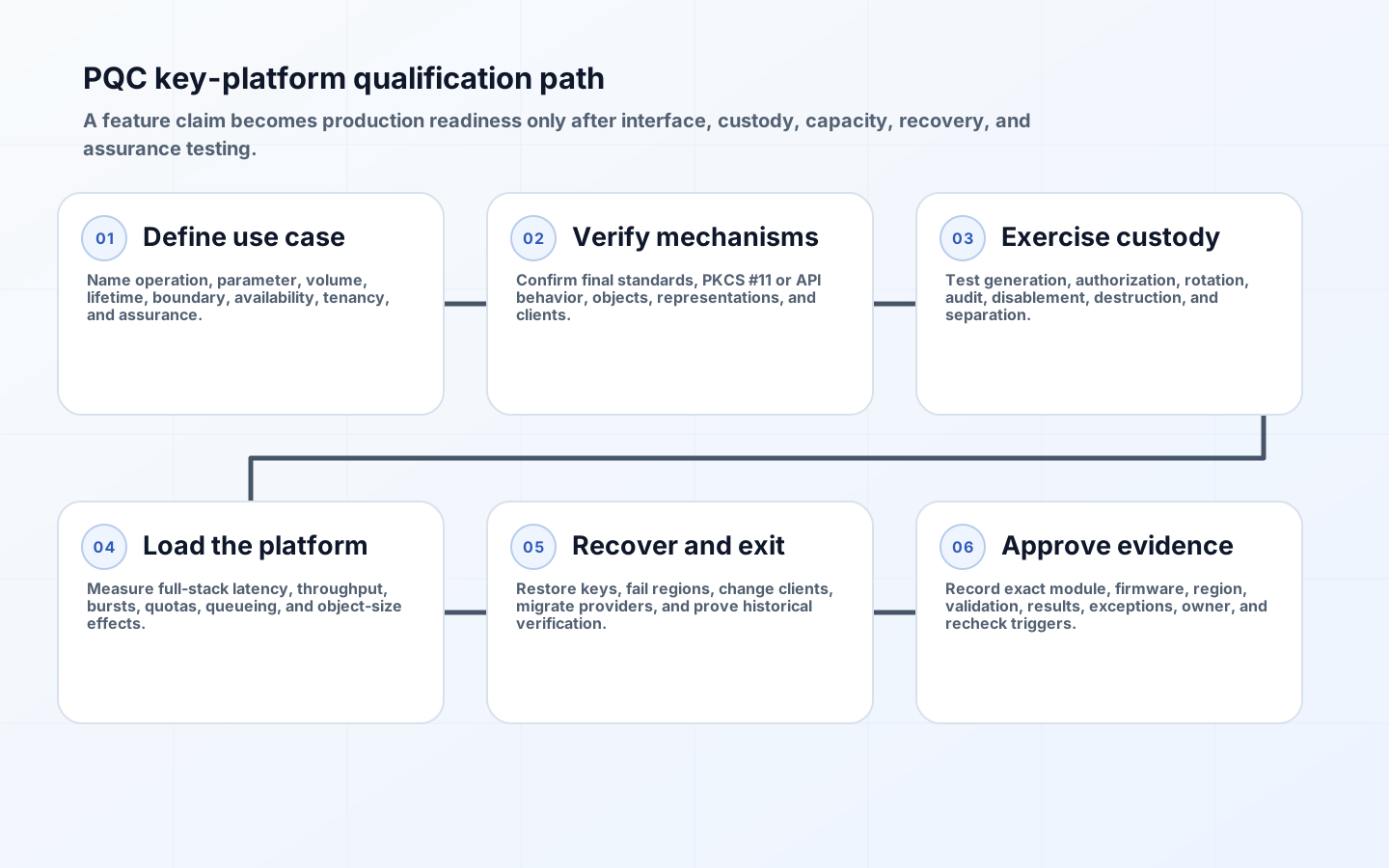
An HSM or cloud KMS is not post-quantum ready because a roadmap slide lists ML-KEM and ML-DSA. Readiness means the platform supports the final standards and required parameter sets through usable interfaces, protects keys through their complete lifecycle, meets applicable cryptographic-module requirements, performs under realistic load, survives backup and disaster recovery, and gives dependent applications a supported migration path. Buyers need evidence for their exact model, firmware, service region, API, and configuration.
Post-quantum keys stress assumptions hidden by familiar RSA and elliptic-curve operations. Key objects and signatures are larger, a KEM encapsulates and decapsulates rather than encrypting arbitrary messages, interfaces may expose seed or expanded representations, firmware and client libraries may evolve at different speeds, and validation status may lag implementation. A structured qualification prevents an experimental mechanism from becoming a production dependency before custody, interoperability, throughput, audit, and recovery are understood.
Start with key-management use cases, not vendor features
List the cryptographic job: ML-DSA code signing, certificate authority signing, service authentication, SLH-DSA for a selected long-lived use, ML-KEM decapsulation for a protocol endpoint, key generation for external use, or custody of roots. For each, record parameter set, operation rate, latency target, concurrency, key count, tenancy, availability, backup, regions, export policy, compliance, verifier population, and lifetime. A KMS appropriate for occasional document signatures may not serve a high-rate TLS termination path.
Separate control-plane and data-plane operations. Key creation, policy, grants, rotation, metadata, backup, and destruction have different permissions and failure modes from sign or decapsulate. Determine whether the cryptographic operation occurs entirely inside the module boundary, in provider software, or in the client. Ask what sensitive security parameters cross each boundary and how application messages are hashed, encoded, or framed before the HSM operation.
Define a readiness ladder with evidence
Use distinct states: research prototype, private preview, public preview, generally available, supported for production, interoperable with the required stack, approved in the applicable mode, validated in a named cryptographic module, and qualified by your organization. These are not synonyms. A vendor can implement correct ML-DSA in software while its HSM firmware lacks the mechanism, or ship a mechanism in a module whose validation certificate does not yet cover that version or approved mode.
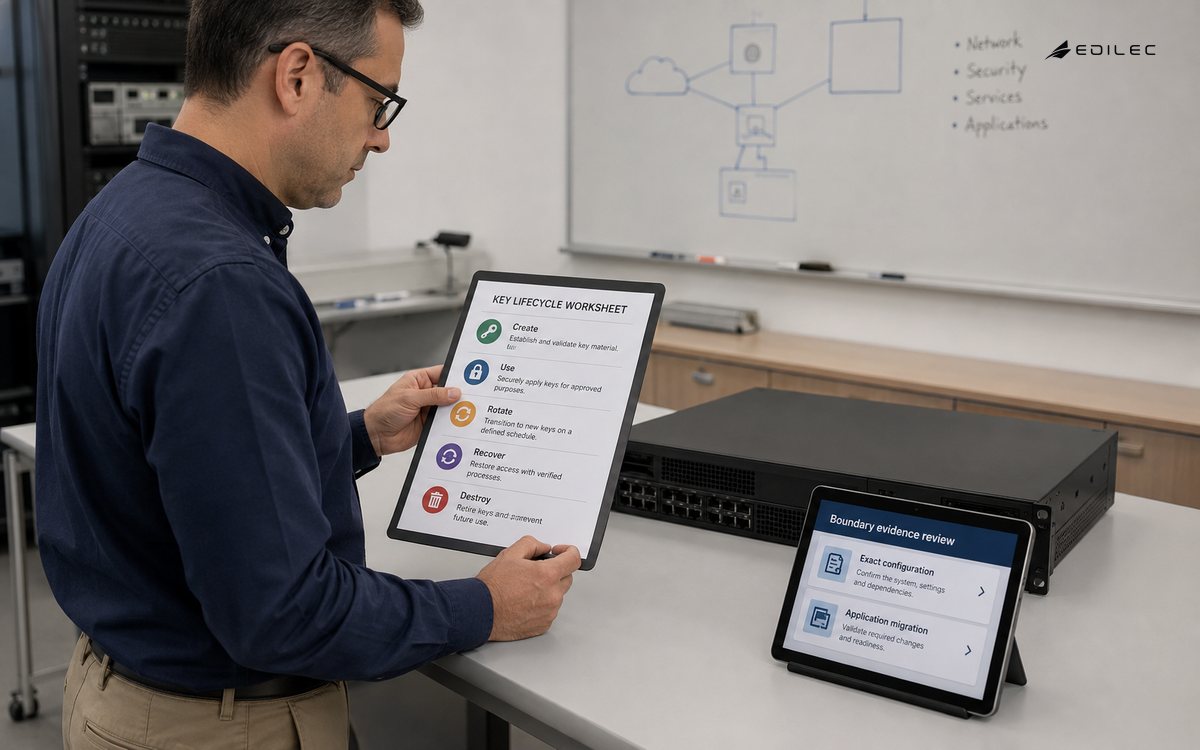
Record evidence and date for each state: release notes, mechanism list, API documentation, standards conformance tests, validation certificate and security policy, tested client versions, service-level terms, and your own qualification report. The NIST CMVP guidance page publishes current FIPS 140-3 implementation-guidance updates. Verify the certificate, module name, version, operational environment, algorithms, and configuration rather than accepting the phrase FIPS compliant.
| Readiness claim | Minimum evidence | Does not prove | Buyer action |
|---|---|---|---|
| Algorithm implemented | Final FIPS test results and version | Production support or module validation | Run negative and interoperability tests |
| Production supported | GA documentation and support terms | Approved mode for regulated use | Review mechanism and lifecycle limits |
| FIPS validated module | Current certificate and security policy | Every service path uses that module and mode | Map exact configuration and boundary |
| PKCS #11 support | Mechanisms, objects and client version | Application format interoperability | Test full application stack |
| Cloud KMS support | Regions, API, quotas and SLA | Export, backup or cross-cloud portability | Exercise lifecycle and exit |
| Quantum safe | Named algorithms, parameters and protocols | Complete application or historical-data migration | Reject undefined marketing term |
Inspect mechanisms, objects, and key representations
PKCS #11 v3.2 includes ML-DSA and ML-KEM key objects and mechanisms, offering a standardized interface target for cryptographic tokens. Confirm which mechanisms the product implements, parameter sets, single- or multipart operation behavior, attributes, key generation, import and export, encapsulation and decapsulation calls, client compatibility, and errors. Supporting PKCS #11 generally does not mean the deployed version supports its new PQC portions.
Key representation affects storage, portability, backup, and security. NIST's June 2026 PQC FAQ clarifies that seed representations are acceptable alternatives for ML-KEM and ML-DSA key pairs or private keys under stated conditions, with deterministic derivation producing the standardized outputs. Ask whether the platform stores a seed, expanded key, or vendor object; what can be imported or exported; whether public keys are derived consistently; and how representation is preserved across backup, replication, and migration.
Test the complete quantum-safe key lifecycle
Generate keys using the platform's approved random source and capture non-sensitive metadata: algorithm, parameter, key ID, module, firmware, policy, owner, purpose, creation time, and lifecycle state. Test activation, permission grants, use limits, concurrent access, rotation, certificate or public-key distribution, disablement, revocation, destruction, and audit. Verify that aliases cannot accidentally redirect a production signer to a test or classical key without policy detection.
Backup and recovery require special scrutiny. Some HSM clusters replicate opaque objects; others use secure backup appliances, quorum procedures, or vendor-controlled regional recovery. Cloud KMS may replicate automatically but limit key export or cross-provider restoration. Exercise loss of a node, region, account, administrator, client library, and vendor service. Restore into an approved target and verify that signatures or decapsulation outputs remain interoperable without exposing private material.
| Lifecycle test | Expected property | Failure to detect | Retained evidence |
|---|---|---|---|
| Generate | Correct final parameter set and protected entropy | Legacy or mislabeled algorithm | Metadata and conformance result |
| Authorize | Only bounded workload and administrators can act | Broad sign or decapsulate permission | Policy and denied-use tests |
| Operate | Correct output under normal and malformed input | Parser, mechanism or error mismatch | Vectors, negative tests and logs |
| Rotate | New key activates without ambiguous trust | Alias drift or stranded verifier | Cutover and rollback record |
| Backup and restore | Key remains protected, usable and attributable | Nonportable or unrecoverable object | Exercise report and restored verification |
| Destroy | All replicas and recovery copies follow policy | Orphaned key material or usable alias | Deletion and post-destruction test |
Benchmark performance and capacity under realistic workloads
Measure key generation, signing, verification where offered, encapsulation, decapsulation, object lookup, login or session setup, backup, and replication. Capture median and tail latency, operations per second, concurrent sessions, CPU or hardware utilization, memory, queueing, error rate, and throttling. Use realistic message sizes and prehash or pure modes as specified by the application. Include network latency and client serialization for remote KMS; primitive benchmarks alone hide service overhead.
Test bursts such as emergency firmware release, certificate renewal, service restart, autoscaling, and regional failover. Larger signatures and public keys can affect API limits, database records, audit volume, certificates, and message envelopes outside the module. Model cost for cloud operations, reserved capacity, replicas, test environments, logging, egress, and migration support. Keep headroom for rotation or incident response rather than sizing at ordinary steady state.
Review boundary, tenancy, side channels, and administration
Understand where key generation and private operations run, which administrators or provider personnel can affect them, firmware signing and update controls, secure boot, physical protections, tamper response, tenant isolation, session separation, and audit integrity. PQC does not repair weak administration. Use quorum or dual control for roots, separate key policy from application deployment, require phishing-resistant administrator access, and alert on mechanism, firmware, policy, backup, or export changes.
Ask how implementations address timing, cache, power, fault, and malformed-input attacks relevant to the platform and threat model. Review self-tests, pairwise consistency or known-answer testing, error behavior, zeroization, entropy failure, and patch procedures. For cloud services, clarify shared responsibility and what assurance evidence the provider exposes. For on-premises appliances, include supply chain, maintenance ports, replacement parts, and end-of-life firmware.
Put migration commitments and exit rights into procurement
Request named final standards, parameter sets, mechanisms and APIs; hardware and firmware prerequisites; client compatibility; regions; GA dates; validation roadmap; certificate identifiers when available; performance limits; backup and replication; audit fields; support lifecycle; vulnerability handling; and migration tooling. Require notice of changes that affect algorithm behavior, validation, key representation, or interoperability. Tie claims to product versions rather than an undated platform roadmap.
Plan exit before importing irreplaceable roots. Determine whether seed or private-key export is allowed, in what wrapped format, under whose quorum, and which target products can import it. Where keys are intentionally non-exportable, design cross-signing, new-anchor distribution, or parallel issuance. Contract for data and metadata export, transition assistance, overlap period, and continued verification of historical signatures. Vendor lock-in can become a cryptographic deadline if migration rights are vague.
Make a use-case-specific platform decision
Create a qualification record per use case, not one enterprise yes or no. State supported algorithm and parameter, module and version, interface, approved or validated status, key representation, boundary, lifecycle results, performance, failure and recovery results, dependencies, exceptions, owner, and review trigger. A platform can be ready for low-volume internal ML-DSA signing while unready for production ML-KEM decapsulation or regulated CA roots.
Use a limited pilot with noncritical keys, then a production-like environment, controlled workload, and staged criticality. Monitor mechanism use, key versions, latency, failures, access denials, firmware, capacity, and backups. Requalify after material firmware, hardware, client, validation, region, or interface changes. Preserve a classical or alternate recovery path only with explicit expiry and a plan to prevent silent downgrade.
Key takeaways
- Define readiness per cryptographic use case, parameter set, product version, interface, region and assurance requirement.
- Distinguish implementation, production support, approved operation, module validation and local qualification.
- Test key representation, lifecycle, backup, restore, rotation, destruction and application interoperability.
- Benchmark full service behavior under burst, failover and recovery rather than primitive speed alone.
- Contract for final-standard support, evidence, change notice, lifecycle commitments and a workable exit path.
Frequently asked questions
Does FIPS 140-3 validation mean every PQC algorithm is covered?
No. Check the exact module certificate, version, security policy, operational environment, algorithm certificates, and approved mode. A validated product family or older module version may not cover the new mechanism you intend to use.
Is PKCS #11 v3.2 support enough for application migration?
It is useful interface support, but the token, client, middleware, application format, protocol, parameter set, and error behavior must all interoperate. Test the complete stack and the deployed versions.
Should post-quantum private keys be exportable?
It depends on custody and continuity requirements. Non-exportability can strengthen protection but complicate disaster recovery and vendor exit. Wrapped export, seed handling, quorum, or planned rekeying must be designed and tested deliberately.
Conclusion
HSM post-quantum readiness is an evidence-backed property of one use case and configuration. Final algorithm support is the beginning; secure key representation, interfaces, validated boundaries, authorization, capacity, recovery, observability, and exit determine whether the platform can carry production trust. Qualify those properties with real keys and applications before committing long-lived roots or high-volume services. That discipline turns a vendor roadmap into a controlled cryptographic migration capability.