A QKD trusted node is not merely a convenient repeater cabinet. In a relay-based quantum key distribution network, key material is handled inside intermediate nodes so distant endpoints can receive related keys. Compromise of a node, its key manager, administrator, software, internal links, or connected control plane can undermine the confidentiality or integrity claimed for relayed keys. The number and placement of nodes therefore change the end-to-end trust model. Every new relay adds a site that must remain trustworthy throughout procurement, installation, operation, maintenance, incident response, and retirement.
ITU-T X.1713 defines a trusted node as a boundary protected against intrusion and unauthorized attack and describes physical, environmental, interface, platform, and operational requirements. ITU-T X.1710 explains the broader security framework and key-relay context. Use these as engineering inputs, then document the organization's actual node boundary, assumptions, and residual risk.
Define the trusted node boundary precisely
Draw what is inside: QKD modules, key managers, controllers, management systems, cryptographic applications if co-located, switches, firewalls, HSMs, clocks, storage, consoles, internal links, environmental sensors, and power. Mark every crossing: quantum channel, authenticated classical channel, key-manager links, application delivery, control, management, monitoring, vendor support, update media, and backup. Assign an owner and security property to each interface. A locked room does not protect a remotely administered key manager if its management plane crosses an ordinary network without equivalent controls.
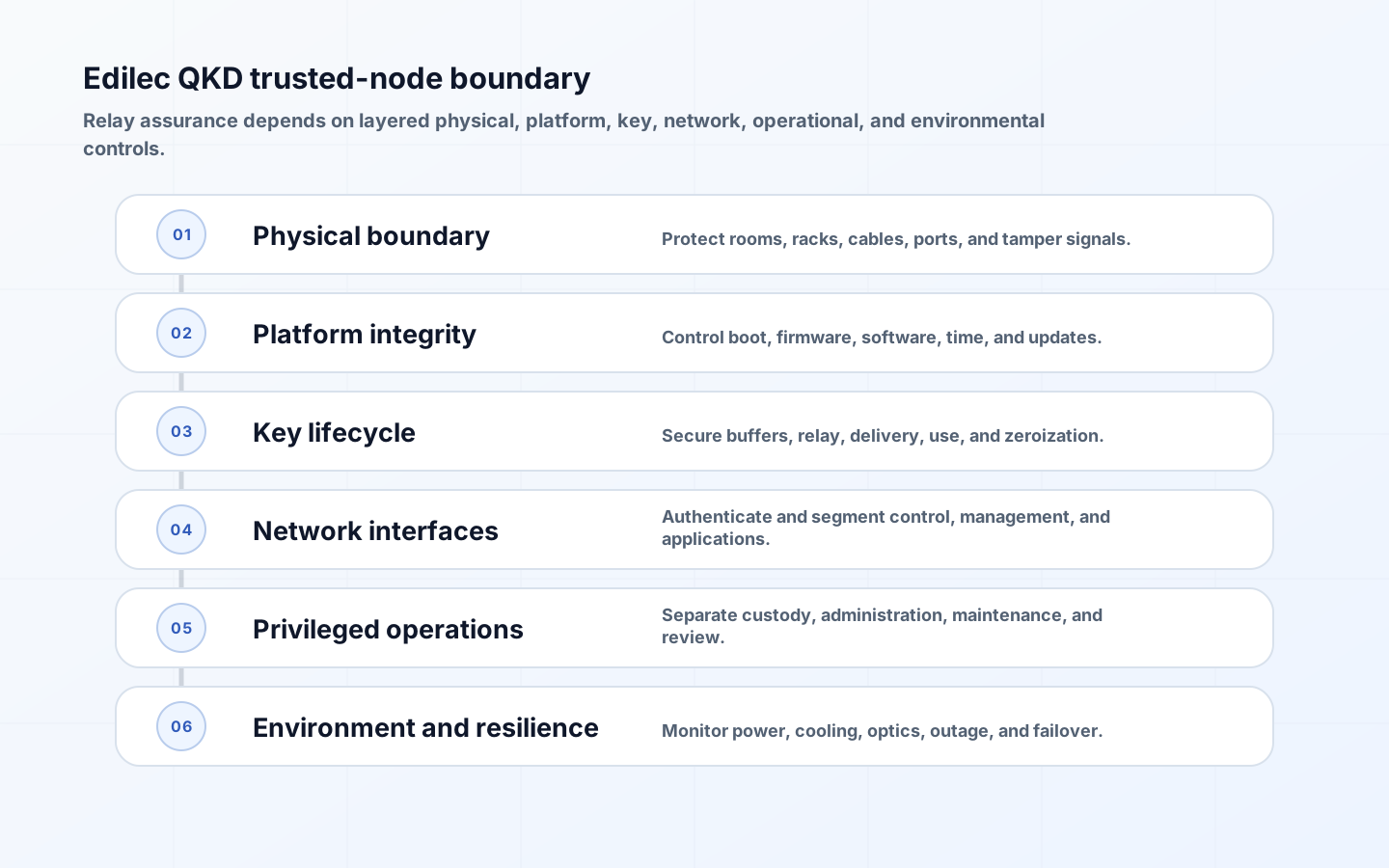
| Layer | Assets | Primary threats | Design evidence |
|---|---|---|---|
| Physical | Modules, HSMs, cables, racks | Entry, tampering, theft, damage | Zones, access logs, tamper response |
| Platform | OS, firmware, boot, clock | Malware, rollback, supply-chain defect | Secure boot, inventory, patch test |
| Key management | Buffers, relay keys, metadata | Disclosure, reuse, corruption, exhaustion | Lifecycle and zeroization tests |
| Network | Control, management, application links | Spoofing, interception, lateral movement | Segmentation and mutual authentication |
| Operations | Admins, maintenance, media | Privilege abuse and unsafe change | Dual control and session records |
| Environment | Power, cooling, optical conditions | Outage, drift, induced failure | Sensors, alarms, resilient supply |
Place nodes by risk, not distance alone
Optical feasibility may suggest a relay site, but security and governance decide whether it is acceptable. Compare ownership, jurisdiction, public access, natural hazards, staffing, communications diversity, emergency access, maintenance travel, and the ability to investigate. Avoid placing all independent paths through the same building, administrator, power source, or vendor management plane. If the architecture claims resilience from route diversity, test whether compromise of one node, management domain, or supplier can still expose every path. Record data and mission consequences for each node's compromise.
Protect the complete key-relay lifecycle
Document generation, identification, storage, relay protection, synchronization, delivery, consumption, expiry, destruction, backup policy, and audit. Keys should not be logged or copied into general monitoring. Metadata needs integrity and privacy because identifiers, rates, routes, and application requests can reveal sensitive operations. ITU-T Y.3803 covers QKD-network key-management functions and relay. Test duplicate prevention, incomplete relay, replay, mismatched identifiers, buffer exhaustion, restart, clock error, and verified zeroization after use or compromise.
Govern privileged operations and maintenance
Separate physical access, platform administration, key-management administration, network control, security monitoring, and audit review. Use named accounts, strong authentication, least privilege, approval for sensitive actions, recorded sessions where lawful, and time-bounded vendor access. Apply dual control to changes that can expose key material, disable alarms, alter trust, or erase evidence. Updates need provenance verification, staging, compatibility tests, rollback rules, and an emergency process. Maintenance equipment and removable media enter the boundary temporarily and require inventory, inspection, and sanitization.
| Event | Immediate control | Evidence | Recovery gate |
|---|---|---|---|
| Unauthorized entry | Isolate node and stop key use | Access, video, tamper, system logs | Re-establish physical and key trust |
| Key-manager anomaly | Quarantine affected buffers and routes | Integrity and relay records | Clean state and peer reconciliation |
| Quantum-channel alarm | Classify interference versus fault | Optical metrics and timeline | Stable rate and investigated cause |
| Failed update | Hold version and prevent unsafe fallback | Package, signature, console log | Validated software and configuration |
| Admin credential compromise | Revoke access and rotate trust | Sessions, changes, affected nodes | Independent review complete |
| Site outage | Invoke approved alternate key path | Consumption and failover telemetry | Capacity and security restored |
Design for compromise, outage, and failover
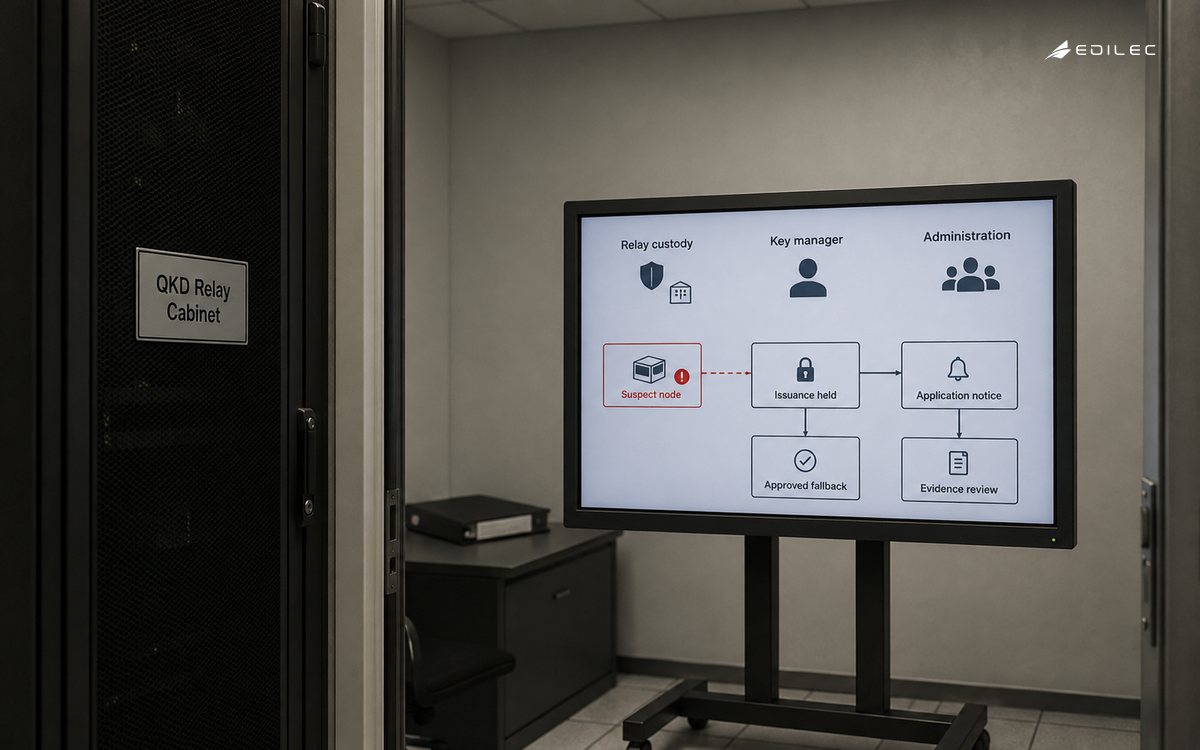
Predefine how to stop key issuance, invalidate or quarantine keys that traversed a suspect node, notify connected applications, rotate authentication material, preserve evidence, rebuild trusted state, and decide whether historical traffic is at risk. Availability planning must model key rate, buffer depletion, application demand, and recovery time. The NCSC quantum networking paper stresses whole-system security and recommends PQC as the primary quantum mitigation. An alternate approved PQC path may be safer than forcing traffic through a suspect relay; failover logic must be explicit and monitored.
Assure the node throughout its life
Acceptance testing should include enclosure and sensor response, secure boot, interface authentication, segmentation, key lifecycle, load, depletion, failover, log integrity, clock behavior, update, backup policy, zeroization, and compromise exercises. Reassess after relocation, component replacement, firmware change, new application integration, ownership transfer, or threat change. The ETSI QKD group provides a standards ecosystem, but conformance to one interface does not establish the security of a deployed node. Maintain a node dossier with configuration, custodians, dependencies, tests, exceptions, incidents, and retirement certificate.
Audit the trusted node in the field
Reconcile installed hardware, firmware, modules, links, interfaces, sensors, power, and application connections with design records. Walk the perimeter and access path, including shared spaces, cable routes, racks, ports, cameras, alarms, environment, visitor handling, and emergency entry. Sample access against named authorization, work orders, vendor sessions, key-sensitive changes, and revocation. Verify that management, control, key, monitoring, and application traffic follow segmentation and mutual-authentication rules without undocumented maintenance paths. Inspect secure boot, update provenance, vulnerabilities, baseline, time, local evidence, backup policy, and recovery media custody.
Exercise a relay failure, stale identifier, buffer threshold, request spike, restart, and zeroization while observing alarms. Simulate compromise and require staff to stop issuance, identify traversing keys and applications, quarantine state, preserve evidence, invoke alternatives, and escalate. Test loss of quantum channel, management connectivity, power, cooling, primary operator, monitoring, and adjacent node without unsafe fallback. Challenge route diversity for common site, carrier, supplier, administrator, controller, trust anchor, and utility dependencies. Every finding should state security consequence, affected paths, interim restriction, owner, date, retest, and risk-acceptance authority. An audit is complete only when field behavior supports the architecture's trust assumptions.
- Maintain a current route-to-node map so an application owner can identify every relay, administrative domain, key manager, and alternate path that contributes to its security claim.
- Define the maximum key exposure interval around suspected compromise, including buffered, relayed, delivered, and consumed material and the traffic each key may protect.
- Protect alarm integrity and availability; an attacker who suppresses or floods physical, optical, platform, or key-management alarms can influence both confidentiality decisions and denial of service.
- Separate maintenance safety from security acceptance. Restoring optical performance does not establish that software, keys, configuration, and evidence remained trustworthy during intervention.
- Control spare modules and replacement media with the same provenance, storage, transport, inspection, and sanitization discipline as installed equipment.
- Test custody transitions between site owner, carrier, QKD operator, vendor, and application team, including who may enter, approve work, see telemetry, and declare restored trust.
- At retirement, stop application delivery, account for buffered keys, revoke administration and authentication, preserve required evidence, sanitize components, update route assumptions, and verify no fallback dependency remains.
Govern the network with a route assurance statement for every protected application. It should name nodes, node owners, relay method, authentication, key manager, application interface, availability path, accepted exceptions, test evidence, and review triggers. Operations can then determine whether a site change affects a particular service instead of treating the QKD network as one undifferentiated trusted object. Review statements after maintenance, new routes, firmware, application onboarding, ownership changes, incidents, and audit findings. Expired assurance should stop new sensitive use until an accountable owner accepts a bounded exception.
Governance must remain testable during ordinary maintenance, not only annual audit.
QKD trusted node security takeaways
- Treat every relay as an end-to-end security dependency and document compromise consequences.
- Draw all physical, platform, key, control, application, support, and monitoring interfaces.
- Choose sites using ownership, jurisdiction, hazard, staffing, route, and investigation criteria.
- Apply dual control and attributable administration to key-sensitive changes and maintenance.
- Predefine key quarantine, trust restoration, alternate paths, and application behavior during failure.
- Maintain a tested node dossier from acceptance through component change and certified retirement.
QKD trusted node security FAQ
Does trusted mean independently certified? Not necessarily. It describes an architectural assumption and protected boundary; assurance must come from requirements, implementation evidence, testing, and governance.
Can route diversity eliminate node trust? It can reduce single-node dependence only if paths are genuinely independent and key-combination and compromise assumptions are explicitly designed and verified.
Should a node store keys for outages? Buffering can support continuity, but increases key-at-rest exposure. Set capacity, protection, expiry, consumption, and zeroization from the threat and availability model.
Conclusion
Trusted nodes convert distance into a security governance problem. Make the boundary visible, minimize and separate privilege, protect each key state, engineer alternate operation, and rehearse compromise. A QKD network's assurance is no stronger than the least understood relay on the path.