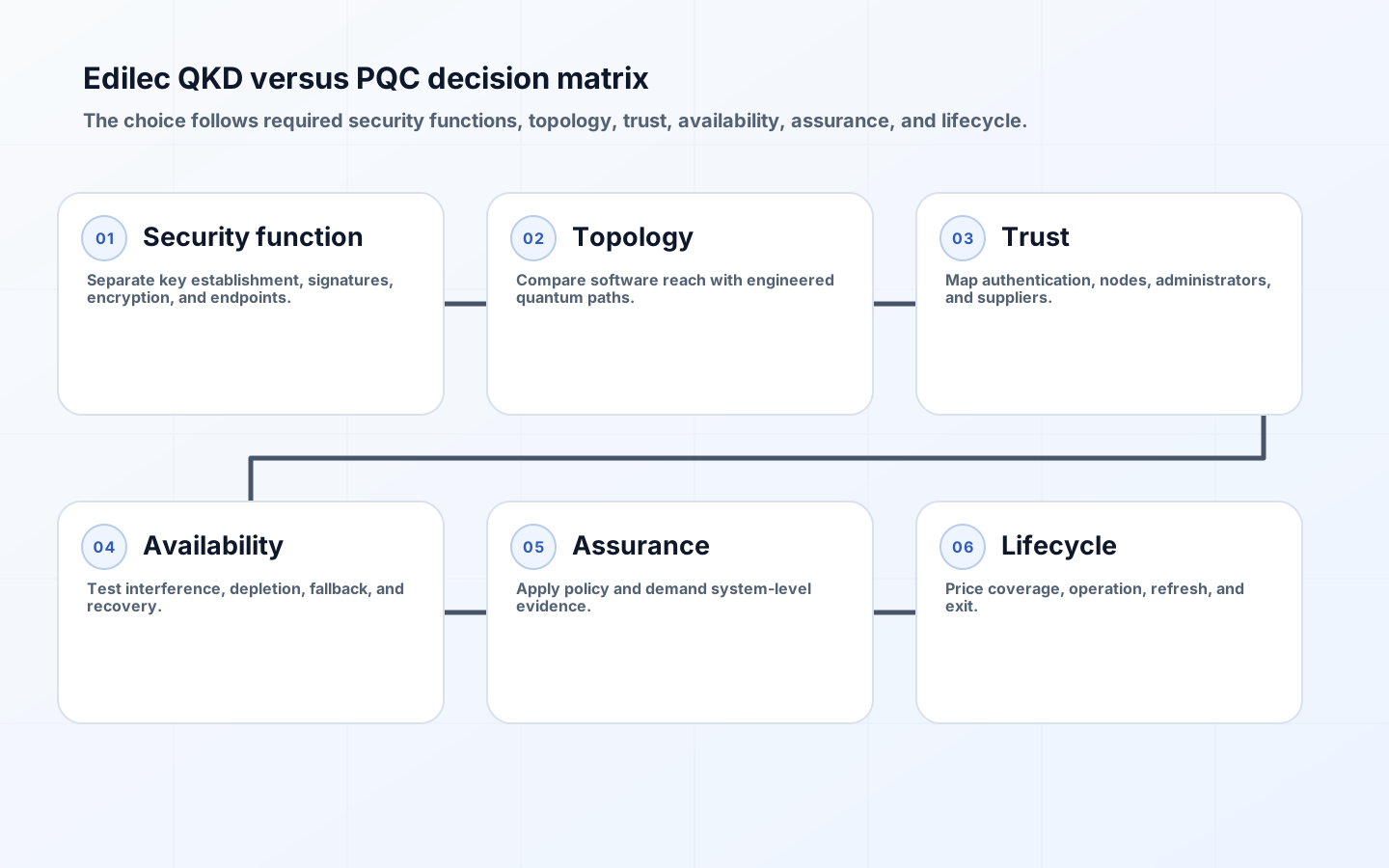
QKD and post-quantum cryptography are often placed in one budget line because both are discussed as responses to quantum computing. They are not interchangeable products. PQC uses mathematical algorithms on conventional computing platforms to provide key establishment and digital signatures designed to resist known quantum attacks. QKD uses specialized quantum and classical equipment to establish symmetric key material across a link or network. Choosing between them requires a threat model, application scope, topology, authentication design, operational model, and lifecycle cost, not a contest over which label sounds more quantum-safe.
NIST has standardized initial PQC algorithms through its post-quantum cryptography project, creating a migration path for broadly deployed software and protocols. QKD remains an active standards and engineering domain, represented by work such as the ETSI QKD group. The right default for most organizations is to execute PQC migration. A QKD evaluation should begin only where its distinct link-key property, network constraints, and assurance case map to a specific mission.
Separate the security functions
QKD generates or distributes shared secret key material and may reveal disturbance on the quantum channel under defined assumptions. It does not by itself encrypt application data, authenticate every classical message, provide digital signatures, secure endpoints, authorize users, or repair vulnerable software. Applications still use symmetric encryption and classical control systems. PQC key-encapsulation mechanisms support key establishment; PQC signature schemes support authenticity and integrity. Neither approach protects a compromised endpoint or poorly managed key after delivery. Write the desired security property and boundary before comparing equipment or algorithms.
| Dimension | PQC | QKD | Decision implication |
|---|---|---|---|
| Key establishment | Software-based KEM in supported protocols | Link or network key delivery | Map to endpoints and applications |
| Digital signatures | Standardized signature schemes available | Not supplied by QKD | PQC or other signatures still required |
| Authentication | Requires certificates, keys, or protocol binding | Classical channel must be authenticated | Design bootstrap and lifecycle |
| Endpoint security | Does not secure compromised hosts | Does not secure compromised nodes or apps | Maintain conventional controls |
| Eavesdropper model | Computational security assumptions | Physical and implementation assumptions | Document assurance basis |
| Scope | Potentially internet-scale software deployment | Constrained physical topology | Inventory reachable use cases |
Compare topology and network reality
PQC can often be introduced through libraries, certificates, protocol updates, services, and device firmware, although payload size, performance, middleboxes, hardware, and legacy clients still require testing. QKD needs compatible endpoints, a quantum channel, classical control, key management, and integration with encryptors or applications. Distance and topology may require trusted relay nodes or other architectures, each adding physical sites and trust assumptions. The NCSC quantum networking paper recommends PQC as the primary mitigation and analyzes QKD within the security of the whole classical and quantum system.
Evaluate trust, authentication, and nodes
A QKD link needs authenticated classical communication; otherwise an active attacker can impersonate endpoints. The design must explain initial authentication, credential rotation, algorithm transition, and behavior after compromise. In a trusted-node network, relayed key material is exposed within or protected by each node's boundary, so physical custody, administrators, software, key managers, update mechanisms, and interfaces enter the assurance case. ITU-T X.1713 explicitly treats a QKD node as a protected trusted boundary. PQC also has trust dependencies, but usually avoids adding geographically distributed key-relay sites.
| Question | Evidence favoring PQC | Evidence supporting QKD evaluation | Stop condition |
|---|---|---|---|
| Coverage | Many internet, cloud, mobile, or signing uses | Small fixed set of high-value links | No mapped application property |
| Topology | Dynamic or global endpoints | Controlled fiber or feasible optical path | Required path cannot be engineered |
| Trust | Existing PKI and endpoint governance | Trusted sites can be strongly governed | Unacceptable relay-node trust |
| Availability | Normal network resilience is required | Alternate key source and failover exist | Key exhaustion causes mission failure |
| Assurance | Validated algorithm and implementation evidence | Defensible device and system assurance | Claim relies on theory alone |
| Economics | Broad software migration serves many systems | Narrow mission justifies dedicated lifecycle | Operations and refresh unfunded |
Test availability and operations
Quantum-channel disturbance, fiber work, environmental change, calibration, equipment fault, or deliberate interference can reduce or stop key generation. Model key consumption, buffering, depletion, failover, recovery, and alarm handling under peak traffic. Decide whether applications pause, switch to an approved alternative, or consume pre-positioned keys, and prevent silent downgrade. PQC has different failure modes: software defects, CPU or memory pressure, larger messages, certificate incompatibility, and protocol rejection. Compare measured service behavior under failure rather than comparing idealized throughput.
Consider standards, policy, and assurance
Use the policy applicable to the system. NSA's current post-quantum cybersecurity resources state that it does not recommend QKD for US National Security Systems unless identified limitations are overcome and views PQC as more maintainable and cost-effective in that context. That position is not a universal legal ban, but it is decisive for its stated constituency and a serious assurance input elsewhere. For any QKD proposal, require protocol, device, implementation, integration, and operational evidence; for PQC, require approved standards, profiles, modules, interoperability, and migration controls.
Run a bounded pilot only after the gate
A QKD pilot should have a named link, threat, application, security property, success criteria, and exit decision. Measure secure key rate under realistic loss, key consumption, outage and recovery, classical authentication, node access, alarm quality, application integration, failover, staffing, maintenance, and total lifecycle cost. Red-team interfaces and operational procedures, not only the quantum channel. Continue the independent PQC roadmap because QKD does not replace signatures or the broad estate's public-key migration. A pilot that demonstrates photons over fiber but never delivers governed keys to an application has not answered the investment question.
Compare whole-life cost and residual risk
For PQC, include discovery, libraries, protocols, certificates, hardware capacity, application tests, partner migration, dual operation, monitoring, and retirement. For QKD, include route survey, fiber access, endpoint and relay equipment, secure sites, power, cooling, key managers, encryptors, authentication, spares, calibration, and specialist operators. Price trusted-node controls: physical zones, access governance, tamper monitoring, investigation, vendor maintenance, and destruction. Model availability from channel interruption, fiber work, environmental drift, key depletion, alternate routing, approved fallback, and application behavior. Include refresh risk for specialized components and evolving PQC profiles.
Coverage is economically decisive. One QKD route serves connected applications but does not migrate signatures, remote users, cloud services, software updates, mobile devices, and unrelated partners. Assurance also costs money: device characterization, protocol analysis, integration assessment, red-team work, conformance, and exercises. Use ranges because topology, capacity, site control, supplier maturity, and defects can dominate estimates. Define the decision horizon and exit cost; a demonstration may be affordable while production expansion or multi-vendor replacement is not. Present residual risk beside price, including endpoint compromise, node trust, classical authentication, denial of service, algorithm implementation defects, and privileged administration. The lowest acquisition quote is not the lowest-risk quantum transition.
- Reject comparisons based only on theoretical security level; the application consumes keys or signatures through implemented protocols with devices, software, people, and failure behavior.
- Ask whether the mission needs confidentiality against future decryption, current eavesdropper detection assumptions, authenticity, non-repudiation, broad connectivity, or several properties with different controls.
- Count every trust domain: QKD endpoints, relay sites, carriers, management systems, vendors, applications, and authentication credentials; PQC adds its own libraries, PKI, modules, and suppliers.
- Compare expansion paths. Adding a PQC endpoint may be a software and credential project, while adding a QKD destination can require an engineered optical route and secure facilities.
- Test coexistence carefully when both are used; define key combination, entropy assumptions, failure, negotiation, monitoring, and the condition under which one mechanism may operate alone.
- Plan retirement before pilot approval, including key destruction, device sanitization, fiber and site contracts, evidence retention, software rollback removal, and continued protection of historical data.
A decision paper should state the selected property, covered applications, topology, trust assumptions, policy fit, measured performance, failure behavior, whole-life cost, residual risk, and rejected alternatives. It should also state what the decision does not cover. That final boundary is important: approving one QKD route must not be interpreted as completing PQC migration, while selecting PQC does not imply every legacy protocol and device already supports it. Owners and dates for uncovered work keep the comparison from becoming a symbolic technology choice.
QKD vs PQC key takeaways
- Define key establishment, signatures, authentication, data encryption, and endpoint security as separate functions.
- Use PQC as the broad migration path; evaluate QKD only for a bounded mission and feasible physical topology.
- Include classical authentication, key management, trusted nodes, applications, and operations in the QKD boundary.
- Compare denial-of-service, failover, interoperability, and recovery using measured system behavior.
- Apply the governing national or sector policy and demand implementation evidence for either technology.
- Keep PQC migration moving even during a QKD pilot because the rest of the cryptographic estate remains exposed.
QKD vs PQC FAQ
Can QKD replace digital signatures? No. It distributes key material; authentication and digital-signature requirements need separate mechanisms.
Is QKD unhackable? No operational system should receive that label. Security depends on protocol assumptions, devices, classical components, nodes, integration, people, and procedures.
Can an organization deploy both? Yes, for a justified architecture. The composition must define which property each provides, how keys are combined or selected, and how failure avoids unsafe downgrade.
Conclusion
Choose QKD or PQC by asking what must be protected, across which topology, against whom, for how long, and under which operational constraints. PQC addresses the scalable replacement of vulnerable public-key mechanisms. QKD may merit a narrow evaluation where dedicated infrastructure and trust can be justified. Keeping those roles explicit prevents an impressive link demonstration from being mistaken for an enterprise quantum-security strategy.