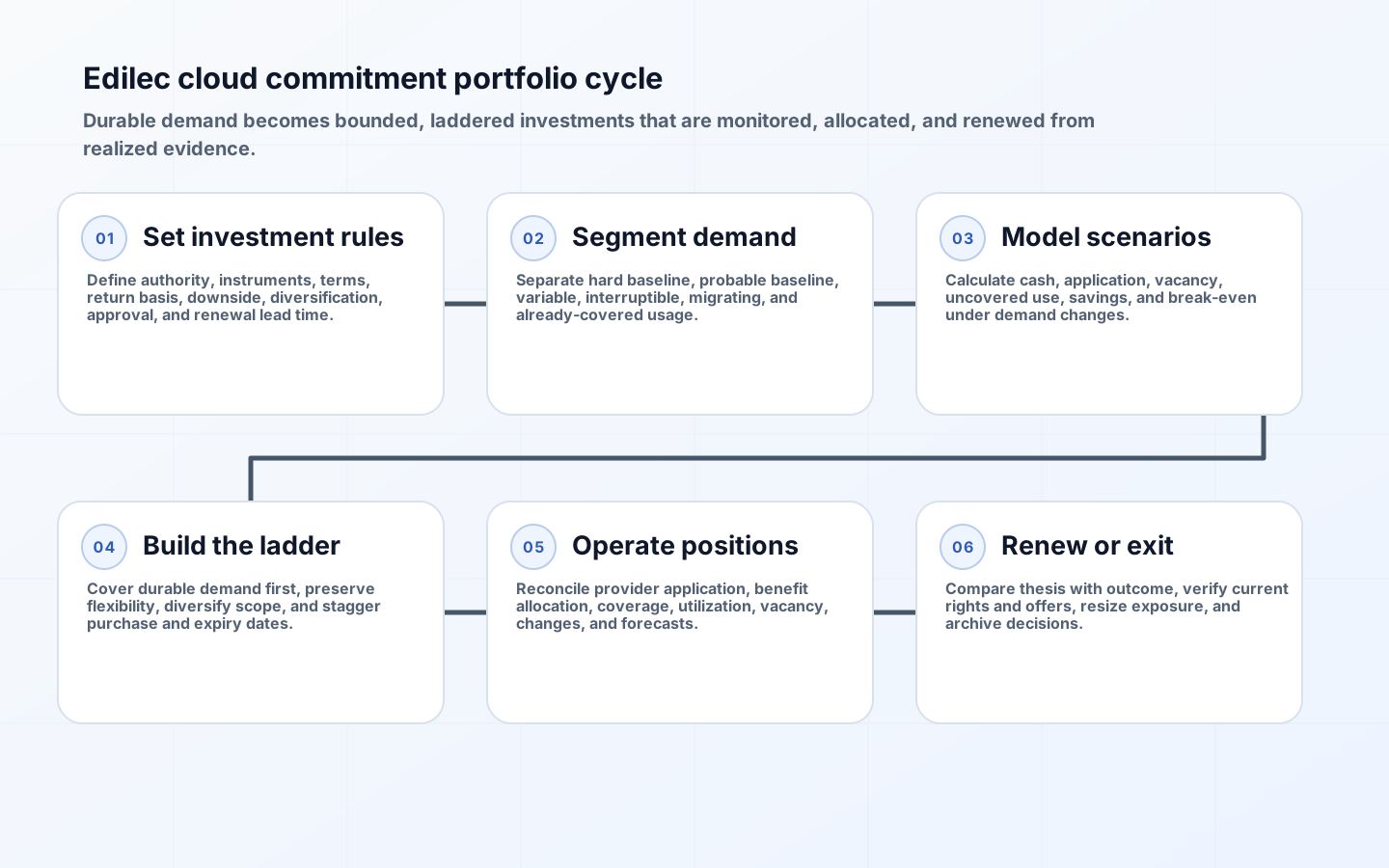
Cloud commitment discount management is portfolio management because each purchase exchanges flexibility for a rate benefit over time. Demand changes, services migrate, regions shift, providers revise programs, and yesterday’s baseline can become tomorrow’s vacancy. A sound process segments stable demand, compares eligible instruments, models downside, stages purchases, allocates benefit consistently, and revisits the portfolio before renewal. A provider recommendation is an input, not delegated investment authority.
The FinOps rate optimization capability distinguishes spend-based and resource-based commitment discounts and emphasizes coverage, utilization or vacancy, effective savings, planned changes, and centralized coordination. Provider terms differ materially. AWS Savings Plans commit spend, Azure Reservations cover eligible product configurations, and Google Cloud offers spend-based and resource-based CUDs. Compare the exact current offer and contract, never the category label alone.
Define the commitment investment policy
Set authority, approved instruments, maximum term, payment options, target return, downside limit, diversification, renewal lead time, and required sign-offs from FinOps, engineering, finance, and procurement. Define the cost basis used for savings: on-demand equivalent, actual effective rate, negotiated rate, and fees can produce different answers. Record whether taxes, support, credits, and enterprise discounts are included. Require an immutable purchase thesis for each position.

The thesis should name eligible demand, owner, baseline window, forecast, planned migrations, elasticity, instrument scope, hourly or resource commitment, term, expected savings, break-even, downside cases, exit or modification rights, and monitoring thresholds. Separate recommendation generation from approval and purchase. Restrict purchase permissions and log actions. An auto-renew setting is an active investment decision, not an administrative convenience.
| Dimension | Spend-based commitment | Resource-based commitment | Portfolio implication |
|---|---|---|---|
| Commitment unit | currency spend over time | specific resource quantity or configuration | model demand in the purchased unit |
| Flexibility | often broader eligible usage | usually narrower product, region or family | higher restriction can increase vacancy risk |
| Discount | varies by term and scope | varies by resource and term | compare effective, not headline, savings |
| Operational dependency | eligible spend must continue | matching resources must run | architecture roadmap affects both |
| Exit mechanics | provider-specific | provider-specific exchange, trade or refund | verify current contract before purchase |
Segment demand before forecasting coverage
Build hourly or provider-relevant demand distributions by service, region, account, platform, and eligibility. Remove one-time events and explain known step changes. Segment hard baseline, probable baseline, variable demand, interruptible work, and workloads already scheduled for migration or rightsizing. Do not buy against a percentile without knowing why the tail or floor exists. A development fleet that runs nights only has different commitment risk from a twenty-four-hour control plane.
Model dependencies among positions. Existing reservations, savings plans, negotiated discounts, free tiers, spot usage, and provider allocation order can change which demand remains coverable. Rightsizing and architecture work should update the forecast, but waiting for perfect optimization can forfeit sensible savings. Use scenarios: expected demand, planned reduction, delayed growth, region move, product shutdown, and provider migration. Calculate cash outlay, applied benefit, vacancy, uncovered usage, and break-even in each.
Construct a laddered, bounded portfolio
Cover the most durable baseline first with the least risky useful instrument. Add narrower or longer commitments only where the workload and return justify them. Stagger purchase dates so not every position expires together; a ladder creates regular opportunities to incorporate new demand evidence. Preserve some on-demand exposure as flexibility. The right coverage target depends on variability, growth uncertainty, cash constraints, and the cost of stranded commitment, not a universal percentage.
Compare provider mechanics at decision time. AWS documents Savings Plans as a commitment measured in dollars per hour against eligible usage. Microsoft’s Azure reservation guidance defines eligible reservation products and management behavior. Google Cloud’s CUD overview distinguishes resource-based and spend-based programs, scope, attribution, and product availability. These terms evolve; store the dated source and signed commercial terms with approval.
| Metric | Question answered | Misreading to avoid | Action trigger |
|---|---|---|---|
| Coverage | how much eligible use receives a commitment benefit? | high coverage can coexist with waste | review on-demand exposure |
| Utilization or application | how much purchased commitment found eligible use? | provider formulas vary | investigate sustained vacancy |
| Vacancy cost | what commitment remained economically unused? | do not hide through allocation | reforecast or exercise valid options |
| Effective savings rate | what net saving did the portfolio create? | headline discount is not realized return | compare thesis to outcome |
| Expiry concentration | how much renews in one window? | renewal convenience can amplify risk | stagger future purchases |
| Forecast error | why did actual eligible demand differ? | aggregate error hides migrations | update segment assumptions |
Operate benefit allocation and monitoring
Decide whether discounts follow eligible consumption proportionally, are prioritized to purchasing teams, or are pooled under another policy. Keep economic performance visible at the central portfolio even when benefits are distributed. Otherwise, unused commitment can disappear into team statements. Reconcile provider application to internal allocation each period. Separate commitment fees, covered usage, on-demand equivalent, applied discount, negotiated discounts, and vacancy.
Monitor daily or at the provider’s useful cadence, but respond to sustained evidence rather than noise. Alert on utilization decline, unexpected uncovered eligible use, expiring positions, scope changes, and forecast-breaking architecture decisions. Create an engineering change feed for migrations, region moves, service retirement, and major rightsizing. FinOps cannot manage a portfolio from billing history alone; planned technical change is a leading indicator.
Renew, modify, or exit from evidence
Begin renewal review early enough to change architecture or commercial strategy. Compare the original thesis with realized demand, utilization, vacancy, effective savings, and forecast error. Re-run downside scenarios using the current provider offer and enterprise agreement. Verify exchange, trade-in, refund, scope, sharing, and auto-renew rights from current official terms; never assume a mechanism available for one product or purchase date applies to another.
Renew only the durable baseline that still exists. A temporarily underutilized position may recover; a retired product will not. Where modification is permitted and economically sound, record the new thesis and accounting treatment. If no exit exists, expose vacancy and avoid buying more to make the percentage look better. Retire stale purchase permissions and archive decisions so future committees can distinguish disciplined risk from accidental luck.
Stress-test concentration beyond provider and expiry date. A portfolio can be concentrated in one region, machine family, database engine, business product, or forecast assumption even when purchases are staggered. Map each position to the workloads expected to consume it and calculate loss under correlated changes such as a regional migration or platform rearchitecture. Set exposure limits where the organization would otherwise be forced to preserve an inferior design merely to use a discount. Commitments should follow architecture strategy, not veto it.
Maintain a decision calendar that joins provider expiries with budget cycles, product sunsets, data-center exits, major launches, and contract negotiations. Send renewal packets early with current utilization, forecast, sensitivity, options, and engineering sign-off. Explicitly choose auto-renew on or off after review. After each purchase, compare realized application and savings with the approved scenario at thirty, ninety, and period-specific milestones. Calibrating forecast assumptions from actual positions improves the portfolio; celebrating only purchases trains the organization to ignore vacancy.
Account for currency, payment timing, and accounting constraints in cross-provider comparisons. An all-upfront reservation can show attractive nominal savings while using cash earlier; a monthly commitment may expose the organization differently to currency movement or budget boundaries. Finance should validate present-value assumptions, tax treatment, capitalization policy where relevant, and who carries the obligation. Procurement should account for enterprise agreement interactions. Report both economic savings and cash schedule so a portfolio committee does not select a technically flexible instrument that conflicts with liquidity or contractual strategy.
Keep recommendation models under change control. Record lookback window, excluded anomalies, existing-benefit treatment, forecast inputs, provider price snapshot, and code version. Re-run approved historical cases after model changes and compare proposed purchases. A recommendation that grows because a credit disappeared or a temporary migration ran longer should be explainable before approval. Independent reproducibility is especially important when a vendor or third-party tool both recommends and facilitates the purchase.
Key takeaways
- Treat each commitment as an investment with a dated demand thesis, downside cases, and owner.
- Segment stable, probable, variable, interruptible, and migrating demand before choosing coverage.
- Ladder purchases and preserve flexibility rather than concentrating terms and expiry.
- Measure coverage, application, vacancy, effective savings, and forecast error together.
- Review current provider terms and architecture plans before every purchase, modification, or renewal.
Frequently asked questions
Should a portfolio target 100 percent coverage?
Usually not by default. Variable and uncertain demand may be more valuable as on-demand flexibility. The target should follow downside tolerance and demand durability.
What is the difference between coverage and utilization?
Coverage asks how much eligible usage receives commitment benefit; utilization or application asks how much purchased commitment finds eligible usage. Provider definitions must be checked.
Can provider recommendations be purchased automatically?
Only under an approved bounded policy with independent controls. Recommendations may not know product shutdowns, migrations, cash constraints, or contractual context.
Conclusion
Commitment discounts create value when durable demand and commercial scope remain aligned. Govern them as a living portfolio: segment demand, bound downside, ladder purchases, reconcile realized benefit, and incorporate engineering change before renewal. That discipline captures rate savings without turning an old forecast into a long-running obligation.