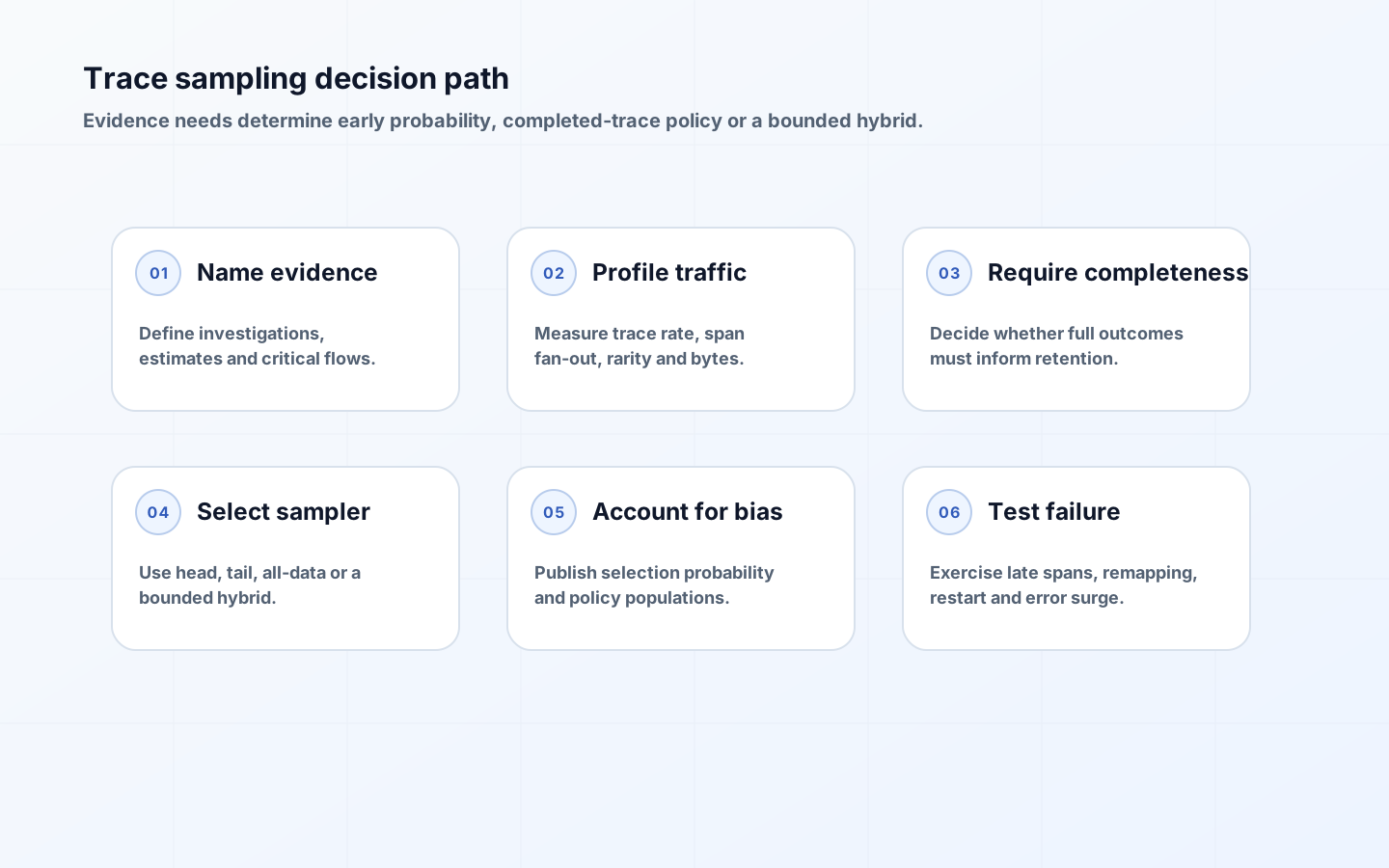
The head sampling vs tail sampling choice is a decision about evidence. Head sampling decides near the start of a trace, before the complete outcome is known. Tail sampling waits to inspect more or all of the trace and can retain errors, high latency, or business-critical paths. Both reduce data volume, but they produce different blind spots, infrastructure demands, and interpretations.
Sampling is not only a storage discount. It changes which incidents and populations are visible. A simple probability sample can support representative aggregate analysis when selection probabilities are known. A policy that keeps all errors and one percent of successes is intentionally biased toward failure and needs separate interpretation. Start with the questions traces must answer, not a target reduction percentage.
Define the diagnostic and analytical evidence needed
List use cases: follow a single customer transaction, investigate rare errors, compare route latency, estimate dependency contribution, validate releases, or preserve traces for a regulated workflow. Record traffic volume and rarity. If the service emits only tens of small traces per second, sampling complexity may cost more than storage. For high-volume homogeneous success traffic, a low consistent probability can still represent normal behavior well.
Decide whether complete traces are required. Parent-based head decisions propagated in trace context can keep or drop the whole distributed trace when instrumentation honors them. Incomplete instrumentation, asynchronous links, or independent span sampling can still fragment it. Tail sampling additionally requires all spans to reach the same decision point before the decision window closes. Late spans and long-running traces complicate both completeness and cost.
| Evidence need | Head sampling fit | Tail sampling fit | Interpretation caution |
|---|---|---|---|
| Representative normal latency | Strong with known consistent probability | Possible but often policy-biased | Weight or segment samples correctly |
| Retain every observed error trace | Cannot know future downstream error | Strong when error status arrives before decision | Instrumentation may not mark all failures |
| Rare business-critical path | Use attribute-aware early rule if known | Use completed-trace attributes and criticality | Attribute quality is part of policy |
| Lowest pipeline cost | Strong: dropped near source | Weak: ingest and buffer before drop | Include engineering and compute cost |
| Immediate export | Strong | Decision window adds delay | Delayed traces affect investigation freshness |
Use head sampling for efficiency and known selection probability
Consistent probability sampling uses trace identity and a configured probability to make an early decision. The decision can propagate so downstream SDKs agree, reducing application processing, network, Collector, and backend volume. It is relatively stateless and easy to scale. Use different probabilities for stable, bounded service classes where policy is available at trace start, but avoid uncontrolled per-instance randomness that creates inconsistent traces.
The limitation is outcome blindness. At trace start the sampler does not know that a downstream span will fail or the total duration will be high. Head sampling can retain all requests with a known route, tenant class, or debug marker, but it cannot guarantee all future errors. Very rare failures may disappear if the baseline probability is too low. Preserve metrics and logs for broad detection; tracing is not the only reliability signal.
Use tail sampling for outcome-aware retention

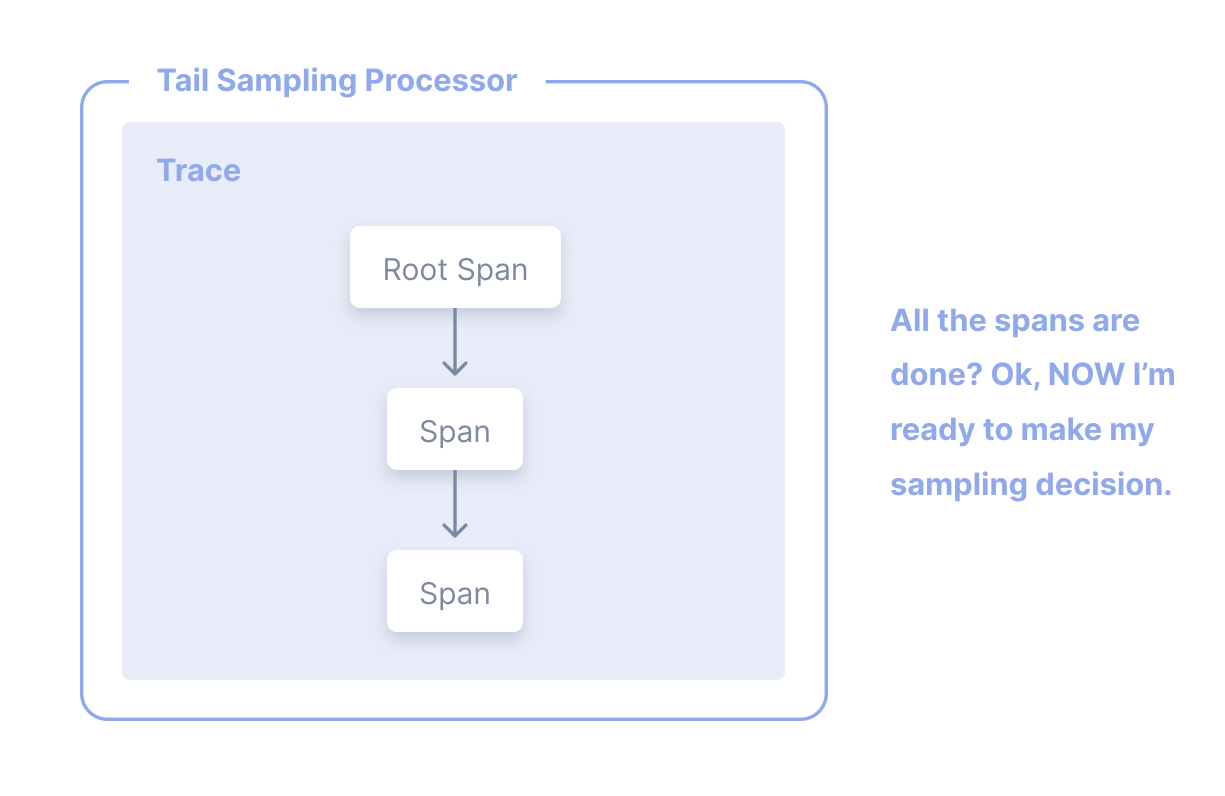
A tail sampler buffers spans for a decision interval, assembles traces, and applies policies such as status, latency, attributes, service criticality, or a probabilistic fallback. It can keep all observed error traces, slow traces above a threshold, critical flows at a higher rate, and a representative sample of ordinary traffic. This improves diagnostic yield when important behavior is identifiable only after work completes.
Tail sampling is stateful. Every candidate trace reaches the sampling tier before most are discarded, so network and Collector ingress cost remain. Memory depends on new traces per second, decision wait, span count, and payload size. The sampler adds export delay and can lose state on restart. A policy that keeps too much during an incident may overload the very pipeline expected to preserve evidence.
Route all spans for one trace to the same Collector instance, commonly with trace-ID-aware load balancing. Ordinary round robin can split a trace and cause incorrect decisions. Scaling changes may remap trace IDs while decisions are in flight; test rolling updates and backend-set changes. Monitor dropped, incomplete, late, and policy-selected traces rather than assuming the processor is a transparent filter.
Make policy bias explicit in every downstream use
Outcome-based policies deliberately overrepresent unusual behavior. A dashboard built from tail-sampled traces may show an error rate far above the service’s true error rate because errors were retained at a higher probability. Store or attach sampling probability where supported, segment policy classes, and use metrics for service-level rates. Do not calculate customer prevalence or SLO compliance from a diagnostic sample unless the estimator accounts for selection.
Policy order and composition matter. If any matching policy retains a trace, broad attribute rules can overwhelm a narrow cost budget. Unknown or missing attributes may exclude the very service being investigated. Test policies against recorded representative trace metadata before rollout, estimate retained volume for normal and incident conditions, and version policy with an owner and change record.
| Sampling policy | Diagnostic benefit | Bias or cost | Guardrail |
|---|---|---|---|
| Consistent probability | Representative baseline and complete chosen traces | Rare events may be missed | Minimum rate by traffic and validation with metrics |
| All error status | High failure diagnostic yield | Errors dominate trace-derived rates | Separate error and success populations |
| Latency threshold | Captures slow completed paths | Threshold surge can flood backend | Cap volume and retain probabilistic fallback |
| Criticality attribute | Spends budget on important services | Bad or missing metadata changes coverage | Govern attribute values and audit unknowns |
| Debug or customer flag | Targeted investigation | Abuse, privacy, and unbounded retention | Authorize, expire, and rate-limit activation |
Combine head and tail sampling only with a clear budget
A high-volume service can head-sample before a tail tier to protect network and Collector capacity, then apply richer policies to the surviving traces. This reduces cost but the tail sampler cannot recover an error trace already dropped at the head. The combination answers: choose a bounded candidate population early, then improve diagnostic selection within it. Document the effective probability for each class.
An alternative is head sampling for ordinary traffic plus a narrow always-on path for known critical routes or explicit debug sessions. Another is tail sampling at a regional gateway with a protective probabilistic fallback when state exceeds capacity. Choose degradation behavior before saturation: drop new traces, shorten decision wait, reduce retained classes, or bypass complex policies. Silent uncontrolled loss is the worst option.
Calculate full telemetry cost and failure impact
Model spans per second, bytes per span, fan-out, compression, ingress, buffer memory, Collector CPU, export volume, backend ingest, indexing, retention, and query. Include engineering time for policy tuning, routing, incident response, and upgrades. Head sampling saves earlier in the path; tail sampling may save backend cost while still requiring substantial pipeline capacity. Compare both with simply retaining all traces for low-volume systems.
Test backend throttling, sampler restart, gateway loss, late spans, unusually large traces, and a burst in policy-matching errors. Observe application overhead, accepted and refused spans, decision latency, incomplete traces, queue saturation, export failures, and retained volume by policy. Keep the sampling control plane available independently, with safe defaults when configuration cannot be fetched.
Roll out with a measurable coverage contract
Define coverage targets such as a known probability for normal traffic, retention of error-marked traces up to a tested capacity, maximum decision delay, and acceptable incomplete-trace rate. Shadow-evaluate a new tail policy where possible, compare counts with unsampled metrics, and deploy by service cohort. Give investigators a way to see which policy retained a trace and whether upstream sampling had already limited the population.
Review after traffic, architecture, semantic attributes, or incident patterns change. Sampling that was suitable for a monolith may fail after service fan-out multiplies spans per trace. Remove obsolete debug rules and cap user-controlled attributes. Treat sampling as an operated reliability feature, not a static cost switch.
Key takeaways
- Start from diagnostic and analytical questions, traffic rarity, and completeness needs.
- Use consistent head sampling for early efficiency and known probability.
- Use tail sampling when completed-trace outcomes justify state, delay, and routing complexity.
- Never interpret policy-biased diagnostic traces as an unweighted service population.
- Capacity-test incident surges, late spans, restarts, and safe sampler degradation.
Frequently asked questions
Does tail sampling guarantee every error trace?
No. It can retain traces marked as errors that arrive within the decision window and capacity. Missing instrumentation, late spans, split routing, sampler failure, or upstream head sampling can still remove them. Define and measure the practical coverage boundary.
What trace sampling rate should a team use?
There is no universal rate. Estimate the probability needed for common populations, guaranteed or higher coverage for critical classes, and the pipeline budget under normal and incident traffic. Validate against metrics and investigation outcomes.
Can SLOs be calculated from sampled traces?
Prefer dedicated metrics for SLOs. Probability samples can support estimation when probabilities and completeness are known, but outcome-aware tail samples are biased by design. Diagnostic trace data should not silently become the source of record for reliability rates.
Conclusion
Head sampling buys early efficiency; tail sampling buys outcome-aware choice. Neither guarantees useful evidence without complete context, governed policy, and measured failure behavior. Choose the smallest sampling system that preserves the investigations and estimates the organization actually needs, then make its bias and coverage visible to every consumer.