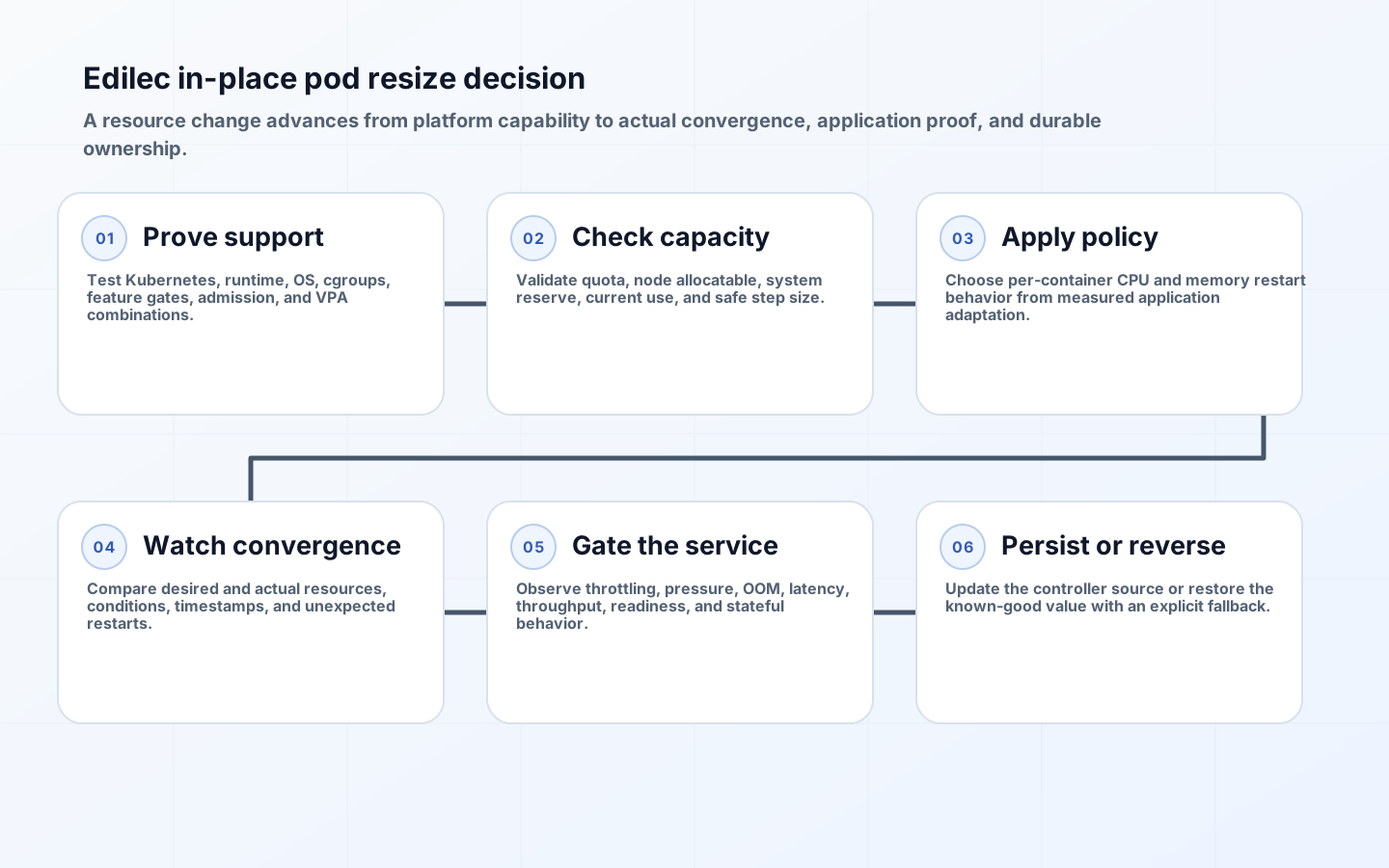
In-place pod resource resize changes a long-standing Kubernetes assumption: adjusting CPU or memory does not always require replacing a pod. It can reduce disruption for expensive startup, warm caches, long-lived connections, and stateful processes. It does not make vertical scaling free. The node still needs capacity, the runtime must apply the change, application behavior may depend on startup-time resource discovery, and some memory changes require a container restart or can remain deferred.
The Kubernetes resize task distinguishes desired resources in the pod spec from actual resources in container status. That distinction is operationally central. A successful API patch expresses intent; it does not prove that cgroups changed or the application can use the new allocation. Production automation must watch status, conditions, restart counts, scheduling feasibility, and service metrics until actual resources converge or a controlled fallback begins.
Gate in-place resize through six production checks
Inventory cluster version, feature gates, container runtime, node operating systems, cgroup configuration, admission policies, workload controller, and autoscaler versions. Build a capability test that resizes CPU up and down, memory up and down, requests and limits separately, and both together. Run it on every node image family. Record whether the change is applied in place, deferred, or requires a restart. Managed Kubernetes release notes can override assumptions derived from upstream feature state.

| Workload condition | In-place value | Primary risk | Preferred safeguard |
|---|---|---|---|
| Long startup or cache warmup | Avoids replacement cost | Application does not detect new CPU | Runtime-aware validation |
| Long-lived connections | Preserves session continuity | Memory reduction destabilizes process | Conservative step and health gate |
| Stateful member with controlled headroom | Reduces leadership churn | Node lacks additional capacity | Capacity precheck and fallback |
| Immutable startup configuration | Limited benefit | Process sizes pools only at start | Restart-based rollout |
| Request change belongs in source template | Temporary operational bridge | Drift returns on next rollout | Patch controller template after proof |
Understand desired, actual, and allocated resources
CPU and memory requests affect scheduling and node accounting; limits affect runtime enforcement. The resource management reference explains that the scheduler places pods from requests, while kubelet and runtime enforce limits. Increasing a request on an already scheduled pod can exceed node allocatable capacity even though the API change is valid. Decreasing a request may create apparent headroom, but only after the resize is actually applied and reflected in status.
Inspect status.containerStatuses[*].resources and the pod resize conditions. A proposed resize can be InProgress while the node works toward it or Deferred until capacity becomes available. Preserve timestamps for request, admission, actual application, and any restart. Alert when convergence exceeds an operational threshold. Do not compute cost savings from the desired spec while actual resources remain unchanged, and do not launch another resize blindly on top of an unresolved one.
Set container resize policy from application behavior
Container resizePolicy lets a workload declare whether CPU or memory changes may be applied without restart or require restart. Decide separately for each resource and container. A JVM, worker runtime, or native allocator may inspect available processors or memory only at startup; sidecars may behave differently from the main process. Test application-level concurrency pools, heap sizing, garbage collection, cache limits, and thread count after a live change. Kernel-level allocation is not equivalent to application-level adaptation.
Memory reduction deserves a stricter gate because current working set and unreclaimable pages can exceed the new boundary. Step down gradually, monitor pressure, OOM events, latency, and eviction signals, and preserve a rollback value. CPU reduction is often less abrupt but can create throttling and missed deadlines. Resource changes should be bounded by service objectives and node safety, not just recent averages. The pod lifecycle documentation remains relevant because a resize-triggered restart still follows container restart and readiness behavior.
Coordinate VPA and workload-controller ownership
A direct patch to a pod does not necessarily update the Deployment, StatefulSet, or other controller template. A later rollout can recreate the old requests. Define the source of truth: automation may first test a candidate on live pods, then commit accepted resources to the controller template; or VPA may own recommendations and update execution. Avoid a GitOps reconciler repeatedly undoing a resize while an autoscaler reapplies it. Ownership must include who changes limits, not only requests.
The upstream VPA quick start includes InPlaceOrRecreate, which tries in-place updates and falls back to eviction when necessary. That is useful only when the workload's disruption policy accepts the fallback. Test PodDisruptionBudget behavior, readiness, ordered StatefulSet semantics, and maintenance windows. Start with recommendation-only mode, constrain allowed values, and compare VPA advice with real performance before enabling automatic updates.
| Observed state | Meaning | Operator action | Rollback path |
|---|---|---|---|
| Actual equals desired, no restart | Resize converged in place | Validate application and persist source | Patch prior value if regression |
| InProgress | Node is applying change | Watch health and deadline | Cancel to prior safe target if supported |
| Deferred | Capacity or feasibility blocks change | Add capacity or choose restart placement | Restore desired value |
| Container restarted | Policy or runtime required restart | Validate readiness and disruption | Controller rollout to known-good resources |
| Performance regresses | Application cannot use new shape safely | Stop automation and diagnose | Return resources and restart if needed |
Operate a bounded resize runbook
Select one replica, verify spare capacity, record baseline, apply a small change, and watch both Kubernetes status and service behavior. Promote to another replica only after a soak period. For a scale-up, ensure node allocatable and quotas can absorb the request; for a scale-down, verify working set and application adaptation. Define a maximum change per step, minimum interval, convergence timeout, stop condition, and escalation owner. Serialize changes per pod so the audit trail remains intelligible.
Measure restart avoidance, resize convergence time, deferred rate, unexpected restart rate, OOM events, CPU throttling, pending pods after fallback, and divergence between pod specs and controller templates. A lower restart count is not success if latency or node fragmentation worsens. Re-run capability tests after Kubernetes, node image, runtime, VPA, or policy upgrades. In-place resize belongs in the same change-management discipline as a rollout because it changes the resources available to production code.
Protect quotas, nodes, and service classes during resize
Admission and quota policy must account for mutable requests. A resize that raises one pod's request can exceed a namespace ResourceQuota, a workload class maximum, or a node's safe overcommit assumptions. Test whether policy engines validate the resize subresource and whether audit records capture the old and new values. Grant resize permissions narrowly; permission to patch arbitrary pod resources can redirect scarce capacity or weaken limits without changing the controller manifest reviewed by the application team.
Node pressure changes the risk calculation. Increasing memory on several pods at once may consume reclaimable headroom and make unrelated workloads vulnerable to eviction. Decreasing requests without corresponding use reduction can improve apparent schedulability while worsening contention. Coordinate batch resizes with node autoscaling and scheduling: add compatible capacity before large increases, and allow actual status to converge before considering the freed request available. Preserve system and DaemonSet reservations in every calculation.
Define service classes for automation. Stateless replicas with quick readiness might use restart-based VPA because replacement is simpler and re-evaluates startup configuration. Long-lived stateful members might permit CPU in place but require memory restart. Critical serving pods may allow only recommendations during peak hours. Encode per-container minimum, maximum, controlled resources, change step, and maintenance window, then reject recommendations outside the class rather than clipping them silently.
Incident response also needs a clear boundary. A temporary CPU increase can be a sound mitigation for saturation, but it should have an owner, expiry, persistence decision, and post-incident review. If the resize cannot converge, responders need a preapproved choice among capacity addition, pod replacement, replica scaling, or rollback. This turns in-place resize into a reliable operational tool instead of an invisible emergency tweak that vanishes at the next rollout.
Key takeaways
- Prove resize support on every target node and runtime combination.
- Watch actual container resources and pod conditions, not only the patched spec.
- Set CPU and memory resize policy from measured application behavior.
- Coordinate pod changes with controller templates, GitOps, VPA, and disruption policy.
- Use small bounded steps with capacity checks, service gates, and a known-good rollback value.
Frequently asked questions
Can every pod resource be resized in place?
No. The feature focuses on CPU and memory, and actual behavior depends on platform support and container policy. Extended resources and other pod changes follow different rules.
Does resizing a pod update its Deployment template?
Not automatically. Persist the accepted value in the workload controller or the next replacement may return to the old resources.
Does in-place resize guarantee no restart?
No. Policy, runtime feasibility, and VPA fallback can require recreation. Design availability for that outcome even when restart avoidance is preferred.
Conclusion
In-place resizing is most valuable where restart cost is real and the application can adapt safely. Treat desired and actual resources as separate states, prove platform capability, and make fallback disruption explicit. Used as a bounded change with status and service evidence, it can replace many routine restarts; used as an unchecked patch, it merely moves risk from rollout time into a harder-to-see control loop.