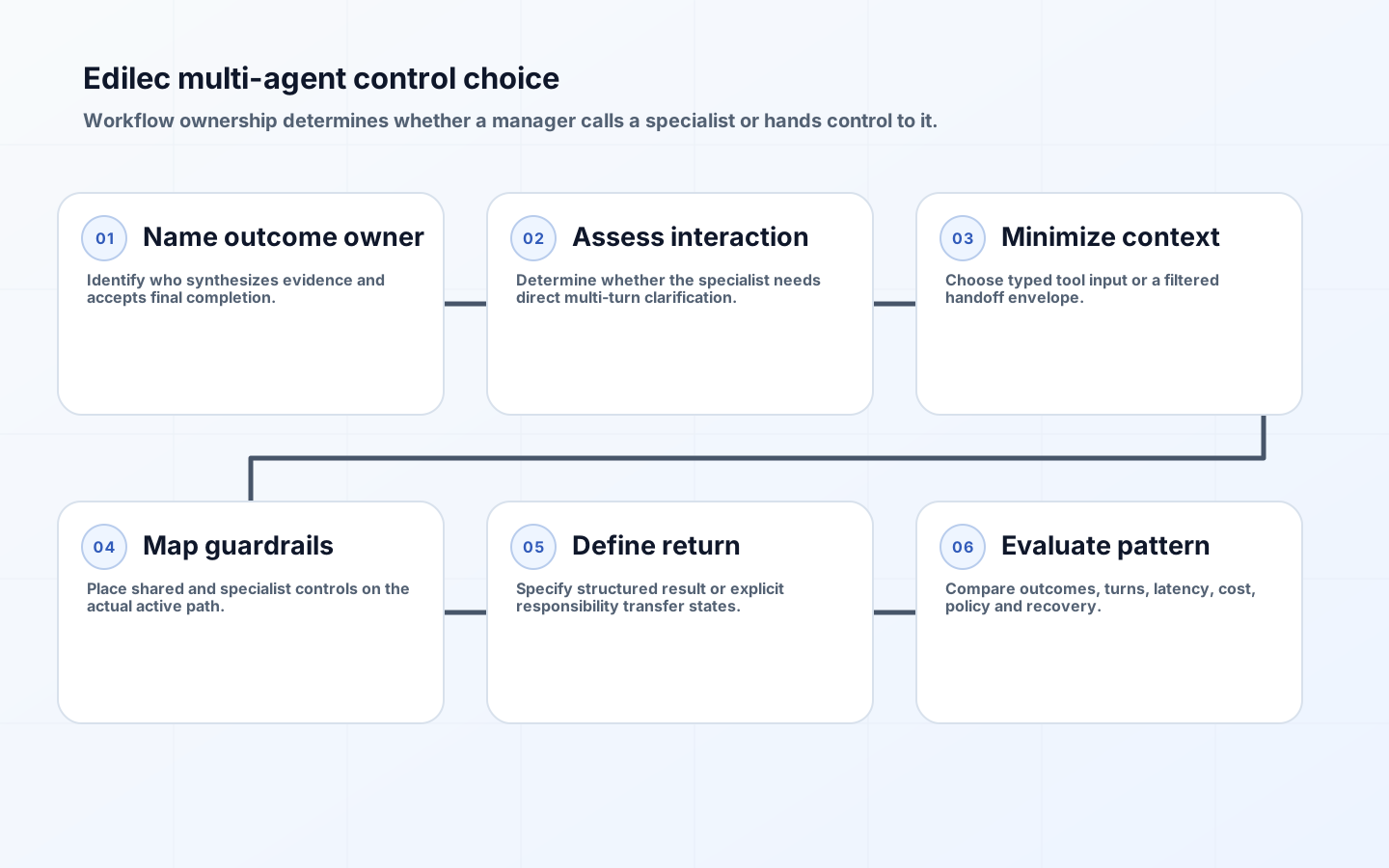
Manager agent vs handoffs is a choice about where control remains after specialist work begins. In the manager pattern, one agent keeps the user interaction, calls specialists as tools and assembles the answer. In a handoff pattern, a specialist becomes the active agent for part or all of the interaction. Both can use the same models and tools, but they create different accountability, context exposure, guardrail coverage and recovery paths.
Choose from workflow needs, not from an abstract preference for centralization or autonomy. Edilec's guide to agent workflows provides the broader architecture, while the first-principles agent guide covers goals, state and controls. Here the decision is narrower: which agent owns the next turn, final synthesis and user-visible outcome?
Define manager agent vs handoffs precisely
A manager agent treats specialists as callable capabilities. It chooses a specialist, sends bounded input, receives structured output and remains responsible for the next decision. The OpenAI Agents SDK orchestration guide calls this the manager or agents-as-tools pattern. It suits workflows where one agent should apply a common policy, combine several expert results or maintain a consistent user experience.
A handoff changes the active agent. The specialist receives the conversation or filtered state and handles subsequent turns until it completes, escalates or hands back. The handoffs guide exposes handoffs as model-visible tools with configurable input schemas, callbacks and filters. This pattern suits triage and routing where expertise includes managing the interaction, not just producing a component result.
Choose from the shape of responsibility
Prefer a manager when the outcome requires synthesis across domains, a single policy owner or a stable response schema. Prefer handoffs when a specialist needs several turns, owns a distinct service boundary or should interact directly with the user. A payroll question routed to a payroll agent may be a natural handoff; a due-diligence report combining legal, finance and security findings is more naturally managed and synthesized centrally.
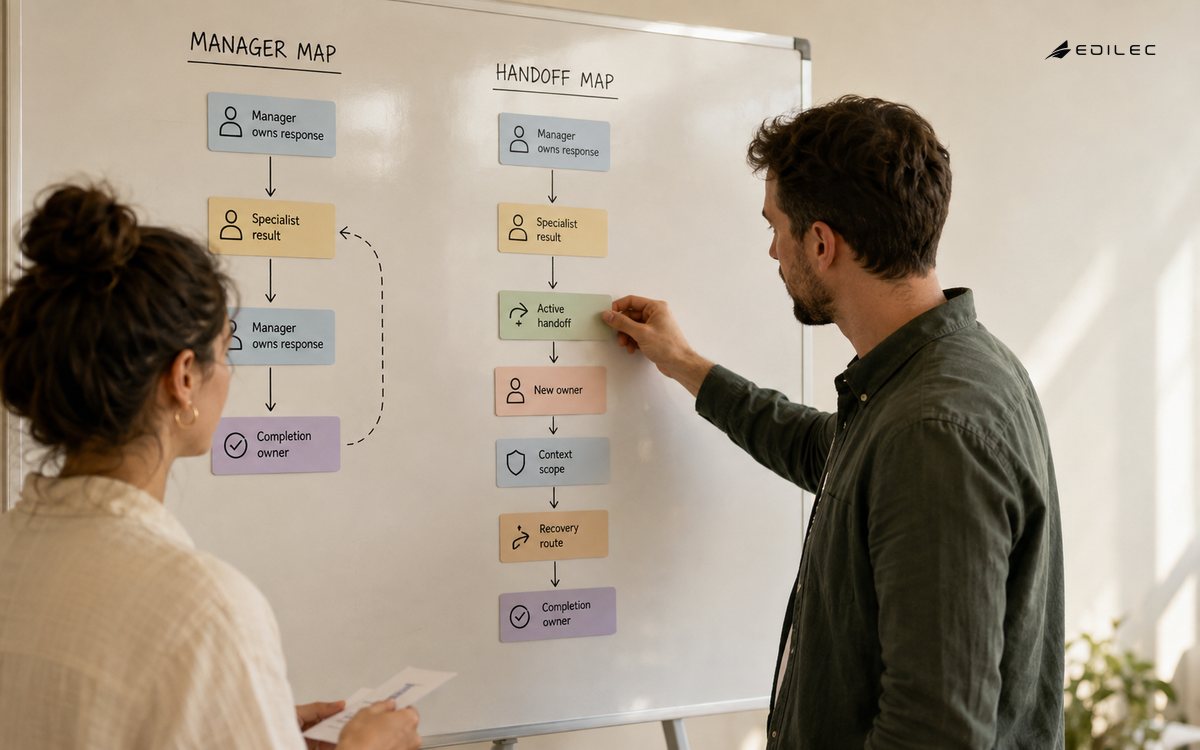
Do not infer the pattern from team topology alone. A remote organizational team can expose a bounded specialist tool, while two agents in one process can use a formal handoff. Ask who is accountable for interpreting the final result, who may ask the user for clarification and who decides the task is complete. Those answers reveal the control owner.
| Decision factor | Manager agent | Handoff |
|---|---|---|
| Final accountability | Manager synthesizes and completes | Active specialist completes its assigned interaction |
| User experience | One continuous persona | Specialist identity or behavior may become visible |
| Context | Manager filters input for each call | Selected conversation state moves to specialist |
| Parallel work | Natural for several specialist calls | Usually sequential ownership transfer |
| Policy placement | Common policy can stay central | Shared controls must follow each active agent |
Place state with the accountable agent
In a manager design, the manager owns canonical task state. Specialist calls should be stateless where possible or return explicit continuation tokens. The manager records which evidence informed its synthesis and resolves conflicts. Specialists must not secretly commit business effects unless their tool contract declares them. Central state makes replay and audit simpler, but the manager can become a bottleneck or an overly privileged hub.
In a handoff design, transfer a versioned state envelope and create an acceptance event. The receiver becomes responsible for keeping its part current and returning a structured terminal state. Do not let both agents independently continue the same action. The A2A specification demonstrates a durable task model with status and artifacts; even local handoffs need similarly explicit ownership when work outlives a turn.
Minimize context exposure in either pattern
Managers can protect privacy by sending each specialist only the fields it needs. They can also accidentally become data concentrators because the manager sees everything. Handoffs can preserve conversational nuance, but copying full history exposes unrelated records and malicious instructions to more agents. Build typed input for manager calls and input filters for handoffs. Keep credentials, hidden reasoning and irrelevant user data out of both.
Separate verified evidence from user content and model summaries. A specialist should retrieve authoritative records under its own access policy rather than trust identifiers embedded in prose. Track data classifications across transfers and delete temporary context when the task ends. Context minimization is a design measure: evaluate whether removing each field changes task performance before retaining it by habit.
Map guardrails to the active control flow
Guardrails do not automatically cover every nested or transferred execution. The OpenAI Agents SDK guardrails documentation distinguishes input, output and tool guardrails and describes where they run. Verify framework behavior for manager-invoked tools and handoff targets. Put consequential authorization and transaction rules at the tool or service boundary so they remain enforced regardless of which agent is active.
A manager can enforce common output policy before responding, but specialist tool outputs still need validation. A handoff target needs its own input and output controls because it now owns the turn. Shared policies should be packaged as versioned components and tested against every agent configuration. Edilec's agent tool permissions guide explains why model instructions cannot replace server-side permissions.
Compare latency, cost, and failure behavior
A manager adds model turns for routing and synthesis but can call independent specialists in parallel and use smaller models for narrow work. Handoffs can reduce repeated synthesis and let a specialist handle a conversation efficiently, but each transfer may carry substantial context. Measure task-level token use, elapsed time and correction rate rather than counting agents. The cheaper pattern is the one that reaches an accepted outcome with less rework.
Failure containment differs. If a specialist tool fails, the manager can retry safely, choose another source or report a partial result while retaining state. If a handed-off agent fails, the runtime needs return-to-sender, recovery state and clear user messaging. In both patterns, distinguish timeout from cancellation and query authoritative systems before repeating side effects. Cap recursion and handoff depth.
| Workflow signal | Recommended starting pattern | Reason | Watch for |
|---|---|---|---|
| Several experts inform one decision | Manager | Central synthesis and conflict resolution | Manager context overload |
| Specialist needs direct clarification | Handoff | Expert owns multi-turn interaction | Lost shared guardrails |
| High-impact action with one policy owner | Manager | Single approval and completion boundary | Over-privileged manager |
| Independent external agent service | Handoff or A2A | Provider owns task execution | Unclear cancellation and status |
| Simple classification or extraction | Single agent or tool | Multi-agent control adds little value | Premature orchestration |
Use hybrid patterns deliberately
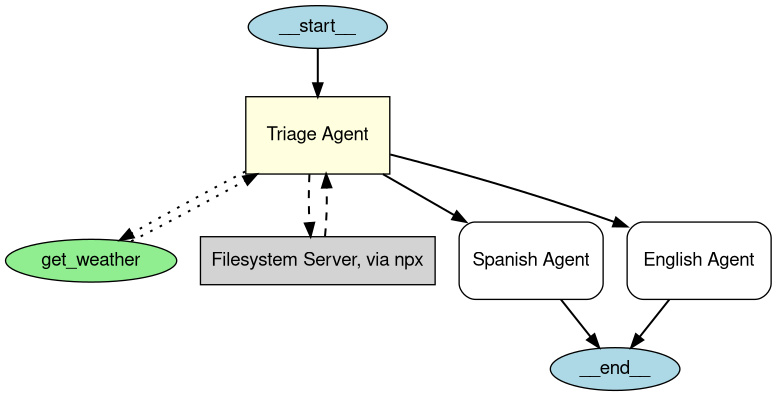
Many systems need both. A triage agent can hand a conversation to a claims specialist, which calls fraud and document agents as tools while retaining the case. A manager can also hand off only when direct specialist interaction becomes necessary. Document each edge in the control graph as tool call or responsibility transfer. Do not call every edge “delegation,” because operators need to know where active ownership changed.
Keep the top-level graph shallow. Each agent should have a clear purpose, permitted peers and terminal conditions. Prevent arbitrary peer-to-peer routing unless the task model supports cycles and ownership reconciliation. Hybrid designs should reduce a real complexity, such as specialist clarification or multi-source synthesis. If they merely showcase framework features, they create extra prompts, traces and failure modes without improving the user outcome.
Migrate when evidence shows the boundary is wrong
Move from manager to handoff when specialist calls repeatedly require conversation history, follow-up questions and manager relaying. Define a handoff envelope, transfer acceptance and return route before changing control. Move from handoff to manager when users are bounced among agents, policy diverges or final answers require repeated central correction. Replace the handoff with a typed specialist output and let the manager synthesize.
Evaluate both patterns on the same representative task set. Measure accepted completion, user turns, tool errors, policy violations, evidence quality, elapsed time, cost and recovery. Include adversarial context and unavailable specialists. A migration succeeds when responsibility becomes clearer and outcomes improve, not when the diagram has fewer boxes. Retire obsolete routes and agent permissions after the transition.
Key takeaways
- Use a manager when one agent must synthesize, apply common policy or own the final result.
- Use a handoff when a specialist should own several turns and completion of its task.
- Keep canonical state with the accountable agent and make every ownership transfer explicit.
- Verify guardrail coverage in the actual framework and enforce effects at service boundaries.
- Adopt hybrid graphs only for demonstrated interaction or synthesis needs, then evaluate task outcomes.
Frequently asked questions
Is a manager agent always more controllable?
No. Central control can simplify policy and evidence, but it also concentrates data and authority. A narrow handoff to a well-governed specialist may be safer. Controllability depends on explicit state, permissions, validation and recovery, not merely on having a central agent.
Should users know when a handoff occurs?
Tell users when the specialist's identity, authority, data access, expected duration or terms materially differ. A seamless interface can still provide a concise transition notice. Hidden handoffs are risky when they change who operates the service or how information is used.
Can specialists call one another?
Yes, within an explicit graph and delegation policy. Limit depth, prevent uncontrolled cycles, preserve the original task identifier and define who remains accountable. For many workflows, returning to the manager for another specialist call is easier to reason about.
Conclusion
The manager agent vs handoffs decision determines who owns the next decision and the final outcome. Managers are strong at synthesis and consistent policy; handoffs are strong when expertise includes direct, multi-turn responsibility. Neither pattern removes the need for bounded tools, explicit state and server-side authorization.
Prototype the simplest credible pattern on real failure cases. If a manager becomes a message relay, introduce a typed handoff. If handoffs fragment the experience and accountability, restore central synthesis. Let measured task behavior shape the control graph, and keep every edge honest about whether it returns information or transfers responsibility.