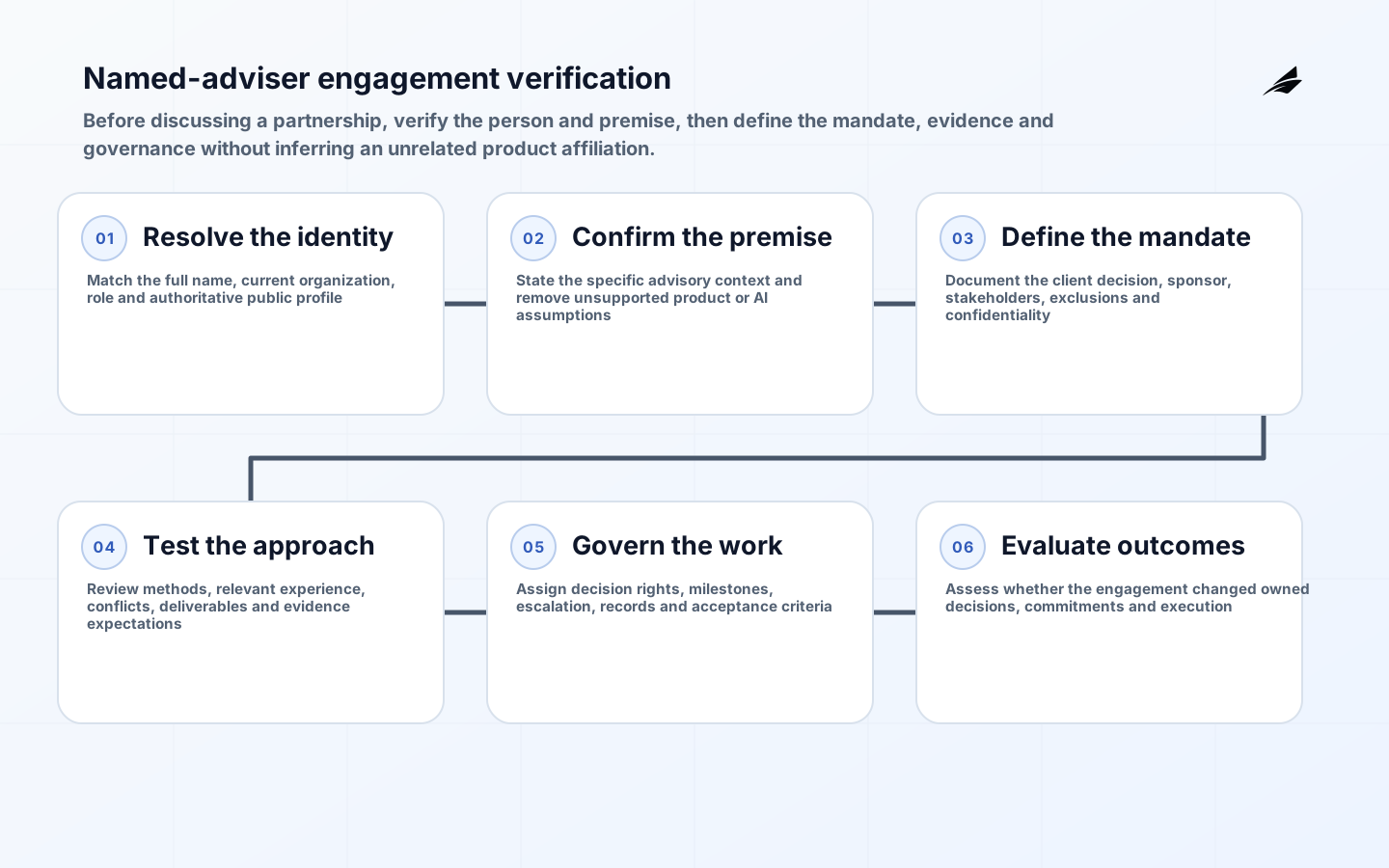
Advisory partner due diligence starts with a precise identity and service boundary. For a leadership team shortlisting an advisory firm for a reputation, corporate-purpose or AI trust engagement, the practical goals are to verify the partner’s identity and role, write a decision-worthy brief and connect stated purpose to observable leadership, operating and communication choices. That requires decisions about identity and role verification, stakeholder and reputation problem definition, and evidence from customers, employees, partners and public commitments, followed by proof that the resulting engagement works under normal pressure, disagreement and change. A published profile, a firm’s brand or a consulting label can narrow the field, but it cannot replace scope definition, accountable ownership or acceptance tests. The team should record assumptions, exclusions and decision authority before asking firms for proposals. Reputation claims remain leadership-owned.
The governing boundary is equally important. A partner’s public profile describes a person’s role and background; it does not describe a technical product, model or automation service, and an advisory engagement is not an AI product. If AI tools will be used in the work, the proposal must say so and govern that use separately. This distinction shapes contract terms, data access, testing and incident response. It also prevents a familiar failure in which each party performs its assigned activity but nobody owns the end-to-end outcome. Readers who need adjacent context can use Vetting an Advisory Partner for Reputation and AI Trust Work to compare the topic with broader engagement patterns.
Key takeaways
- Name the outcome in operational terms: verify the partner’s identity and role, define a decision-worthy brief and connect stated purpose to observable leadership, operating and communication choices.
- Document the responsibility boundary: a public profile describes a person’s role, not a product or a technical service, so any tools or AI use must be stated in the proposal.
- Design around the real components: identity and role verification, stakeholder and reputation problem definition, and evidence from customers, employees, partners and public commitments.
- Treat mistaking a profile for a service commitment, and commissioning a slogan before examining operational contradictions, as testable delivery risks, not footnotes.
- Install review controls, including the current official profile as the identity baseline and a brief that writes down the decision, affected stakeholders and unacceptable contradictions.
- Measure stakeholder understanding of specific commitments, employee escalation confidence and complaint themes together so one metric cannot hide a degraded journey.
How should scope and decision authority be defined?

Start discovery with representative work, not a generic capability list. Trace one routine stakeholder question, one high-stakes claim, one exception and one correction through identity and role verification, problem definition and stakeholder evidence. For every step, record who initiates it, the authoritative record, the rule that applies, the permission needed, the dependencies, the expected result and the evidence of completion. This exposes whether the proposed scope includes the difficult seams or only the visible deliverables. It also gives estimators concrete volumes, variants and constraints rather than a list of aspirations.
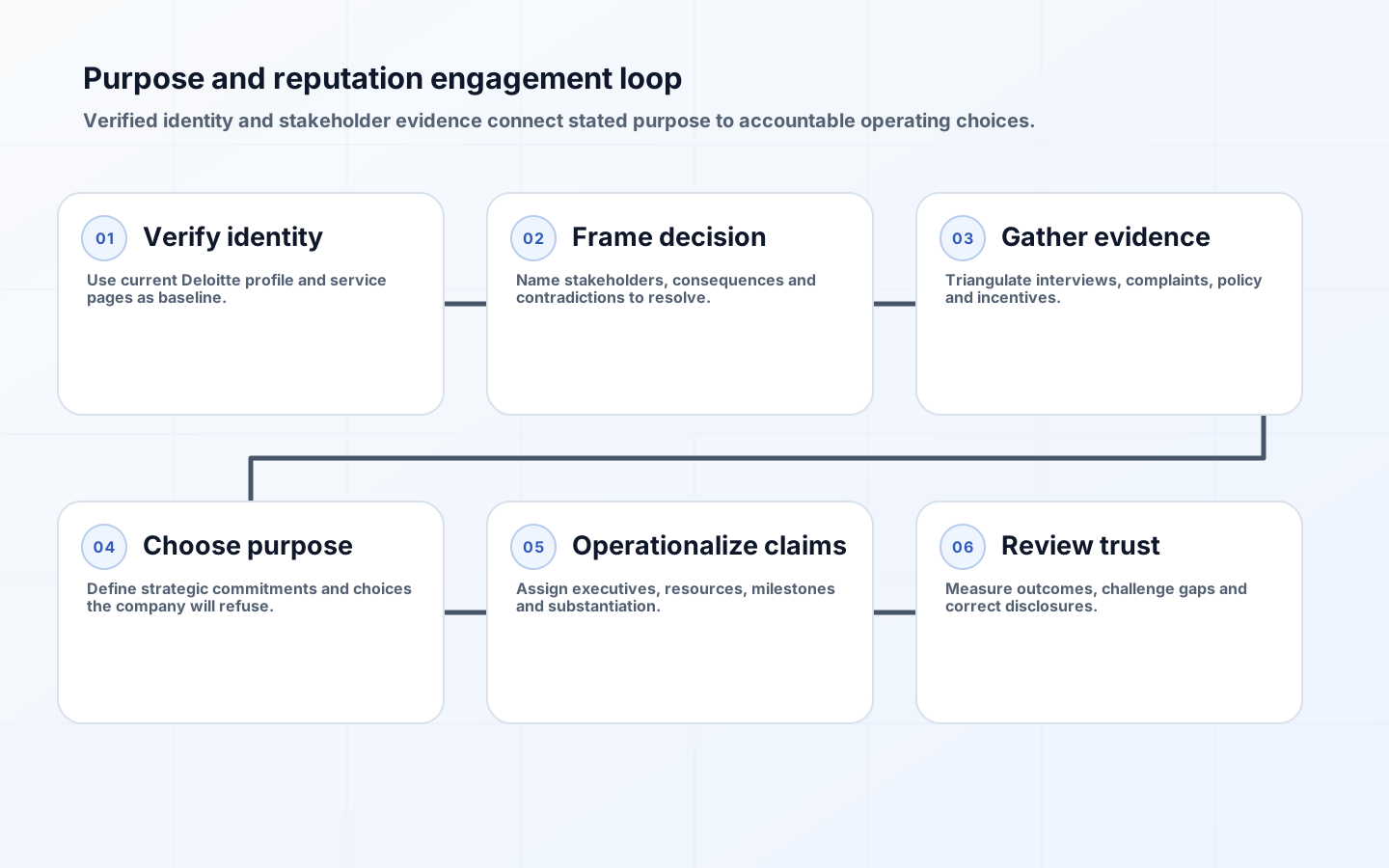
Decision authority should follow consequence. A business sponsor approves outcomes and policy; data owners approve meaning, retention and permitted use; security and privacy owners approve control requirements; legal reviewers decide what may be claimed publicly; operations owners accept follow-through and monitoring. An adviser can recommend a choice, but acceptance remains with the party carrying the consequence. Record time-bounded delegations for urgent decisions. When a decision is deferred, keep its assumption, owner, latest decision date and affected work visible rather than silently converting uncertainty into scope.
How should the engagement structure and its boundaries be set out?
The proposal should show both movement and authority. Map identity and role verification, problem definition, stakeholder evidence, purpose and strategic choice design, operating behaviors, governance and communications, and measurement, challenge, correction and disclosure as connected responsibilities. Mark where the people involved change, where data crosses a trust boundary, where an AI tool touches material, where a human must decide and where an outside party could delay completion. Each boundary needs a contract: inputs, outputs, access, validation, timing, treatment of changes and ownership. Identify the record that holds the findings and the way later decisions are reconciled when part of the work is revised.
| Engagement area | Required design decision | Acceptance evidence |
|---|---|---|
| Identity and role verification | Decide who verifies the partner and team, from which sources, and when the check is repeated. | Dated verification notes, and the same names and entity in the proposal and the contract. |
| Stakeholder and reputation problem definition | Decide which stakeholder problem and decision the engagement addresses, and what it excludes. | A brief that names the decision, affected groups and unacceptable contradictions. |
| Evidence from customers, employees, partners and public commitments | Decide which sources are used and how interviews are triangulated with complaints, policies, incentives and operating records. | Evidence plan with sample, limitations and a record of missing voices. |
| Purpose and strategic choice design | Decide who substantiates and approves each claim before public communication. | Claim register with owner, evidence, reviewer and expiry. |
Prefer reversible change and explicit interfaces. A small first phase should still use real governance, data handling and review paths; otherwise the pilot proves only that a workshop can be run. Keep working files editable, confidential material apart from deliverables and business policy apart from wording. Version material inputs and outputs so a later question can be reconstructed. Plan for capacity peaks such as executive availability and review queues. Recovery means restoring a coherent set of decisions and records, not just rescheduling meetings while duplicate or contradictory work remains.
How should delivery be sequenced with evidence gates?
Organize delivery around thin, end-to-end increments. The first increment should exercise identity and role verification, stakeholder evidence and measurement with a small but representative group. It must include access, logging, error handling, support and reconciliation from the start. Expand only after the team can explain defects and run the slice. This sequencing discovers ownership problems while changing course is still affordable, and it gives sponsors something complete enough to evaluate rather than disconnected pieces whose combined effect remains unknown until the public launch.
| Gate | Evidence to review | Stop condition |
|---|---|---|
| Baseline | Measured stakeholder understanding of specific commitments and employee escalation confidence, with volumes and exceptions. | No agreed starting point or outcome owner. |
| Design | Traceable decisions for identity and role verification, purpose and strategic choice design, and operating behaviors, governance and communications. | Critical boundary or authority remains implicit. |
| Pilot | Representative success, failure, privacy and correction tests. | Team cannot diagnose or reconcile a failed case. |
| Scale | Stable complaint themes and resolution, supplier or partner adherence to stated expectations and support ownership. | Exceptions grow faster than owners can resolve them. |
| Handover | Working files, access, dashboards, knowledge and escalation routes exercised. | Permanent team depends on project-only people or credentials. |
A gate is a decision point, not a status meeting. Name the approver, evidence, tolerance and options: proceed, correct, reduce scope or stop. Rehearse any public launch or announcement against realistic conditions, including communications, freeze decisions, rollback criteria and reconciliation of commitments. After release, keep a bounded follow-up period with explicit exit criteria. Open defects and workarounds must transfer to permanent owners with priority, due date and observable risk.
What review, quality and AI controls should be in place?
Security begins with an inventory and least privilege. Classify the material an adviser will receive, such as interview recordings, customer data and internal strategy, before granting access; use named accounts for people and separate arrangements for any tools; use time-limited access where supported and log who opened what and why. Encryption and attestations matter, but they do not correct excessive permissions or unclear processing. Review suppliers, subprocessors and regional handling against the actual data flow, then test access removal rather than accepting policy text alone. Public claims should also be tested against the rules that apply where they are made, such as the Competition Bureau’s environmental claims guidance, the Canadian Code of Advertising Standards and the OECD Guidelines for Multinational Enterprises; legal advice should confirm which apply.
Quality controls must cover business behavior and process behavior. Apply the identity baseline, write the decision, affected stakeholders and unacceptable contradictions into the brief, and triangulate interviews with complaints, policies, incentives and operating records. Then verify that claim substantiation and approval come before public communication, that commitments are tied to named executives, resources, milestones and correction routes, and that stakeholder outcomes and emerging gaps are reviewed on a fixed governance cadence. Where AI supports transcription, coding or drafting, ask for the tools, data and reviewers in writing and map the controls to a public framework such as NIST’s AI RMF 1.0, treating the mapping as evidence the team can show rather than a label. A control needs an owner, trigger, response, evidence and review cadence; a dashboard without an action rule is only a display.
- 1. Use the current official profile and service page as the identity baseline, and record the date they were checked.
- 2. Write the decision, affected stakeholders and unacceptable contradictions into the brief, and have the sponsor sign it.
- 3. Triangulate interviews with complaints, policies, incentives and operating records.
- 4. Assign claim substantiation and approval before public communication.
- 5. Tie commitments to named executives, resources, milestones and correction routes.
- 6. Review stakeholder outcomes and emerging gaps on a fixed governance cadence. For every control, name the accountable owner, supporting evidence, exception route and next measurable check.
How should value, reliability and cost be measured together?
Build a measurement tree from the intended outcome to stakeholder, process, quality and cost signals. Track stakeholder understanding of specific commitments and employee escalation confidence and observed alignment as outcome measures; pair them with complaint themes and resolution and supplier or partner adherence to stated expectations to expose quality and control effects. Use substantiated-claim exceptions and corrections and milestone delivery against public commitments to test whether the work remains economical and correctable. Define formula, source, population, exclusion, frequency and owner for every measure. Segment results where different groups can experience materially different outcomes.
Do not declare value from activity counts alone. More workshops, reports, messages or monitored mentions can coexist with greater rework. Compare against a credible baseline and include transition labor, parallel running, licenses for any tools, support and exception handling. Review leading signals such as open questions, unresolved decisions and expiring access beside lagging outcomes. When results miss tolerance, the governance forum should choose an action and owner; explanations without a funded correction are not benefits realization.
Frequently asked questions
- How can a business verify an advisory partner’s public profile? Read the firm’s official profile page, note the date, and check that the title, practice and employing entity match the proposal and the contract. Check any credential or membership claim with the body that issues it, and treat anything that cannot be checked as a question for the firm, not an assumption.
- What should a proposal state? The contracting entity, lead partner, day-to-day team and expected allocation, scope and exclusions, conflicts and independence position, deliverables with acceptance criteria, fee basis, assumptions, change control and the evidence behind each finding.
- Does a public profile show that a named partner will do the work? No. It shows a role and background. Ask who is accountable, who does the day-to-day work, how much time each person commits and what notice applies if a key person changes.
- What belongs in the first phase? Choose one representative question or claim that crosses the most important boundary, has an accountable owner and can be corrected without unacceptable harm.
- How detailed should the contract or charter be? It should name eligible scope, exclusions, responsibilities, evidence, service targets, change treatment, data handling, exit rights and acceptance authority.
- What should the contract say about AI tools? Which tools are used for which tasks, what data they may receive, who reviews the output, how long data is retained and how it is deleted, and whether the buyer can require a non-AI path for sensitive material.
- How should a firm’s claims about results be assessed? Confirm the exact scope and date, request evidence for the buyer’s own situation, validate references with the people named and run a short, controlled diagnostic before committing to a larger program.
- What should trigger a pause? Unowned critical risk, irreconcilable evidence, missing authorization, unclear rollback or a material outcome below its agreed threshold.
Conclusion
A defensible approach to advisory partner due diligence turns a name or a brand into a bounded engagement with tested responsibilities. Begin by verifying the partner’s identity and role, defining a decision-worthy brief and connecting stated purpose to observable leadership, operating and communication choices; map the complete journey; then make delivery and operating decisions visible. The most credible plan does not promise that every uncertainty disappears. It shows who decides, what evidence is required, how failure is contained and how the organization will learn. If the team can run the first representative slice, reconcile its records, explain its cost and reverse a bad decision, it has a foundation worth scaling. Reputation claims remain leadership-owned.