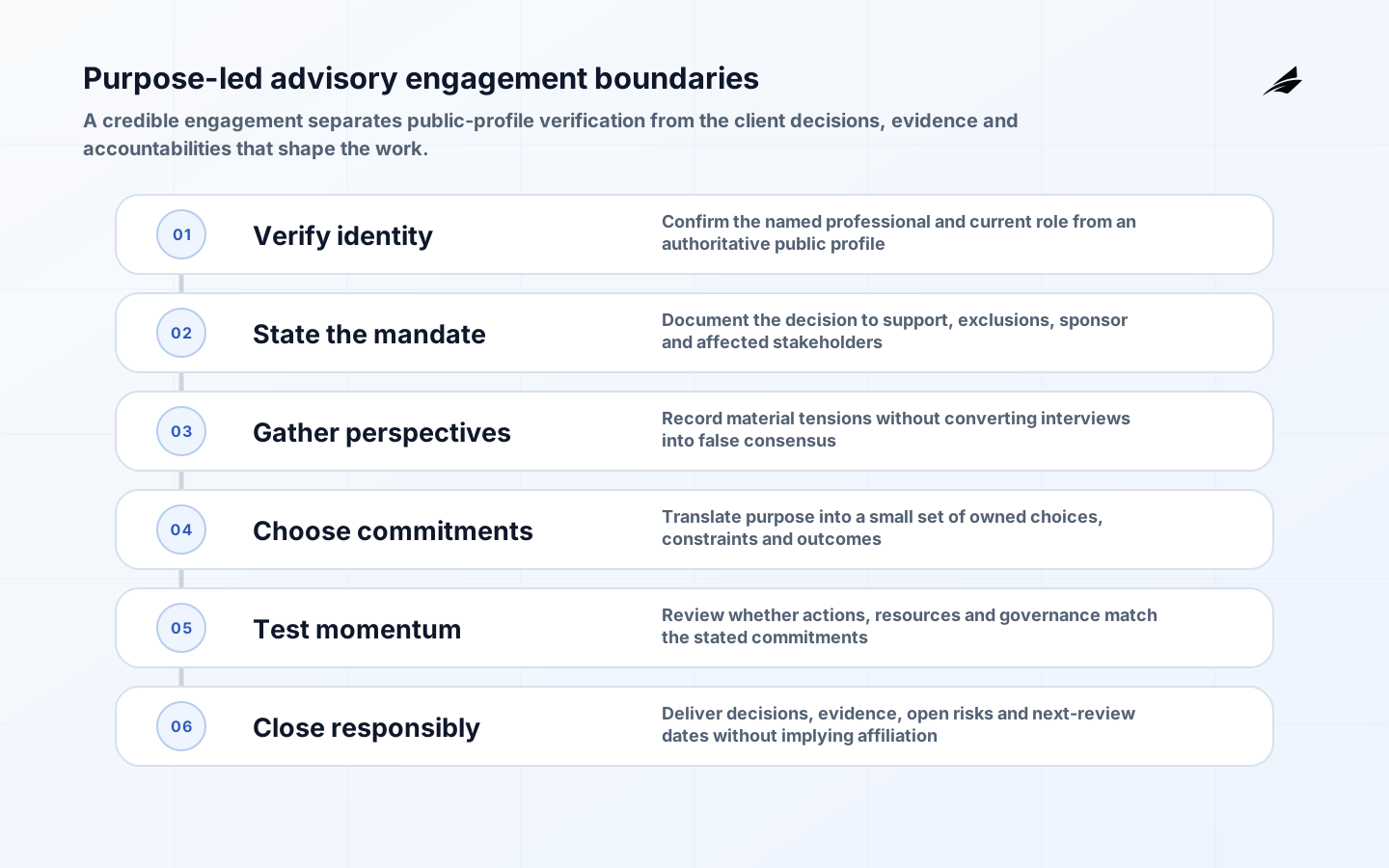
A purpose-led reputation and AI trust engagement needs an exact definition before anyone is hired or a tool is chosen. This checklist frames the engagement around the verified adviser, the contracting firm, the decision mandate and the affected stakeholder groups. For the wider guide, see Vetting an Advisory Partner for Reputation and AI Trust Work: Profile Checks, Scope and Due Diligence. The sections below cover evidence, operating model, delivery, controls, measurement, cost and ownership without implying capabilities or affiliations that no source establishes.
Set the engagement scope and decision boundary
Begin with the decision the organization must make, the stakeholder groups it affects and the executive who can approve the outcome. Then collect three or four real situations the engagement must handle: a routine stakeholder question, a contested claim, an ambiguous research finding and a complaint that contradicts the preferred story. Record who raises each, which source owns each fact, who may approve the outcome and what makes a public statement hard to reverse. Scope is complete only when the sponsor can say what remains outside the engagement and how that work will proceed. Write acceptance criteria for evidence, review, escalation and correction. This prevents a broad label such as purpose-led consulting from hiding several different services with incompatible authority and risk.
Map the people affected by the decision and invite review from those who operate, govern or experience it. Separate facts from assumptions, and give every unresolved assumption a test. If the engagement touches regulated disclosure, employment, safety, money, personal data or public claims, involve the relevant domain, legal and governance owners before the brief is final. ISO 37000 (governance of organizations), the GRI Standards (sustainability reporting) and ISO 26000 (social responsibility) are useful reference vocabulary for governance and disclosure questions, not proof that an engagement is sound. The first phase should show one complete path from question to retained evidence. Polishing isolated steps, such as a message or a workshop, can make one result look good while contradictions remain elsewhere in the organization.
Build the engagement around authority and ownership
The operating model spans five layers: the engagement charter and verified identity, the stakeholder evidence and participation record, governance, incentives and operating commitments, measurement, and public claims and internal ownership. Each layer needs a named owner, a versioned document, least-privilege access to data and an observable way to fail. Keep recommendation separate from decision: the adviser recommends and the accountable executive decides. Preserve enough source context for a reviewer to understand a finding without exposing unrelated sensitive data. If a dependency such as an interview schedule or a data extract slips, it should appear as a visible, tracked item rather than a silent gap.
| Operating area | Required decision | Release evidence |
|---|---|---|
| Engagement charter and verified identity | Name the contracting entity, lead partner, team and sponsor, and record how each was verified. | Charter approved by an accountable executive, with dated verification notes |
| Stakeholder evidence and participation record | Decide who is heard, by what method, and which consent and retention rules apply. | Participation log with sampling rationale, consent and known gaps |
| Governance, incentives and operating commitments | Decide which policies, budgets or incentives will change if the evidence requires it. | Decision log showing owners, dates and recorded dissent |
| Measurement, public claims and internal ownership | Decide which measures, claims and working files the organization will own after handover. | Claim register, measurement definitions and a named internal owner for each |
Deliver through six evidence-bearing stages
Delivery should retire uncertainty in a deliberate order. Start with the riskiest evidence and permission questions, not the most impressive deliverable. Make every stage produce an artifact that another person can inspect and a decision to continue, revise or stop. Pilot messages and commitments with representative stakeholders, keep the current communication route running and limit how widely a new claim is used. Expansion should follow demonstrated quality and a sustainable review workload rather than a launch date.

- Confirm the named adviser, firm, current role and service from official sources, then again in the proposal.
- Charter the strategic decision and material tradeoffs.
- Gather representative stakeholder and operating evidence.
- Translate findings into governance, policy and incentive changes.
- Test commitments against difficult real decisions.
- Transfer ownership and review stakeholder outcomes over time.
Design controls for realistic failure modes
Controls must match consequence and reversibility. A draft message can tolerate experimentation that a public claim or a statement to a regulator cannot. Put deterministic review steps around any probabilistic tool: when AI supports transcription, coding, drafting or monitoring, limit the data it may see, record the tool, its version and the purpose it was used for, and keep a named person accountable for every output that leaves the engagement. NIST’s AI RMF 1.0 organizes AI risk work under four functions, Govern, Map, Measure and Manage; use them as prompts for what the team should be able to show. Test missing owners, contradictory evidence, stale data and a tool outage. A manual fallback counts only when ordinary staff can use it under pressure.
| Failure mode | Control response | Signal to review |
|---|---|---|
| Overstated credentials or affiliation | Verify the claim with the issuing body or the firm and describe the relationship precisely. | Unverified identity, membership or endorsement claims |
| Purpose washing | Gate public language on operating evidence and named ownership. | Claims without implemented commitments |
| Selective listening | Document participant rationale and missing stakeholder voices. | Representation gaps |
| Consultant dependency | Require editable evidence, internal owners and scenario handover. | Decisions only advisers can explain |
| Unreviewed AI output | Require disclosure of AI use, source references and human review before anything is shared. | Generated text or summaries with no named reviewer |
Measure outcomes and full engagement cost
Track decisions changed by the agreed principles, stakeholder participation and unresolved concerns, operating commitments implemented by their owners, and published claims supported by current evidence. Establish a baseline before the pilot and look at the spread of results, not only averages. Review a sample of accepted, corrected, escalated and rejected items so the team can tell whether a problem came from source evidence, policy, wording, reviewer capacity or follow-through. A favorable metric is not a benefit if the work or risk has simply moved to another team or stakeholder.
Price discovery, stakeholder research, executive decision work, operating redesign, measurement and handover separately. A public profile does not establish availability, affiliation or commercial terms, so procurement must confirm each point directly. Keep one-time discovery and set-up distinct from recurring support. A proposal should state data rights, access to sources and working files, incident support, subcontractors, export and transition assistance. Review the commercial model after representative use, because pilot volume rarely predicts exception handling, retention cost or support load at scale.
Rehearse the handover before expanding the mandate
Run one stakeholder question through the full path, then interrupt it with the first two failure modes in the table. Ask a colleague who did not run the engagement to locate the evidence, identify the accountable owner, choose a safe fallback and resume without duplicating work. Revoke a contractor’s data access and verify that no copy or credential remains. Then restore the affected record from the documented source. This rehearsal tests whether the engagement is understandable and recoverable, not whether its preferred path works in a workshop.
The handover packet should include the approved scope, ownership map, data and access model, a register of tools and AI use, evaluation sample, control tests, support route, cost baseline and exit procedure. Temporary exceptions need an owner and an expiry. Handover is complete when internal teams can operate, investigate and change the work using editable artifacts. Any high-consequence ambiguity must be resolved before the mandate, the audience or the public exposure grows.
Rehearse a representative engagement scenario
Follow one representative claim across the charter and the evidence record. Stop after every handoff and ask which record is authoritative, who is acting, whether the review rule is current and whether repeating the step could duplicate or contradict an earlier result. Introduce a missing interview and a delayed data extract. The reviewer must be able to identify the owner, explain why the claim paused and continue through the documented fallback without private coaching.
Next, simulate an overstated credential and a purpose-washing claim. Verify that review surfaces the problem before an outsider does, that the retained evidence supports diagnosis and that the response does not widen access or disturb unrelated work. Record elapsed time, manual steps and unresolved ambiguity, and add the scenario to the regression checklist so the next engagement is tested against the exact failure.
The acceptance packet for a purpose-led engagement should contain the approved boundary, ownership map, source and document versions, access tests, evaluation sample, support route, cost baseline and recovery procedure. Give those artifacts to someone who did not run the engagement; if they can handle a normal case, diagnose a stale input and choose a safe fallback, the work is transferable. Temporary exceptions require an owner, a compensating control and an expiry before the mandate or the audience grows.
Key takeaways
- Name one decision, outcome and accountable owner.
- Preserve authoritative source evidence and explicit permission boundaries.
- Keep a register of AI use, data and human reviewers, and require review before anything is shared.
- Pilot with realistic exceptions and a usable fallback.
- Expand only when the work is observable, supportable and recoverable.
Frequently asked questions
- What should discovery produce? A bounded scope statement, authority map, representative cases, risk register, evidence plan, AI-use register, cost range and explicit exclusions.
- How long should a pilot run? Long enough to include ordinary work, realistic exceptions and a correction exercise. Evidence coverage matters more than a universal number of weeks.
- Can an adviser own the outcome? An adviser can deliver agreed work and make recommendations, but the organization keeps accountability for policy, data use, affected people and business decisions.
- What is the safest first phase? A baseline and recommendations package with inspectable evidence is often safer than an immediate public campaign, provided it addresses a useful decision.
- How is success demonstrated? Compare the baseline with completed outcomes, corrections, exceptions, failures, engagement cost and stakeholder impact, then review representative cases behind the aggregate.
Conclusion
A purpose-led reputation and AI trust engagement should leave an organization with work it can explain, operate and improve. The essential steps are to narrow the decision, preserve evidence, separate recommendation from authority and test recovery before scale. Cost and value must include research, review and long-term ownership. When those conditions are met, the engagement can sharpen judgment and remove avoidable rework without hiding responsibility inside an adviser, a tool or a polished narrative.