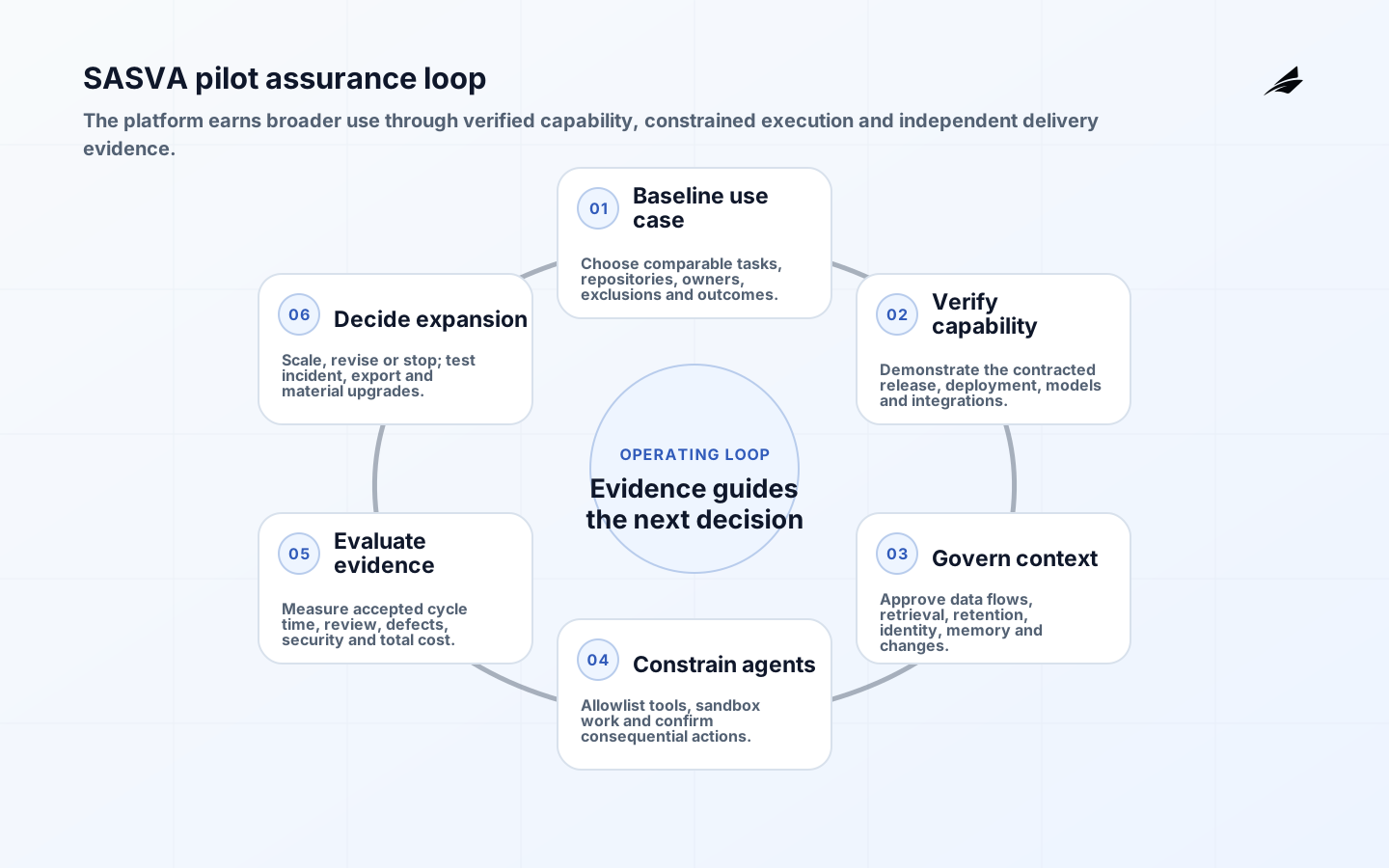
SASVA AI solutions are positioned by Persistent Systems as an enterprise AI engineering platform spanning software-delivery activities and coordinated human-agent work. An implementation should still begin with a business problem, not product claims. The buyer must verify current capabilities, deployment choices, model and tool integrations, governance, data handling, quality evidence, cost and exit terms in its contracted version. A controlled pilot is the right place to replace assumptions with observed behavior.
This checklist is independent implementation guidance for teams evaluating SASVA; it is not a product endorsement or a substitute for Persistent’s current documentation and contract. Use it alongside the SASVA scope and cost plan, the SASVA FAQ and the business process implementation checklist. Validate every provider-specific statement during technical and commercial due diligence.
Choose a bounded engineering use case
Select a workflow with a measurable baseline, sufficient automated tests and reversible outcomes. Candidates include codebase assessment, test drafting, documentation synchronization, migration analysis or a defined maintenance change. Avoid using the first pilot for production deployment, secrets rotation, high-impact financial logic or a repository with unknown ownership. Name eligible repositories, task classes, excluded data, approved tools and the person accountable for acceptance.
Write a hypothesis across speed, quality and risk: “For Java maintenance changes under three files, the pilot will reduce median preparation time by 15% without increasing review rework, escaped defects or policy violations.” Capture baseline lead time, active effort, review time, test quality, defects, change failure, developer experience and cost. Generated volume and suggestion acceptance do not prove delivery improvement. The companion NIST AI RMF can structure governance, context mapping, measurement and treatment.
| Candidate workflow | Why it can be suitable | Prerequisite | Keep out of first pilot |
|---|---|---|---|
| Repository assessment | Read-only and evidence oriented | Current owners and architecture map | Automatic modernization estimate |
| Test drafting | Output has executable feedback | Known behavior and meaningful assertions | Tests copied from implementation |
| Small maintenance change | Cycle time can be compared | Bounded files and rollback | Authorization or payment core |
| Documentation update | Diff is reviewable | Authoritative source and owner | Unverified operational promises |
| Migration analysis | Can expose dependency questions | Representative code and runtime data | Autonomous bulk rewrite |
Verify the contracted SASVA capability
Persistent’s current SASVA 4.0 page describes a team-centered platform with a visual control layer, human-agent collaboration, memory across work, lifecycle coverage, deterministic guardrails, and deployment or model choices. Treat those as areas for demonstration and contractual clarification. Ask the provider to show the exact licensed release in the intended deployment, with the buyer’s representative repository and identity boundary. Record which functions are generally available, optional, preview, partner-provided or custom services.
Request an architecture and data-flow diagram for prompts, retrieved source, embeddings or indexes, model calls, tool results, generated artifacts, telemetry, support access and backups. Confirm cloud, on-premises or hybrid responsibilities; supported models; region; encryption and key ownership; retention and deletion; training use; subprocessors; availability; update process; and incident notification. The Visual Studio Marketplace listing can confirm the published editor extension, but marketplace presence does not establish enterprise security or suitability.
Define governance and information boundaries
Create a use policy before connecting repositories. Classify source code, customer records, tickets, logs, credentials and licensed material. Map each class to approved model endpoints, retrieval and retention. Use enterprise identity, least privilege and separate administrative roles. Exclude secrets and production data by default. Test repository isolation, branch permissions and whether hidden or deleted files remain in indexes. Define who can create, change and approve agent workflows or guardrails.
Keep an inventory of models, prompts, knowledge sources, agents, tools, plugins and external services with owners and versions. The NIST generative AI SSDF profile extends secure development considerations to AI model and system producers and acquirers. Require change notice and reevaluation for material model, agent, retrieval or policy changes. An approved product name does not make every future configuration approved.
Constrain agents and deterministic workflows
Start agents read-only and sandboxed. Add write access to a temporary branch after observing command and retrieval behavior. Allowlist tools, paths, network destinations and package sources. Require a person to confirm dependency installation, destructive commands, external communication, infrastructure change and access to sensitive systems. Use short-lived credentials issued for the task, cap runtime and spend, and revoke access at completion. A prompt instruction is not an adequate enforcement boundary.
For any visual or configured workflow, inspect every stage: trigger, inputs, retrieval, model choice, tools, validation, fallback and final action. Version it as code or exportable configuration, peer-review changes and test failure states. Determine how partial execution resumes, whether a replay duplicates effects and how an operator cancels work. Preserve an attributable trace from user intent through model and tool actions to the final artifact without storing unnecessary confidential content.
Keep independent quality and security gates
SASVA-generated artifacts should enter the same branch, build, test, review and deployment controls as other changes. Compile and test in a clean environment; scan dependencies, secrets, code and infrastructure; and check licenses. Require behavioral tests that would fail without the intended change. The OWASP ASVS can provide versioned, testable requirements for web application controls. Add domain-specific gates for privacy, money, safety and regulated decisions.
| Assurance gate | Evidence | Independent owner | Stop condition |
|---|---|---|---|
| Intent | Accepted issue, constraints and agent plan | Product or maintainer | Unclear business behavior |
| Context | Approved sources and access trace | Data or repository owner | Unexpected file or tenant |
| Code | Bounded diff and architecture fit | Human reviewer | Unexplained bulk or generated binary |
| Security | Threat checks, scans and resolved findings | Security engineer | Secret, unsafe dependency or high finding |
| Release | Tests, telemetry, rollout and rollback | Service owner | No recovery or accountable operator |
Do not let one agent workflow author, review and merge its own output without independent evidence. Human review should confirm business invariants, authorization boundaries, failure behavior and maintainability, not just syntax. Sample rejected and heavily edited outputs to understand systematic weaknesses. When generated tests simply mirror generated code, add reference cases, mutation testing or review against specifications to avoid circular confidence.
Run the pilot as a controlled comparison
- Collect baseline delivery, quality, security, experience and cost measures for eligible work.
- Complete architecture, privacy, security, legal, procurement and support reviews for the intended deployment.
- Configure identity, repositories, model endpoints, tools, budgets, logging, exclusions and approval gates.
- Train a small cohort of developers and reviewers with safe, unsafe and escalation examples.
- Run parallel or bounded production work, reviewing samples and incidents every week.
- Decide to expand, revise or stop against the predefined hypothesis and documented residual risks.

Use matched task classes or a staggered rollout rather than comparing an expert greenfield team with a legacy support group. Measure median and tail cycle time, active effort, reviewer effort, escaped defects, change failure, security findings, test effectiveness, developer confidence, support burden and total cost. Segment by task and repository maturity. The DORA guides can help teams reason about delivery performance while avoiding simplistic individual productivity rankings.
Prepare production operation and incident response
Define service owner, platform administrator, vendor contact, model-provider contact, support hours, severity, evidence retention and recovery. Monitor authentication, repository access, agent tool errors, model latency, rate limits, spending, policy denials and unusual retrieval. Test unavailable models, expired credentials, corrupted indexes, partial agent execution, provider-region outage and a malicious repository instruction. Provide a manual development path so vendor or model failure does not stop critical maintenance.
Create an AI incident playbook covering unexpected data access, prompt injection, insecure generated code, unauthorized actions, provider breach and model behavior regression. Stop the relevant workflow, preserve evidence, revoke credentials, assess affected repositories and data, notify owners, remediate and retest. Distinguish a quality defect from a security or privacy event, while allowing one issue to trigger both processes. Feed incidents into guardrails, training and eligibility policy.
Confirm economics, ownership and exit
Model licenses, model inference, storage, integrations, implementation services, platform operation, training, support and reviewer time. Test expected and peak usage, long-context tasks and failed retries. Ask how model choice changes price and whether budgets can be enforced by team or workflow. Compare total cost per accepted change or completed assessment, not prompts or generated tokens. Include the cost of maintaining custom workflows and integrations after the initial engagement.
Contract for ownership or durable rights to prompts, configured workflows, generated artifacts, evaluation sets and customer-specific integrations. Require export of audit evidence, configuration, usage and relevant indexes in usable formats; define deletion and transition assistance. Preserve repository instructions and quality gates outside the platform where practical. Test a small export and account termination during the pilot. Exit readiness is healthy engineering governance, even when the product performs well.
Key takeaways
- Evaluate SASVA AI solutions against one bounded engineering outcome and measured baseline.
- Verify the exact contracted version, deployment, models, integrations and data flow.
- Constrain agents with technical enforcement, short-lived access and human confirmation.
- Keep independent code, security, test, review and release evidence.
- Expand only after quality-adjusted delivery improvement and a tested incident and exit path.
Frequently asked questions
Is SASVA a coding assistant or an engineering platform?
Persistent currently positions SASVA 4.0 as a team-centered enterprise AI engineering platform spanning lifecycle work and coordinated agents. Buyers should verify which capabilities are included and generally available in their contracted deployment rather than infer them from the broad category.
Can an organization choose its own models?
The current product page describes model and infrastructure freedom. Confirm the supported models, hosting, routing, fallback, pricing, retention and responsibility for each intended configuration. A nominal option is not useful until it works with required controls and latency in the target environment.
How should SASVA return on investment be measured?
Measure quality-adjusted outcomes: accepted cycle time, reviewer effort, defects, change failure, security findings, developer experience and total cost for comparable tasks. Avoid using generated code, prompts or adoption alone. Include implementation, model, integration, review and platform-operation costs.
Conclusion
A sound SASVA implementation treats the platform as a configurable participant in the software delivery system. Bound the use case, verify current capabilities, govern context, constrain actions, preserve independent assurance and measure the complete outcome. That produces a decision based on the buyer’s evidence rather than either enthusiasm or fear about enterprise AI engineering.