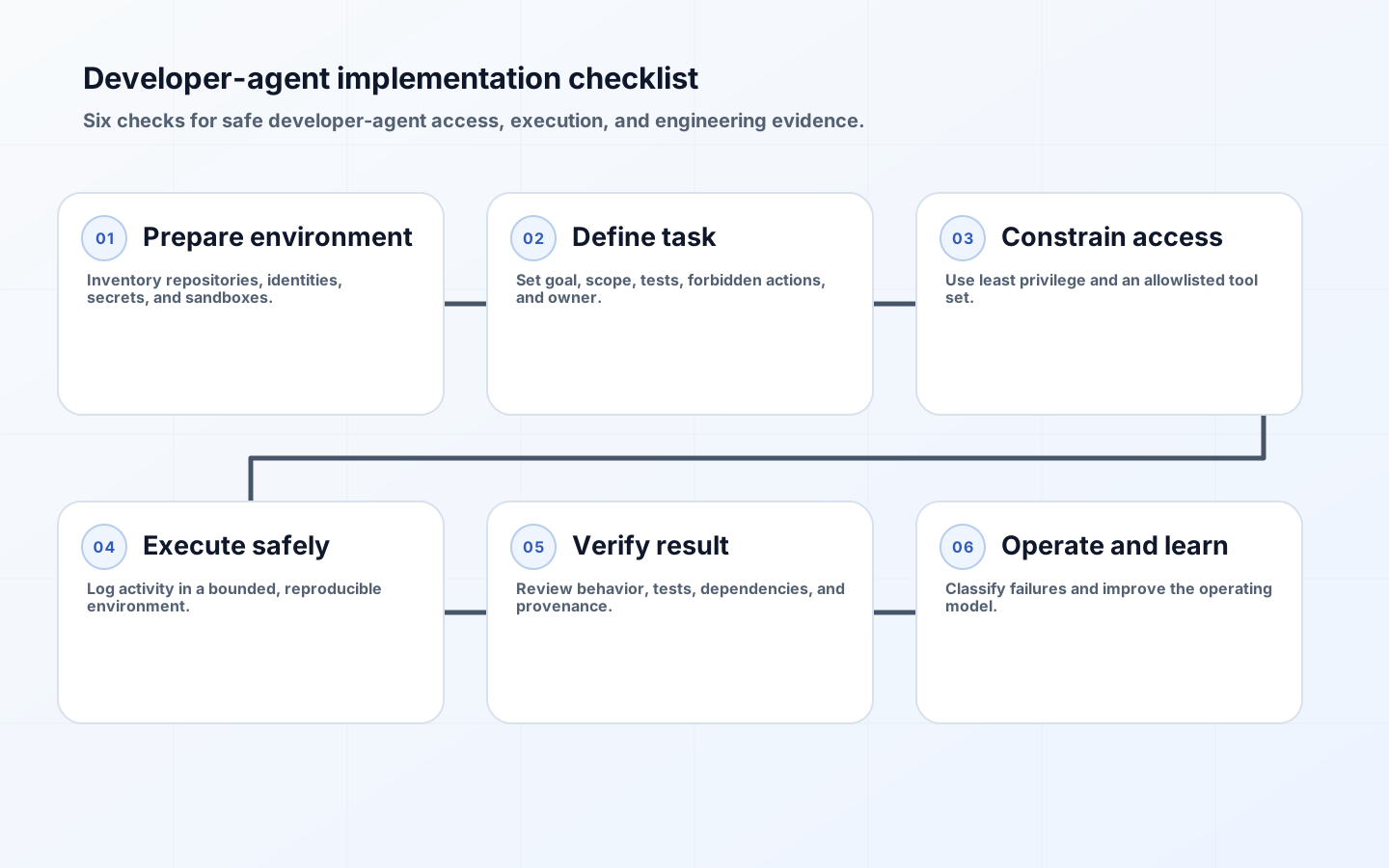
An agentic development platform implementation checklist should help a team preserve the engineering habits that make software trustworthy. Developer agents may inspect repositories, reason across files, generate patches, run tools, or prepare documentation. Each ability changes the security and review boundary. Successful implementation is therefore not measured by how independently an agent appears to work; it is measured by whether engineers can safely use, verify, and improve the assistance. Start with a small group of tasks, a controlled environment, and an agreement that human owners remain responsible for the change.
Prepare the engineering environment
Inventory repositories, protected branches, CI workflows, package registries, secrets, and deployment paths before connecting a platform. Decide which environments are suitable for initial work and make read-only access the default. Clean up high-risk credentials and unowned automation that an agent could inadvertently encounter. Use the NIST Secure Software Development Framework to review how the platform will sit within existing secure development practices. The important outcome is a concrete boundary, not a generic statement that the platform is secure.

| Preparation item | Minimum evidence | Reason |
|---|---|---|
| Asset inventory | Selected repositories, branches, systems, and owners are listed. | Prevents accidental expansion through forgotten dependencies. |
| Identity design | A dedicated service identity has documented scopes and expiry. | Separates agent access from a developer's broad account. |
| Sandbox | Tool execution has filesystem, network, and resource limits. | Contains unintended commands and unsafe content. |
| Policy baseline | Allowed tasks, prohibited actions, and approval points are published. | Gives users a clear operating boundary. |
Define tasks and acceptance criteria
Write task templates that state the goal, relevant repository area, required tests, forbidden actions, and expected evidence. A task such as 'fix the bug' is too open for an early agent rollout; 'add validation for these inputs in this module, with these tests, without changing external contracts' is auditable. Include a stop rule for missing information or a conflicting instruction. Users should be able to inspect the plan before tools run. This makes the agent's work reviewable and teaches teams which tasks are actually suitable for assistance.
- Name the system owner and reviewer before execution.
- Restrict the repository path, branch, and files where practical.
- Specify tests and nonfunctional constraints relevant to the change.
- Prohibit deployment, credential changes, and unapproved external communication.
- Require the agent to cite files and assumptions in its summary.
- Define when the task must stop and return to an engineer.
Constrain tools and permissions
Permissioning should reflect the individual task, not the broadest capability the platform advertises. Allow read access to a selected repository before allowing writes; allow local tests before allowing CI actions; require a human for pull-request merge and release. Treat repository instructions, tickets, and issue comments as untrusted input when they can affect tool execution. The OWASP LLM Top 10 offers a useful prompt-injection and excessive-agency checklist. Do not place secrets in prompts or let the agent choose which credentials it receives.
| Permission | Early implementation | Expansion condition |
|---|---|---|
| Read source | Selected repositories with audit logging. | Access review confirms the scope remains necessary. |
| Write code | Draft branch or local workspace only. | Reviewers validate diff quality and task adherence. |
| Run tools | Allowlisted commands in a sandbox. | Logs show reliable, bounded use without policy violations. |
| Trigger delivery | Prepare a request, not an independent release. | Established controls approve a documented, low-risk use case. |
Verify every meaningful result
Require the same evidence an engineer would need for an equivalent human-authored change: correct tests, static checks, dependency assessment, code review, and a clear explanation of behavior. Agents can create convincing but incomplete diffs, especially when requirements are ambiguous or repository context is missing. The SLSA specification is helpful when reviewing how build provenance and integrity are retained across automation. Keep review independent: an agent-generated summary is useful context, but it should not be the only explanation a reviewer sees.
- Reproduce the relevant test or analysis results in the approved environment.
- Review changed files and surrounding behavior, not just the generated explanation.
- Check dependency, license, and security effects where code or configuration changed.
- Confirm no secrets, sensitive records, or unintended files entered the diff or logs.
- Link the change to a task, agent configuration, tool activity, and human approval.
- Exercise rollback or fix-forward procedures for the class of change.
Operate and learn from failures
Collect examples of rejected patches, unsafe tool requests, confusing summaries, test failures, and escaped defects. Classify whether the issue arose from a poor task, missing repository context, inadequate permissions, platform behavior, or weak review. That classification prevents a simplistic response such as endlessly rewriting prompts. Monitor access anomalies, tool failures, task duration, review burden, and user feedback. The NIST AI Risk Management Framework supports a cycle of measuring and managing these changes as the use case evolves.
Frequently asked questions
- Can we skip code review for simple agent changes? Keep an approval proportionate to the change; removing review should be a separately justified policy decision, not a convenience setting.
- Should agents access every repository? No. Start with the smallest relevant scope and grant more only for a demonstrated need.
- How do we handle generated tests? Treat them as test code that needs review; passing generated tests do not independently prove the requirement is met.
- What should be logged? Enough task, configuration, tool, and decision context to investigate outcomes, while protecting sensitive content.
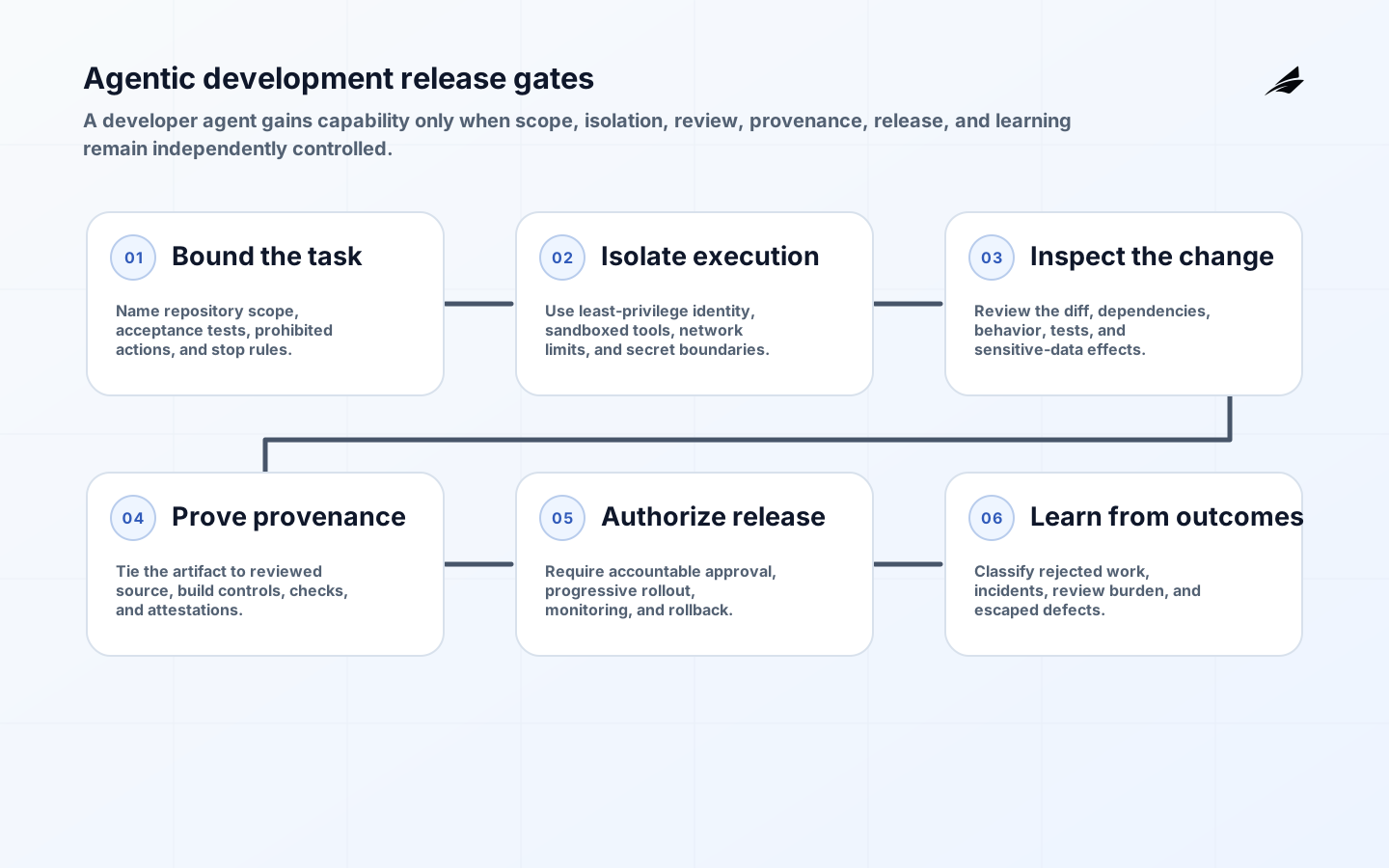
Add release gates that survive agent autonomy
A developer agent can compress the time between an instruction and a proposed change, but it does not remove the software supply-chain boundary. Treat every generated patch as an untrusted build input until the normal controls establish what source was used, which tools ran, and who accepted the result. The NIST Secure Software Development Framework separates preparation, protection, production, and vulnerability response; that structure is useful for agent-assisted work because it prevents a fast authoring experience from bypassing repository protection or response ownership. The SLSA specification adds a practical vocabulary for provenance. Record the source revision, isolated build environment, dependencies, checks, and final artifact rather than trusting the agent transcript as proof.
| Release gate | Evidence to inspect | Stop condition |
|---|---|---|
| Scope gate | Task, repository boundary, permitted tools, and acceptance tests | The request needs credentials, systems, or authority outside the approved task |
| Change gate | Diff, dependency effects, generated and independent tests, and reviewer notes | Behavior cannot be explained from code and evidence |
| Artifact gate | Reproducible build, provenance, signature or attestation, and vulnerability results | Artifact cannot be tied to the reviewed source revision |
| Production gate | Human approval, rollout plan, monitoring, and rollback owner | No accountable operator can contain or reverse the change |
Set release authority independently from generation authority. An agent may be permitted to edit a branch and run an allowlisted test suite while remaining unable to approve its own pull request, alter protected checks, publish packages, or deploy. Require a fresh human decision when a task crosses repositories, introduces a new dependency, changes authentication, modifies infrastructure, or touches customer data. The NIST Generative AI Profile emphasizes pre-deployment testing and incident disclosure; for a development platform, those ideas translate into representative task evaluations, retained failure examples, and a clear route for reporting an unsafe suggestion or unintended tool action.
Teams introducing developer agents should connect platform policy to the broader engineering system. Compare the rollout with Agent Tool Permissions: A Practical Guide to Bounded AI Actions, Agent Tool Permissions: Design Least-Authority AI Actions, and Agent Tool Permissions: A Practical Control Checklist.
Key takeaways
- Prepare repositories, identities, and sandboxes before use.
- Turn vague requests into bounded, reviewable tasks.
- Grant permissions in small, observable steps.
- Verify results through established engineering evidence.
- Use failures to improve tasks, controls, and training.
Conclusion
Developer agents are easiest to adopt safely when the implementation makes boundaries explicit and normal engineering discipline visible. This checklist focuses attention on the work around code generation: access, evidence, review, and recovery. Continue with least-authority agent design and practical permissions controls.