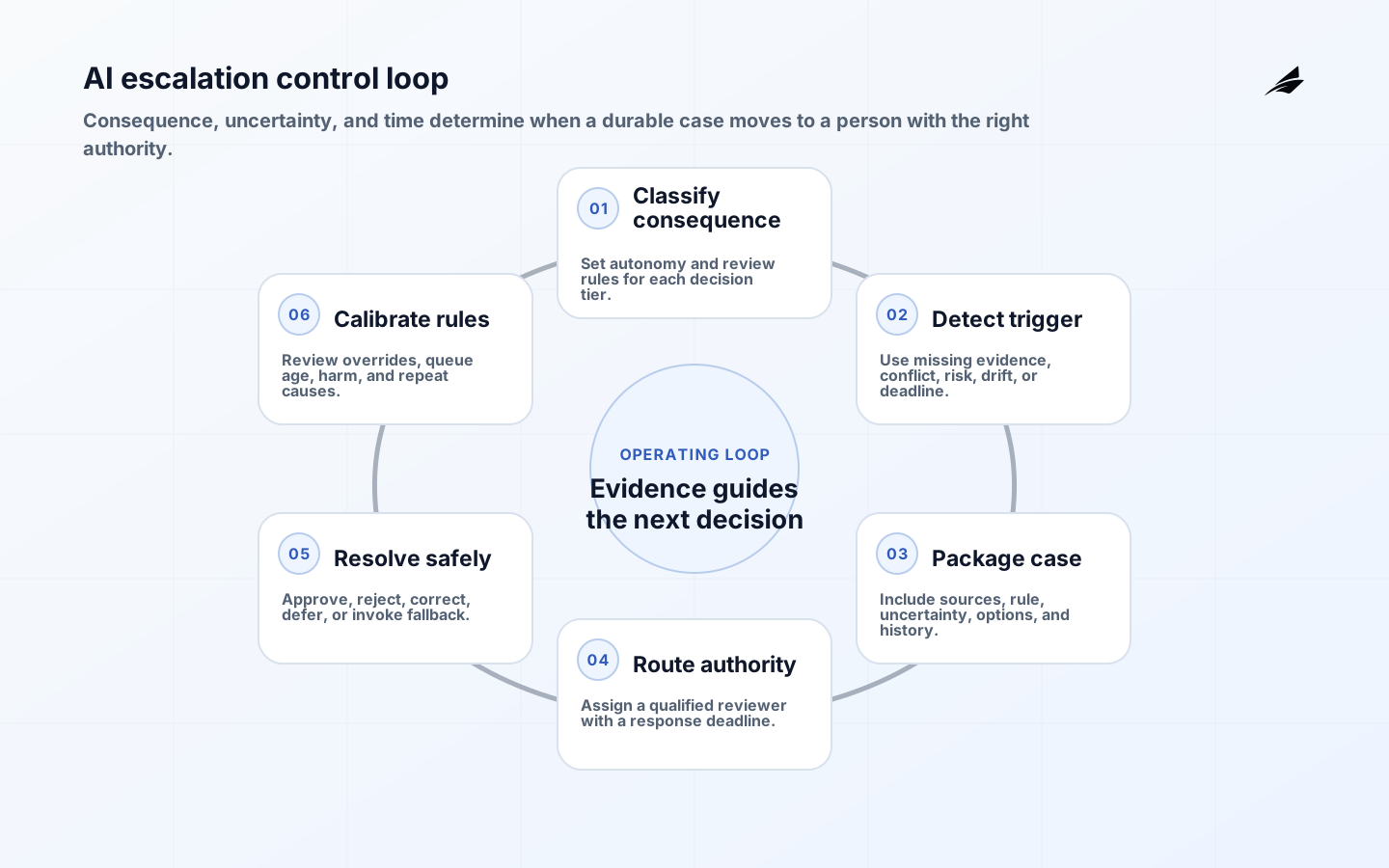
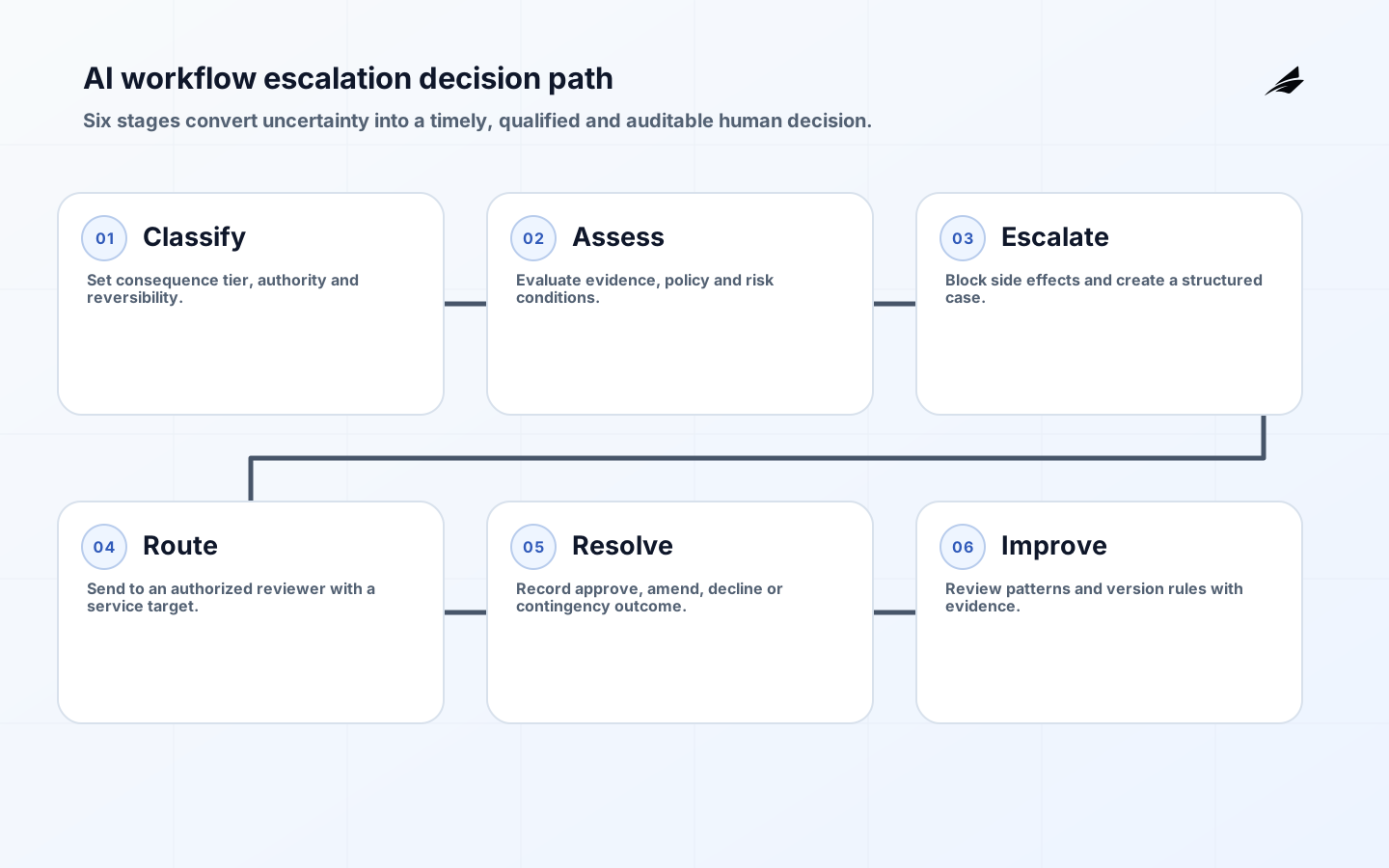
AI workflow escalation rules are the mechanism that turns an uncertain recommendation into an accountable decision. They should not be a vague instruction to involve a human when something looks wrong. For every workflow, define what the system may complete, what it may prepare, what must wait for review and what it must refuse. Escalation can be triggered by confidence, missing evidence, policy conflict, unusual input, a sensitive customer segment, a threshold amount, tool failure or a request for an action outside the model’s authority. The rule must route work to a qualified person with enough context and a service expectation. Without that design, automation often moves risk into an opaque queue where it waits longer and becomes harder to correct.
Classify decisions and consequences
Begin by mapping each decision point in the process. State the customer or business effect, reversibility, evidence required, permitted automation level, accountable role and maximum time without review. A generated summary may be advisory and easy to correct. A change to a customer record, a financial commitment or a safety-related recommendation may require stricter validation and approval. Do not use a model confidence score as the only classifier. It reflects a model’s internal estimate, not the consequence of being wrong. Combine it with deterministic conditions such as identity verification, source quality, policy category, value threshold and whether the system can validate the final state after an action.

| Decision tier | Automation boundary | Escalation condition |
|---|---|---|
| Advisory | Generate and label as draft | Conflicting or absent source |
| Low-impact action | Prepare reversible change | Policy mismatch or low evidence |
| Material action | Recommend only | Qualified approval required |
| High-risk action | Do not automate execution | Route to named authority |
| Emergency | Contain and preserve state | Safety, security or legal trigger |
Design the escalation package
A reviewer needs a concise case, not a transcript dump. Package the request, relevant source references, proposed outcome, policy result, reason for escalation, model and workflow version, prior attempts, affected deadline and allowed choices. Show uncertainty plainly. Give the reviewer options that match their authority: approve, amend, decline, request evidence, reassign or invoke a contingency route. Capture the decision and rationale as structured data so the system can resume safely and the team can later evaluate recurring patterns. Protect sensitive case material with the same access controls that apply to the underlying record. An escalation that exposes more information than the routine path is a design failure.
Queue design determines whether escalation actually reduces harm. Use priority based on customer impact and deadline, not solely arrival order. Set a service target, substitute coverage and a breach path for each tier. Avoid a single catch-all queue where specialists must rediscover the context. When no qualified reviewer is available, the workflow should move to a documented safe state: hold the action, notify the requester, preserve the draft or revert to the established manual process. Test the behavior at peak demand and during a downstream outage. A system that escalates perfectly but creates a stranded backlog has not met its operational obligation.
| Queue problem | Early signal | Control |
|---|---|---|
| Unqualified routing | High reassignment rate | Role and topic routing rules |
| Review delay | Age beyond service target | Delegation and breach notification |
| Missing context | Repeated evidence requests | Structured escalation package |
| Unsafe auto-resume | Action after unresolved conflict | Explicit final-state validation |
| Feedback loop failure | Same issue repeats | Categorize decisions and review themes |
Calibrate rules with evidence
Build a test set of routine, ambiguous, policy-sensitive and adversarial cases. Run the workflow through its proposed rules and inspect both unnecessary escalations and missed escalations. The cost of these errors differs by tier: a harmless extra review may be acceptable for a high-impact decision, while a delayed low-risk reply may harm service quality. Use reviewer outcomes to understand where rules are unclear, but do not automatically train the system on every override; an override can reflect an individual mistake or a temporary exception. Review changes with the policy owner and domain experts. Version thresholds and decision rules, document why they changed and re-run the cases that originally motivated the rule.
- Define authority from consequence and reversibility, not model confidence alone.
- Send reviewers source evidence, reason code and permitted actions.
- Set queue service targets, substitutes and safe behavior when breached.
- Test missed escalation and excessive escalation across realistic cases.
- Version rules and retain the decision rationale for later review.
Connect escalation to incident response
Some escalations are individual cases; others indicate a system incident. Define aggregate triggers, such as a sharp increase in manual corrections, a surge in refused requests, a common tool error or evidence of hostile input. The incident path should distinguish containment from diagnosis. An operator may first disable a tool or force review while engineering determines whether the cause is a model change, data problem, policy update or attack. Preserve affected identifiers and versions, but avoid collecting unnecessary customer content. After containment, reconcile incomplete actions and communicate through the service’s established process. This design prevents the team from treating a widespread safety issue as a collection of isolated reviewer tasks.
Operate a rule review cycle
Review escalation performance weekly for active workflows and after any material change. Inspect volume by reason, queue age, reassignment, reviewer agreement, override themes, customer outcome and policy exceptions. Ask whether a pattern needs better automation, a narrower scope, clearer policy or more reviewer capacity. The correct response is not always to lower a threshold. Sometimes the workflow is attempting a decision that should stay human-led. Periodically run a tabletop exercise for an unavailable reviewer pool, a compromised input source and a tool action that did not reach the expected state. Record owners, decisions and follow-up dates so the escalation layer itself remains an operable service.
Set escalation service levels and delegated authority
An escalation rule is incomplete without a deadline and a decision right. Define how long a case may wait, who can accept, reject, request more evidence, or override, and what happens when that person is unavailable. Use consequence rather than model confidence alone: a low-value draft may proceed with later sampling, while a high-impact account change may require explicit approval even when the model appears certain. The NIST AI RMF Core calls for documented human oversight, and NIST’s risk escalation definition emphasizes transfer to a higher level of authority. Both ideas require an actual operating path, not a generic “human in the loop” label.
Measure queue age by consequence tier, percentage of cases returned for missing evidence, override reasons, repeat escalation causes, and decisions made after the deadline. Review a sample with policy owners so rules evolve from observed work rather than intuition. Edilec’s business approval agent guide explains bounded authority; the human review design guide covers usable review gates; and the LLM evaluation framework shows how to turn recurring exceptions into test cases.
Key takeaways
- Set automation boundaries by consequence, evidence and reversibility.
- Make every escalation a structured, permissioned decision package.
- Design queues with service targets and documented safe states.
- Evaluate rules for both missed and unnecessary escalations.
- Promote repeated patterns into incident handling when the system is implicated.
- Review and version thresholds as part of normal operations.
Frequently asked questions
What confidence threshold should trigger review?
There is no universal threshold. Calibrate it against representative cases, the harm of an incorrect automatic action and the capacity of qualified reviewers. A small uncertainty may justify review for a material decision, while a lower threshold can be acceptable for a reversible draft.
What happens when a reviewer is unavailable?
Define it before launch. The workflow should reassign to an authorized substitute, use an approved manual process or hold safely with clear requester communication. It should never silently proceed because a service target was missed.
Design for the requester
Escalation also affects the person waiting for a decision. Tell the requester when the case has entered review, what information is still needed, the expected next update and which safe alternatives are available. Avoid exposing internal confidence scores or reviewer notes that could confuse or disclose sensitive reasoning. If the workflow requests clarification, make the question specific and preserve earlier context so the person does not repeat work. For time-sensitive requests, provide a documented route to a higher authority rather than inviting users to bypass the system through informal messages. Measuring requester follow-up, abandonment and repeated submission can reveal an escalation process that is technically controlled but operationally frustrating.
Audit the authority path
Periodically sample resolved cases to confirm that the person who decided had the required role, the evidence shown was current, the recorded rationale matched the final action and any time-bound delegation had expired correctly. Compare these samples with workflow permissions and policy changes. This audit is not a search for reviewer mistakes; it is a way to find paths where the system makes the wrong choice easy. If reviewers repeatedly need an undocumented workaround, either formalize an approved route or narrow the workflow until authority and evidence can be made clear. Include cases that were re-routed, timed out or later reversed, because they reveal authority failures that routine approvals can hide. Good escalation design remains auditable when volume, staffing and policy change.
Conclusion
Strong escalation rules make uncertainty visible and workable. They give automation a safe stopping point, give people the evidence and authority to decide, and give operators a way to detect when isolated cases have become a service problem.