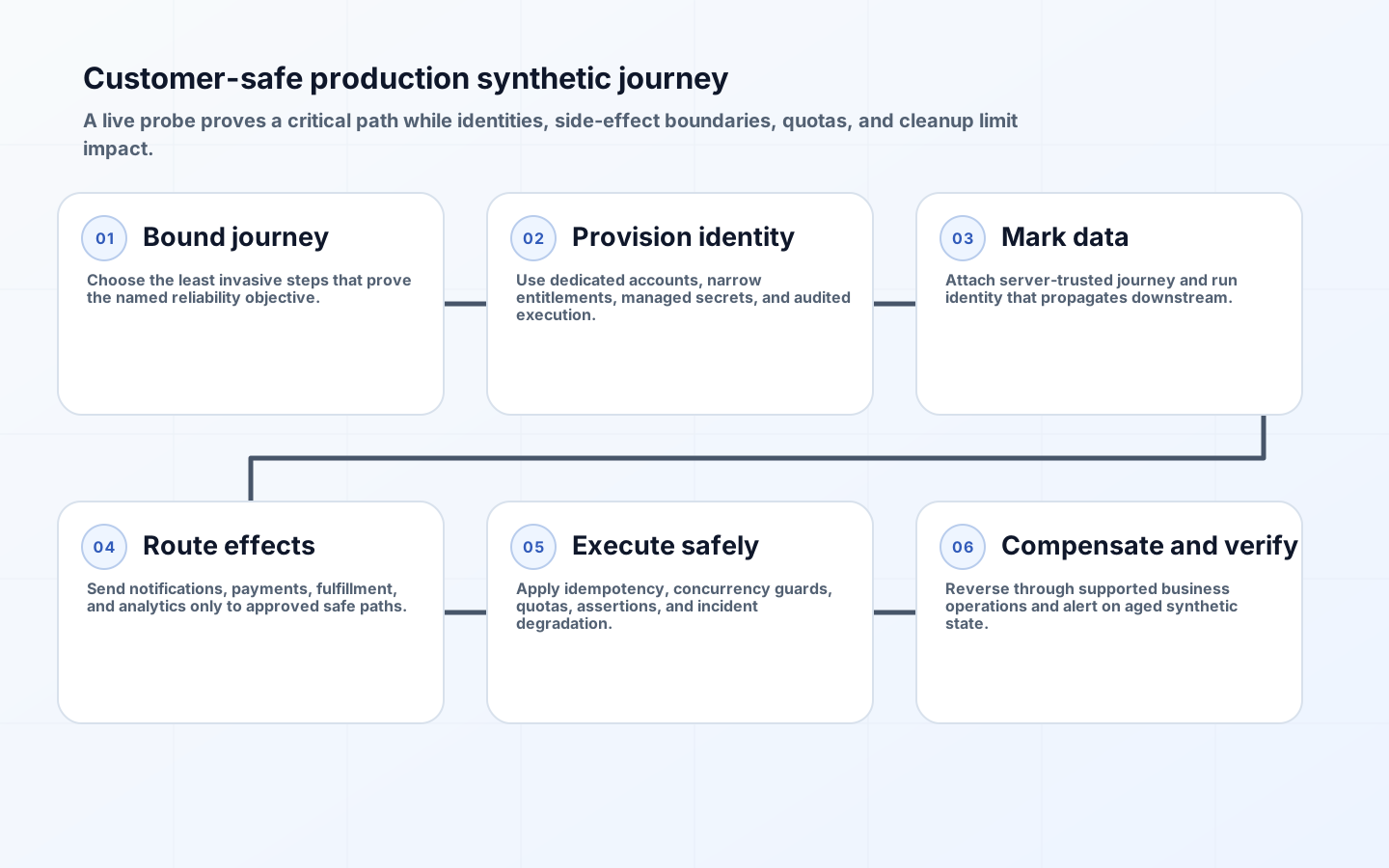
Production synthetic testing runs controlled requests through the live path on a schedule. Unlike a shallow health endpoint, a synthetic journey can prove that identity, routing, application logic, databases, queues, and a customer-facing response still work together. That reach is valuable precisely because it is risky: a careless probe can place an order, send a message, consume inventory, trigger fraud controls, pollute analytics, or expose credentials in monitoring artifacts.
Customer-safe design begins by treating each probe as a production actor with a restricted business contract. It receives dedicated identities, marked data, bounded rates, suppressed external effects, reversible state changes, and tested cleanup. Monitoring code is production code. It needs review, deployment controls, secrets management, telemetry, rollback, and incident behavior rather than an administrator pasting a browser script into a console.
Choose the smallest journey that proves the objective
State the reliability question first. An anonymous read may prove edge routing and rendering. An authenticated read adds identity and authorization. A cart calculation can verify pricing without committing an order. A reversible booking may be justified when the commit path is the only way to prove the service objective. Every added step increases coverage, execution time, failure ambiguity, credentials, and side effects. Stop when the journey proves the user outcome that drives an operational decision.

Separate probes by purpose instead of building one enormous golden path. Run a frequent, low-impact read journey for rapid detection and a less frequent transactional journey for the write path. Give each step a stable name and assertion. CloudWatch canaries and other services publish per-run and sometimes per-step telemetry; use that granularity so a failed payment-token request is not reported only as generic checkout downtime.
| Journey level | Evidence gained | Primary risk | Recommended frequency |
|---|---|---|---|
| Endpoint read | DNS, TLS, routing, response contract | Traffic and false confidence | Frequent within service limits |
| Browser read | Page load, scripts, identity redirect, key UI assertion | Artifact exposure and rendering variance | Frequent but region-bounded |
| Authenticated workflow | Session, authorization, dependent services | Credential misuse and account policy effects | Moderate |
| Reversible write | Commit, persistence, read-after-write, cancellation | Business side effects and orphan data | Lower frequency |
| External settlement | Third-party production path | Real charge, notification, compliance, partner limits | Avoid unless an approved non-value mechanism exists |
Create dedicated identities and entitlements
Never borrow an employee or customer account. Provision a synthetic tenant and users through the normal identity lifecycle, clearly labeled in administrative views. Grant only the actions required by the journey. Exclude privileged support, bulk export, account recovery, and destructive administration. If multi-factor authentication is part of the path, use an approved workload-compatible mechanism rather than disabling MFA broadly or storing a person's factor seed.
Store credentials in a managed secret service and inject them at runtime. Rotate them, audit reads, and alert on use outside the expected runner, regions, schedule, and network path. Avoid placing tokens, passwords, personal data, or session-bearing URLs in screenshots, HAR files, traces, or error messages. AWS documents that canaries can retain screenshots and reports as artifacts; artifact buckets and keys therefore need least privilege, encryption, retention, and access logging.
Mark synthetic data at creation
Attach an immutable marker such as actor type, journey ID, and run ID at the trusted server boundary. Do not rely only on a visible name like Test User because customers can choose similar text and clients can omit it. Propagate the marker to orders, messages, analytics events, logs, and downstream integration envelopes. The marker supports filtering and cleanup, but it must not bypass authorization, validation, or core application logic that the journey intends to test.
Keep synthetic records realistic without using real personal information. Use reserved domains, non-routable phone values where valid, and addresses approved for the relevant tax or fulfillment sandbox behavior. Maintain a registry of allowed data patterns. Analytics pipelines should either exclude marked activity from business metrics or expose it as a separate quality dimension. Silent contamination can make conversion, revenue, failure, and fraud rates less trustworthy.
Suppress irreversible side effects by policy
Inventory every effect after each step: email, SMS, push, webhooks, inventory reservation, warehouse work, tax reporting, payment, loyalty points, support cases, audit alerts, recommendation training, and partner messages. Decide whether each effect is required evidence, can route to a sink, can use a provider test token in production context, or must stop before invocation. Suppression belongs in the receiving boundary and should require a trusted synthetic marker, not a browser-controlled header alone.
Do not create a universal isTest branch that skips all downstream behavior. That proves a special path, not production. Prefer narrow adapters: notifications deliver only to an owned sink, warehouse messages route to a synthetic facility, and payment authorization uses an approved zero-value or test instrument if the provider supports it. Where no safe substitute exists, end the journey before the irreversible call and monitor that dependency separately.
Design writes for idempotency and compensation
Give each run a stable idempotency key. If the runner times out after sending a request, it must query the authoritative state before retrying. A new random key could create a duplicate transaction. Store the run ID with the business record and make creation return the existing result on a repeated request where the API supports idempotency. The probe should assert both the forward outcome and the duplicate-request behavior periodically.
Compensation is a business operation, not database deletion. Cancel an order through the supported state transition, release the reservation, and verify the resulting ledger or status. Some actions are irreversible after a point; model that boundary explicitly. Cleanup needs its own retries, dead-letter path, age alert, and operator runbook. A probe is not complete merely because its availability result was emitted while orphan records remain.
| Control | Run-time behavior | Evidence | Failure response |
|---|---|---|---|
| Idempotency | Reuse run key after unknown outcome | One authoritative transaction per run | Read state, then retry safely |
| Side-effect routing | Send marked actions only to approved sinks | No real recipient or partner delivery | Disable write probe and investigate |
| Rate limit | Cap global, regional, and per-account execution | Known maximum production load | Shed probe traffic before customer traffic |
| Cleanup | Compensate through supported business transitions | No aged synthetic state beyond policy | Queue repair and alert owner |
| Kill switch | Stop schedules and in-flight writes centrally | Exercise record and authorized actors | Invoke during incident or policy breach |
Bound load and protect incident capacity
Calculate maximum requests, writes, and downstream operations per minute across all locations. Provider schedulers can overlap when a run is slow, so use a lease or concurrency guard for stateful journeys. Apply application-recognized quotas to synthetic tenants and a global budget to the runner. The test must never become an unplanned load test. AWS explicitly warns that canary frequency increases endpoint traffic; ownership or permission to monitor an endpoint is also required.
During an incident, read-only probes may provide essential evidence while write probes amplify pressure. Define automatic degradation based on error rate, queue depth, or an incident flag: reduce regions, lower frequency, stop writes, and preserve one diagnostic path. A manual kill switch must not depend solely on the failing application. Rehearse it, record who can activate it, and ensure disabling a probe does not automatically close an active availability incident.
Assert business state, not just HTTP success
A 200 response can contain an error page, stale data, or an incomplete workflow. Assert a stable user-visible fact and, for a write, read the created state from an authoritative path. Keep assertions resilient to harmless copy changes but specific enough to catch broken outcomes. Collect latency by step and location, then alert on consecutive or multi-location failures according to the service objective rather than on every single network fluctuation.
Correlate the run ID through application traces and logs without storing secrets. Google Cloud synthetic monitors can emit execution history, logs, traces, and latency for outbound requests depending on the template; Azure availability tests expose results and diagnostic details. Whatever the platform, monitoring telemetry must distinguish probe failure, application failure, cleanup failure, and runner infrastructure failure because each routes to a different owner.
Release probes as versioned production code
Keep scripts, policy, infrastructure, alerts, dashboards, and cleanup code in version control. Test the journey against a production-like environment, then perform a controlled production dry run with side effects disabled and artifacts inspected. Pin runtime and dependency versions where the platform allows it. Roll out one location and low frequency before expansion. A monitor change can create false incidents or harmful traffic even when the application did not change.
Review permissions and data retention during every material journey change. Provider-managed runners create supporting functions, roles, logs, and artifact stores; deleting the monitor might not remove every associated resource. Maintain an inventory and lifecycle owner. Verify firewall authentication: Microsoft warns that shared availability-test IP addresses should not be the only origin control, so use a secret custom header or stronger application-level validation as appropriate.
Example: a safe reservation journey
A travel service needs to know whether customers can search, authenticate, reserve, and cancel. The probe uses a dedicated tenant, a reserved synthetic property, and inventory held outside customer allocation. Creation carries a server-validated run ID and idempotency key. Confirmation email routes to an owned sink, loyalty accrual is disabled only for the marked tenant at that adapter, and analytics retain a synthetic dimension excluded from commercial reporting.
The journey verifies the reservation through a read API, cancels it through the normal state transition, and confirms inventory release. A cleanup worker finds any run older than the journey deadline and repeats compensation safely. During major booking incidents, automation stops reservation writes but leaves search and authentication probes active. This design tests meaningful production state while bounding the ways the monitor can touch customers.
Key takeaways
- Use the least invasive journey that proves a named reliability objective.
- Provision dedicated synthetic identities with narrow entitlements and managed secrets.
- Mark data at a trusted boundary and propagate the marker through downstream systems.
- Prevent irreversible side effects instead of assuming deletion will undo them.
- Make writes idempotent and cleanup compensating, observable, and retry-safe.
- Throttle probes and degrade write journeys before they compete with customers during incidents.
Frequently asked questions
Why not run the same journey only in staging?
Staging proves the release in a controlled approximation. It cannot prove production DNS, identity policy, live configuration, data stores, network routes, quotas, or regional dependencies. Use both, with production scope constrained by customer-safety controls.
Should a synthetic test make a real payment?
Usually no. Prefer an approved provider mechanism that exercises the integration without moving value, or stop before settlement. Real charges create refunds, fees, fraud signals, accounting entries, and compliance obligations that cleanup may not reverse.
Can synthetic records contain realistic personal data?
Use structurally valid but clearly artificial values from an approved registry. Do not copy customer data. Protect artifacts because even synthetic credentials, session tokens, internal URLs, and application responses can be sensitive.
Conclusion
Production synthetic testing is safe when the probe has a designed business identity and a bounded effect budget. Dedicated accounts, trusted markers, narrow side-effect routing, idempotent writes, compensating cleanup, quotas, secure artifacts, and incident-aware shutdown turn live journeys into reliable evidence. Without those controls, monitoring can become another source of customer impact instead of an early warning.