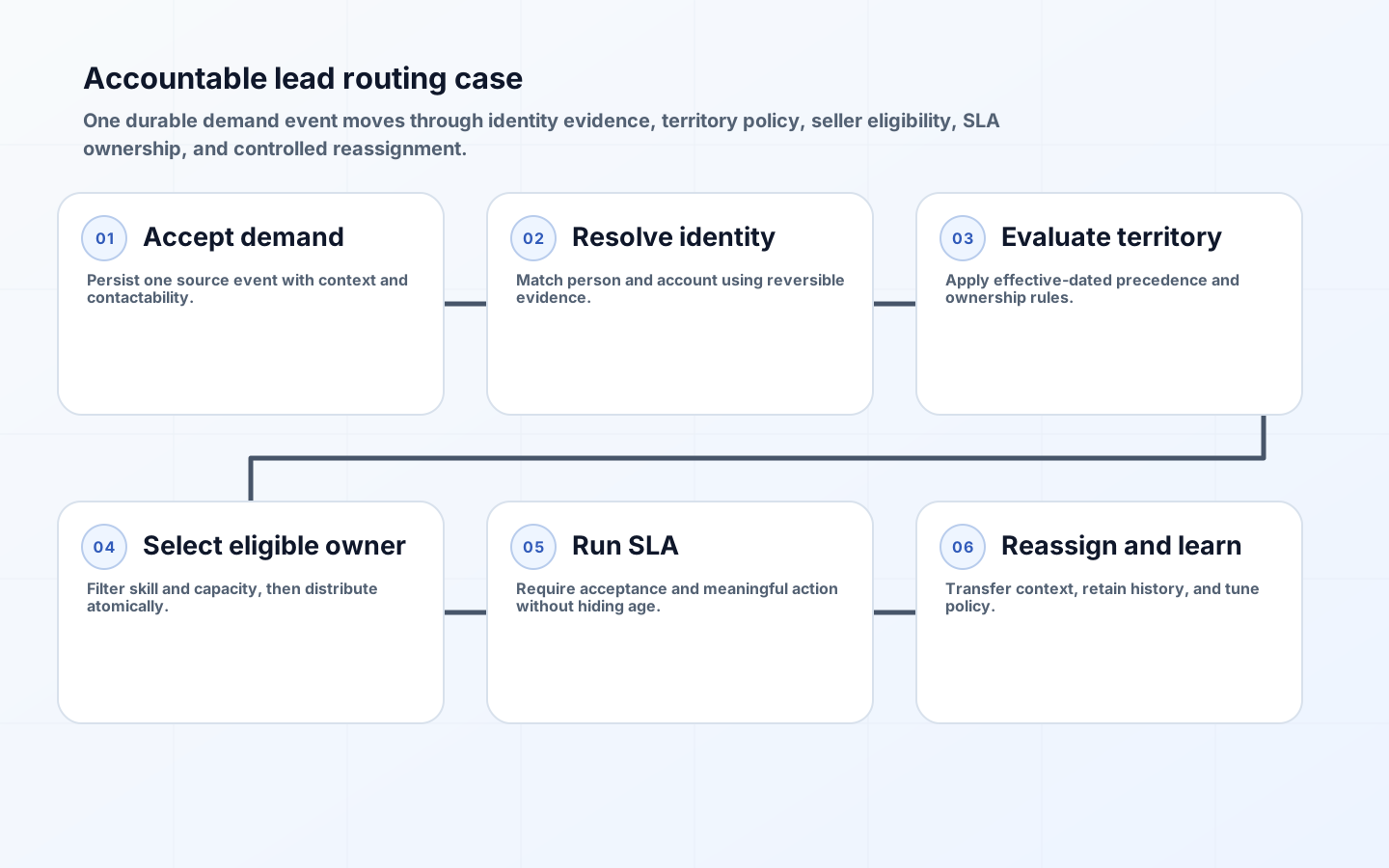
RevOps lead assignment architecture must turn a noisy inbound signal into accountable work without creating duplicate ownership or hiding delay. Leads arrive from forms, product events, partners, lists, chat, and existing accounts. They may represent a new person, a known buying committee, a customer expansion, a duplicate, or an ineligible request. A round-robin rule applied immediately cannot resolve those distinctions.
Design routing as a stateful decision process: accept and deduplicate intake, resolve identity and account, classify demand, evaluate territory and ownership, choose an eligible seller or queue, start an SLA, and reassign through explicit events. Preserve the inputs, rule version, candidates, decision, and later outcome. That evidence lets revenue operations improve policy without arguing from anecdotes or rewriting historical assignments.
Create a durable intake contract
Give every submission a source event ID, received time, source, campaign or partner context, consent and contactability fields, raw identity references, product interest, geography evidence, and payload version. Acknowledge the source only after durable acceptance. Use idempotency so browser retries or webhook redelivery do not create new leads. Keep the original event even when it maps to an existing CRM record, because source and timing matter for attribution and SLA.
Validate required fields, normalize phones and domains without discarding originals, and quarantine malformed or suspicious submissions. Separate machine spam, test traffic, employee activity, support requests, and job seekers before sales assignment. Define what happens when consent or required contact permission is missing. The route may be no-contact research, a service queue, or rejection; it should not silently default to a seller.
Resolve person and account with reversible evidence
Match deterministic identifiers such as authenticated account, verified email, CRM contact ID, or partner-provided account reference first. Corporate email domain can be evidence, but subsidiaries, agencies, shared domains, consultants, and personal addresses create ambiguity. Keep match candidates, rule, confidence, and source. Do not merge contacts solely to simplify routing. False merges expose activity to the wrong owner and distort account engagement.
| Evidence | Typical strength | Routing use | Failure case |
|---|---|---|---|
| Authenticated customer account | High | Route to account or expansion owner | User belongs to multiple organizations |
| Verified business email | High for person | Find existing contact | Role address or recycled mailbox |
| Company domain | Medium | Generate account candidates | Agency, subsidiary, or shared provider |
| Name and company text | Low to medium | Manual review or enrichment | Common names and spelling variation |
| IP-derived location | Low | Fallback region hint only | VPN, mobile carrier, or corporate gateway |
Account match should consider legal hierarchy, selling relationship, parent-child policy, open opportunities, customer status, and named-account ownership. Preserve unresolved candidates instead of forcing a match. Define a manual resolution queue with a deadline and restricted fields. When a match is corrected, emit unlink and relink events, then evaluate whether ownership and SLA must change. Historical reporting should retain the original decision and the authorized correction.
Version territory and ownership policy
Territory is an effective-dated decision table over attributes such as geography, segment, product, industry, account tier, partner, language, and named-account exception. Represent precedence explicitly. A named global account may outrank postal territory; an existing opportunity owner may outrank general round robin; a product specialist may collaborate without becoming primary owner. Decision Model and Notation provides a standard way to express decision requirements and tables, though implementation can use any testable rules engine.
Freeze the resolved rule version for each assignment. Future territory changes should not rewrite history or automatically move every open lead. Define transition policy: grandfather existing work, re-evaluate untouched records, or run a reviewed migration. Test boundary postal codes, missing country, parent-child conflicts, account ownership gaps, and daylight-saving dates. Revenue operations owns policy semantics; CRM engineering owns deterministic execution and audit.
Filter eligibility before distribution
Build the candidate set from role, territory, skills, language, product certification, employment status, schedule, leave, capacity, conflict rules, and account restrictions. Only then choose a distribution method. Microsoft Dynamics 365 documents round robin based on last assignment and load balancing based on active capacity, with seller schedules and workload affecting assignment. The important pattern is separating eligibility from fairness.
| Distribution method | Good fit | Required state | Tradeoff |
|---|---|---|---|
| Account owner | Existing account or opportunity | Current accepted ownership | Can overload strategic owners |
| Round robin | Comparable sellers and work | Atomic last-assigned order | Ignores case complexity |
| Load balancing | Variable active workload | Reliable capacity and closure state | Can reward slow updates |
| Weighted allocation | Ramp, specialization, or quotas | Versioned weights | Harder to explain |
| Skill priority | Technical or language-specific demand | Verified skill inventory | Small pools create delay |
| Manual queue | Ambiguous or consequential cases | Owner and SLA | Adds handling time |
Commit assignment atomically with capacity and fairness state so concurrent leads do not select the same apparent slot. Use a stable assignment ID and make retries return the same outcome. If no seller is eligible, route to an owned exception queue and record failed predicates. Never leave an unassigned CRM record without an alert and aging clock. Platform examples from Dynamics include explicit views and management for unassigned records; every implementation needs an equivalent control.
Model SLA as a state machine
Define starts, business calendars, pauses, milestones, and terminal outcomes. Intake-to-assignment, assignment-to-acceptance, and acceptance-to-first-qualified-action are different clocks. An automated email should not necessarily count as meaningful response. Store due times when the policy is resolved, not by repeatedly recalculating from today's configuration. Account for seller timezone and holidays while keeping a single audit timestamp basis.
Use states such as received, resolving, queued, assigned, accepted, working, converted, disqualified, returned, and closed. Every transition has actor, reason, effective time, and rule. Alert before breach and escalate to a team or manager able to act. Pauses require reasons such as awaiting customer or compliance review and should not hide age. Report both wall-clock customer wait and policy-adjusted SLA.
Make acceptance, rejection, and reassignment explicit
Assignment offers work; acceptance confirms responsibility. Require sellers to accept or begin a qualifying action within a window. Valid rejection reasons might include wrong territory, duplicate, conflict, bad data, or unavailable skill. Some reasons trigger re-resolution, others close or send to review. Limit repeated rejection and prevent sellers from gaming fairness by returning difficult leads without evidence.
Reassignment may follow nonacceptance, SLA risk, schedule change, capacity, territory correction, seller departure, or manager decision. Preserve the same lead and assignment history instead of creating a new record. Transfer context, activities, due time, and customer communications. Decide whether the SLA continues or a distinct handoff clock begins; resetting age on every transfer conceals customer delay. Notify old and new owners and prevent concurrent outreach during uncertain handoff.
Store a decision receipt
For each route, store normalized inputs, identity and account match evidence, territory rule version, eligible candidates and exclusions, distribution state, selected owner, capacity snapshot, SLA policy, and reason codes. Protect sensitive enrichment and avoid exposing unnecessary personal data. A seller-facing explanation can be concise: matched to Account A, enterprise India territory, product skill X, selected by least active capacity.
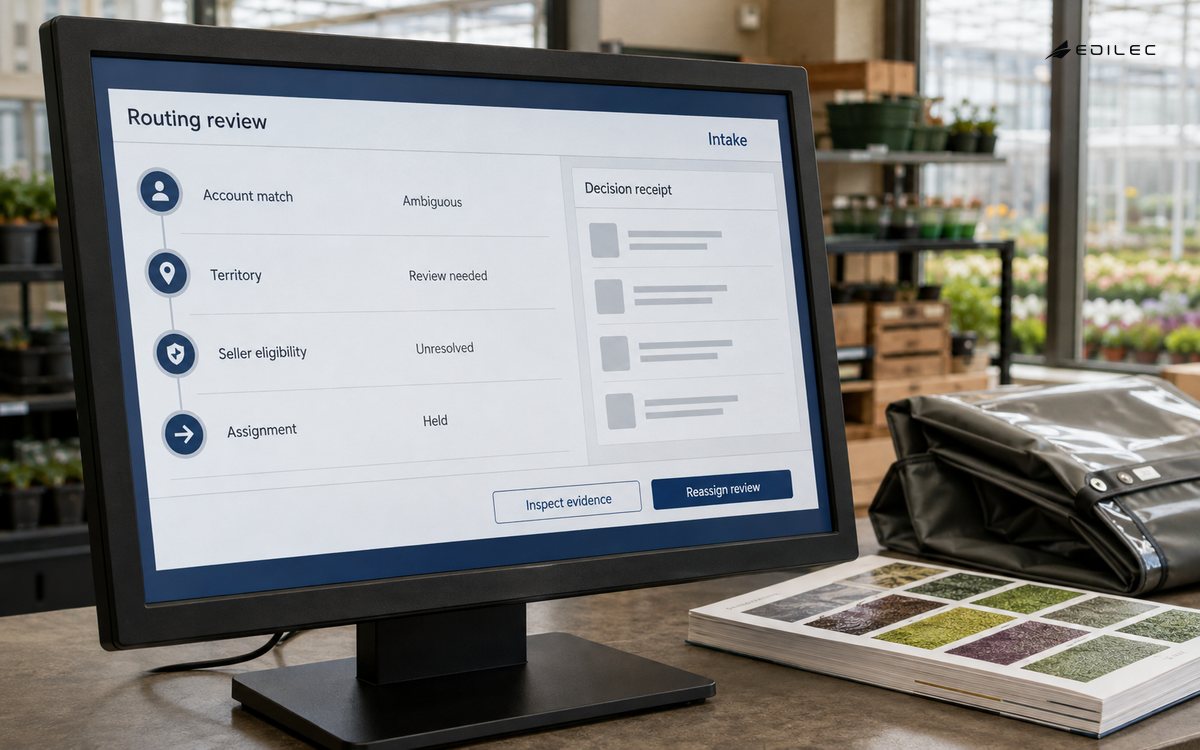
Decision receipts support dispute resolution, fairness review, replay, and safe policy change. Replay a historical sample against proposed rules without changing ownership, then compare reassignment volume, segment coverage, and SLA impact. Keep shadow results separate from production decisions. Manual overrides require actor, reason, effective period, and whether the exception changes account ownership or only this lead.
Operate routing with business and technical controls
Monitor intake lag, duplicate rate, unresolved identity age, match confidence, no-eligible-seller rate, assignment latency, acceptance, first meaningful action, SLA risk, rejections, reassignments, and customer outcomes by source and segment. Compare workload and outcomes carefully; conversion is affected by lead quality and market, not only seller. Audit for protected or proxy attributes and evaluate whether rules create inappropriate disadvantage with legal and HR guidance.
Provide operator controls to retry a failed event idempotently, correct a match, re-evaluate under an authorized rule, assign an exception, pause a source, and reconcile CRM ownership. Exercise webhook duplication, CRM outage, stale seller availability, concurrent assignment, territory rollout, manager override, and mass seller departure. Keep a kill switch that sends new demand to an accountable queue rather than dropping or applying known-bad policy.
Key takeaways
- Persist every intake event idempotently before person, account, or ownership decisions.
- Use reversible identity and account evidence and preserve unresolved candidates for review.
- Version territory decision tables and separate seller eligibility from round-robin, capacity, or weighted distribution.
- Keep SLA age through acceptance and reassignment instead of resetting customer wait.
- Store decision receipts and run proposed policy in shadow before changing production ownership.
Frequently asked questions
Should existing account ownership always win? Usually it is strong routing evidence, but stale owners, global-account rules, open opportunities, product specialization, and conflicts may require explicit precedence or review.
Is round robin fair? It distributes count fairly only among the eligible set and according to its maintained order. It does not account for complexity, capacity, lead quality, or outcomes unless those are designed separately.
When should a lead be reassigned automatically? Use objective events such as nonacceptance, expired availability, or a corrected territory with a tested policy. Ambiguous disputes and active customer conversations usually need reviewed handoff.
Conclusion
Lead routing is an accountable workflow, not a formula in one CRM field. Durable intake, explainable matching, effective-dated territory, verified eligibility, atomic distribution, honest SLA clocks, and controlled reassignment make ownership reliable. The result is faster response with fewer duplicate touches and enough evidence to improve the revenue system as teams, markets, and products change.