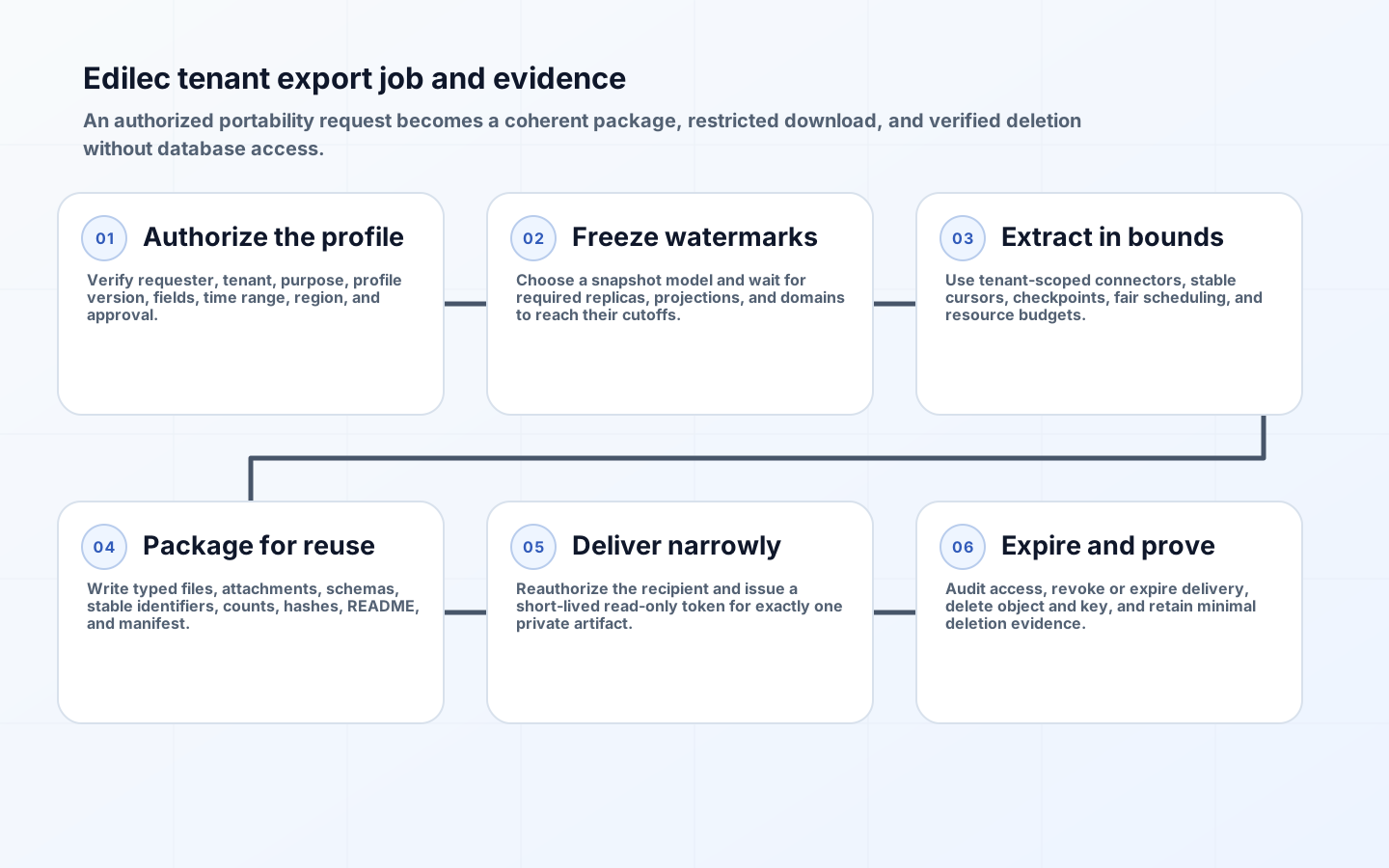
SaaS data export architecture should provide customer portability without granting production database access or turning every request into a support project. A productized export must authorize scope, capture a coherent view, traverse every tenant-owned store, produce a documented format, deliver it securely, and remove the artifact on time. It must also protect other tenants and the production workload while a large account is being extracted.
Portability is broader than a database dump. Customers need records they can understand and reuse, with stable identifiers, relationships, timestamps, attachments, and a manifest. The provider needs to distinguish customer-provided data, system-generated business records, configuration, audit evidence, secrets, licensed content, internal security signals, and data held under retention obligations. Product, privacy, security, and legal owners should approve the export contract.
Define the export scope and format contract
Create named export profiles such as workspace portability, user data request, administrator audit package, or account offboarding. Each profile defines authorized requester roles, included entities and fields, excluded classes, attachment handling, relationship rules, time range, format version, expected freshness, retention, and delivery policy. Version the profile so a completed package remains interpretable after the product schema evolves.
| Data class | Default treatment | Reason | Possible exception |
|---|---|---|---|
| Customer content and configuration | Include in tenant export | Core portability value | Exclude deleted items beyond policy |
| System-generated business records | Include with documented semantics | Needed to reconstruct activity | Aggregate where individual details are restricted |
| Audit log | Include authorized tenant-visible events | Accountability and investigation | Protect security-sensitive actor details |
| Secrets and credentials | Exclude or replace with metadata | Would create immediate compromise | Never export secret values |
| Internal fraud and abuse signals | Exclude | Could reveal detection controls or third parties | Provide case outcome where required |
| Licensed third-party content | Reference or exclude | Customer may lack redistribution rights | Include customer-owned annotations |
| Backups and deleted data | Exclude from standard package | Not an active application dataset | Handle through separate legal process |
For personal data, Article 20 of the GDPR describes a right to receive certain personal data in a structured, commonly used, machine-readable format and, where technically feasible, transmit it to another controller. That legal right has scope and conditions; it is not identical to an enterprise tenant's contractual export. Build profiles that can support approved legal workflows without claiming every product export satisfies every request automatically.
Authorize the request and freeze its intent
Require a recent strong authentication step for sensitive exports, verify tenant and administrative role, evaluate regional and legal holds, and record purpose. For high-risk or full-account exports, support dual approval or a customer-controlled destination. At creation, freeze requester, tenant, profile version, filters, cutoff strategy, destination policy, encryption choice, and idempotency key. Later permission changes can cancel delivery, but must not silently broaden the package.
Return an opaque job ID, not a storage path. The status endpoint exposes queued, preparing, extracting, packaging, validating, ready, expired, canceled, or failed, with safe progress and errors. An idempotency key prevents duplicate jobs when clients retry. Apply per-tenant and global limits on concurrent jobs, frequency, date span, and estimated bytes. Export is a privileged batch workload, not an unbounded query endpoint.
Capture a consistent snapshot across data stores
| Strategy | Consistency | Production impact | Best fit |
|---|---|---|---|
| Database transaction snapshot | Strong within one database | Long transactions may retain versions and pressure storage | Moderate relational exports |
| Read replica at watermark | Consistent after lag catches up | Replica capacity and lag management | Large read-heavy package |
| Temporal or versioned queries | Entity-level as-of reconstruction | Requires complete history semantics | Systems designed for time travel |
| Event-log replay | Rebuilds state to a sequence watermark | Complex compaction and schema evolution | Event-sourced domains |
| Per-domain watermarks plus manifest | Bounded cross-store consistency | Package is not globally atomic | Distributed SaaS with explicit caveats |
| Maintenance freeze | Simple consistency | Customer write interruption | Rare offboarding with agreed window |
Choose and disclose the model. In a distributed system, a globally atomic snapshot may be impractical. Capture per-domain watermarks, wait for projections through those watermarks, and include them in the manifest. Define how records created, updated, or deleted during the job appear. Never mix arbitrary query times while presenting the package as an exact point-in-time export.
Orchestrate bounded, tenant-safe extraction
- Resolve the immutable export profile and verify approval immediately before execution.
- Acquire source watermarks and wait for required replicas or projections to catch up.
- Enumerate tenant-scoped partitions using stable cursors and server-side authorization.
- Write chunks to a private job prefix while computing counts and cryptographic checksums.
- Package data, attachments, schemas, README, manifest, and error or omission report.
- Validate totals and scope, then mark the artifact ready and notify the authorized requester.

Each connector accepts tenant context from the trusted job, applies row-level scope again, and emits canonical records. Avoid raw ad hoc SQL assembled from profile strings. Use keyset pagination, bounded pages, timeouts, and checkpointed chunks. Separate high-volume tenants into fair scheduling lanes and adapt concurrency to replica lag, database latency, object-store errors, and shared queue depth. A single export must not become a noisy neighbor. Set byte, row, duration, and retry budgets per connector; when one source exceeds them, pause the job with a specific resumable failure rather than emitting an apparently complete partial package.
Design formats for reuse and long-term interpretation
CSV is accessible for flat tables but cannot naturally express nested structures or all data types. RFC 4180 documents a common CSV format and MIME type, including quoting and line conventions. Specify UTF-8, headers, null representation, line endings, timestamp format and timezone, decimal precision, Boolean values, formula-injection mitigation, and escaping. Do not leave spreadsheet applications to guess identifiers or dates.
Use JSON Lines or structured JSON for nested records, and retain binary attachments as separate files with manifest references. Include manifest.json with export ID, tenant ID, profile and schema versions, generated time, source watermarks, file paths, media types, record counts, bytes, hashes, and known omissions. Publish JSON Schema or another precise data dictionary and a changelog. Stable source IDs and relationship keys matter more than matching an internal table layout.
Deliver through a short-lived, scoped download
Store completed artifacts in a private, tenant-separated bucket or container with encryption, retention, malware policy where applicable, and no public listing. The application reauthorizes the user when requesting a download and issues a short-lived read-only URL for exactly one artifact. Microsoft's Valet Key pattern recommends a token limited by resource, operation, and validity to offload transfer without sharing storage credentials.
Signed URLs are bearer credentials. Keep them out of analytics, referrers, support tickets, and ordinary logs; use HTTPS; set a narrow expiry; and support revocation or artifact deletion. Do not email the URL directly when a portal notification can ask the user to authenticate again. For very sensitive packages, encrypt the archive to a customer public key or deliver to an approved customer-controlled storage destination with auditable identity.
Validate, audit, expire, and delete
Before readiness, compare exported counts with source queries at each watermark, verify every file hash, scan for cross-tenant IDs, confirm prohibited fields are absent, and sample relationships. Run seeded tenant-isolation tests in every connector. Preserve a validation report with the job but avoid placing sensitive record values in central logs. Failed packages remain inaccessible and are deleted on a short failure-retention schedule.
Audit request, approval, execution identity, profile, watermarks, artifact hash, readiness, download-token issuance, storage access, expiration, cancellation, and deletion. Notify administrators about full exports and unusual volume. A lifecycle worker deletes the object and encryption key at expiry, marks the job terminal, and verifies deletion. Retain minimal audit metadata under policy, not the export itself. Test cleanup after worker failure and storage lifecycle misconfiguration.
Key takeaways
- Define named, versioned export profiles instead of exposing database structure.
- Freeze authorized scope and snapshot strategy when the job is created.
- Extract asynchronously with tenant-scoped connectors, stable cursors, checkpoints, and fairness controls.
- Publish reusable formats with schemas, stable IDs, watermarks, counts, hashes, and omissions.
- Reauthorize at download and issue a short-lived read-only token for one private artifact.
- Prove isolation and completeness, then expire and delete the package automatically.
SaaS data export FAQ
Why not let customers query a read replica?
A replica still exposes internal schema, can create costly queries, complicates row-level isolation, and provides no stable portability contract. A controlled export can enforce purpose, bound load, version formats, include multiple stores, and produce evidence. A dedicated analytics API may complement it for recurring access.
Should an export be one file?
Usually one archive containing multiple typed files is better. It supports streaming, independent validation, attachments, and future entity additions. Keep a manifest and data dictionary at the root so recipients can automate ingestion without guessing relationships.
Should deleted records be included?
Only when the profile and policy require tombstones or retained history. Standard portability often covers active data and authorized audit records, not recoverable backup remnants. State the cutoff and deletion semantics. Legal or regulatory requests may follow a separately reviewed workflow.
Conclusion
Customer portability is strongest when it is a repeatable product workflow rather than privileged database work. Explicit profiles, coherent watermarks, bounded tenant-safe jobs, durable format contracts, restricted delivery, and verified cleanup create exports that customers can use and operators can defend.