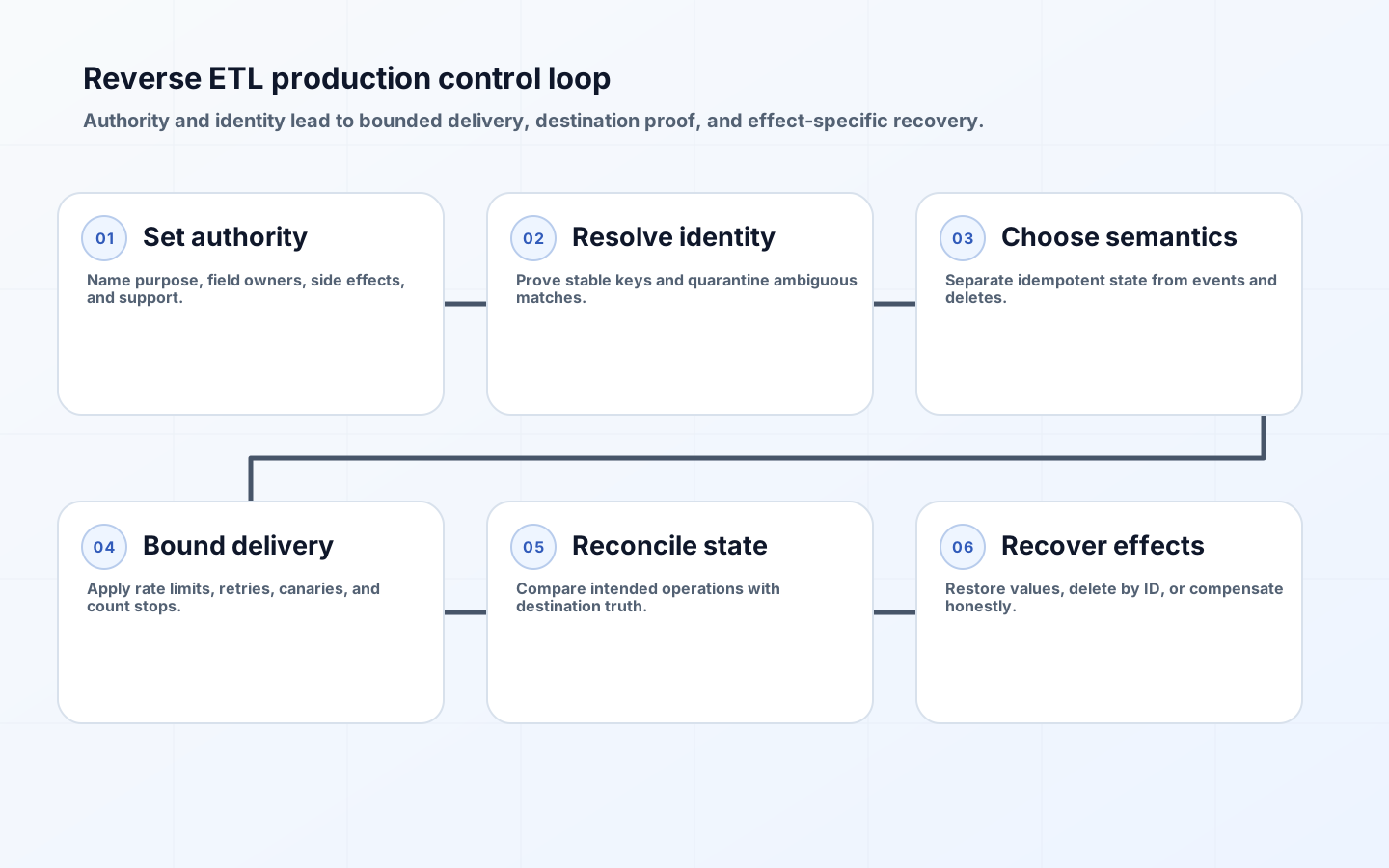
Reverse ETL moves modeled warehouse data into operational systems such as a CRM, marketing platform, support tool, or product database. The technical action looks like a sync, but the business effect can be a changed account tier, a suppressed campaign, a reassigned lead, or a customer-visible entitlement. Reverse ETL best practices therefore begin with production ownership and authority, not connector setup. A pipeline that delivers every row on time can still be wrong if it overwrites a human decision, matches the wrong person, or repeats a non-idempotent action.
A dependable service defines which system is authoritative for each field, how warehouse identities map to destination records, what an added, changed, or removed row means, and who responds when results drift. Hightouch's sync documentation illustrates why these choices matter: update, insert, upsert, and delete behavior produce different destination effects, while a full resync can be safe for an idempotent upsert and dangerous for an event or insert destination. The operating model must make those semantics explicit before a large run is allowed.
Define the activation contract and owner
Write one contract per sync. Name the business purpose, source model, destination object, schedule, freshness expectation, fields, record key, update mode, deletion behavior, volume range, and accountable owner. Also name the destination administrator and business process owner. The data team can own reliable delivery without owning the meaning of a sales status or the consequences of clearing it. An on-call route should distinguish connector failure, source-model defect, identity defect, destination policy rejection, and disputed business meaning.

Authority belongs at field level. A warehouse may be authoritative for a propensity score while the CRM is authoritative for owner, legal consent, and manually entered notes. Mark fields as warehouse-owned, destination-owned, or derived with a conflict policy. Do not rely on schedule order to resolve conflicts. If two systems can write the same field, define precedence, version evidence, and a manual exception path. For consequential fields, require a destination-side audit trail that records the old value, new value, sync run, source row version, and reason.
| Contract decision | Safe default | Risk to resolve | Evidence |
|---|---|---|---|
| Record identity | Stable immutable business key | Email or name can change or collide | Uniqueness test and match-rate sample |
| Update mode | Upsert for state synchronization | Insert can duplicate on replay | Destination idempotency test |
| Removed row | No action until meaning is approved | Absence may not mean deletion | Business deletion decision |
| Field authority | One writer per field | Human edits can be overwritten | Field ownership matrix |
| Run ownership | Named data and process owners | Failures cross team boundaries | Escalation and response target |
Resolve identity before applying mutations
The primary key is a control, not an implementation detail. Build a model with one row per destination record and test it for uniqueness, non-null values, stability, and expected population. Prefer an immutable internal customer or account identifier carried into the destination. If the destination only exposes email, phone, or another mutable identifier, maintain a mapping table from warehouse identity to destination record ID after the first successful match. Quarantine ambiguous matches rather than selecting one arbitrarily.
Test identity using cohorts that reveal edge cases: merged accounts, reused email addresses, shared business contacts, deleted and recreated destination records, regional duplicates, and people with several workspaces. Measure unmatched, multiply matched, and remapped records separately. A high aggregate match rate can hide a small but severe cross-tenant error. Identity changes deserve change control because resetting change tracking after a key change may reinterpret existing rows as additions or removals.
Choose replay-safe write semantics
State synchronization and event delivery require different designs. For state, an idempotent upsert keyed by destination record can converge after retry. For events, messages, and webhook-triggered actions, the same payload may cause a second conversion, notification, or workflow. Include a durable event ID or idempotency key when the destination supports one; otherwise persist a delivery ledger and avoid blind full resyncs. Hightouch documents that full resyncs process current rows as added and are not recommended for insert, event, and webhook use cases because duplicates can result.
Treat removal as its own contract. A row can leave a model because the entity was deleted, became ineligible, moved outside a time window, failed an upstream join, or arrived late. Only the first two may justify clearing or deleting destination state. Model explicit desired state such as eligible=false instead of inferring intent from absence when the consequence matters. Separate reversible field clearing from destructive record deletion, and require approval for broad changes in removal counts.
| Destination effect | Retry property | Rollback option | Recommended safeguard |
|---|---|---|---|
| Upsert profile fields | Usually convergent with stable key | Write prior values or recompute | Before-image ledger for critical fields |
| Insert record | May create duplicates | Delete by recorded destination IDs | Client idempotency key |
| Send event | Side effect may repeat | Often compensating action only | Delivery ledger and dedupe window |
| Delete record | Repeated delete may be harmless but irreversible | Restore from archive if supported | Two-step approval and count limit |
| Clear field | Convergent but loses manual value | Restore captured before-image | Authority check and sampled preview |
Design for rate limits and partial success
Destination APIs impose batch, concurrency, payload, and rate constraints that can vary by endpoint or account. Set a throughput envelope from observed quotas and ordinary business traffic, leaving headroom for interactive users and other integrations. Back off on throttling, cap concurrency, and classify responses into retryable, permanent, authentication, authorization, validation, and conflict failures. A run is not simply successful or failed when 98 percent of rows were accepted; the rejected two percent need durable identity and an owned disposition.
Persist row-level request outcome without leaking unnecessary personal data. Record source key, destination key, operation, attempt, response class, timestamp, run ID, and a redacted diagnostic. Retry transient failures with bounded exponential backoff and jitter. Quarantine permanent validation failures for correction, then replay only corrected rows. Alert on age and business impact, not merely error count: one rejected enterprise entitlement may matter more than thousands of optional profile attributes.
Close the loop with destination reconciliation
Connector success proves that requests were accepted, not that the destination now represents intended state. Reconciliation compares the source population, intended operations, acknowledged writes, and sampled destination state. At minimum, account for source rows, additions, changes, removals, successes, retries, permanent rejects, and no-op records. Check totals by tenant, region, object type, and critical business status so offsetting errors do not cancel out.
Use a read-after-write sample when destination APIs allow it, and run a periodic full comparison for critical fields. Define tolerances that reflect expected destination delay, eventual consistency, and known exclusions. Every difference must land in a state such as expected delay, source defect, identity mismatch, destination edit, rejected write, or unexplained drift. The unexplained category should have an age target and owner. Store reconciliations by run so a later incident can identify the first divergence.
Release changes with a bounded rollback
Test one representative row, then a non-production destination or isolated segment, then a canary cohort with explicit count and tenant limits. Preview the operation diff before enabling writes. A release packet should show model version, mapping changes, key changes, expected adds and removals, side-effect classification, and rollback method. Large deletion or clear-field deltas should stop automatically. Keep schedules disabled until the canary is reconciled.
Rollback means different things by effect. For warehouse-owned fields, redeploying the prior model and resyncing may restore state. For overwritten destination-owned fields, retain before-images. For inserted records, capture destination IDs so they can be removed selectively. For emails, campaigns, or external events, no technical rollback can make the action unseen; use pause, suppression, correction, or another compensating workflow. State those limits before approval rather than discovering them during an incident.
Operate the sync as a supported service
Review freshness, run duration, source volume, destination operations, rejection age, reconciliation drift, rate-limit pressure, and ownership coverage. Set alerts on material deviations from a cohort baseline. Keep credentials least-privileged and rotate them without changing data behavior. Review mapped fields for minimization because activating every available attribute expands privacy exposure and destination complexity. Retire unused syncs rather than leaving dormant credentials and stale change-tracking state.
Run recovery exercises. Simulate an expired credential, destination throttling, a duplicate source key, an accidental model expansion, and a replay after partial success. Confirm that responders can pause writes without deleting evidence, locate rejected rows, compute the intended diff, and choose a safe recovery mode. Hightouch's documented CDC behavior retries failed rows in a later run, but teams still need to verify the behavior and retention of the particular tool, engine, and destination they operate.
Key takeaways
- Assign field-level authority and business ownership before enabling a sync.
- Use stable identity and quarantine ambiguous matches, especially across tenants.
- Distinguish convergent state upserts from non-idempotent events and inserts.
- Reconcile intended state to destination state instead of trusting connector completion.
- Release with count limits, canaries, before-images, and effect-specific rollback.
- Operate rejected rows, credentials, drift, and recovery as production concerns.
Frequently asked questions
Who should own reverse ETL?
Use shared accountability. A data owner is responsible for model and delivery reliability, while the destination process owner approves business meaning, authority, and side effects. The destination administrator owns API access and platform constraints. One named service owner coordinates incidents across those boundaries.
When is a full resync safe?
It is safest when operations are idempotent upserts using a stable destination key and removal behavior is understood. It is unsafe by default for inserts, events, webhooks, and actions that send messages or create workflows. Preview counts and test the exact destination mode first.
Should the warehouse always be authoritative?
No. The warehouse can be authoritative for modeled attributes while the operational system remains authoritative for consent, ownership, notes, or workflow state. Decide authority field by field and prevent two writers from silently fighting.
Conclusion
Reliable warehouse activation is a controlled mutation service. Stable identity, explicit authority, replay-safe semantics, rate-aware delivery, destination reconciliation, and honest rollback boundaries turn reverse ETL from convenient plumbing into an accountable production capability. The strongest implementation is not the one that sends the most rows; it is the one that can explain every consequential change and recover without making the destination less trustworthy.