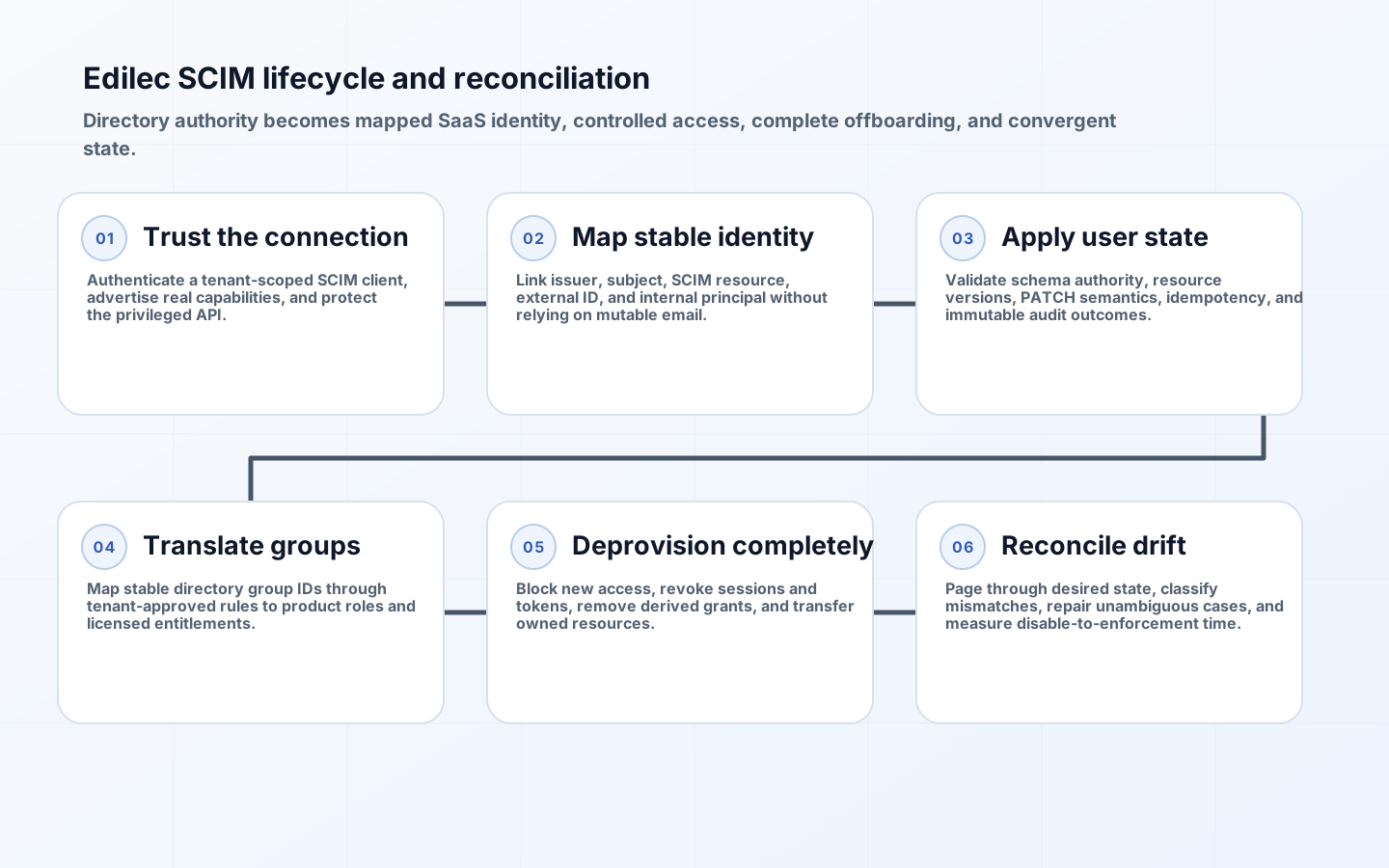
SCIM provisioning for SaaS solves a different problem from enterprise SSO. SAML or OpenID Connect can authenticate a person at login, but neither guarantees that an account was created before first use, renamed when the directory changed, assigned the right groups, suspended promptly, or reconciled after a missed event. Enterprise lifecycle automation needs a provisioning authority and a state model that continues operating when nobody signs in.
Treat the identity provider as an authoritative source for selected workforce attributes, not as the owner of every product decision. The SaaS provider still owns tenant boundaries, product roles, licenses, local service accounts, legal retention, audit records, and break-glass access. A successful design defines which system controls each field and how conflicts, duplicates, partial updates, and deletions are resolved.
Separate authentication from provisioning
| Capability | Typical protocol | Trigger | What it must not imply |
|---|---|---|---|
| Authentication | SAML 2.0 or OpenID Connect | Interactive login | Account is licensed or provisioned correctly |
| Just-in-time creation | Application logic after federation | First successful login | Offboarding occurs without a future login |
| Lifecycle provisioning | SCIM 2.0 | Directory create, update, disable, delete | User can authenticate through the same channel |
| Group synchronization | SCIM Group resources | Membership changes and reconciliation | Directory group names are safe product permissions |
| Session termination | OIDC/SAML logout or vendor event | Logout or security action | Account data and grants are deleted |
| Access review | Governance workflow and reports | Periodic or risk-based review | Protocol state alone proves business appropriateness |
OASIS's SAML 2.0 technical overview describes web SSO and federation exchanges using assertions. OpenID Connect likewise defines an identity layer for authenticating an end user. Use federation subject identifiers to link login to an existing provisioned principal, but do not make a mutable email address the sole identity key. Store tenant, issuer, immutable subject, SCIM resource ID, and internal user ID as separate mappings.
Define attribute authority and stable identity keys
Create an attribute contract for userName, external ID, display name, emails, active state, manager, locale, and extension attributes. For each field, document requiredness, uniqueness scope, mutability, canonicalization, source authority, validation, and behavior when omitted. SCIM PATCH omission is not necessarily a request to clear an attribute. Preserve the raw directory value where useful, but make authorization decisions from normalized, reviewed internal claims.
RFC 7643 defines the SCIM core schema, including User and Group resources, attribute mutability, and the active user attribute. It also states that group membership can support common role-based models while leaving authorization semantics to the service provider. That boundary is crucial: a group called Admins has no trustworthy product meaning until the tenant administrator maps it to a controlled role.
Implement the SCIM resource contract faithfully
| Operation | Required engineering decision | Idempotent behavior | Audit evidence |
|---|---|---|---|
| POST Users | Uniqueness and duplicate-link policy | Return conflict or link only through approved match | Request, mapping, creator, outcome |
| GET with filter | Supported attributes and canonicalization | Same predicate semantics across pages | Filter class and result count |
| PUT | Full replacement interpretation | Preserve server-managed fields | Before and after resource version |
| PATCH | Path grammar, add/replace/remove behavior | Repeated operation reaches stable state where possible | Operations, affected attributes, version |
| DELETE or active=false | Disable, retain, anonymize, and purge policy | Repeated call remains disabled | Authority, sessions revoked, jobs queued |
| Groups membership | Direct versus nested handling and limits | Set reconciliation avoids duplicate grants | Membership delta and role effect |
RFC 7644 defines the SCIM protocol, including discovery endpoints, filtering, pagination, PATCH, bulk operations, errors, and HTTP conditional requests. Publish ServiceProviderConfig, ResourceTypes, and Schemas that match reality. If filtering, sorting, PATCH, or bulk is unsupported, say so through discovery and return specification-aligned errors. Enterprise connectors often depend on exact status codes, schemas, and list-response fields.
Use resource versions and ETags to prevent lost updates where clients support them. Authenticate each tenant connection with a revocable scoped credential; do not accept tenant identity from the body. Rate-limit by connection and protect expensive filters. Log request identity, endpoint, resource, outcome, latency, and changed field names without placing access tokens or unnecessary personal values in logs. A SCIM endpoint is a privileged administrative API.
Map directory groups to product access deliberately
Keep four concepts separate: directory group, SCIM Group resource, tenant-defined mapping, and internal permission set. The mapping should reference stable group ID, not display name, and should be versioned with the administrator who approved it. Decide whether absence from all mapped groups suspends access, leaves a base role, or removes only group-derived grants. Local grants need provenance so deprovisioning can remove directory-derived access without erasing a legitimate service ownership assignment.
Nested groups are especially variable. SCIM does not require every provider to compute transitive membership in the same way. Choose direct-only, flattened effective membership, or explicit nesting support; publish limits and test the target identity providers. Detect cycles and oversized groups. For destructive membership changes, calculate a preview showing users who will lose access and retain a short operational recovery window without leaving active sessions open.
Design deprovisioning as a security state machine
- Authenticate and authorize the tenant's SCIM connection, then validate the target mapping.
- Atomically mark the principal unable to start new sessions and increment its authorization version.
- Revoke or invalidate active web, API, mobile, and refresh-token sessions.
- Remove group-derived permissions, delegated grants, personal access tokens, and queued privileged work.
- Transfer owned resources or preserve them under tenant policy without reactivating the principal.
- Record completion, retention and purge deadlines, failures, and the authoritative directory event.
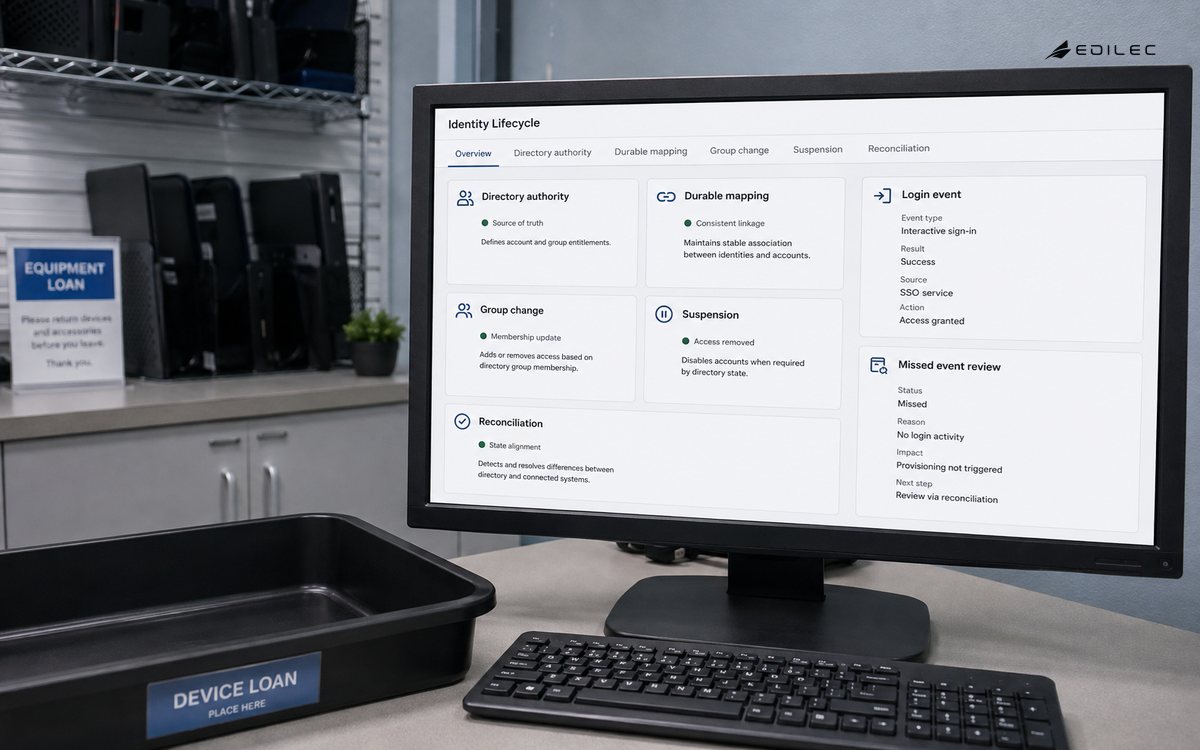
Use active=false as immediate access suspension when possible; treat DELETE according to the documented retention model. The user resource may need to remain as a tombstone to prevent accidental relinking and preserve audit referential integrity. Separate disable, anonymize, and physical purge. An administrator may need to restore an account within retention, but restoration must re-evaluate current groups, licenses, and policy rather than resurrecting stale grants.
Reconcile the directory and SaaS state
Push operations can be lost through credential expiry, connector bugs, rate limits, or partial failures. Run scheduled reconciliation that pages through users and groups, accounts for unstable pagination, compares normalized desired state with internal state, and applies bounded repairs. RFC 7644 warns that pagination is not stateful and results can change between requests. Use overlap, stable filters where available, and repeated passes until a watermark or two consecutive scans converge.
Classify drift: missing user, unexpected active user, attribute mismatch, missing group, membership mismatch, duplicate identity, or locally blocked change. Auto-repair only cases with unambiguous authority. Route destructive or duplicate cases to an administrator with evidence. Track time from directory disable to application enforcement, reconciliation age, failed operations by identity provider, duplicate rate, unmapped group changes, and sessions remaining after suspension.
Roll out enterprise provisioning safely
Start in report-only mode for an internal tenant and representative identity providers. Import a small group, compare identities, and prove that disabling a test user removes every access path. Then test rename, email reuse, group deletion, nested membership, duplicate POST, out-of-order PATCH, credential rotation, throttling, bulk partial failure, and reconciliation after intentionally dropped requests. Provide tenant administrators with connection health and last successful synchronization.
Migration from JIT-only accounts needs explicit linking. Match using verified tenant-scoped federation issuer and subject where available, then require administrative review for ambiguous email matches. Freeze dangerous automatic merges. After linking, decide whether SCIM becomes authoritative for active state and profile fields, and explain that decision to the administrator. Keep emergency local administrators outside automatic group removal, with strong authentication and periodic review.
Key takeaways
- SSO authenticates; SCIM provisions and reconciles lifecycle state.
- Map immutable issuer, subject, SCIM ID, external ID, and internal ID rather than relying on email.
- Publish accurate SCIM discovery and implement protocol semantics consistently.
- Translate groups through tenant-approved mappings; never infer permissions from display names.
- Disable access, revoke sessions, remove derived grants, and handle ownership as one observed workflow.
- Reconcile periodically because push delivery is not proof that desired state and actual state agree.
SCIM provisioning FAQ
Should JIT provisioning remain enabled after SCIM?
Only with a defined policy. It can provide resilience during rollout, but it may recreate a user omitted from the directory assignment. Many products allow login only for an already provisioned principal once SCIM is authoritative, while retaining controlled JIT for tenants that have not enabled lifecycle provisioning.
Should SCIM DELETE erase all user data?
Usually not immediately. Disable access first, then apply tenant ownership, legal retention, privacy, and deletion policies to profile and created content. Document the behavior. SCIM resource deletion and erasure of every business record are distinct operations with different authorization and audit needs.
Can SCIM groups assign licenses?
Yes, if the product defines a deterministic mapping and handles exhaustion. Decide whether an over-capacity assignment fails, queues, or suspends another seat; do not silently grant unpaid access. Surface the conflict to tenant administrators and keep billing entitlement separate from protocol acceptance.
Conclusion
Enterprise provisioning is trustworthy when directory intent becomes timely, explainable application state even without a login. Standards-compliant SCIM resources, stable identity keys, explicit group mappings, comprehensive deprovisioning, and convergent reconciliation turn federation from a sign-in feature into a complete, auditable customer lifecycle capability with measurable control.