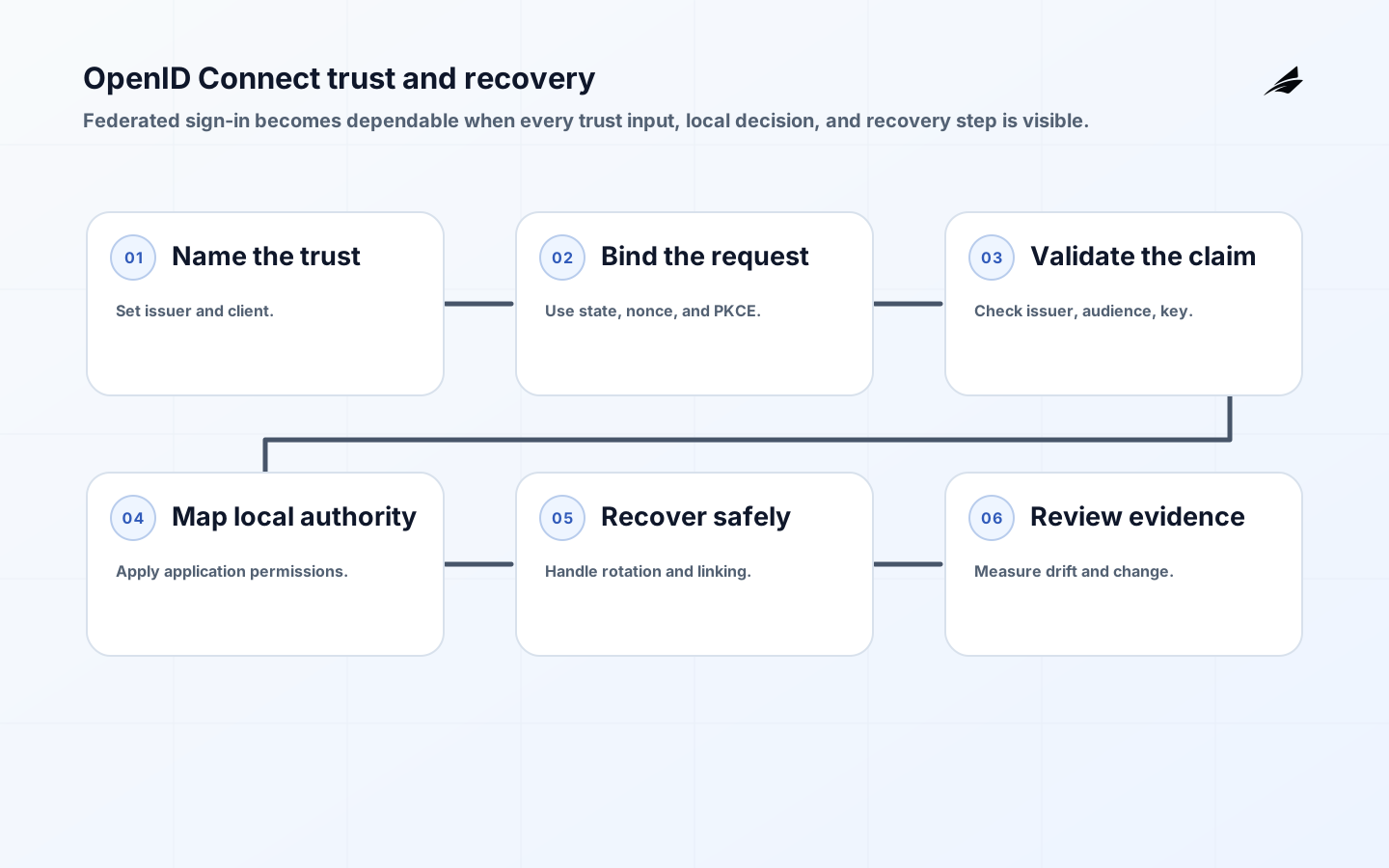
OpenID Connect is often introduced as a convenient sign-in button, but the first build creates a durable trust relationship between an identity provider and a relying party. That relationship decides which issuer may speak for a person, which client may receive an assertion, which claims the application retains, and how a local session is ended. A signed token is not automatically a safe login. The application still has to establish the right audience, nonce, time window, claims policy, and account association before it grants a session. This guide is for engineering teams making those choices before a provider console and a library quietly become the architecture.
Begin by mapping the actual journey: a browser starts an authorization request, the provider authenticates the person, an authorization code returns, the client exchanges it, and the relying party validates the result before creating its own session. Include discovery metadata, key retrieval, tenant routing, logout, support access, and background jobs in that map. For adjacent implementation decisions, compare OAuth security before the first build, OpenID Connect for cybersecurity, and audit log architecture. Those links are useful because federation, authorization, and evidence have different owners even when they share a request.
Set the OpenID Connect trust boundary
Write the boundary as a set of decisions rather than a product description. Name the allowed issuer or issuers, the client registration, exact redirect URIs, response type, requested scopes, claim minimization rule, session lifetime, and account-linking rule. Also name what is outside the boundary: downstream authorization, customer entitlements, support impersonation, and machine-to-machine access should not be smuggled into an ID token check. The OpenID Connect Core specification defines protocol behavior, while your team must decide how that behavior maps to your routes, tenants, records, and risk appetite.
| Decision | Concrete rule | Evidence to retain |
|---|---|---|
| Provider | Accept only configured issuers and an approved metadata source. | Provider inventory, owner, and change record. |
| Client | Register exact redirect URIs and keep client secrets out of browser code. | Registration export and secret-rotation date. |
| Identity | Use issuer plus subject as the stable federation key. | Mapping policy and collision test. |
| Authorization | Evaluate application permissions after authentication. | Policy decision and denied-path test. |
| Session | Create, rotate, expire, and revoke the local session deliberately. | Session event and termination evidence. |
Separate provider, relying party, and application roles
An identity provider authenticates a subject and issues an assertion; the relying party verifies the assertion and decides whether to establish an application session. That session does not transfer the provider’s entire authority into your product. A role claim, group claim, or email address can be an input to an authorization policy, but it should not become an unexamined permission grant. NIST SP 800-63C frames federation around trust agreements, issuer and subject identifiers, assertion protection, and audience restriction. Record those assumptions in a decision log so a future maintainer can see which party is trusted for which fact.
Make ID token validation an explicit contract
Validation should fail closed when issuer, audience, signature, expiration, not-before time, nonce, or required claim semantics do not match the client’s configuration. Pin acceptable algorithms in configuration instead of allowing a token header to select verification behavior. RFC 8725 warns against algorithm confusion and unvalidated issuer or audience claims; apply that guidance in the library wrapper, not only in a reviewer checklist. Keep token parsing separate from authorization and do not place raw ID tokens in broad logs. A useful test suite includes a valid token, an expired token, a token for another client, a token from another issuer, a replayed nonce, and a key identifier that appears during rotation.

Use claims for a purpose, not as a directory copy
Ask what the application must know at sign-in and what it can look up from its own authoritative records. Store the stable provider subject and only the profile attributes needed for a user-visible function. Treat email changes, tenant changes, and group changes as data events with an owner rather than silently overwriting local identity. If a product must link an existing account, require a high-confidence, user-visible proof and record why the link was allowed. A similar display name or email string is not a universal identity key, especially when more than one provider or tenant can reach the same relying party.
Choose a browser flow that is safe to operate
For browser-based applications, use an authorization-code flow with the protections required by the client type and the current OAuth security guidance. Generate and validate state to bind the response to the initiating browser transaction, use a nonce for ID token replay and substitution defenses, and use PKCE where the client cannot keep a secret. RFC 9700 is the current best-practice baseline for redirect handling, code interception, and retiring weaker modes. Keep redirect URI matching exact and make the callback endpoint narrow. Do not use a broad redirect parameter as a convenience feature; it turns an authentication response into a forwarding primitive.
- Draw the browser, provider, callback, token, session, and authorization boundaries.
- Register exact redirect URIs and document which environment owns each one.
- Test state, nonce, PKCE, issuer, audience, signature, expiration, and key-rotation failures.
- Decide which claims are retained, which are looked up, and which are never accepted for authorization.
- Define local logout, idle expiry, forced revocation, and support recovery without weakening validation.
- Give one owner authority to pause a rollout when the provider or claim contract changes.
Treat account linking as a separate security decision
Account linking is where a correct federation protocol can still produce an unsafe product. A new provider subject may resemble an existing user, a person may belong to several tenants, or an email address may be reassigned. Make the linking command explicit. Require the current account to be authenticated at an appropriate assurance level, show the proposed relationship, confirm the target provider subject, and retain an audit event. If the evidence is ambiguous, do not choose the most convenient record. Leave the new identity unlinked and route it to a recovery or support process that can verify ownership without exposing account details.
Plan for failure, rotation, and escalation
A provider outage, discovery change, signing-key rotation, tenant misroute, or expired authorization transaction should result in a bounded user experience and an actionable operator signal. Never bypass issuer or audience checks to restore availability. Cache discovery and key metadata with a documented freshness policy, refresh on a new key identifier, and alert when validation failures exceed a known baseline. A provider configuration change should have a rollback or containment action. The team should be able to distinguish a user cancellation from a bad callback, a missing key, a stale session, and a suspected account-linking problem without reading secrets from logs.
| Observed condition | Safe response | Escalation evidence |
|---|---|---|
| Issuer mismatch | Reject the response and preserve a reason code. | Issuer, client, environment, and configuration version. |
| Audience mismatch | Reject; never convert the token into a session. | Expected and received audience without the token body. |
| Key identifier miss | Refresh approved metadata once, then fail closed. | Key ID, refresh result, and provider status. |
| Account ambiguity | Stop automatic linking and request stronger proof. | Candidate mapping, reviewer, and outcome. |
| Callback timeout | Expire state and offer a restart without replay. | Transaction age, correlation, and user-safe status. |
Release and operate the integration with evidence
Start with one provider, one tenant model, and a small set of routes. Ship the callback and validation wrapper behind an observable boundary, then test real sign-in, sign-out, denied claims, provider key rotation, and support recovery before adding another issuer. Record configuration versions, validation outcomes, callback errors, session creation and termination, link decisions, and time to revoke access. Keep personal data and tokens out of general telemetry. Review the exception queue, stale registrations, abandoned authorization attempts, and provider changes on a cadence. A healthy integration is one in which an operator can explain why access was granted, denied, or paused.
Key OpenID Connect takeaways
- Define the issuer, client, redirect, claims, session, and account-linking boundaries before selecting convenience settings.
- Validate issuer, audience, signature, algorithm, time, nonce, and required claims at the relying party.
- Keep application authorization separate from the fact that a provider authenticated a subject.
- Make discovery and key rotation observable, bounded, and owned.
- Treat local session termination and account recovery as part of federation design.
- Preserve evidence that lets support and security explain a disputed sign-in without exposing secrets.
OpenID Connect FAQ
Can an email claim be the account key?
Not by default. Use the configured issuer and provider subject as the federation identity, then define a separate, verified rule for any local account link. Email can be a useful contact attribute, but it can change, be reused, or appear in more than one tenant context.
Does OpenID Connect replace OAuth security work?
No. OpenID Connect adds an identity layer on top of OAuth authorization flows. Redirect URI matching, state, PKCE, code exchange, client registration, token handling, and session controls remain part of the security design.
What should logout do?
End the application session, clear or rotate the session material, and document whether provider logout is also requested. Do not imply that ending one local session revokes every provider or application session unless the integration actually enforces that result.
Conclusion: keep OpenID Connect operable
A dependable OpenID Connect integration is a small, explicit security system: trusted provider metadata, exact client boundaries, validated assertions, separate application authorization, deliberate sessions, and recoverable operations. Decide those responsibilities before the first build, exercise the denied and rotated paths, and preserve evidence that matches the deployed behavior. That discipline keeps a sign-in integration useful during ordinary change and defensible when a provider, account, or assertion becomes uncertain.