When incident playbooks move into production, they become part of releases, support escalations, vendor changes, and customer communications. The key change is accountability: an incident lead must make a bounded decision from current evidence while responders need safe access to the controls and records that decision depends on. For planning and coordination, use CISA’s JCDC plans and resources, its incident and vulnerability response playbooks, the NIST incident response project, and CISA’s Incident Response Plan Basics. NIST SP 800-61 Rev. 3 places response within risk management; in practice, detection must connect to containment, recovery, and improvement.
Set the incident playbooks boundary
Start with detection, triage, communications, evidence handling, containment, recovery, and learning for events that affect the product or its customers. Draw the request or data path in enough detail to name the asset, actor, action, policy input, enforcement point, and recovery route. This avoids a familiar failure: a team purchases a control or adopts a standard, then discovers that a proxy, integration, background worker, or support workflow takes a path outside it. The map should identify the system of record for each decision and the person who can approve an exception. It should also show where a missing dependency produces a deny, a bounded continuity mode, or an alert. A boundary that can be tested is more useful than a broad promise of protection.
The boundary should join adjacent practices without blending their ownership. secure administration paths are a useful comparison whenever administrators can alter this control, while audit-log design helps make resulting decisions investigable. Keep the question narrow: which normal and exceptional paths can affect the incident decision, and what stops the wrong path from doing so? That focus lets a small team make a real improvement without waiting for a total platform redesign.
Design a production incident playbooks architecture
A durable architecture makes the relevant decision explicit and puts enforcement where it can affect the requested action. For this topic, alerting and intake feed an incident lead, technical responders, communication owners, and pre-authorized containment actions with a shared timeline and decision record. Each component needs a crisp contract: inputs it accepts, information it treats as authoritative, maximum acceptable staleness, failure behavior, and safe telemetry. Do not assume a dashboard setting or an upstream assertion has reached every application path. Cache behavior, replicas, asynchronous jobs, and manual processes all deserve a place in the design. The result is not a single perfect control; it is a system whose trust boundaries, dependencies, and consequences can be reviewed before an incident forces the issue.
| Decision area | Production rule | Why it matters |
|---|---|---|
| Triage | Capture signal, affected path, confidence, and immediate safety concern. | Separates a useful initial picture from premature certainty. |
| Authority | Name an incident lead and decision owners early. | Responders can act without waiting through an ambiguous escalation chain. |
| Containment | Choose reversible controls proportionate to the observed risk. | Limits damage while preserving a path to safe recovery. |
| Recovery | Define what healthy service and customer impact verification mean. | Restoration is not complete when only the alert stops. |
Make incident playbooks decisions reviewable
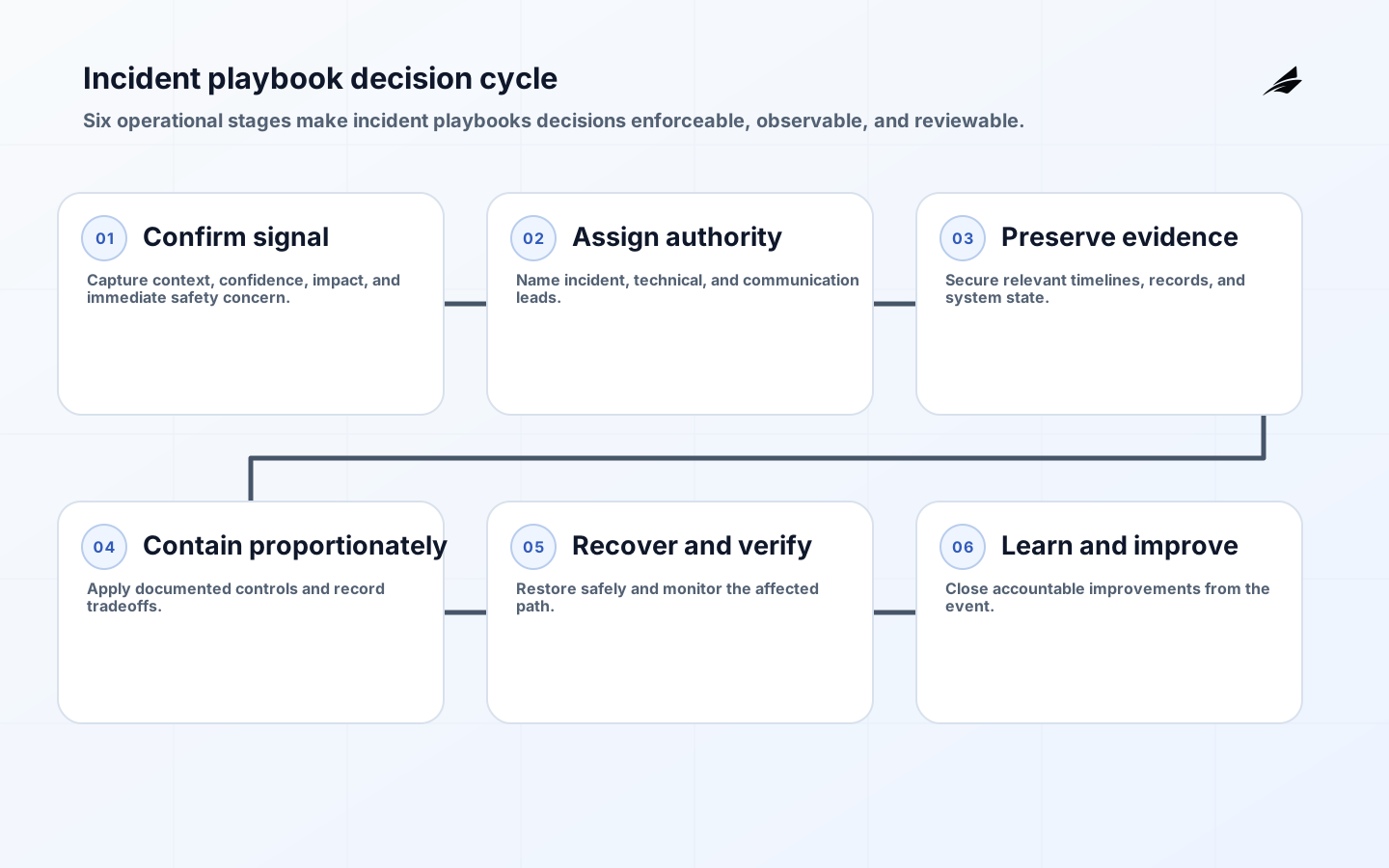
Write down incident declaration, severity, authority, evidence preservation, containment proportion, customer communication, recovery criteria, and post-incident follow-through. A concise decision record should state the expected behavior, the false-permit and false-deny cost, the accountable owner, the monitoring signal, and the deadline for re-evaluation. This turns an exception from a quiet configuration change into a time-bounded operating choice. The detailed guidance in NIST SP 800-61 Rev. 3, Incident Response Recommendations are a strong technical baseline, but production teams must still decide how its controls apply to their own routes, assets, customers, and failure modes. Reviewers should be able to answer why a particular outcome is permitted and what evidence would show that the decision has drifted.
- Write playbooks around decisions and roles, not a long list of tools that may change during an incident.
- Keep emergency access tested, bounded, and attributable before an event occurs.
- Use plain-language status checkpoints so product, support, legal, and engineering share the same current facts.
- Practice with realistic dependencies, vendor contacts, and customer-impact questions.
- Track improvements to completion and verify that owners close them, rather than treating the retrospective as the endpoint.
Implement incident playbooks without losing the operating model
Use a staged release that exposes assumptions early. Run a scenario involving a product dependency or account takeover, time the handoffs, test contact paths, and revise the playbook from what actually slowed the team. A change plan should identify the old rule, proposed rule, affected paths, test cases, observability, rollback condition, and person authorized to pause rollout. Include a support and recovery path, because users will encounter denied actions, expired state, or an interrupted workflow. The goal is not to eliminate every exception; it is to make exceptions visible, attributable, and temporary. This is also the right point to align engineering work with the more general practices in NIST Cybersecurity Framework 2.0, rather than treating a security control as a detached compliance activity.

| Observed condition | Likely meaning | Practical response |
|---|---|---|
| Unclear severity | Impact data is incomplete. | State the uncertainty, assign a deadline, and use a conservative containment option. |
| Evidence overwritten | Routine systems rotate before collection. | Preserve relevant logs and state under the organization’s evidence process. |
| Communication stalls | No owner has approved customer or executive messaging. | Assign a communications lead with pre-agreed decision rights. |
| Service restored, risk remains | Root cause or stolen access is still active. | Separate availability recovery from security recovery and monitor both. |
Operate and measure incident playbooks
Production confidence comes from evidence that the intended path is still the actual path. Retain alert context, timestamps, commands or changes, affected assets, decision authority, customer notices, recovery checks, and action owners. Protect the records themselves: logs should help an investigator understand decisions without copying secrets, tokens, or unnecessary personal data into a broad telemetry system. Define a small review cadence for configuration changes, exception age, coverage gaps, and control health. The aim is a signal that prompts a decision, not a decorative metric. The primary guidance in CISA Federal Government Cybersecurity Incident and Vulnerability Response Playbooks and NIST SP 800-86, Integrating Forensic Techniques can help test whether local choices still align with current, authoritative practice.
Key incident playbooks takeaways
- Protect the incident decision by defining the decision boundary before selecting or expanding tooling.
- Use accountable, time-bounded rules for incident declaration, severity, authority, evidence preservation, containment proportion, customer communication, recovery criteria, and post-incident follow-through.
- Release controls through observable, reversible steps and test both the intended and denied paths.
- Keep evidence that shows the deployed behavior, not merely the policy that was approved.
Incident playbooks FAQ
How detailed should an incident playbook be? Detailed enough to remove avoidable uncertainty about responsibilities, evidence, and approved actions, but short enough to work under pressure. Is a tabletop exercise sufficient? It is valuable for decisions and communication, while technical drills are also needed to prove access, telemetry, backup, and containment capabilities.
Plan for production failure and escalation
During an active incident, teams should treat every containment action as a hypothesis with a tradeoff. Disabling an integration may protect customers but remove operational evidence or disrupt a recovery path; leaving it active may worsen impact. Record the decision, authority, expected effect, and next observation. After restoration, validate that attacker access, unsafe configuration, or faulty automation is actually gone. A status update declaring service healthy is not a substitute for a security recovery check.
Maintain current contact methods outside the affected collaboration platform and verify that key responders can reach the required logs, controls, and customer context. A well-written plan is still ineffective when the team cannot communicate or act during the first hour.
Keep a lightweight record of decisions made outside the incident channel, such as an emergency vendor call or an executive direction to preserve availability. Those choices may later explain technical actions and customer communication. Bringing them into the shared timeline lets the incident lead maintain one accountable view without slowing responders who have to act quickly.
Conclusion: keep incident playbooks operable
Incident playbooks are strongest when their daily decisions remain narrow, explainable, and testable. Set the boundary, name the owner, enforce the rule near the protected action, preserve safe evidence, and revisit exceptions before they become the architecture. That discipline makes the incident decision easier to operate during routine change and far easier to defend when conditions become urgent.
Production incident response: turn readiness into an operating decision
Production incident response: test declaration through recovery
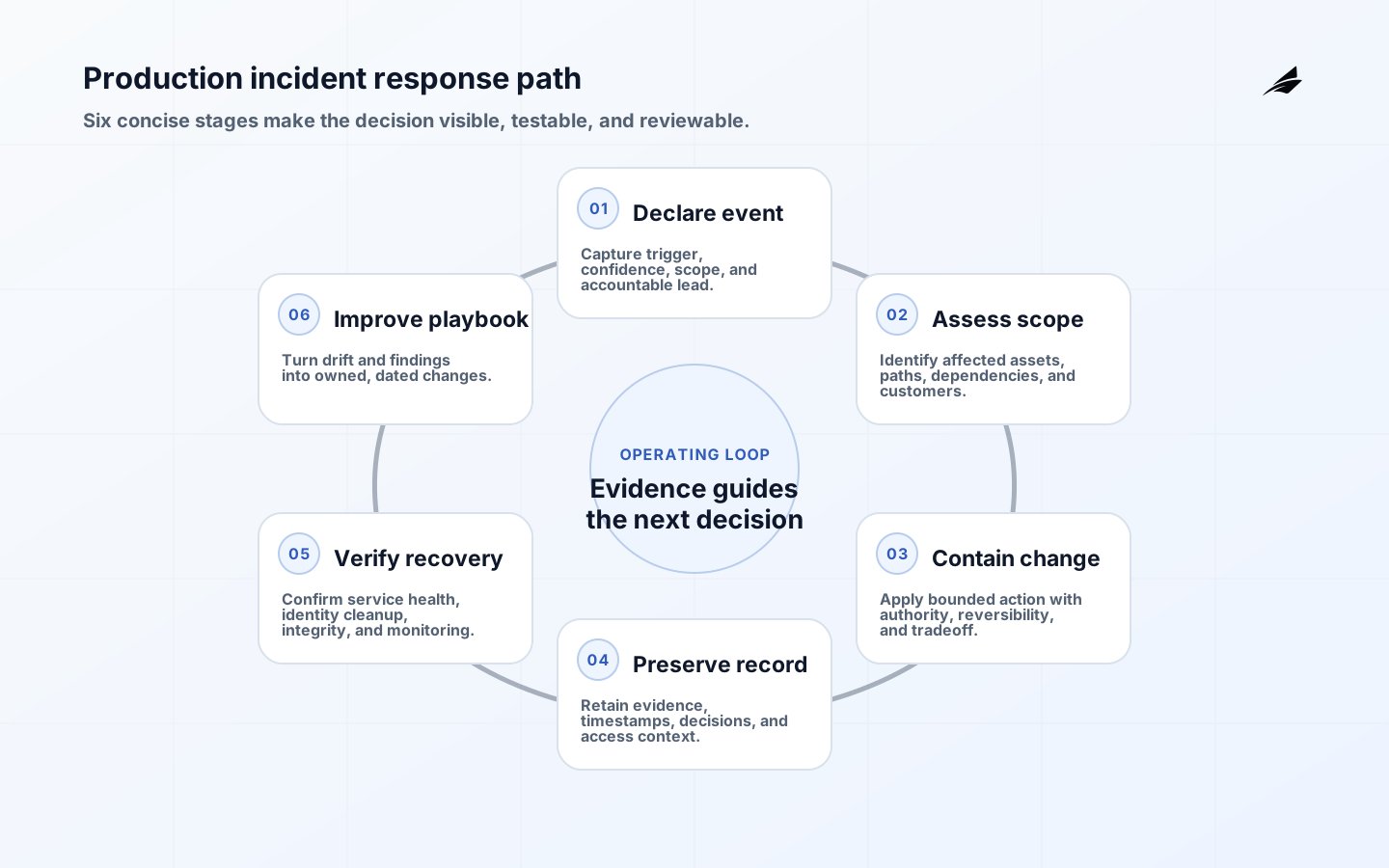
Convert the playbook into executable checkpoints. At declaration capture trigger, confidence, scope, and lead. During analysis preserve relevant logs and state unknowns. For containment record action, expected effect, reversibility, and customer tradeoff. For recovery verify service health, identity cleanup, data integrity, and monitoring. For closure assign corrective actions and a review date. CISA’s playbooks are a useful reference, but each checkpoint must point to local systems, owners, and escalation routes.
Test production-like friction. Run a drill during a deployment, make a vendor contact unavailable, expire a responder’s usual credential, and introduce conflicting telemetry. Check whether the team can distinguish a false positive from a low-confidence real event, preserve evidence before changing state, and communicate uncertainty without overclaiming. NIST SP 800-86 matters when forensic needs compete with rapid containment: define evidence, collector, and access controls in advance.
Keep the operating record narrow and protected. Retain timestamps, decisions, actors, affected assets, changes, notifications, recovery checks, and action ownership, but avoid secrets or unnecessary personal data in broad channels. Review time to declaration, containment, accurate update, and verified recovery. A playbook that repeatedly requires an undocumented exception is telling the team to redesign the normal path.
Production incident response: connect playbooks to service work
In the production incident response context, for a broader view, compare incident playbooks access and operations, evidence and review practice, and recovery planning. In the production incident response context, these Edilec guides add the human and operational context around this article’s technical decision.
Production incident response: preserve review evidence
Make each production checkpoint observable in the systems responders actually use. A declaration event should have an incident identifier; containment changes should carry a change or ticket reference; evidence collection should record source and time; recovery should include a customer-impact check. These links let an investigator reconstruct the decision without relying on memory or a single chat transcript. They also make review faster because the evidence is already grouped by event rather than scattered across services.
Separate playbook drift from incident complexity. Drift includes an owner who left, a vendor endpoint that changed, a runbook link that no longer works, an expired emergency credential, or a control whose output is not logged. Complexity may be inherent in the event. Review the playbook after every exercise and material incident, but fix drift immediately when it can block a safe first action.
Make the review output visible to service owners. A named change, missing dependency, or stale contact should become work with an owner and due date, while an accepted risk should carry an explicit rationale and review date. Visibility prevents the playbook from becoming an isolated security document.
Include the customer-impact owner in the drill, not only after the technical response. The person responsible for status updates should receive the same uncertainty and scope information as the incident lead, know what has been verified, and have a scheduled next update. This reduces contradictory messages while responders continue to investigate.
The resulting record should make the next response faster and safer.
That record should identify the decision owner, the evidence used, and the next review point. It is the bridge between urgent response and ordinary engineering work.