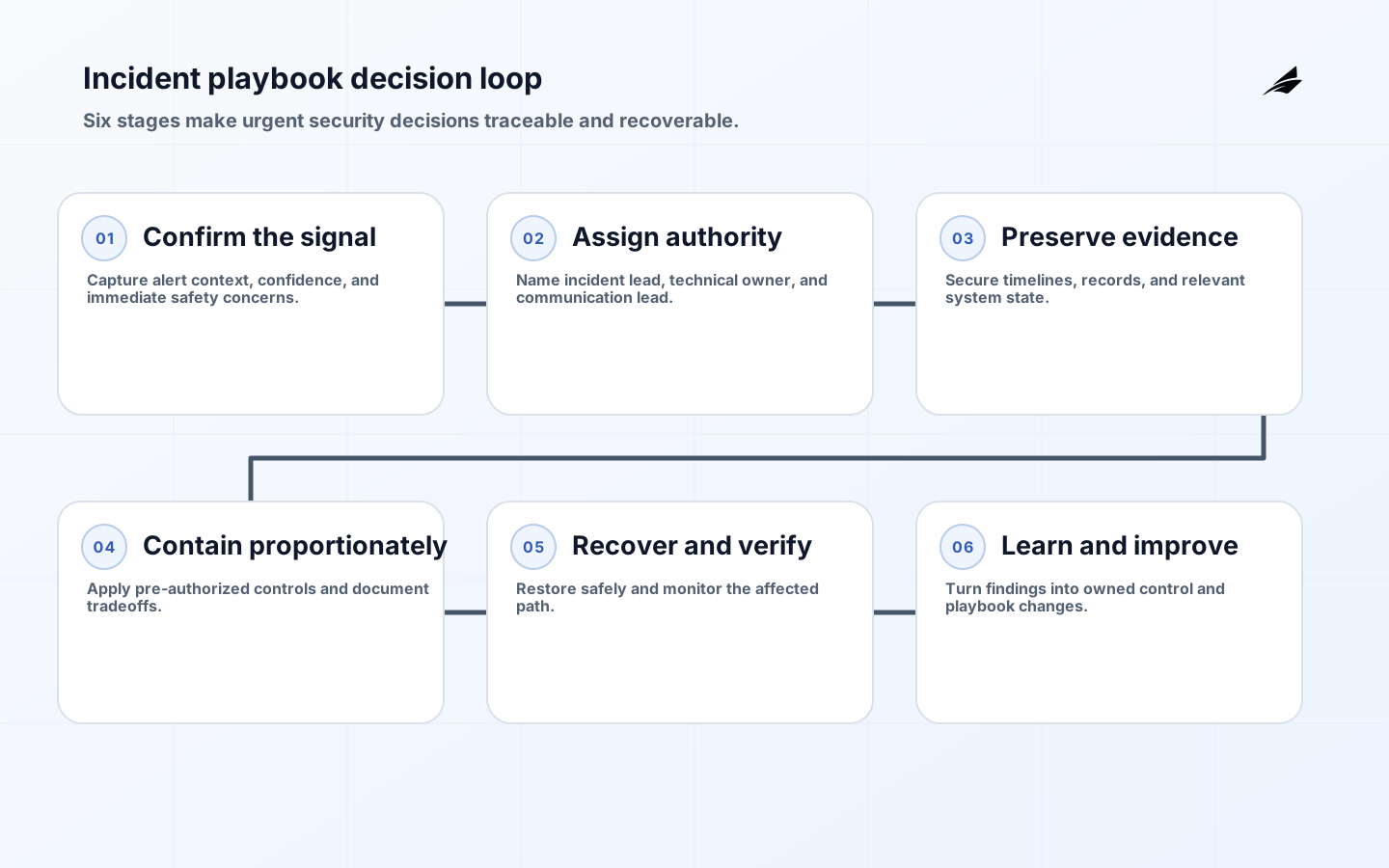
Incident Playbooks for Cybersecurity: a Practical Guide is about prepared decision aids for recurring security events that state roles, evidence, containment options, communication, recovery checks, and learning. For engineering teams, the practical question is not whether the phrase belongs in a policy; it is whether the team can make the right decision when a normal path changes. During a live incident, ambiguity about who may act, what evidence to preserve, and when to communicate can cost more time than the technical symptom. A useful program names the protected asset, the people who own the decision, the evidence that supports it, and the recovery route when a control cannot operate as expected.
Define the incident playbooks boundary
Start by drawing the boundary around detection intake, triage, evidence handling, containment, eradication, recovery, customer and regulator communication, and post-incident improvement. The protected asset is the ability to make timely, proportionate, and accountable decisions under pressure. That statement prevents an easy mistake: treating a technical setting as the whole control. The setting matters only because it changes a decision about access, integrity, availability, or investigation. Include the systems that supply trust signals, the people who approve exceptions, and the places where an operator can override or recover. The resulting map should be small enough to review and specific enough to test.
This boundary also makes adjacent work clearer. data retention is a useful companion because it addresses a related control, while MFA rollout in production helps place the decision in a broader production operating model. Do not collapse the topics into one catch-all backlog. Each control needs a clearly accountable owner, a definition of successful behavior, and a way to prove that the production system still follows its intended rule.
Make the incident playbooks decisions explicit
The durable design is keep the playbook close to the operational tools and define a common incident record. The record should link alerts, scope hypotheses, actions, owners, timestamps, approvals, and open decisions without forcing responders to reconstruct a story from separate chat channels. Before a team chooses a product feature or copies a configuration, it should state who or what makes the decision, which evidence is authoritative, how current that evidence must be, and which outcome is enforceable. When the answer is spread across tickets, code comments, and vendor defaults, support teams cannot explain why an outcome occurred. Production controls need an understandable decision model, including the case where data is missing or contradictory.
Keep a concise decision record for the consequential cases. It should cover the intended behavior, the risk of a false permit and false denial, the owner who can change the rule, and the monitoring signal that would expose drift. This is where incident playbooks becomes an operating practice instead of a launch checklist. A change is safer when reviewers can see the old rule, the proposed rule, the affected paths, and the rollback or containment option before release.
| Decision area | Practical rule | Why it matters |
|---|---|---|
| Classification | Use impact and confidence criteria that people can apply quickly. | A severity label should trigger an operating posture, not merely a reporting field. |
| Authority | Pre-authorize reversible containment actions and escalation paths. | Responders need to know when they may disable access, block traffic, or take a service offline. |
| Evidence | Preserve relevant records before destructive remediation. | A rushed cleanup can remove the material needed to understand scope. |
| Communication | Set audience, cadence, and approved facts for each stage. | Clear status prevents speculation and lets leaders make informed tradeoffs. |
Build incident playbooks into the production architecture
Production architecture should preserve a separable path for the decision, enforcement, and evidence. For incident playbooks, that means teams can identify the input, the policy or rule, the component that applies it, and the record that explains the result. Avoid relying on a user interface label or a single vendor dashboard as the only source of truth. Integrations fail, messages arrive late, and configuration changes drift. A design that exposes these boundaries makes faults easier to contain and investigate.
The evidence to retain is alert context, timeline, scope assessment, containment actions, approvals, affected identities or assets, recovery checks, and lessons with owners. Retain enough context to reconstruct a material decision, but do not casually duplicate sensitive credentials or personal data across troubleshooting systems. Define identifiers, timestamps, and ownership early. Then run a negative test: remove or stale one input, simulate an unavailable dependency, and confirm that the system responds according to the documented policy. A measured degraded mode is safer than an accidental bypass.
| Failure mode | Design response | Evidence to keep |
|---|---|---|
| Tool-first response | Start from a decision and evidence checklist, then use tools. | Time to owner assignment and decision log completeness. |
| Unowned containment | Name authority for customer-impacting actions. | Elapsed time from alert to approved containment. |
| Premature closure | Require recovery and monitoring checks after eradication. | Reopened incidents and post-recovery alerts. |
| Stale playbook | Exercise and revise it after systems or suppliers change. | Exercise findings and overdue playbook reviews. |
Implement incident playbooks with a narrow first release
A practical first release is not a broad transformation. Take one plausible alert such as suspicious administrator access and run a tabletop from first signal through recovery, with the people who would actually make the calls. Make the owner, normal path, abnormal path, and success measure visible on one page. This approach gives product, security, and operations people a shared object to review. It also reveals dependency assumptions early: which source must be available, which role may approve an exception, and what happens to work already in progress when the decision changes.
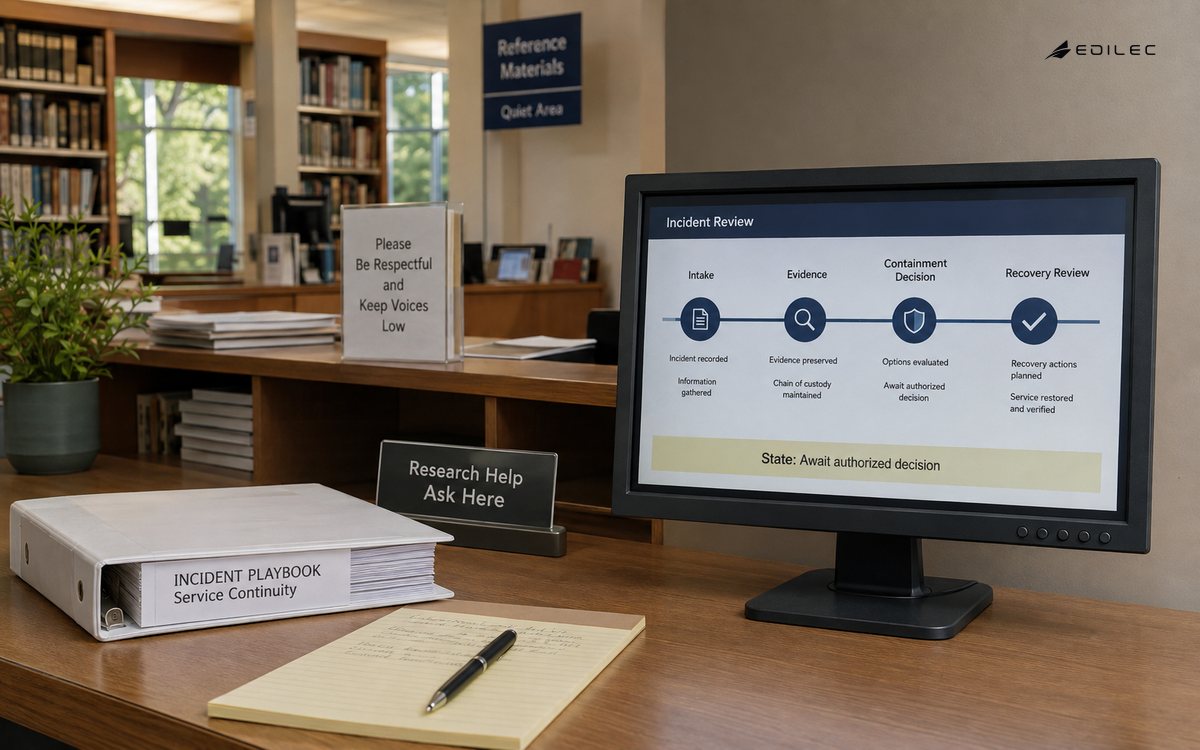
- Name the protected asset and the specific decision incident playbooks must improve.
- Identify the authoritative identity, configuration, or asset record behind that decision.
- Write allowed, denied, unavailable, and recovery outcomes in plain language.
- Test a normal case, a misuse case, an upstream failure, and a rollback or revocation case.
- Log the decision and owner without placing secrets or raw credentials in ordinary logs.
- Review the result with the people who support the workflow, not only its implementers.
Release criteria should include more than a passing happy path. The team should show that the relevant decisions are enforceable, that the evidence is reachable during an investigation, and that an authorized person can recover safely. For example, test an identity provider alert that may indicate session theft while the service remains available. The objective is not to eliminate every operational tradeoff. It is to make the tradeoff visible, authorized, and reversible where possible. This is particularly important when a change affects customers, administrators, or a service that cannot simply be stopped.
Operate and assure incident playbooks
For incident playbooks, watch time to assign an incident lead, completeness of the decision timeline, containment approval latency, exercise findings, and reopened incidents. Compare them with the impact on affected users and services. A concise response record reveals whether people had the authority and evidence they needed, which is more useful than measuring how many pages a playbook contains.
Review changes as changes to a trust boundary. Require an owner, a test result, and a short explanation for any new client, integration, scope, role, host, workflow, or exception that changes incident playbooks. This is an appropriate place to use lightweight automation: detect drift, create a review item, and preserve the evidence. Automation should not silently decide away an unresolved high-consequence question. vulnerability management in production is another relevant internal guide when the program needs to connect this control to an adjacent production concern.
Avoid common incident playbooks failures
The recurring failure is writing a procedural document that does not specify the decisions and authority responders need at 2 a.m. Another is treating successful deployment as verification. A deployment proves that code or configuration reached an environment; it does not prove that the intended resource, identity, and exception behavior work together under realistic conditions. Keep tests close to the decision, include a support or incident scenario, and re-run them after significant changes to dependencies or trust inputs. That discipline catches drift while the team still has context to correct it.
Key Takeaways
- Incident playbooks protects the ability to make timely, proportionate, and accountable decisions under pressure through explicit, testable production decisions.
- A good boundary includes the source of trust, the enforcement point, the recovery path, and the accountable owner.
- Severity, convenience, or a vendor default alone should not decide high-consequence access or release behavior.
- Evidence should explain material outcomes without creating a second store of sensitive secrets.
- A narrow, exercised workflow provides stronger learning than a broad policy with no operational proof.
FAQ
How detailed should an incident playbook be?
It should be detailed enough to reduce hesitation on repeatable decisions and short enough to use while stressed. Include triggers, roles, immediate safeguards, evidence to preserve, escalation thresholds, communication owners, and recovery criteria. Leave room for judgment where facts vary. A script that assumes every incident is identical can cause harm just as easily as an empty document.
What should a tabletop test?
Test the handoffs, decision rights, access to evidence, and communication path as much as the technical remediation. Introduce a missing log, an unavailable vendor contact, a conflicting business deadline, or a false-positive clue. Those conditions reveal whether the playbook helps the team reason rather than merely list familiar security terms.
Conclusion: make incident playbooks operable
Incident playbooks becomes valuable when people can explain the protected asset, the decision, the evidence, and the recovery route without improvising during an incident. Start with the smallest consequential workflow, test its uncomfortable cases, and give the result a named owner. From there, expand only when the controls, logs, and exception process are earning trust in everyday use. That is how a security requirement becomes a production capability rather than a fragile configuration.
Authoritative References
The implementation guidance in this article is grounded in NIST SP 800-61 Rev. 3, Incident Response Recommendations, NIST SP 800-61 Rev. 2, Computer Security Incident Handling Guide, NIST Cybersecurity Framework 2.0, CISA Cybersecurity Performance Goals. These primary references should be consulted for protocol, control, and deployment details; every organization still needs to apply them to its own systems, risk decisions, and legal obligations.