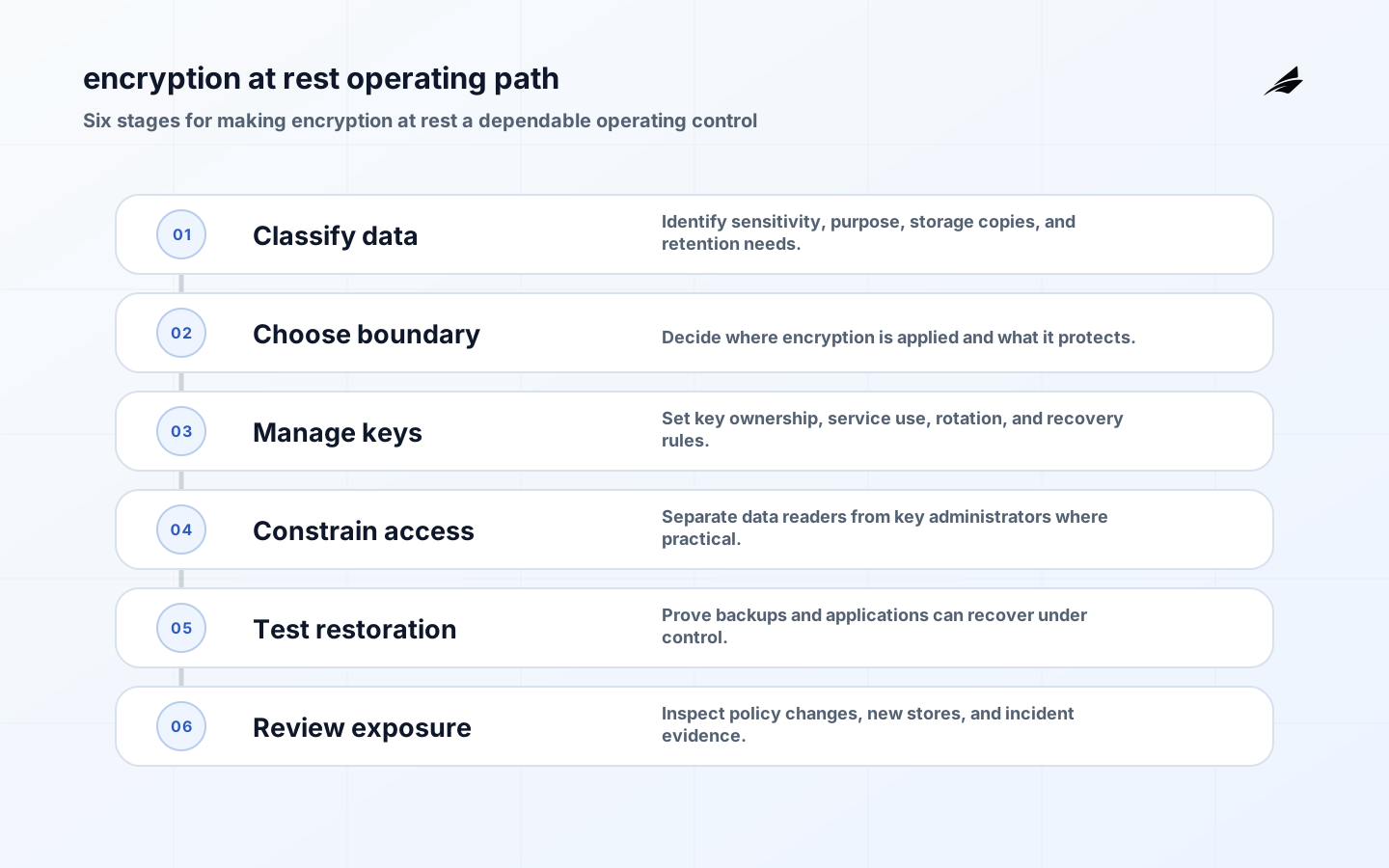
Encryption at Rest for Product Teams: Protect Data and Keep Key Decisions Operable starts with a practical question: can the team make a defensible decision about primary databases, object storage, search indexes, analytics copies, backups, exports, and the key-management services that support them when a customer, auditor, incident responder, or new engineer asks how it works? Encryption at rest is useful when it turns an abstract security goal into an operating choice with a clear owner, a protected boundary, and evidence. For product teams, the aim is not maximal process. It is stored data protected by a design that can survive routine operations, restoration, and incident response. Start with the most consequential path, state what normal behavior looks like, and make the failure path visible before tools or policies multiply.
Define the encryption at rest decision
Begin with one real scenario: a product stores customer documents in object storage, indexes metadata for search, creates nightly backups, and supports a controlled export feature. Write down the actor, the asset or action, the systems involved, the condition that makes the request acceptable, and the consequence of getting it wrong. This prevents a broad encryption at rest program from becoming a list of products or a collection of vague assurances. A concise decision record should make it possible for the business owner and technical owner to agree on the boundary, the expected behavior, and the evidence they will inspect when something changes.
| Question | Why it matters | Useful evidence |
|---|---|---|
| What is protected? | The scope determines whether encryption at rest is solving a real risk. | Named resources, actions, data categories, and affected users. |
| Who decides? | A control without an accountable owner quietly decays. | Business owner, technical owner, and approval limit. |
| What is normal? | Teams need a baseline before they can recognize failure. | Expected request, response, time limit, and permitted scope. |
| How is failure handled? | An emergency path can defeat the control if it is invisible. | Escalation route, rollback, notification, and review record. |
Understand the encryption at rest operating model
The core model is data classification, storage location, encryption boundary, data-encryption key, key-encryption key, key owner, access policy, backup, and recovery procedure. A durable design makes each part explicit instead of relying on a private convention or a network location. The policy or decision logic should be understandable by the people who operate the product, while enforcement should occur where the protected resource can reject an invalid request. NIST SP 800-57 Part 1 Rev. 5: Key Management is a useful primary reference for the protocol or control model, but its value increases when the team maps its terms to its own applications, vendors, and support procedures.
- Name the authoritative systems and owners that supply the inputs to encryption at rest.
- Separate authentication, authorization, data handling, and operational approval instead of assuming one proves another.
- Default to a bounded outcome when a required input is absent, stale, or cannot be verified.
- Record the reason for consequential decisions in a form an investigator can retrieve.
- Design an exception path with a named approver, scope, expiration, and follow-up review.
Build the encryption at rest control path
Implement the decision as a path rather than a static setting: classify the data, use maintained cryptographic services, separate data access from key-administration authority, limit key use by service identity, and test recovery without improvising key access. Keep control-plane administration separate from the routine path where feasible, because the ability to change a rule or credential is often more sensitive than using it. Start with a narrow production slice and trace it end to end. The goal is to prove that the intended identity, context, and policy reach the system that performs the protected action, including asynchronous jobs, retries, and administrative tools.
Test encryption at rest against normal and adverse conditions
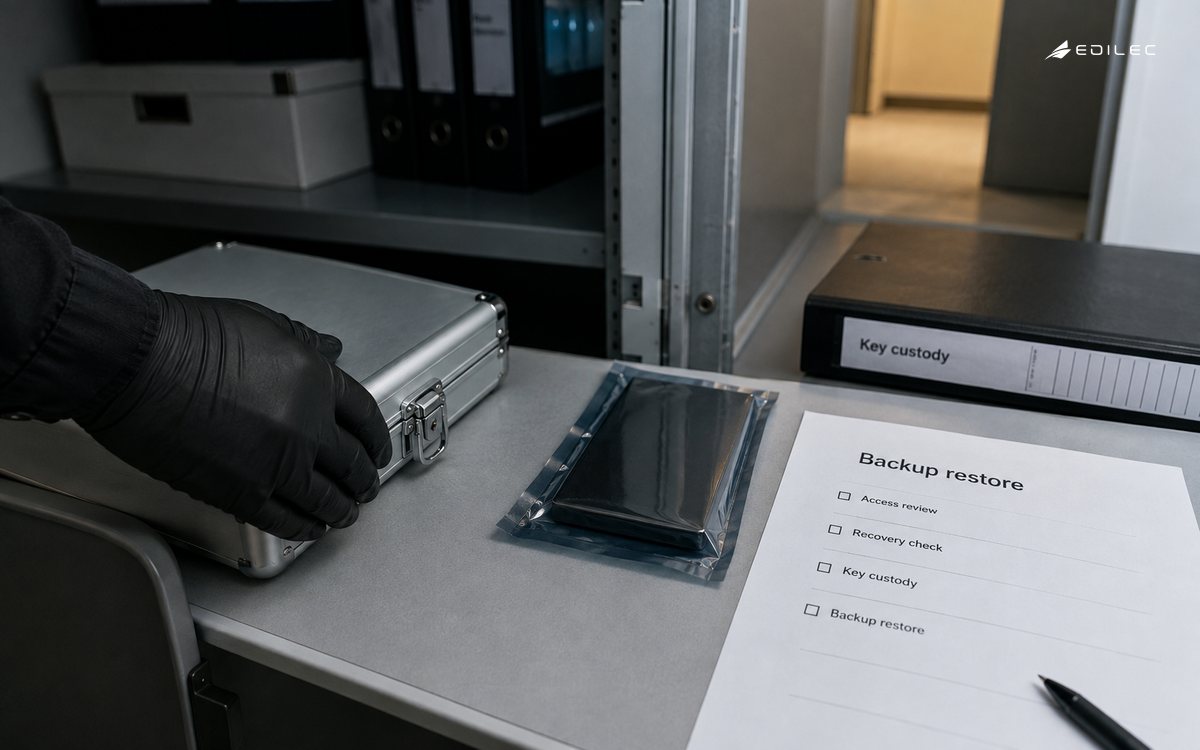
Server-side encryption on an object store can be an important baseline, yet the design still needs to address who can read the objects, who may change the key policy, and whether the recovery process can restore data without granting broad human access. Test the ordinary case, then deliberately test conditions that often expose false confidence: a changed owner, missing context, expired item, duplicated request, unavailable dependency, or a user who attempts an action outside the expected boundary. Make the tests proportionate to impact. A customer-facing or privileged failure needs stronger evidence and clearer recovery than a routine low-risk workflow.
| Test case | Expected result | What to retain |
|---|---|---|
| Valid request in scope | The action succeeds with the intended boundary and no broader grant. | Decision outcome, actor or service identity, target, and time. |
| Missing or invalid input | The action is denied, challenged, queued, or safely limited. | Reason code, safe error behavior, and owner notification. |
| Changed context | The system re-evaluates the relevant condition rather than trusting stale state. | Before-and-after result and the source of the changed input. |
| Emergency exception | The bounded path works, is visible, and expires as planned. | Approver, scope, start, end, and post-event review. |
Operate encryption at rest with useful signals
Operational visibility should answer whether the control is protecting work without quietly blocking it. Track unencrypted storage discoveries, key-policy changes, decrypt failures, backup restore tests, access to key-management APIs, and stale or broadly shared service identities. Segment the view by environment, application, client, or tenant when that helps find a concrete owner; an aggregate number can hide a broken integration or an unsafe bypass. Alerts should point to a response that is safe to take, not just a dashboard that proves the team noticed a problem.
Review encryption at rest when the system changes
Treat new integrations, data categories, administrator capabilities, account types, vendors, and deployment patterns as review triggers. This is where most drift appears: the original decision was sensible, but a new path no longer has the same assumptions. In a short change review, ask whether the boundary, inputs, enforcement point, owner, evidence, and recovery behavior still match reality. For adjacent operating discipline, see the companion implementation guide and the related planning guide.
Make encryption at rest ownership routine
Ownership becomes credible when it appears in ordinary delivery and operations rather than only in a security review. For encryption at rest, keep a compact register of the protected path, responsible people, material dependencies, current exceptions, last successful test, and next review trigger. Use release planning, vendor onboarding, incident follow-up, and access review as places to update that record. The work should be small enough that a service owner can complete it, but specific enough that a new colleague can understand why the control exists and how to act when evidence disagrees with the intended design.
Choose one scenario each quarter that is likely to reveal a weak assumption in encryption at rest: a staff departure, service outage, customer escalation, unexpected retry, configuration rollback, or changed third-party behavior. Walk through the event with the people who own the business outcome and the technical enforcement point. Capture only actionable gaps, such as an unknown owner, a missing test, an unclear denial response, or evidence that cannot be retrieved. Assign a date and responsible person, then retest the amended path. This keeps the control connected to real work instead of an inherited checklist.
A measured rollout is usually safer than a broad declaration. Give the first encryption at rest implementation a defined population, explicit success and stop conditions, and a feedback route for people who encounter edge cases. Compare the observed result with the design assumptions before expanding it. This makes tradeoffs visible early: a condition that is reliable in one environment may be incomplete in another, and a recovery path that looks acceptable on a diagram may be too slow during a real customer-impacting event.
Avoid common encryption at rest failures
The most expensive encryption at rest failures usually come from over-broad trust, hidden exceptions, and an inability to reconstruct a decision. Avoid granting permanent access to solve a short-term incident, assuming a private network or familiar client is sufficient context, or treating a control as complete before ordinary operators can support it. A good design states its limits. When the evidence is ambiguous, preserve the path for investigation and choose the least harmful reversible action rather than inventing certainty.
Key takeaways
- Encryption at rest should protect a named decision and a real operating path, not merely satisfy a policy statement.
- The security boundary, accountable owner, and safe failure behavior need to be visible before rollout.
- Test the deployed workflow and its exceptions; configuration evidence alone is not enough.
- Use signals that lead to a specific owner and response, then review them when systems change.
- Begin with the highest-impact path and widen coverage as the team gains reliable evidence.
Frequently asked questions
Conclusion
Encryption at rest becomes practical when it is tied to a real decision, enforced in the live system, tested under ordinary and adverse conditions, and owned through change. That approach gives product teams a control they can operate, explain, and improve without turning security into a separate ritual.