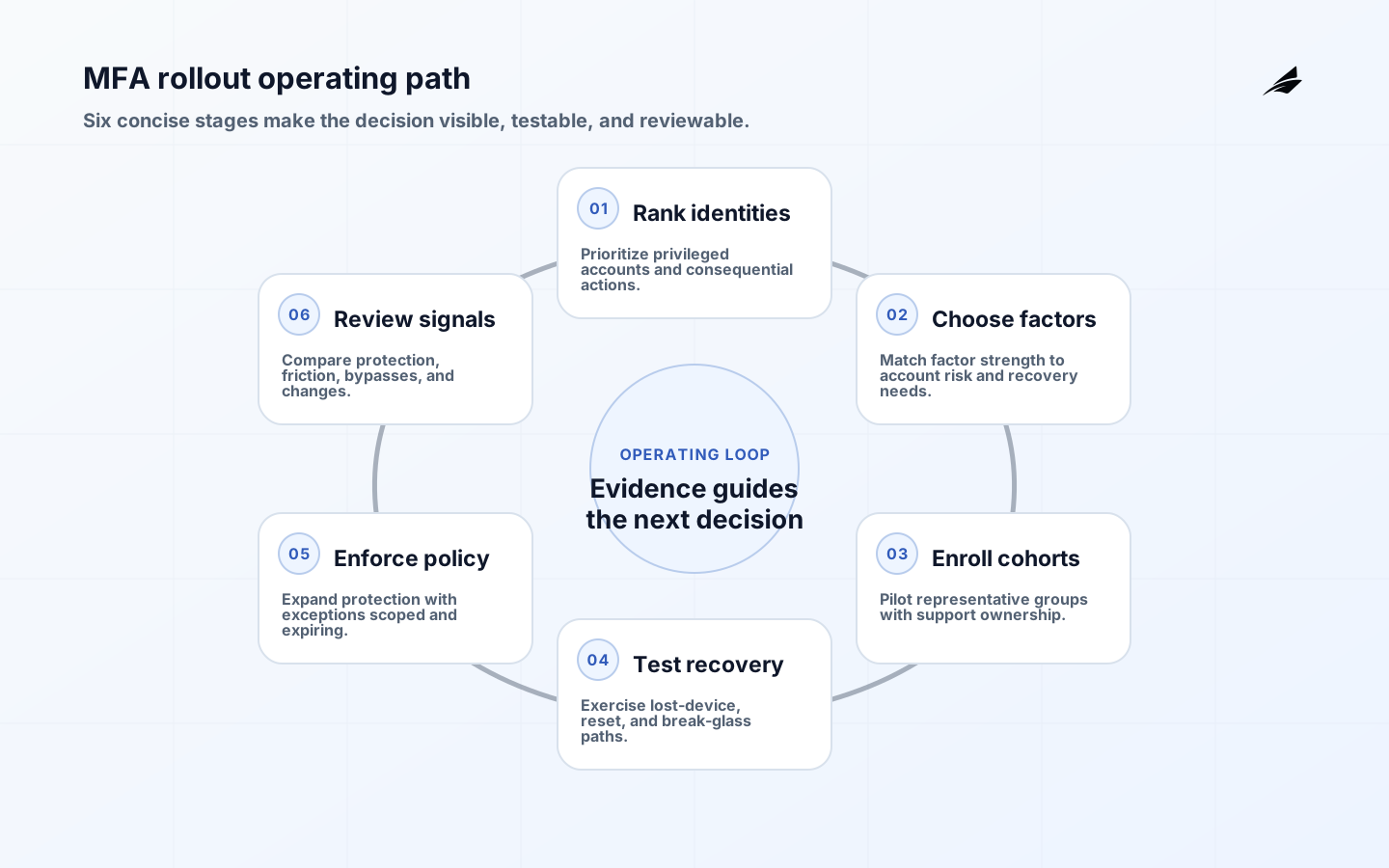
MFA rollout is an identity change programme, not a toggle in the identity provider. Rank the accounts and actions that matter: privileged administration, source control, production access, customer support, finance, and recovery. NIST SP 800-63B treats authentication strength and authenticator management as distinct concerns; use that distinction to decide which factor is acceptable for each risk. For the mechanics behind common factors, compare RFC 4226 HOTP, RFC 6238 TOTP, CISA MFA guidance, and FIDO2. A passkey or security key may be the preferred path for administrators, while a time-based code may be transitional for lower-risk users. Document the rationale and a retirement date for weaker methods.
Set the MFA rollout boundary
In the MFA rollout context, the boundary for MFA rollout is introducing multi-factor authentication across people, administrators, recovery channels, and service operations. In the MFA rollout context, a team should be able to point to the request, the resource, the decision point, and the owner who can change the rule. In the MFA rollout context, in this setting, the central design decision is to make the strongest practical factor the easy default while keeping recovery controlled, tested, and observable. In the MFA rollout context, write down the normal path and the awkward path: a new employee, an automated workload, a support escalation, a revoked account, and a partial outage. In the MFA rollout context, this avoids a familiar pattern where a control exists but nobody can say what it protects. NIST SP 800-53 is useful as a control catalogue because it connects access, configuration, monitoring, and recovery instead of treating them as unrelated checkboxes.
| Boundary question | Practical answer for this design | Evidence to keep |
|---|---|---|
| Protected outcome | State what MFA rollout must allow, prevent, or prove. | Scope statement, owner, and impact of failure. |
| Decision inputs | Use account type, privilege level, enrolled authenticator, factor strength, device binding, recovery event, and sign-in risk. | Source, freshness expectation, and steward for each input. |
| Exception path | Make deviation time-bounded and approved. | Reason, compensating measure, expiry, and review record. |
Design an explainable MFA rollout decision
In the MFA rollout context, good MFA rollout design is intentionally specific. In the MFA rollout context, the key inputs are account type, privilege level, enrolled authenticator, factor strength, device binding, recovery event, and sign-in risk; the implementation needs phishing-resistant authenticators for high-value accounts, staged enrollment, protected recovery, break-glass governance, and sign-in monitoring. In the MFA rollout context, those pieces should agree on vocabulary and ownership. In the MFA rollout context, a policy that says “trusted” without identifying a subject, an action, a scope, and a time limit cannot be tested properly. In the MFA rollout context, keep the rule narrow enough that engineers can predict its outcome, then test the opposite outcome on purpose. In the MFA rollout context, the OWASP Authorization Cheat Sheet reinforces two durable habits: deny by default and verify authorization on the server side. In the MFA rollout context, those habits matter because a polished interface, a network control, or a client-side check cannot establish authority by itself.
- Name one accountable owner for each MFA rollout policy and one reviewer for high-impact exceptions.
- Record which source supplies each decision input and what happens when it is unavailable.
- Keep administrative changes versioned, attributable, and reversible through a tested path.
- Test an expected success, an expected denial, and a recovery action before widening the scope.
Avoid the failure modes that weaken MFA rollout
In the MFA rollout context, the most damaging shortcut in MFA rollout is declaring MFA complete after enrollment while leaving administrators, recovery, or legacy protocols outside the boundary. In the MFA rollout context, it usually begins as a reasonable response to delivery pressure, then becomes invisible infrastructure. In the MFA rollout context, counter it with an explicit inventory, a narrow policy, and an expiry date for every workaround. In the MFA rollout context, do not confuse activity volume with assurance: large logs or a dashboard of green checks do not prove that the right resource was protected. In the MFA rollout context, the OAuth security best current practice is a good reminder that interfaces exposed through browsers and APIs need exact, transaction-bound validation rather than permissive matching. In the MFA rollout context, apply the same discipline here: identify what is bound to the request, what can be replayed or altered, and where the system must reject ambiguity.
Implement MFA rollout in a narrow slice
A credible first release for MFA rollout is administrators first, a representative user cohort next, and rehearsed support and recovery workflows before broad enforcement. Instrument it before broad adoption. Capture a stable actor or workload identifier, the protected target, the policy or configuration version, the outcome, and a correlation identifier. Avoid collecting sensitive material just because it is available; observability should help an operator reconstruct a decision without creating another sensitive store. Treat configuration changes as production changes with peer review and a rollback plan. This approach gives product and security teams a shared way to decide whether the control is helping: they can see the expected traffic, the expected denials, and the support work created by the new boundary.
| Release check | Pass condition | What a miss means |
|---|---|---|
| Expected path | A legitimate MFA rollout request succeeds with attributable evidence. | The policy or integration is not ready to expand. |
| Negative path | An intentionally invalid request is rejected at the enforcement point. | A bypass or incomplete validation may remain. |
| Recovery path | The designated owner can restore approved access without a shared secret. | Operations will invent an unsafe workaround under pressure. |
Operate MFA rollout as a living control
After release, measure whether MFA rollout is still protecting the intended outcome. Watch for changes in request patterns, stale owners, recurring exceptions, policy edits, and dependencies that no longer supply trustworthy information. Review a small sample of both successful and denied decisions with the team that owns the workflow. That investigation should answer who requested what, why the rule reached its result, and how a correction would be made. Use those findings to simplify the policy where possible. The strongest operating signal is not a perfect metric; it is the ability to explain a real event and make a safe correction before a temporary exception turns into permanent access.
Connect MFA rollout to adjacent practices
MFA rollout does not stand alone. It relies on dependable identity, careful authorization, change control, and evidence that can be investigated. The most relevant companion reading is A Field Guide to Zero Trust for Growing Teams, A Field Guide to RBAC for Growing Teams, and session security decisions. Use these guides to align the handoffs: an identity claim should not silently become a broad authorization grant, and a monitoring alert should lead to an accountable response. When the controls share an asset inventory and a consistent owner model, teams can make security improvements without repeatedly rediscovering the same dependencies.
MFA rollout takeaways
- Scope MFA rollout around a protected outcome and a named resource, not a generic security objective.
- Make the decision inputs, enforcement point, owner, and exception expiry visible to operators.
- Start with one measurable workflow, test rejection and recovery, then extend coverage from evidence.
- Review changes and exceptions often enough to remove obsolete access before it becomes institutional memory.
Review MFA rollout evidence
An MFA rollout review should look beyond adoption percentage. Inspect which accounts are actually protected by a strong factor, which legacy protocols still permit password-only access, how administrators recover access, and how often support staff invoke a bypass. Run a controlled lost-device scenario and verify that the recovery process resists impersonation while allowing a legitimate employee to return to work. Track factor changes separately from ordinary sign-ins because they are high-value events. A low-friction enrollment campaign can still leave a serious gap if privileged users, shared operational tools, or emergency accounts fall outside enforcement. Review those boundaries openly, assign owners, and phase out temporary exclusions on dates that are visible to leadership.
MFA rollout FAQ
Where should a team begin with MFA rollout? Begin with one high-value workflow, its resource owner, its normal request path, and the most plausible failure or abuse path. How much documentation is enough? Keep a short decision record with scope, inputs, owner, enforcement point, exception process, and tests; update it when the workflow changes. How do we know the control works? Reproduce a normal request, an invalid request, and an approved recovery while tracing each result to a policy or configuration version. Can a small team do this? Yes. Small teams benefit from a narrower first boundary because it makes ownership and operational evidence realistic rather than aspirational.
Conclusion: make MFA rollout operable
MFA rollout becomes durable when it is a clear decision made at the right boundary, backed by owned inputs and a recoverable operating path. Begin with the workflow that would hurt most to get wrong, make the allow and deny conditions explainable, and expand only after the team can observe and repair the result. That is steady security engineering, with fewer heroic exceptions and more useful evidence.
MFA: turn rollout into an operating decision
MFA: rehearse enrollment and recovery
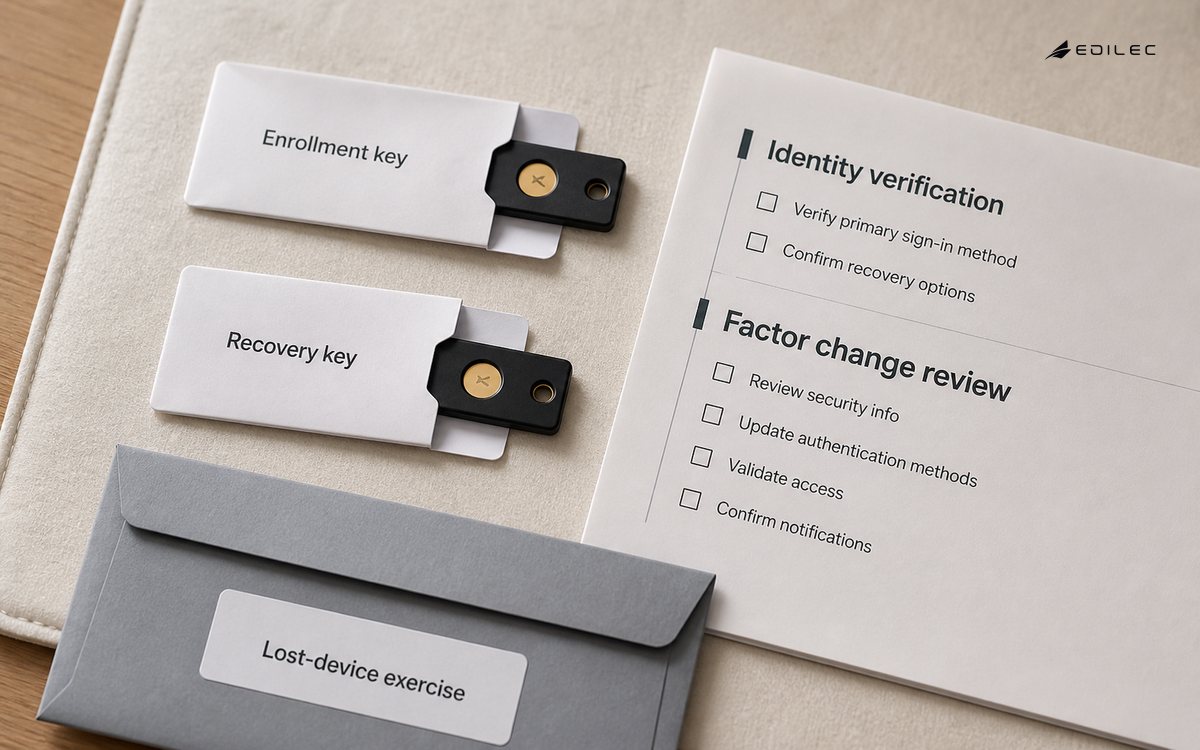
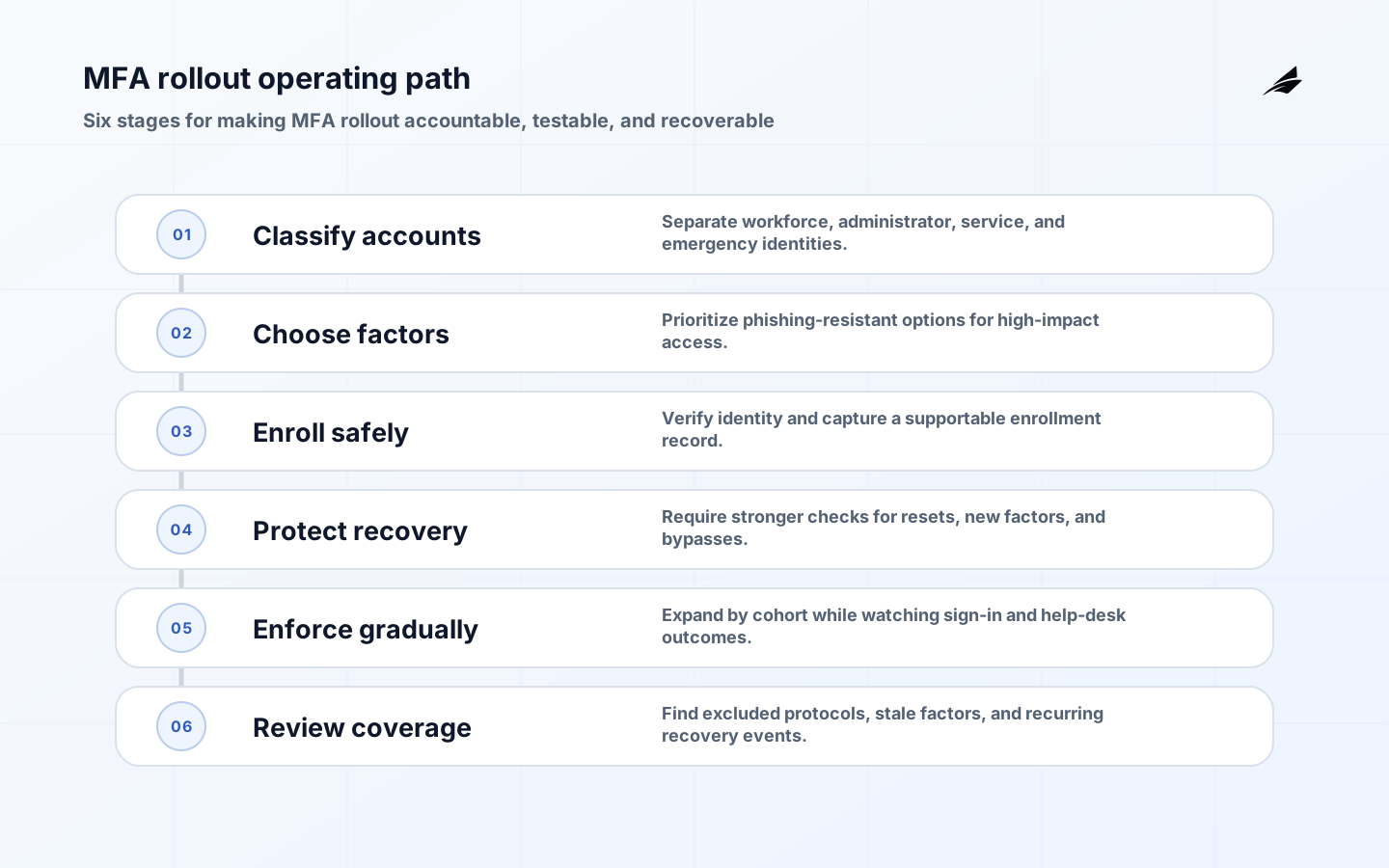
Plan enrollment as a controlled journey. Before enforcement, confirm that users can enroll, sign in from a new device, understand the prompt, and recover without recreating the password-only weakness. Help desks should verify identity through an independent process before resetting factors. Recovery tokens, backup codes, and administrator overrides need ownership, rate limits, expiry, and audit records. A rollout that counts enrollment but cannot explain a recovery event is measuring only the easy part.
Use cohorts to learn without weakening the target state. Begin with security staff and administrators, then teams with predictable support coverage, and finally the broad workforce. Measure enrollment completion, failures by method, recovery requests, time to resolution, suspicious prompts, and exempted accounts. Repeated push prompts or unusual recovery activity should be investigated. RFC 9700 also matters around the factor: OAuth flows must resist code interception, redirect abuse, and token misuse.
Write the operating contract before announcement. Name who approves exceptions, how long they last, what evidence closes them, and what happens when the identity provider is unavailable. Keep service accounts out of a human MFA workaround; use short-lived, scoped workload credentials and separate monitoring. Review inactive authenticators, factor resets, administrative changes, and emergency access after launch.
MFA: connect factors to identity operations
In the MFA rollout context, for a broader view, compare MFA access and operations, evidence and review practice, and recovery planning. In the MFA rollout context, these Edilec guides add the human and operational context around this article’s technical decision.
MFA: preserve rollout evidence and ownership
A practical rollout dashboard should separate protection from friction. Protection signals include privileged accounts without the required factor, factor resets, recovery overrides, repeated prompts, impossible travel, and sign-ins through legacy protocols. Friction signals include enrollment abandonment, device compatibility failures, help-desk wait time, and legitimate users locked out after a device change. Review both by cohort and by authenticator. If one factor creates repeated support failures, fix the enrollment or device path rather than lowering the requirement for everyone. Keep a small pilot group after broad rollout so new identity-provider changes can be tested without exposing the full workforce.
Recovery deserves a red-team exercise. Give the help desk a plausible but incomplete request, test identity proofing, attempt to reuse an old recovery code, and verify that a reset invalidates prior authenticators and active sessions where policy requires it. Confirm that break-glass accounts are monitored, stored separately, and exercised on a scheduled basis. The result should be a short, auditable sequence that restores the right person without creating an easier path for an attacker.
Finally, publish a user-facing change note that says which actions require MFA, which methods are accepted, how recovery works, and where to report a suspicious prompt. Clear language reduces unsafe workarounds and gives support a consistent answer. Revisit the note when policy, factor availability, or recovery ownership changes.