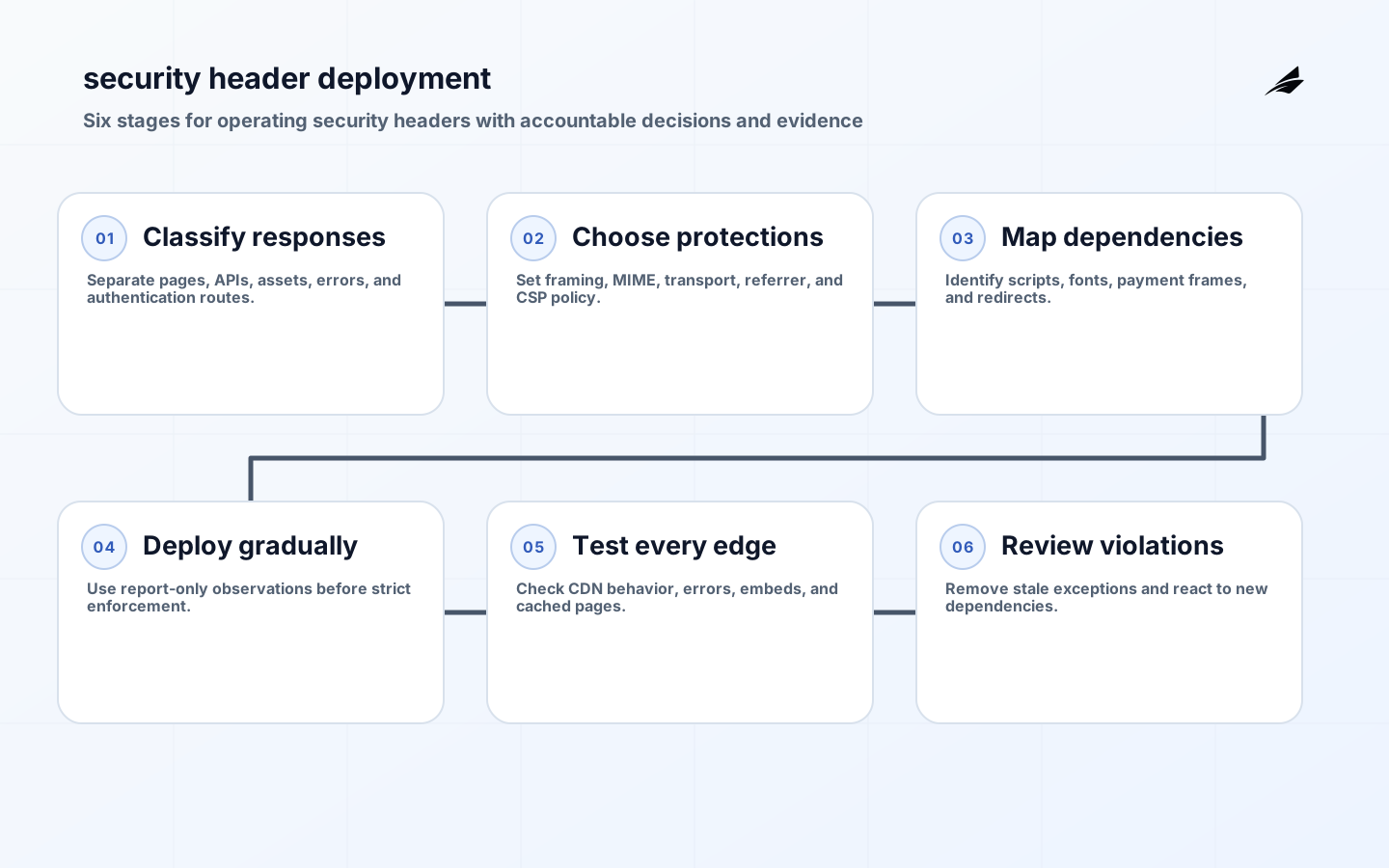
Security headers should be designed as a decision system, not purchased as a feature list. For founders, web engineers, and operations teams, the first question is which concrete outcome must remain reliable and defensible when people, software, or vendors change. In this case the work covers HTTP response protections delivered by browsers and intermediaries across the application, static assets, authentication flows, and embedded third-party content. A useful first release names the protected outcome, the accountable owner, the source of each decision input, and the evidence that explains an allow, denial, exception, or recovery. OWASP Secure Headers Project emphasizes practical safeguards that belong in the implementation rather than in a policy binder. Treat the initial design as a bounded operating practice: reduce the most material failure path, observe it, and make the next change from evidence rather than intuition.
Set the security headers decision boundary
The boundary for security headers is a response type, origin, route class, intended browser behavior, and the service or CDN layer responsible for emitting the header. Write that sentence before selecting a product or assigning a team. It makes ambiguous ownership visible: a control may be technically present while no person can explain who changes it, what dependencies it has, or how a safe exception expires. The design should describe normal operation as well as the awkward paths: automation, support work, recovery, vendor access, and a partial outage. MDN: Content-Security-Policy provides the technical frame for reasoning about the lifecycle and protection of this kind of control. A boundary is credible only when an operator can identify the request or object, the relevant context, the enforcement point, and the person able to resolve a failure without turning a temporary workaround into permanent access.
| Decision | Question to settle | Evidence to retain |
|---|---|---|
| Protected outcome | What must security headers permit, prevent, or prove? | Scope statement, owner, and impact if it fails. |
| Decision input | Which facts are required and who maintains them? | Source, freshness, validation, and steward. |
| Exception | Who can approve a deviation and for how long? | Reason, compensating control, expiry, and review. |
Design security headers for real workflows
A durable security headers design should make the intended path easier than its shortcut. For this topic, set headers at a controlled edge or application layer, begin with route-aware policies, and treat Content-Security-Policy as a tested allowlist rather than a copied string. That is a design choice with operational consequences: teams need clear ownership, versioned change records, an understandable failure response, and enough capacity to avoid bypassing the control during routine work. Avoid describing a trusted network, a shared administrator identity, or a dashboard as proof that the control works. Instead, model the request flow and the decision that protects it. Identify where data enters, where authority is checked, what must be fresh, and what changes must be reviewed. The result is a policy that engineers can implement and an operator can explain without translating vague principles under pressure.
- Assign one owner for the security headers policy and a separate reviewer for high-impact exceptions.
- Keep the smallest rule that protects the stated outcome; document every dependency it assumes.
- Use a time-bounded recovery path with an accountable approver instead of a shared emergency credential or undocumented bypass.
- Link changes to the affected workflow so support and incident teams can distinguish a planned denial from a defect.
Build a narrow, observable security headers release
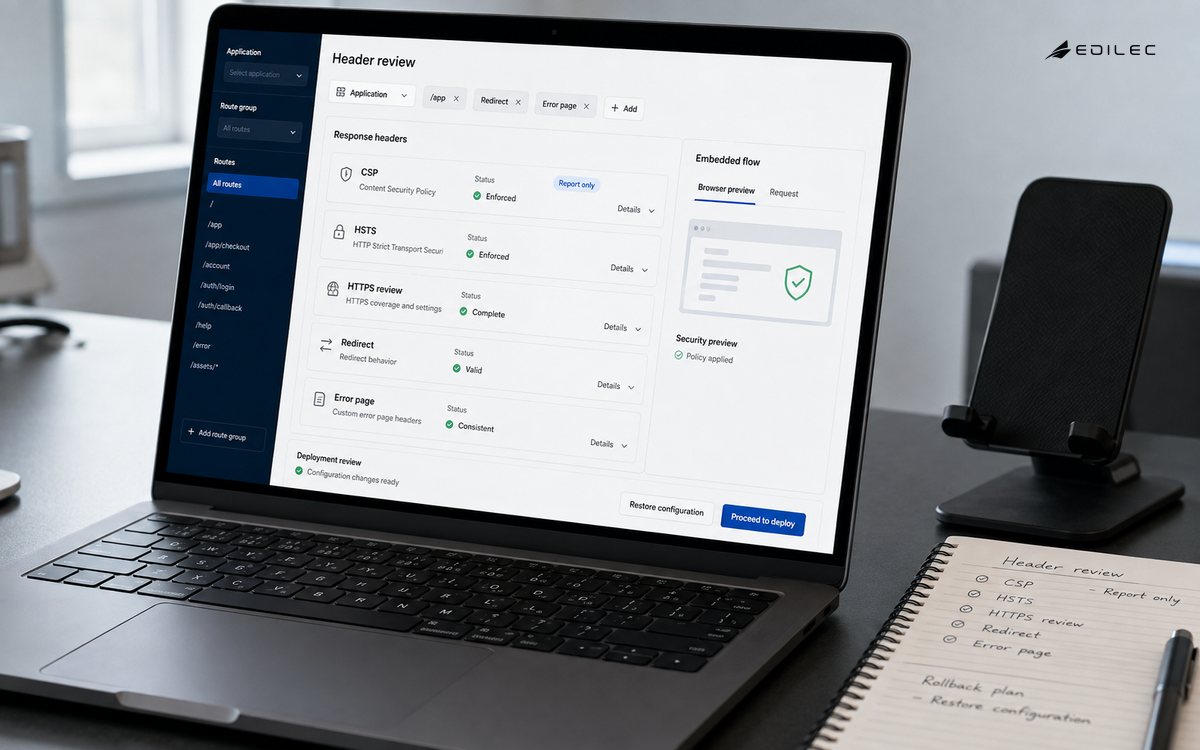
Implementation should start with an end-to-end slice rather than a broad promise. For security headers, inventory response classes, enable HSTS only after HTTPS coverage is complete, deploy a reporting or report-only CSP where appropriate, and version the configuration with application changes. Capture only the evidence needed to operate the decision: a stable actor or workload identifier, target, outcome, policy or configuration version, and correlation identifier. Do not turn the evidence store into another copy of sensitive values. MDN: Strict-Transport-Security is useful here because it joins access, change, monitoring, and recovery concerns instead of treating them as separate features. A first release is ready to widen only after the team can reproduce a normal request, an intentional denial, and a recovery action while identifying the configuration and owner responsible for each result.
| Release check | Pass condition | Why it matters |
|---|---|---|
| Expected use | The intended security headers workflow succeeds with attributable evidence. | Shows that the control fits the work it protects. |
| Expected denial | An altered, stale, or unauthorized variation is blocked safely. | Reveals bypasses, defaults, and missing checks. |
| Recovery | An approved operator restores service without creating lasting access. | Tests ownership, expiry, and evidence under pressure. |
Test failure and recovery before expansion
A configuration review does not demonstrate that security headers survives change. Inspect headers on errors and redirects, test embedded flows and third-party widgets, attempt framing and reflected script cases, and confirm the CDN does not overwrite intended behavior. Run these checks in an environment that resembles production closely enough to expose integration behavior, then record the expected alert, operator action, and rollback condition. The purpose is not to create a theatrical exercise; it is to remove uncertainty from the moment an actual problem arrives. Include a test of the path that teams are tempted to use when the main control is inconvenient. If that path lacks authentication, approval, expiry, or evidence, fix the operating model before expanding coverage. Rehearsal also produces concrete tickets: missing inventory, unclear access, unsafe defaults, or overly broad permissions.
Operate security headers with decision-ready signals
After launch, measure signals that lead to a choice, not activity for its own sake. For security headers, watch CSP violations, missing headers by route, redirect inconsistencies, third-party source changes, report volume, and security configuration drift between environments. A change in one of these signals is an investigation prompt, not automatic evidence that the policy should be weakened. Review a small sample of successful and denied events with the system owner, security partner, and the people who carry support work. OWASP Application Security Verification Standard offers a useful governance frame: protection, detection, response, and recovery remain connected after the first release. Good operations turn exceptions and incidents into improvements to inventory, policy, automation, and documentation rather than a growing list of permanent special cases.
Keep the security headers record usable
Maintain an operating record close to the work, not in a one-time approval document. For this control, record route policy, header owner, CSP source rationale, deployment version, exception domain, review date, and test evidence. This record gives a new engineer or on-call responder enough context to decide whether an event is expected and who can change the situation. Review it when a product capability, integration, owner, or data flow changes, and schedule an explicit check for expiring exceptions. The key test is practical: can someone who did not design the original system trace a surprising result to its input, decision, deployment, and owner without seeking access to unrelated sensitive data? If not, the control is harder to operate than it needs to be.
Connect security headers to adjacent controls
Security headers does not stand alone. Identity, authorization, logging, change management, data handling, and incident response shape whether its boundary remains meaningful over time. The vulnerability management guide is useful adjacent reading because it covers a dependency that frequently appears during implementation and investigation. Keep the linkage practical: use consistent ownership and correlation references, but do not centralize additional sensitive content merely for reporting convenience. When adjacent controls use incompatible identities, clocks, or lifecycle assumptions, teams should resolve that explicitly. Those mismatches are where an otherwise sound local design often loses its value in a real incident or release.
Key security headers takeaways
- Define security headers around a specific protected outcome and a decision boundary that an operator can name.
- Build allow, deny, evidence, and recovery behavior together; a happy-path demonstration is incomplete.
- Make exceptions narrow, approved, observable, and time-bounded so they reveal missing requirements instead of becoming the design.
- Use operational signals and regular ownership reviews to keep the control aligned with changing software and work.
Frequently asked questions about security headers
What should the first security headers release include? One high-value workflow, a named owner, a clear enforcement point, and tested evidence for both success and denial. How should exceptions work? Keep them narrow, approved, visible to reviewers, and automatically or deliberately expired; each exception should create a follow-up decision. Which metric matters first? Begin with whether critical decisions are attributable and explainable, then choose the operational signal closest to the protected outcome. When is the design ready to expand? When the team can repeat a normal request, an intentional failure, and a recovery scenario without relying on one person’s memory.
Conclusion
Good security headers design is concrete enough to operate. Define the boundary, make enforcement and ownership explicit, release the evidence and recovery path with the control, then review what real use teaches. That sequence makes the first build useful without pretending it solves every future case. Before widening the rollout, ask an operator to trace one important workflow through its inputs, decision, outcome, and exception path. Any part they cannot locate or explain is the next piece of work, not a detail to defer.