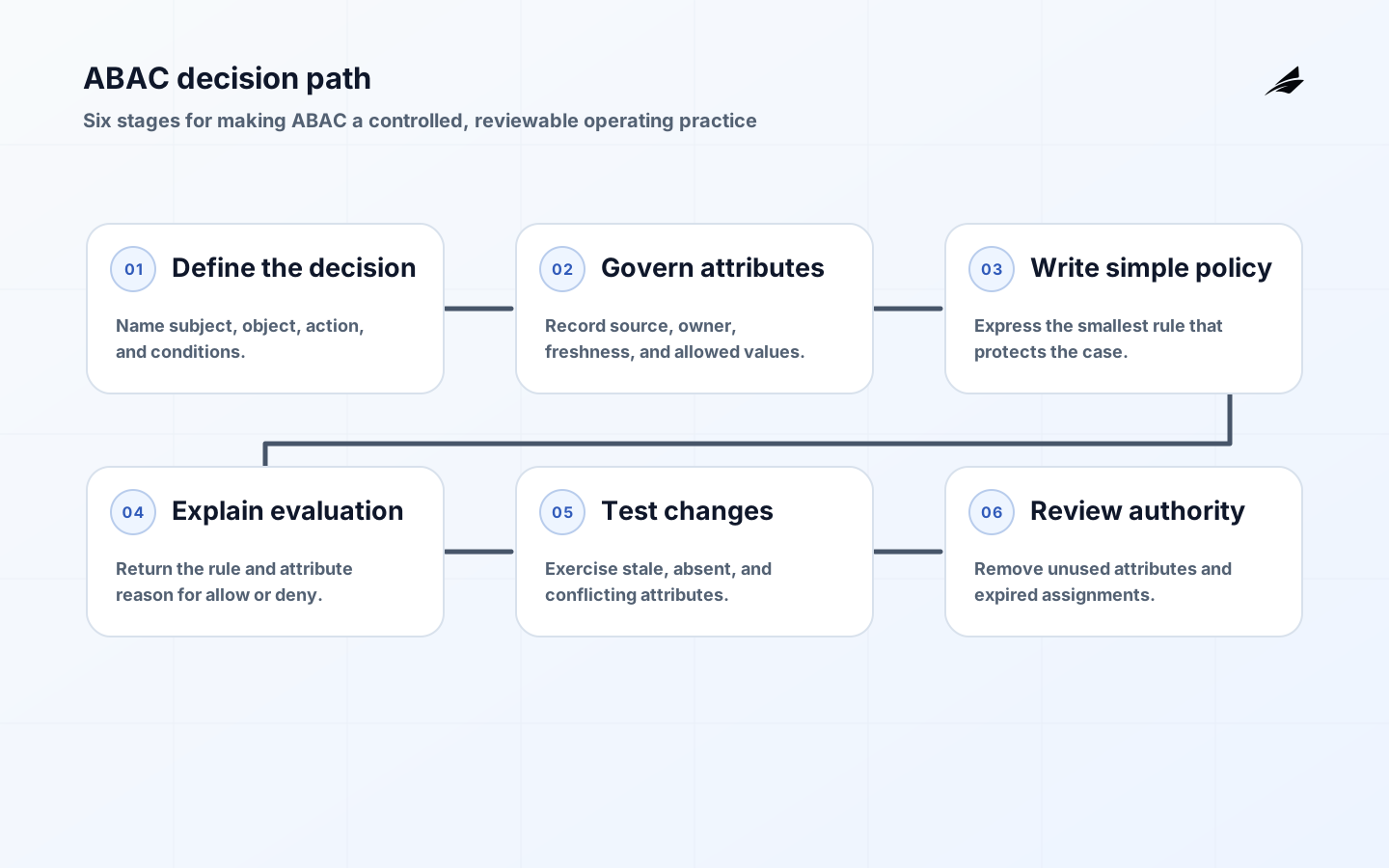
ABAC decisions should begin with the protected outcome, not a product shortlist. Before a team builds or buys anything, write down the request that matters, the people and systems involved, the harm from a wrong decision, and the owner who can resolve an exception. For founders, that turns an abstract security topic into a design constraint that can survive a release. The framing in NIST SP 800-162: Guide to Attribute Based Access Control is useful here because it separates the intended control from the convenient but unsafe shortcut. This guide focuses on the work that belongs before the first build: define the boundary, choose enforcement, test denial and recovery, and retain evidence that explains what happened.
Define the ABAC control boundary
A useful boundary for ABAC is a policy decision evaluated from trusted attributes at request time. Name the subject, object, action, environment, attribute authority, and policy owner before selecting an implementation. This prevents the familiar problem in which a feature protects the happy path but leaves a batch job, administrator tool, backup, mobile client, or vendor connection outside the model. Ask one plain question: for allowing a support engineer to view a customer record only for an assigned case in the correct region and shift, what information must be true before the action is allowed, and which component is responsible for deciding it? The answer should identify the resource, the decision input, the enforcement point, and the operator who owns a failure. That is more valuable than a diagram that only lists systems, because it makes the team state where trust begins and where it must be re-established.

| Decision to settle | Concrete question | Evidence to keep |
|---|---|---|
| Protected outcome | What must ABAC permit or prevent? | Resource, action, owner, and impact statement. |
| Decision inputs | Which facts about the subject, object, action are required? | Source, freshness, and accountable steward for each fact. |
| Exception authority | Who may approve a temporary deviation? | Approver, expiry, reason, and review record. |
Make ABAC architecture choices explicit
The durable architecture choice is to start with a few governed attributes whose source, freshness, and meaning are known. That choice exposes trade-offs early. A central service may simplify policy updates but become a dependency that needs availability and latency limits; distributed checks can be resilient but require a disciplined way to distribute configuration. Avoid using flexible policy syntax before anyone owns the attributes that make a decision reliable. Instead, document the normal request path and the paths people forget: automation, administrators, recovery, exports, and integration callbacks. NIST’s Cybersecurity Framework is helpful as a management frame because governance, protection, detection, response, and recovery are connected work. Architecture is credible when a change owner can answer what fails closed, what fails open only by an approved rule, and how the decision is observed without exposing sensitive values.
- Give ABAC policies, configuration, and deployment changes a named owner and review path.
- Keep attribute provenance, validation, and a policy decision point that produces explainable results separate from application convenience features so it can be tested independently.
- Write the a signed temporary assignment with automatic expiry as a process, not an informal message or shared credential.
Build the smallest useful ABAC path
Start with one bounded path such as allowing a support engineer to view a customer record only for an assigned case in the correct region and shift. Instrument it before expanding coverage: capture the request identity, target, policy or configuration version, outcome, and correlation identifier. Do not capture secrets, complete tokens, or personal fields merely because a log collector can receive them. Implement the normal allow path, the expected deny path, and a recovery path in the same release. The point is not to make every system conform immediately. It is to prove that the selected rule can be operated by the people who inherit it. The OWASP Application Security Verification Standard offers a useful independent lens for checking authentication, access control, and verification expectations while the team translates the design into implementation tasks.
| Release check | Pass condition | What failure teaches |
|---|---|---|
| Normal request | The allowed ABAC action completes with an attributable record. | Whether the intended facts reach the enforcement point. |
| Denied request | A disallowed variation of allowing a support engineer to view a customer record only for an assigned case in the correct region and shift is blocked and explained safely. | Whether a bypass, default, or missing condition exists. |
| Recovery request | An approved operator can recover service without creating permanent access. | Whether the exception route has evidence, expiry, and ownership. |
Test denial, change, and recovery
A configuration review is not proof that ABAC works. Exercise a request with missing, altered, stale, and unexpected context. Verify that the application gives a safe response while operators can see enough evidence to diagnose the event. Then change one relevant input: a policy rule, identity attribute, client registration, certificate, key permission, or rate budget. Observe whether the deployed result matches the intended change and whether rollback restores a known state. In particular, rehearse a signed temporary assignment with automatic expiry. Recovery deserves this attention because attackers often target the route designed to help legitimate users. The control is ready for broader use only when the team can distinguish a real outage from an intentional denial and can repair either without guessing.
Operate ABAC with meaningful signals
After launch, measure behavior that can prompt a decision. For ABAC, watch policy denials driven by stale region, assignment, or employment attributes, changes in exception volume, configuration drift, and the age of unresolved findings. A sudden rise in blocks can indicate abuse, an overly narrow rule, an unannounced client change, or a broken attribute source; it is a prompt to investigate, not an automatic reason to weaken the control. Use a short review cadence with engineering, security, and the business owner. The review should examine a sample of allowed and denied events, expired exceptions, and changes that bypassed the expected release process. NIST SP 800-53 Rev. 5 is a useful reference for treating access, logging, configuration, and incident evidence as connected controls rather than isolated features.
Connect this decision to adjacent controls
ABAC is rarely the entire security decision. Identity, authorization, logging, data handling, and incident response determine whether the boundary remains meaningful as software changes. The rbac decisions that matter before the first build guide is useful related reading because it approaches a neighboring decision from the same build-before-scale perspective. Connect records across these controls with stable request and change identifiers, but avoid centralizing sensitive contents just for convenience. The practical goal is an investigator or operator being able to move from a surprising result to the responsible component, rule, and owner without collecting a second copy of the data at risk.
Make ABAC ownership and records usable
ABAC needs an operating record, not an after-the-fact policy statement. Record the protected workflow, boundary, accountable owner, input source, enforcement location, change reference, exception state, and recovery contact. Keep the record near the operating work so a support engineer can distinguish a planned denial from a defect. That makes handoffs safer: the next person does not have to infer why the control exists or whether a temporary condition is still permitted.
Recognize ABAC failure modes early
The damaging ABAC failures are often quiet. A source can become stale, a new integration can bypass the intended check, an emergency path can become routine access, or a deployment can change a default without updating the decision record. Treat these as design scenarios, not surprising production anecdotes. For each, define the safe behavior, alert threshold, investigator, and condition that permits normal operation to resume. That makes the control resilient without asking people to improvise under pressure.
Bring ABAC into change management
Every material ABAC change should identify which requests, identities, data paths, or customer workflows may behave differently. Review the proposed rule with an owner of the protected process, test representative cases, and release it with a rollback or containment option. Link the policy or configuration version to observed results; a ticket number alone is not enough evidence. This preserves a way to understand a decision after the original release context has faded.
Set a review cadence for ABAC
Schedule a short ABAC review around real events: a new integration, product permission, incident, audit finding, certificate or key lifecycle event, or an exception reaching expiry. Ask whether the boundary remains accurate, source data is trusted, recovery has been rehearsed, and signals point to new bypasses or friction. Retire unused rules and stale exceptions rather than collecting them indefinitely. A predictable review cadence turns evidence into a practical maintenance habit and gives leaders a clear place to accept or reduce residual risk.
Key ABAC takeaways
- Treat ABAC as a decision about a policy decision evaluated from trusted attributes at request time, with a named owner and explicit inputs.
- Release allow, deny, telemetry, and recovery behavior together; a happy-path demonstration is incomplete.
- Use exceptions that expire, leave an evidence trail, and drive a follow-up improvement.
- Review operational signals and real changes so the design does not drift into unexamined trust.
Frequently asked questions about ABAC
What should the first ABAC release include? One high-value workflow, a clear boundary, a tested decision point, a named owner, and evidence for allow, deny, and recovery outcomes. How should exceptions work? Make each exception narrow, approved, time-bounded, and observable; use it to discover a missing requirement rather than as a permanent alternate channel. Which metric matters first? Start with the completeness and explainability of decisions, then track the operational signal most connected to the protected resource. When is the design ready to broaden? When the team can reproduce a normal request, an intentional denial, and a recovery event without relying on tribal knowledge.
Conclusion
Good ABAC design is deliberately concrete. Define the request and resource, choose a verifiable enforcement point, test the awkward paths, and give operations evidence they can use. That sequence makes a control easier to change safely as teams, integrations, and threats evolve. The first build should therefore leave behind more than a feature: it should leave a decision model, a recovery route, and a review habit that keeps the intended boundary intact. Before expanding, have an operator trace one allow and one denial through their attribute sources, policy evaluation, and expiry rules. That rehearsal reveals whether the organization can trust the attributes on which flexible access decisions depend.