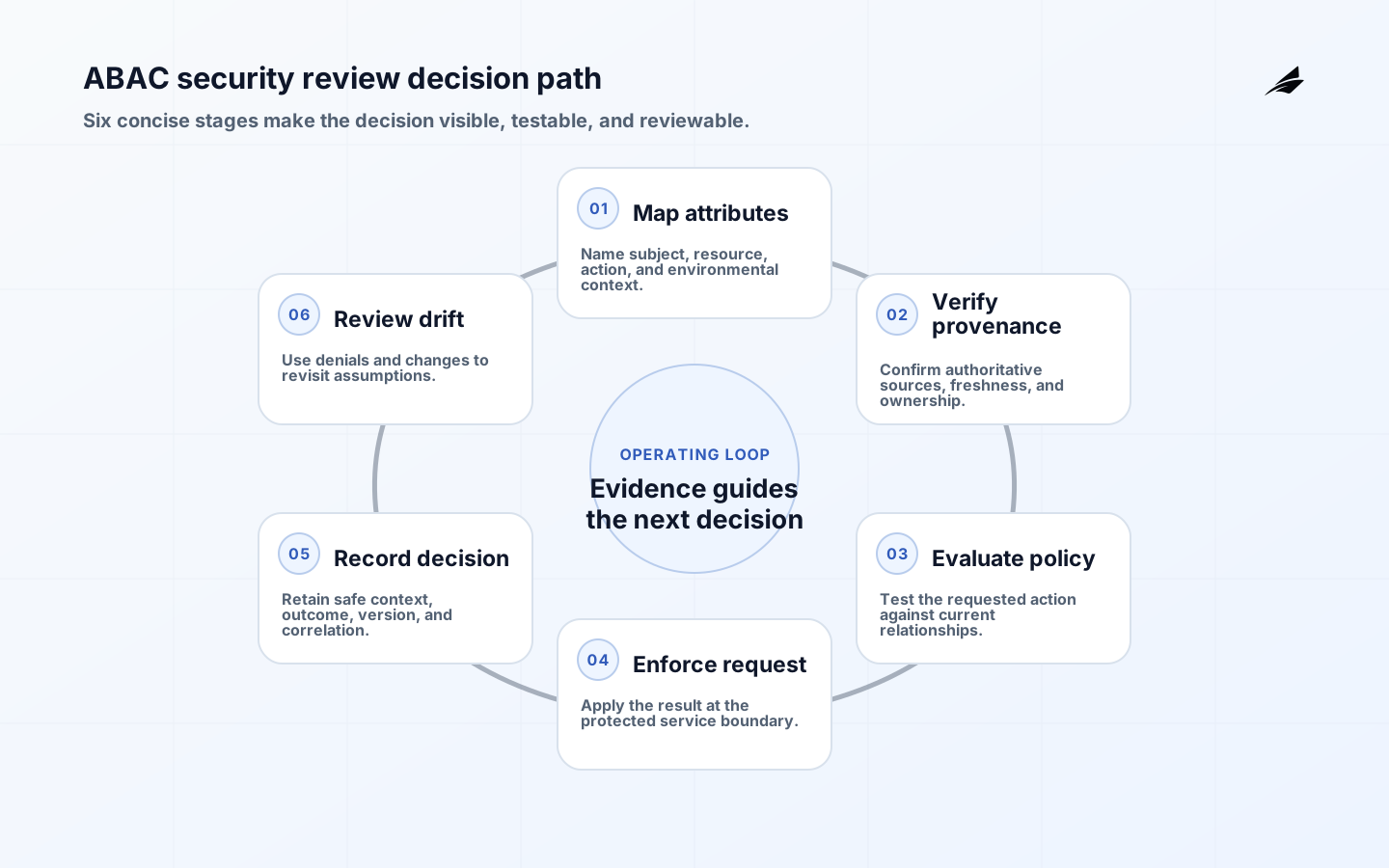
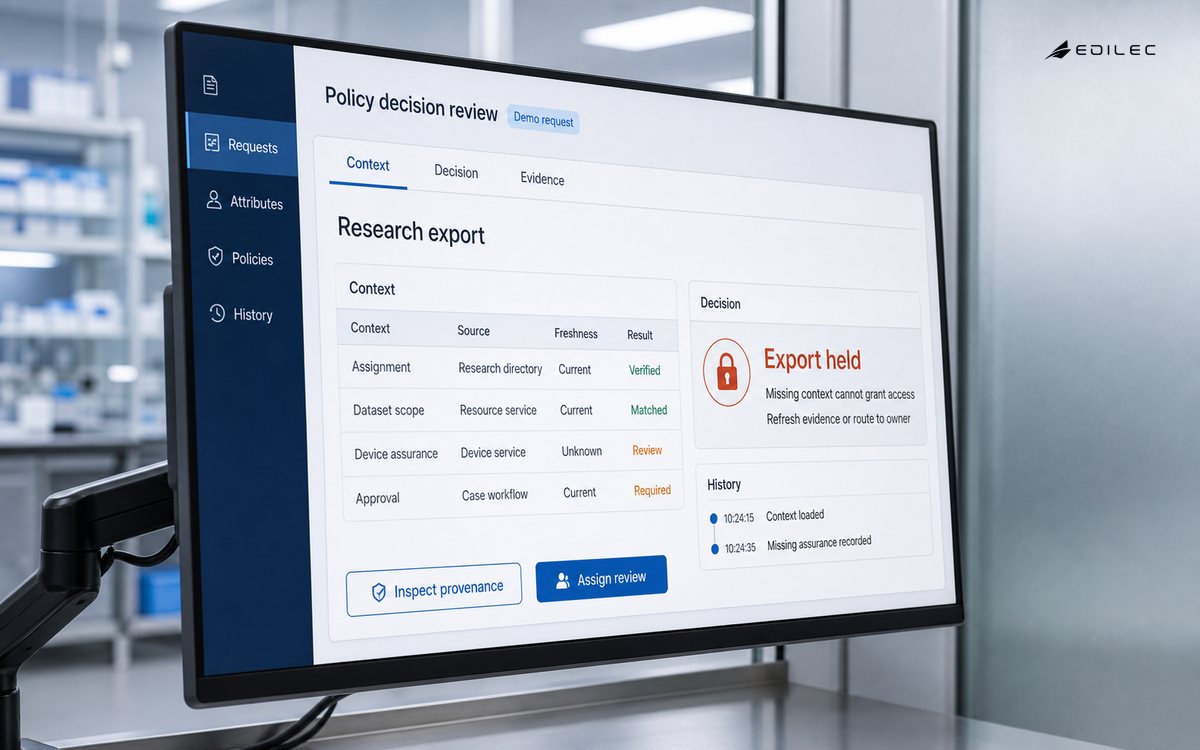
An ABAC review becomes useful when it follows one decision from a business relationship to an enforced result. Take a support export request: the subject is an employee with a current support assignment, the resource is a customer dataset with a tenant and sensitivity label, the action is export rather than view, and the environment may include device assurance and an approved case. NIST SP 800-162 describes these subject, object, operation, and environment attributes as the ingredients of an ABAC decision. Name the owner and freshness expectation for each ingredient. “Assigned support staff may export” is incomplete until assignment, scope, approval, and revocation are testable facts.
Start with a decision, not a policy language
Choose a small number of consequential requests and state the desired outcome in ordinary language. For example: an account manager may export data only for an assigned customer, an approver may authorize a refund only within their limit, and a service workload may call an endpoint only for its registered client. Identify the subject, action, resource, tenant or relationship, and contextual conditions that matter. Then identify conditions that must never become an implicit bypass, such as a missing owner, unknown region, stale employment status, or unavailable risk signal. This produces rules that stakeholders can challenge before they are buried in configuration.
| Attribute group | Examples | Review question |
|---|---|---|
| Subject | Employee status, role, team, tenant membership, device assurance. | Who is authoritative, and how quickly does a change reach policy evaluation? |
| Resource | Owner, classification, tenant, lifecycle state, transaction amount. | Can the service load the correct object before deciding? |
| Action | View, edit, approve, export, delete, administer. | Is the action specific enough to distinguish different consequences? |
| Environment | Time, network, approved change, session risk, location where appropriate. | Is the input reliable, proportionate, and safe when absent? |
Model the decision inputs and their quality
Attributes are not magical facts. They are values produced by identity systems, application databases, workflow engines, device services, and sometimes user input. Document their source, owner, format, update path, freshness expectation, and sensitivity, following NIST SP 800-205 and NIST IR 8112 on attribute considerations and metadata. A rule that relies on a worker's department may fail if a transfer takes days to synchronize; a rule using resource ownership may be wrong if an ownership change is incomplete; a client-supplied tenant value should never decide access by itself. Prefer server-derived attributes and validate their relationship to the requested resource. Decide in advance whether missing or stale context causes denial, a constrained path, or a human review.
- Use stable, documented attribute names and values; ambiguous labels create policy drift.
- Keep authoritative sources close to the business process that changes the attribute.
- Distinguish an unknown value from a value that explicitly means no; both should not default to allow.
- Limit policy inputs to information that materially improves the decision and can be protected appropriately.
- Record ownership for attributes used in high-impact rules, including service-to-service claims and resource metadata.
Enforce close to the resource and action
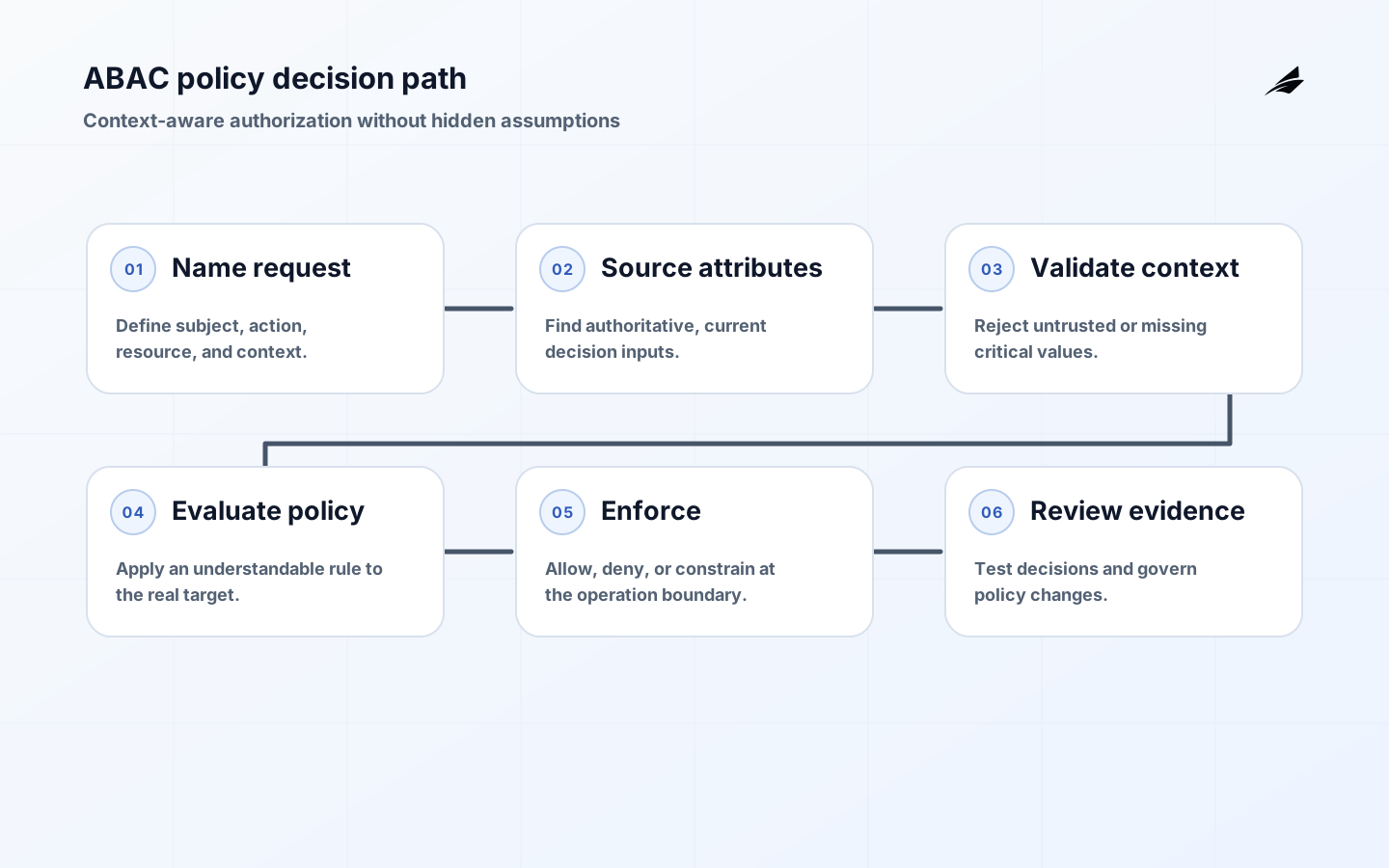
The authorization point must evaluate the real request before the protected operation occurs. It should identify the caller, resolve the resource from a trusted identifier, gather the required server-side attributes, evaluate the policy, and apply the result. A front-end filter that hides rows or a gateway that checks only a broad token claim cannot establish that a particular object is within scope. For workflows involving multiple steps, ensure that approval, execution, and follow-up use the same protected context. Test whether a caller can substitute an identifier, change method, reuse an approval, race a state change, or call a downstream service directly.
Make policies readable and testable
Policy complexity is a security risk when only one engineer can predict a result. Keep a plain-language statement next to the implementation, use consistent action names, and expose an explanation suitable for authorized reviewers without leaking sensitive policy details. Build tests from examples: correct tenant and assignment, wrong tenant, expired assignment, altered amount, missing attribute, stale session, and a denied action after a role or ownership change. Include regression tests whenever a policy or attribute source changes. An audit trail should capture the policy version or decision basis where practical, plus actor, target, action, outcome, and correlation information.
| Failure mode | Likely consequence | Review response |
|---|---|---|
| Stale subject attribute | A mover retains authority from a prior role. | Set update expectations, revoke promptly, and test transfer scenarios. |
| Untrusted resource attribute | A caller changes scope by supplying a field. | Derive or validate the attribute on the server. |
| Policy mismatch across services | One component allows a request another would deny. | Centralize shared decisions or test policy consistency at boundaries. |
| Opaque deny result | Operators cannot distinguish abuse from a data-quality failure. | Log safe decision context and provide an escalation route. |
Govern policy and attribute change
Treat a high-impact policy change as a production change. Define who may author, review, test, approve, deploy, and roll back it. Review changes to attribute meaning with the same care: changing a team value, data classification, customer relationship, or integration claim can alter access without a policy edit. Monitor denied decisions, overrides, unusual use of exception paths, and failures to retrieve attributes. These observations help distinguish hostile probing from an honest mismatch between policy and work. For roles that provide a baseline, RBAC design for internal tools is a useful companion.
Run a practical operating exercise
An ABAC security review becomes more concrete when a team traces one relationship-dependent request through live data. Choose a request such as a manager viewing an assigned account or an approver authorizing a limited refund. Capture the subject attributes, resource attributes, environmental conditions, policy version, and final result. Then deliberately change one input at a time: assignment, tenant, time, amount, employment status, and the availability of the attribute source. Verify that a missing critical input does not become an allow decision and that the explanation permits a legitimate operator to diagnose a data-quality issue. Repeat after a policy deployment or integration change. This establishes whether the authorization system reflects current business facts rather than a collection of stale claims and hidden default behavior.
Add a short review session whenever a policy whose decision relies on changing customer assignment data changes the assumptions behind attribute-based access control. Bring the attribute owner, policy maintainer, and application operator together and start with the actual request rather than a control label. Trace the request from the authoritative record through identity, configuration, policy, implementation, and the evidence an investigator would use. Ask whether stale or unavailable context fails in a safe and explainable way. Then introduce one realistic failure: a delayed directory update, unavailable dependency, stale configuration, unexpected retry, or departure of the person who normally knows the workaround. The group should choose a safe response before the next urgent event forces improvisation. Capture only concrete outcomes: a missing owner, an unclear approval limit, a test that does not reach the enforcement point, a recovery step that is too broad, or an evidence record that cannot be retrieved. Assign each outcome to a person and date, and rerun the same scenario after the change lands. This practice keeps attribute-based access control connected to daily operations. It also reveals when a process appears complete because a document exists, while the service itself still depends on unwritten knowledge or standing privilege. Over time, retain a small decision history so new team members can understand why the boundary exists and which assumptions must be revisited as the product, vendors, and workforce change.
ABAC review takeaways
- An ABAC security review follows a complete decision from attribute source to enforcement and evidence.
- Model attributes as managed dependencies with owners, freshness, provenance, and explicit failure behavior.
- Authorize the exact action against the real server-side resource and relationship.
- Keep policies explainable through plain-language intent and adversarial test cases.
- Govern changes to policies and attribute meaning because both can expand access.
ABAC review FAQ questions
ABAC review conclusion
Attribute-based access control earns its flexibility only when teams govern the facts it depends on. Start with a small consequential decision, establish trusted inputs and a server-side enforcement point, then test the expected and failing paths. A careful ABAC security review turns context from a source of hidden exceptions into an explainable boundary.
ABAC: turn the model into an operating decision
ABAC: test one relationship-dependent request
Use a decision matrix before writing policy syntax. For a normal request, require current employment, an exact tenant relationship, a permitted action, and a recorded case. For an unknown relationship, deny and route to a data owner; for an unavailable risk signal, allow only a lower-risk read if the business accepts that bounded mode; for an emergency export, require separate approval and expiry. This is more precise than treating every failure as either a blanket outage or a silent allow. It also makes review concrete: which attribute changed, who changed it, and did the decision point see the change?
ABAC often fails at joins rather than rules. A directory can correctly report a team while the customer system carries a stale assignment. A service can validate a tenant claim but load an object belonging to another tenant. Test the joins explicitly: change assignment between authorization and execution, substitute an object identifier, replay an allowed decision, and call the downstream endpoint without the front end. NIST’s ABAC publication and OWASP’s authorization guidance both support validating permissions on every request, denying by default, enforcing checks in the right location, and testing authorization logic.
Keep explanations safe and useful. An operator should see that a request was denied because an assignment was missing or an approval expired, but the record should not expose sensitive policy internals unnecessarily. Store actor, action, target, decision, policy version, attribute provenance, and correlation information. Review denied spikes, overrides, stale attributes, and policy changes together. If a rule cannot be explained to its owner or reproduced in a test, it is not ready for production.
ABAC: connect authorization to neighboring controls
In the ABAC review context, for a broader view, compare ABAC access and operations, evidence and review practice, and recovery planning. In the ABAC review context, these Edilec guides add the human and operational context around this article’s technical decision.
ABAC: preserve ownership and decision evidence
For a useful review workshop, bring the policy owner, attribute owners, service engineer, support representative, and incident responder. Trace one allowed request and one denied request using production-shaped but safe data. Ask where each attribute came from, when it was last updated, whether a caller could alter it, and what happens if its source is unavailable. Then change one fact at a time: revoke the assignment, move the resource to another tenant, alter the action from view to export, expire the approval, and replay the request. Record not only the result but the explanation, latency, audit event, and recovery route. This exercise exposes hidden coupling faster than reading policy files. It also gives the team a small regression suite that can run after an identity, directory, data model, or policy change.
Treat policy versioning as part of release management. A review should name the previous rule, the proposed rule, affected requests, test fixtures, approvers, rollout boundary, and rollback condition. Monitor decisions by outcome and reason, not just total authorization volume. A rising deny rate may reveal an attack, a stale relationship, or a product workflow that no longer matches the policy. Route those cases differently and review them with the right owner.