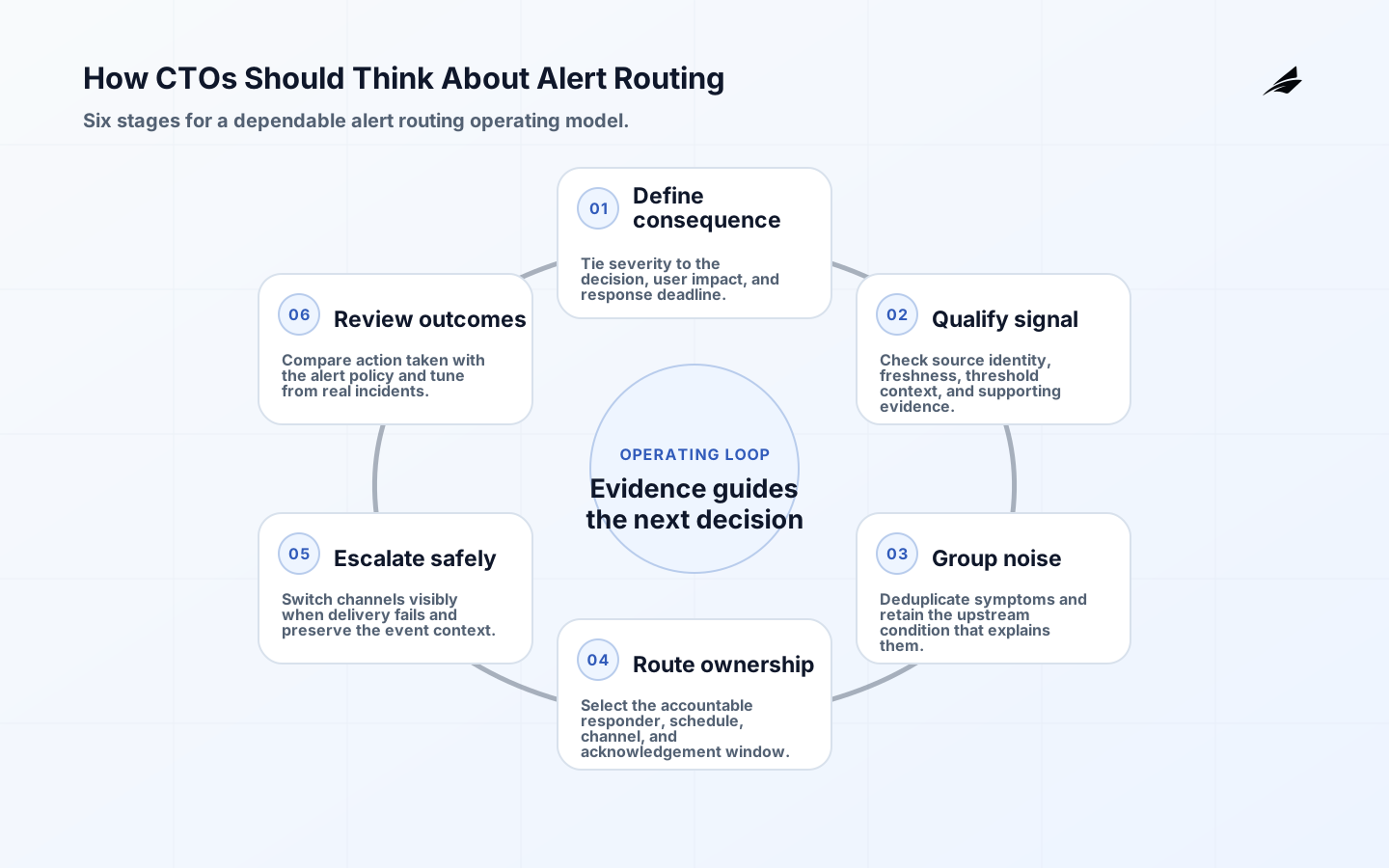
Alert routing is an operating decision system: it decides which signal deserves attention, who can act, how quickly, and what evidence remains when the path is noisy or unavailable. A CTO should treat it as part of the connected product rather than as a notification plug-in. A temperature excursion, a gateway outage, and a failed notification provider may all produce messages, but they do not deserve the same response.
What alert routing must accomplish
Begin with operational consequence, urgency, recipient, acknowledgement expectation, escalation window, and evidence needed to judge whether a signal is real. That keeps alert routing close to the workflow it must support. Speak with the operator, the person who supports the service at an inconvenient hour, and the person accountable for risk. Record ordinary use, maintenance, a disrupted connection, replacement hardware, late information, and unavailable dependencies. A sound scope says what remains possible, what must stop, and who receives a clear status when an assumption is no longer true.
A working model for alert routing
A workable model combines well-defined conditions, deduplication and grouping, severity policy, ownership mapping, channel choice, escalation, acknowledgement, and tuning. None of these pieces is ornamental. A feature can look successful while it has no named owner, no freshness rule, no clear authority, or no recovery path. Write the choices as testable statements: what enters the boundary, what leaves it, which party may change it, and what evidence proves the intended result. Those statements become acceptance checks, support guidance, and a way to settle disagreements without relying on memory.
| Element | Alert-routing decision | Alert-routing evidence |
|---|---|---|
| Operational purpose | Which decision alert routing changes | For alert routing, record the named user and expected action. |
| Boundary | What may cross and under what authority | For alert routing, retain a versioned policy or contract. |
| Recovery | For alert routing, answer this question: What happens when a dependency fails? | For alert routing, retain a test record and owner. |
Notification architecture and responsibility boundaries
Alert-routing architecture must express responsibility rather than merely list components. In practice, separate event detection from notification delivery, preserve original context, integrate schedules and ownership, and protect notification endpoints as production dependencies. In alert routing, make the normal path easy to trace and state the identity, authorization rule, failure behavior, and observation method at every boundary. In alert routing, NIST guidance for operational technology is useful because it treats availability and safety context as essential, not incidental. In alert routing, the equipment and regulations differ by site, but a hidden trust boundary is never a durable simplification.
A measured rollout for alert routing
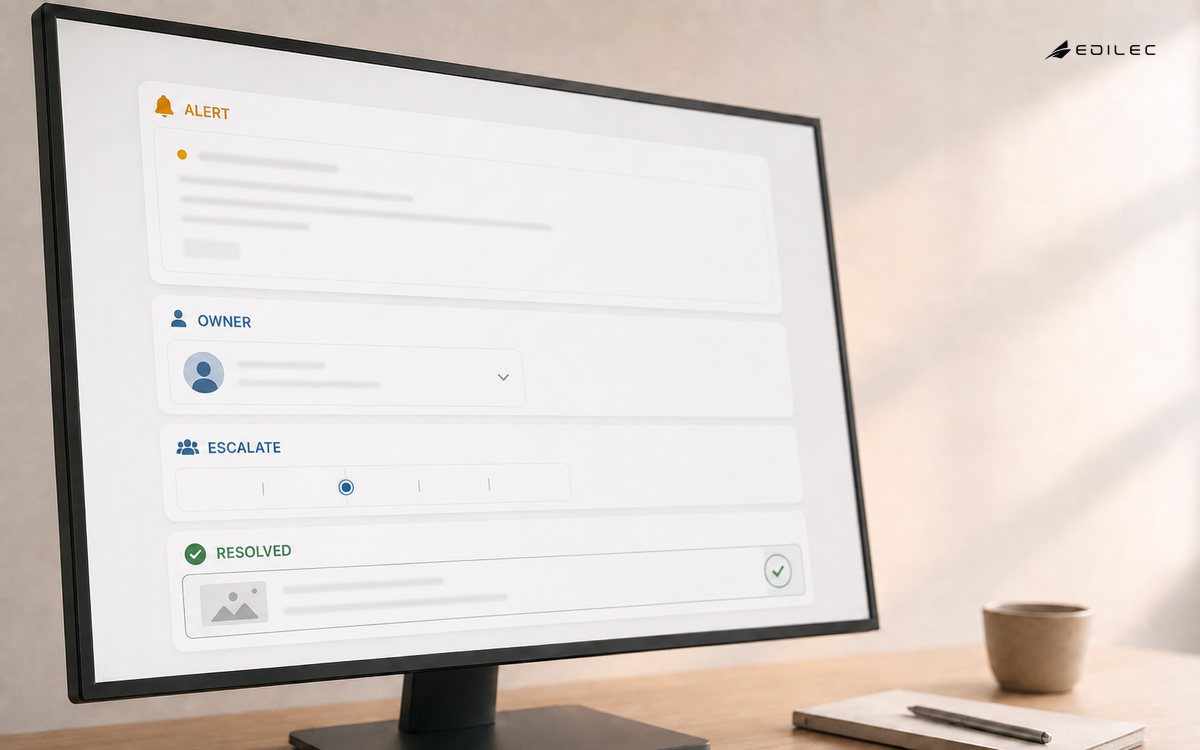
Build in measured stages. Begin with a small set of high-confidence alerts, write a response action for each, simulate duplicate storms and failed channels, then tune from incident evidence. Treat each stage as a hypothesis about an outcome and an acceptable side effect. Instrument it before broadening the scope. A pilot that includes real operators and imperfect conditions teaches more than a clean demonstration, because it exposes missing permissions, misleading timing, and recovery work. The early goal is not maximum coverage; it is reliable evidence to decide whether the model should be expanded, changed, or stopped.
Alert-routing choices under pressure
Group symptoms around one upstream fault. Use an independent escalation path when a channel fails. Convert an alert with no response action into a report or remove it. These are operating decisions, not implementation trivia. In alert routing, capture them in a concise contract that a developer, operator, and reviewer can test. In alert routing, the contract should distinguish observed time from received time where data moves asynchronously, distinguish an accepted request from a completed physical action, and identify what happens when a prerequisite is unavailable. In alert routing, those distinctions prevent a polished interface from overstating what the underlying system knows.
| Situation | Safer response | Alert-routing shortcut to avoid |
|---|---|---|
| Normal operation | Document expected alert routing behavior | For alert routing, do not depend on unstated knowledge. |
| Disrupted dependency | In alert routing, show status, preserve context, and follow a bounded recovery rule | In alert routing, keep acting as if upstream evidence is current |
| For alert routing, document each change or exception. | Use approved ownership and an auditable path | Create permanent broad access or silent overrides |
Signals that reveal routing quality
Operating signals keep the design honest. Review alerts per actionable incident, acknowledgement and resolution time, escalation rate, pages outside ownership, suppressed-event review, and repeated alerts with no action. In alert routing, put each signal beside an objective and an owner able to act on it. In alert routing, metrics without a decision create noise; a compact set tied to user impact makes diagnosis faster. The OpenTelemetry observability primer explains how traces, metrics, and logs can be combined, but it cannot choose the right operational question for a team. In alert routing, retention and access should be explicit when observations expose site behavior or customer activity.
When notification paths fail
The dangerous shortcut is paging a person for every threshold crossing, using severity as a synonym for loud, or treating acknowledgement as proof the condition is fixed. In alert routing, it often begins as a deadline concession and becomes difficult to remove after other teams depend on accidental behavior. In alert routing, design the exception path deliberately: fail closed when an unsafe action must not occur, retain enough context to investigate, and show a visible status when automatic recovery is uncertain. In alert routing, a resilience claim is credible only after the team has exercised loss, restart, and recovery at the boundary that matters.
Who may receive and change alerts
Alert-routing security covers the people and channels allowed to receive operational evidence. Use distinct service identities for integrations, protect on-call schedules, and audit policy changes that alter who is paged or who can suppress a signal. NIST zero trust architecture helps avoid treating a notification channel as inherently trusted. The response record should reveal both the originating condition and the policy that selected the recipient.
Testing delivery, meaning, and escalation
Routing standards are helpful when they drive tests of delivery and meaning. The MQTT specification explains publish-subscribe behaviors, but an alerting application must still decide how to group, expire, and escalate conditions. Test a duplicate storm, missing acknowledgement, failed primary channel, schedule change, and a recovery event. The system should show why a person was contacted and when escalation stops.
Review the on-call experience before scale
In alert routing, before expanding, conduct an operational review with the people who will carry the system. Can they identify current state and freshness? Can responders find the owner of an exception? Can they reverse a material change? Can they explain what evidence proves recovery? The answers reveal whether alert routing has become an accountable service or only a successful integration test. In alert routing, improving these answers often has more value than adding more data, devices, or screens.
Record the routing policy and its assumptions
For alert routing, keep a short decision record that names the use case, accountable owner, boundary, assumed operating conditions, evidence reviewed, and the next review date. In alert routing, record the rejected alternative as well as the chosen approach. In alert routing, this prevents a later maintenance change from quietly undoing a safety, reliability, or access decision that made sense in the original context. In alert routing, when a real incident contradicts an assumption, update the record and the relevant test rather than only patching the immediate symptom.
Alert routing operating contract
For alert routing, write the contract around a real notification decision: name the signal owner, severity rule, acknowledgement window, delivery authority, escalation stop condition, and evidence retained after the event. Test duplicate alarms, a stale source, a schedule change, a failed primary channel, and a responder who must work from the recorded context. The operating model is ready when a responder can distinguish an active condition from a delivery problem. The design also benefits from NIST operational-technology security guidance, NIST zero-trust architecture, MQTT Version 5.0, and RFC 7252. In alert routing, for related Edilec reading, compare the alert-routing checklist, alert-routing architecture guide, and IoT telemetry decision guide.
Test alert routing with one consequential workflow, such as a temperature excursion or gateway outage, and follow the record from detection through acknowledgement and closure. Keep the original event, delivery attempt, recipient decision, escalation history, and final disposition together. Exercise duplicate suppression, delayed input, provider failure, and an on-call handoff; then review whether the responder could identify the next safe action. Judge the result by useful notifications, trustworthy timing, and recoverable evidence rather than delivery volume.
| Decision area | Alert-routing question | Alert-routing evidence |
|---|---|---|
| Purpose | For alert routing, answer this question: Which real decision does the system change? | For alert routing, record the scenario, owner, and acceptance example. |
| Boundary | For alert routing, identify what is allowed, and what is deliberately excluded? | For alert routing, retain policy, identity, and version details. |
| Failure | For alert routing, identify what happens when data, network or dependency fails? | For alert routing, retain a contingency test and visible status. |
| Change | For alert routing, answer this question: Who can alter rules, mappings or access? | For alert routing, retain approval, diff and rollback point. |
| Review | For alert routing, answer this question: What shows the design remains useful? | For alert routing, retain outcome, exception and correction record. |
Alert-routing takeaways worth carrying forward
- Define the decision before selecting an alert-routing implementation.
- Make boundaries, authority, and degraded behavior explicit.
- In alert routing, pilot with real users and failure conditions before broad rollout.
- In alert routing, use evidence tied to an owner to improve the service after launch.
FAQ: questions operators ask about alert routing
When is an alert-routing design worth formalizing? Formalize it when missed, duplicated, or misdirected notifications can delay a material decision or hide evidence needed for investigation. What belongs in the first release? Choose one high-consequence workflow with named owners, severity and acknowledgement rules, a secondary delivery path, and a tested closure record. How should quality be measured? Track actionable-notification rate, acknowledgement and resolution time, escalation accuracy, suppressed-event review, and whether responders can explain why a notification was sent. Who owns the service after launch? The operational owner defines the outcome; engineering, security, and support each need an explicit responsibility for delivery, access, and recovery.
Conclusion: make alert ownership visible
Alert routing delivers value when it makes the next decision clearer and safer. In alert routing, keep the first scope bounded, preserve the context needed to interpret evidence, and refuse shortcuts that bury ownership. In alert routing, the durable result is not a vendor setting or a diagram. In alert routing, it is a service whose boundaries, recovery behavior, and accountable decisions remain understandable as the fleet, site, or product changes.
Checks to run before widening alert coverage
- In alert routing, confirm the documented boundary matches observed production behavior.
- In alert routing, rehearse the most consequential interruption and verify recovery evidence.
- In alert routing, review access, configuration, and ownership changes on a defined cadence.
- In alert routing, keep the design readable enough that a new on-call engineer can find the next safe action.