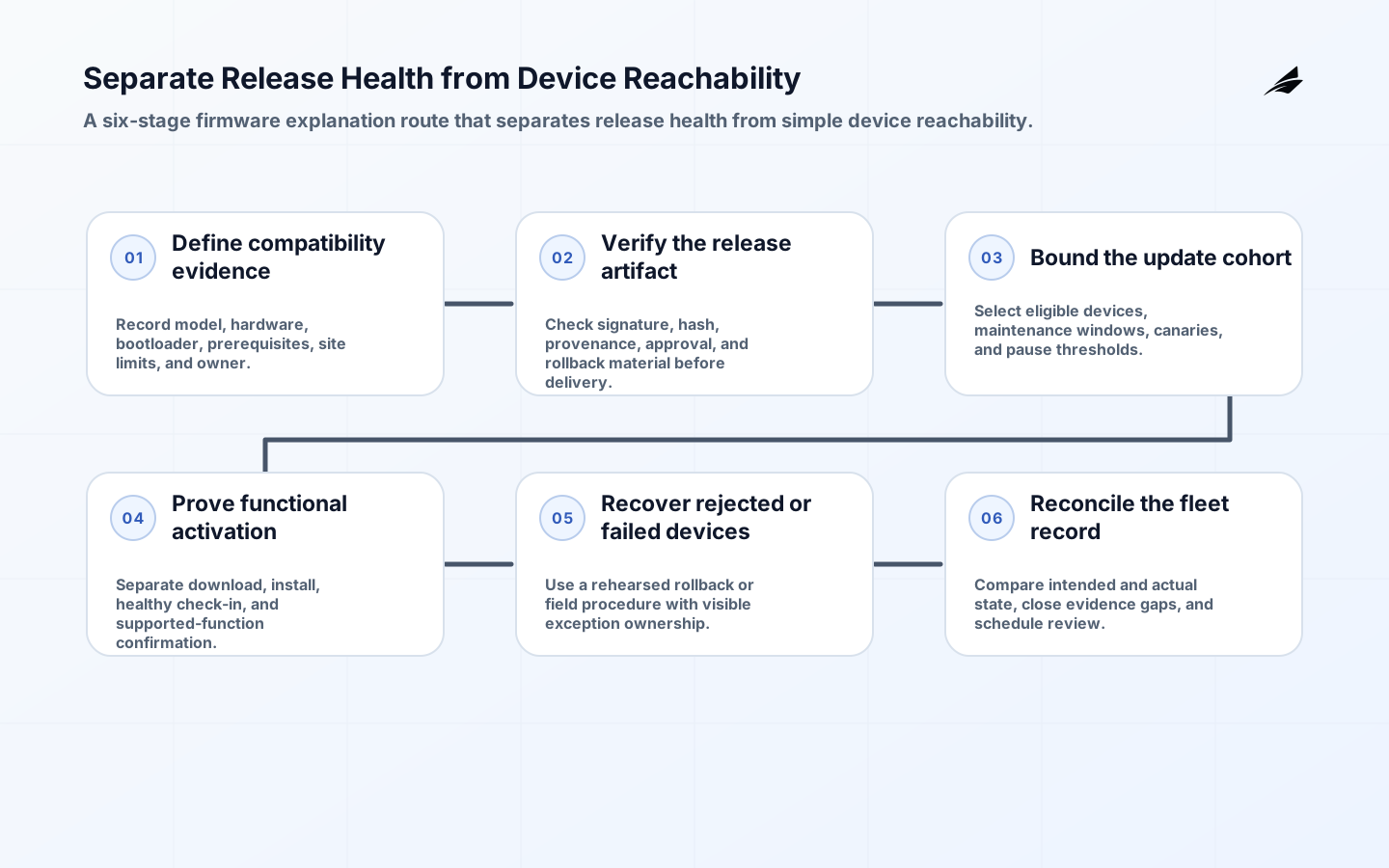
Firmware updating is an operating choice for IT managers and device operations teams, not a product label. In a connected environment, the useful question is whether the process helps people make a timely, defensible decision when devices, networks, and dependencies are imperfect. Firmware updates change device software in a controlled way so vulnerabilities and defects can be addressed without creating an unmanaged fleet failure. Start with the real workflow by naming its decision, accountable owner, required evidence, and safe response to late or disputed information.
Firmware Updating: Define the Operational Promise
In plain language, firmware updates change device software in a controlled way so vulnerabilities and defects can be addressed without creating an unmanaged fleet failure. The distinction between a technical capability and an operational promise matters. Installation is only the technical capability; the operational promise must survive shift changes, supplier maintenance, partial outages, and ordinary human error. State the business or safety consequence first, then identify the data, interface, and authority needed to support it. The term earns its place when it answers a concrete question instead of decorating an architecture diagram.
For firmware updates, a fleet state is credible only when each device reports its identity, hardware revision, installed version, update attempt, verification result, and recovery status. Distinguish package delivery from successful activation: a device can download an image yet fail on reboot or return with a degraded service. Track the target cohort separately from devices that are eligible but deferred because of power, maintenance windows, or a safety constraint. Those distinctions let a release owner pause intelligently instead of interpreting a single percentage as proof of success.
| Operating question | Design answer | Evidence to retain |
|---|---|---|
| What job is being improved? | Firmware updating: name the workflow, response window, and accountable owner. | Firmware updating: a current workflow map and agreed success measure |
| What must be true to act? | Firmware updating: use attributable data inside a known authority boundary. | Firmware updating: source, time, identity, quality, and approval context |
| What changes when something fails? | Firmware updating: show a degraded state and route it to a person who can decide. | Firmware updating: failure test, escalation path, and recovery record |
| How will the team know it works? | Firmware updating: review operational signals instead of launch completion. | Update completion rate, failure rate by hardware revision, time in vulnerable version, rollback count, and devices with unknown state |
Firmware Updating: Design for Interrupted Devices
A practical firmware updates architecture starts with combining authenticated metadata, staged cohorts, power and connectivity checks, recovery partitions where supported, and fleet-level evidence. Trace the journey from device or source through gateway, service, storage, and user action. Identify the authoritative component, cacheable or estimated values, active identity, and points requiring human approval. These implementation details are less glamorous than platform selection, but they expose dependencies before those dependencies become outages or unsafe workarounds.
The failure to guard against is straightforward: a universal rollout can turn a packaging error, incompatible dependency, or interrupted installation into an outage across the same asset class. Design inconvenient cases before scale makes them harder to change. Specify a safe fallback, show users that the system is degraded, and rehearse restoration or reconciliation of state. OT-adjacent firmware work adds particular constraints because availability, safety, and reliability may matter differently than they do in ordinary business software.
Firmware Updating: Bound the First Campaign
Start with one bounded firmware updates workflow. Write down its actor, input, decision, output, exception path, and recovery check in plain language. A limited first release establishes a baseline for latency, accuracy, operator effort, and failure recovery. It also gives security and operations teams something concrete to review. Increase scope only after the first path is understood, supported, and used; a broad platform promise is not evidence of operational value.
- List the real assets, people, records, and approvals involved in firmware updates.
- Write normal and degraded behavior before choosing an implementation detail.
- Keep source, time, quality, and ownership visible at consequential actions.
- Use versioned configuration or contracts for changes that affect operations.
- Exercise an exception path with the team that will support it.
- Review recurring friction before adding a second workflow.
Firmware Updating: Bind Authority to Change
Every consequential firmware updates change needs a named owner, a review point, and a reversible path. The change record for this work should capture the reason, affected assets, configuration or contract version, approver, implementation window, verification result, and rollback condition. That record gives the next person on call a usable history and helps separate a planned behavior change from a fault, often speeding restoration.
| Risk pattern | Control to build | Review signal |
|---|---|---|
| Unknown current state | Expose freshness, quality, and source identity next to the decision. | Records that are stale, missing, or unowned |
| Uncontrolled change | Use versioned configuration, approval, and tested recovery. | Changes without verification or an accountable requester |
| Ambiguous authority | Separate observation, recommendation, and irreversible action. | Actions that bypass the intended review boundary |
| Hidden dependency failure | Test degraded behavior and document the support handoff. | Exception age, failed retries, and recovery duration |
Firmware Updating: Measure Verified Recovery
Use measures that show whether the workflow is trustworthy, rather than merely whether a component is online. For firmware updates, track update completion rate, failure rate by hardware revision, time in vulnerable version, rollback count, and devices with unknown state. Pair those measures with a short review of actual exceptions: what happened, what evidence was present, where the team hesitated, and whether the recovery rule was clear. Together, these views expose the gap between nominal availability and operational usability and prevent an SLA or dashboard from substituting for understanding.
Firmware Updating: Connect Identity and Recovery
Firmware updating is easier to assess alongside its neighbors. Firmware Updates: Operations Playbook offers a focused companion view; Device Provisioning: A Security Review for IoT Teams covers a dependency that commonly shapes design choices; and Device Identity: Explained from First Principles helps frame an operating consequence. These are connected choices, not a shopping list. A sound design leaves operators with clearer authority and stronger evidence when the normal path stops being normal.
Firmware Updating Source Notes
Firmware resiliency, secure development, Uptane, and TUF each contribute a different control: platform recovery, trusted software change, role separation, and metadata integrity. SP 800-193: Platform Firmware Resiliency Guidelines; SP 800-218: Secure Software Development Framework; Uptane Standard 2.0.0; TUF TAP 15: Succinct Roles.
Separate Release Health From Device Reachability
Example: Stage a Sensor-Fleet Firmware Rollout
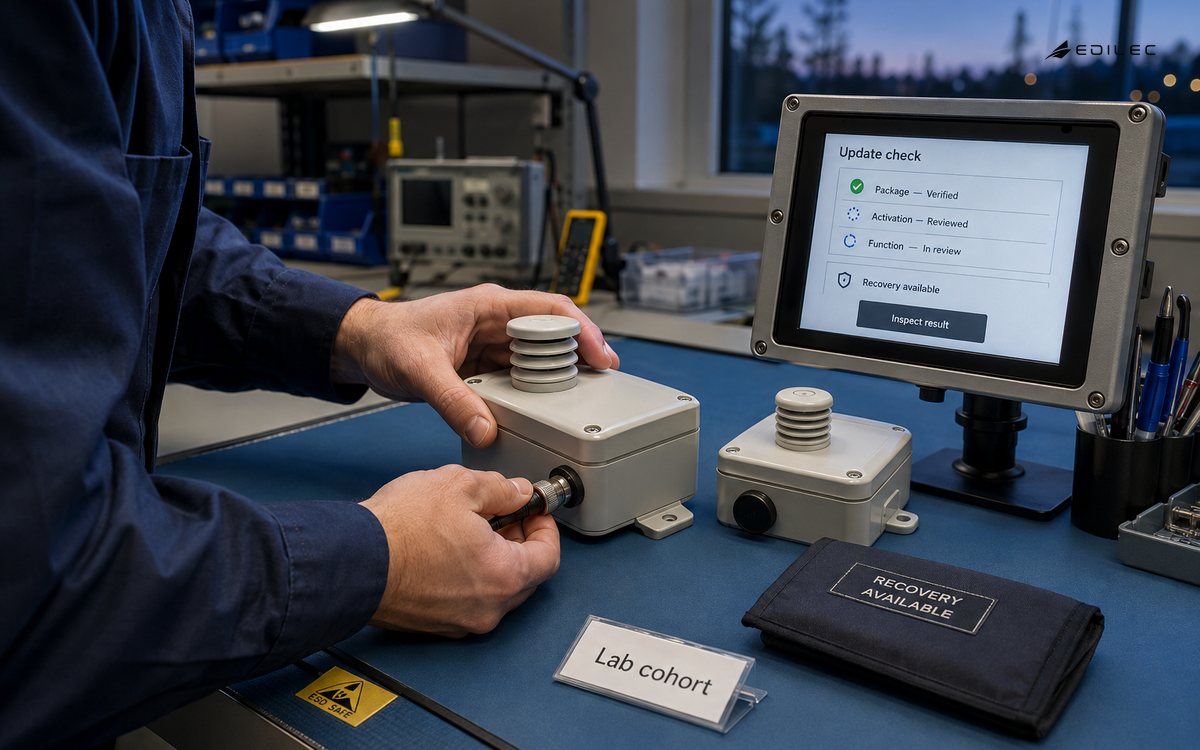
A staged rollout should distinguish three populations: devices eligible for the package, devices that received it, and devices that verified a healthy post-reboot state. Consider 2,000 sensors with two hardware revisions. Start with a lab cohort, then a small production cohort that represents both revisions and several network conditions. Pause on a meaningful failure signal such as boot-loop recovery, missing telemetry, or a measured change in calibration behavior, rather than waiting for every device to report a final state.
Reachability is not release health. A device can be online and still run the wrong image; it can be offline because of a planned outage rather than an update failure. Record package digest, target version, device identity, hardware revision, attempt time, verification result, rollback state, and reason for deferral. Those fields let an owner separate an artifact problem from a site constraint or a telemetry gap.
Rollback should be a tested path with a compatibility rule, not a promise in a runbook. Confirm that the previous image remains available, that configuration migration is reversible, and that a local technician knows the recovery boundary when remote access is unavailable. A release is complete only when the fleet state and the operational consequence agree.
NIST SP 800-82 Rev. 3 keeps OT safety and availability in scope; NISTIR 8259A describes device capabilities needed for security controls; NIST SP 800-207 supports explicit identity and access decisions; and NIST SP 800-213A offers a requirement catalog for IoT device cybersecurity.
For adjacent safeguards, read the firmware operations playbook, the device provisioning review, and the device identity primer alongside the reference. Firmware Updates: Operations Playbook clarifies one boundary; Device Provisioning: A Security Review for IoT Teams adds a complementary operating pattern; and Device Identity: Explained from First Principles helps connect the decision to a wider connected-systems workflow.
Firmware Updating Key Takeaways
- Firmware updates should serve a named operational decision and owner.
- Keep source, time, quality, identity, and authority context near consequential actions.
- Design normal behavior, degraded behavior, and recovery before expanding integrations.
- Firmware updating: treat configuration and contract changes as operating events with evidence.
- Use recurring exceptions to improve the workflow rather than normalize uncertainty.
A firmware rollout needs explicit stop conditions before the first device receives an image. Define the cohort, expected duration, acceptable failure signals, health checks after reboot, and the person empowered to halt expansion. Include devices with relevant hardware revisions, connectivity conditions, and installed versions rather than testing only ideal lab units. When a device fails, preserve the package identifier, logs, power state, and recovery action so the problem can be grouped accurately. The rollout decision should distinguish a temporary communications issue from an installation failure or a functional regression. That evidence makes promotion or rollback a reasoned operational choice.
Keep the release inventory current after promotion. A fleet report should identify devices that were never eligible, were intentionally deferred, or no longer report their version. Those categories need different owners and should not disappear inside a single completion percentage.
For the identity and recovery context around firmware change, compare this explanation with Firmware Updates: Operations Playbook, Device Provisioning: A Security Review for IoT Teams, and Device Identity: Explained from First Principles. A firmware campaign is complete only after the supported device function is confirmed and every exception has an owner and a next review date.
Firmware Updating FAQ
What is the smallest credible first release? One bounded firmware-updating campaign with a real device cohort, an authoritative compatibility record, an exception route, and a recovery exercise. How should a campaign show uncertainty? Mark each device as eligible, pending, stale, rejected, or disputed; retain the package and source evidence; and route consequential ambiguity to the release owner. When should the update design change? Change it when cohort exceptions recur, hardware support changes, or a safety or reliability requirement shows that the compatibility rule no longer matches the fleet.
Conclusion: Make Firmware Change Recoverable
Reliable firmware updates make ordinary work, exceptional work, and recovery understandable to the people responsible for the outcome. Name the decision, protect its evidence, constrain authority, stage the change deliberately, and review real exceptions with the operating team. This turns a connected capability into an operational asset rather than another opaque dependency.