What Changes When HRMS Workflows Move into Production
HRMS production workflow explains how a team can make HRMS production workflow dependable before the work becomes difficult to reverse. HRMS production workflow uses a decision with a named owner, bounded action, visible state, and inspectable evidence.
Define the HRMS production workflow decision
HRMS production workflow is ready for a controlled release when the team can state what is authoritative, which context permits action, what must be retained, and how an exception reaches a responsible person. HRMS production workflow uses a provisional state when evidence is incomplete; HRMS production workflow never turns an unanswered question into a silent default.
What Changes When HRMS Workflows Move into Production
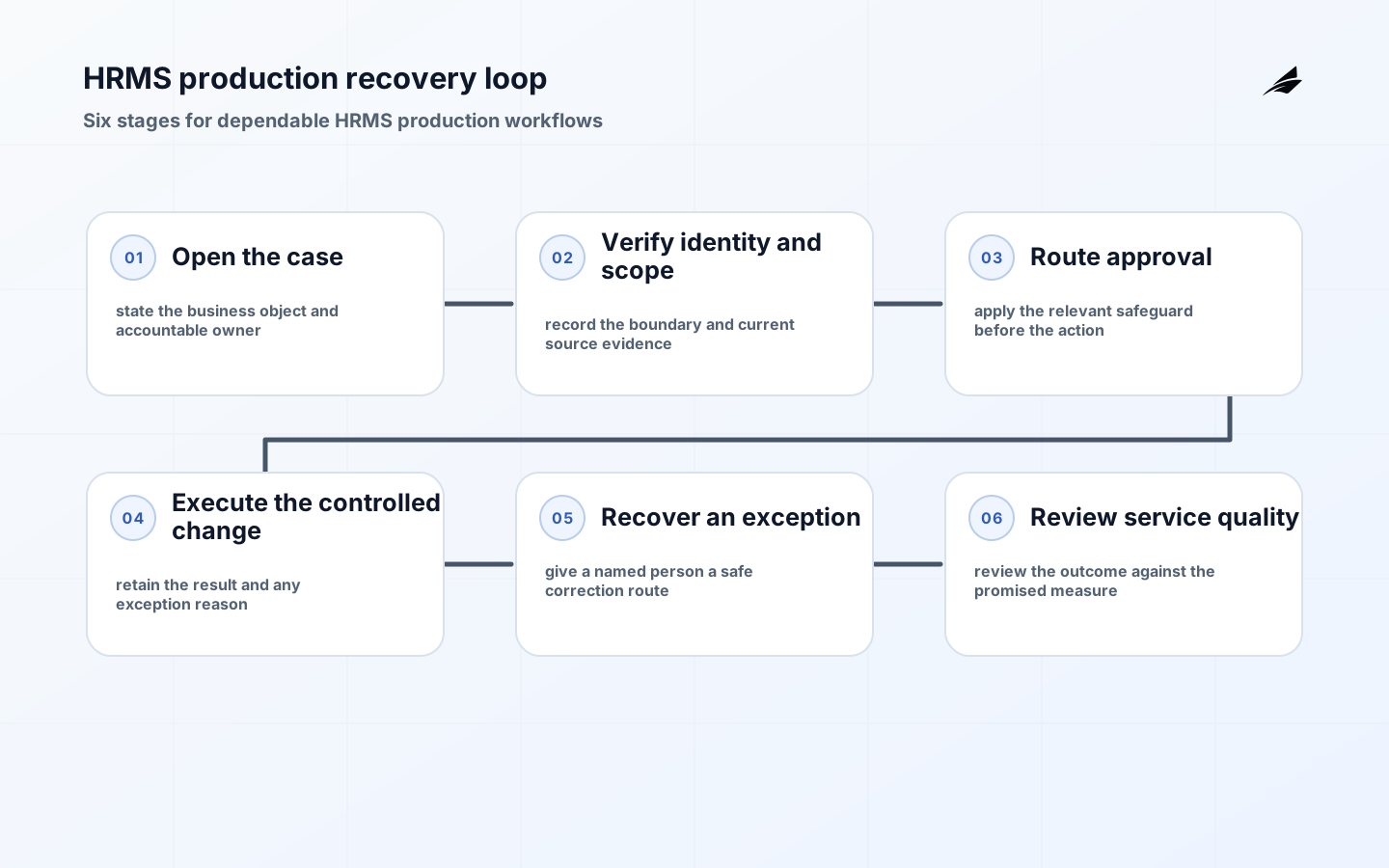
- For HRMS production workflow, frame one consequential business object and one accountable owner.
- For HRMS production workflow, capture employee records at the boundary where a request becomes an approved operational action.
- For HRMS production workflow, test the privacy controls route with missing, late, duplicate, denied, and corrected inputs.
- For HRMS production workflow, review downstream impact before a change reaches a reader, customer, employee, supplier, or device.
- For HRMS production workflow, approve a bounded correction with a named resolver, deadline, and retained reason.
- For HRMS production workflow, verify the released result against the promised measure and record what remains uncertain.
Controls and evidence for HRMS production workflow
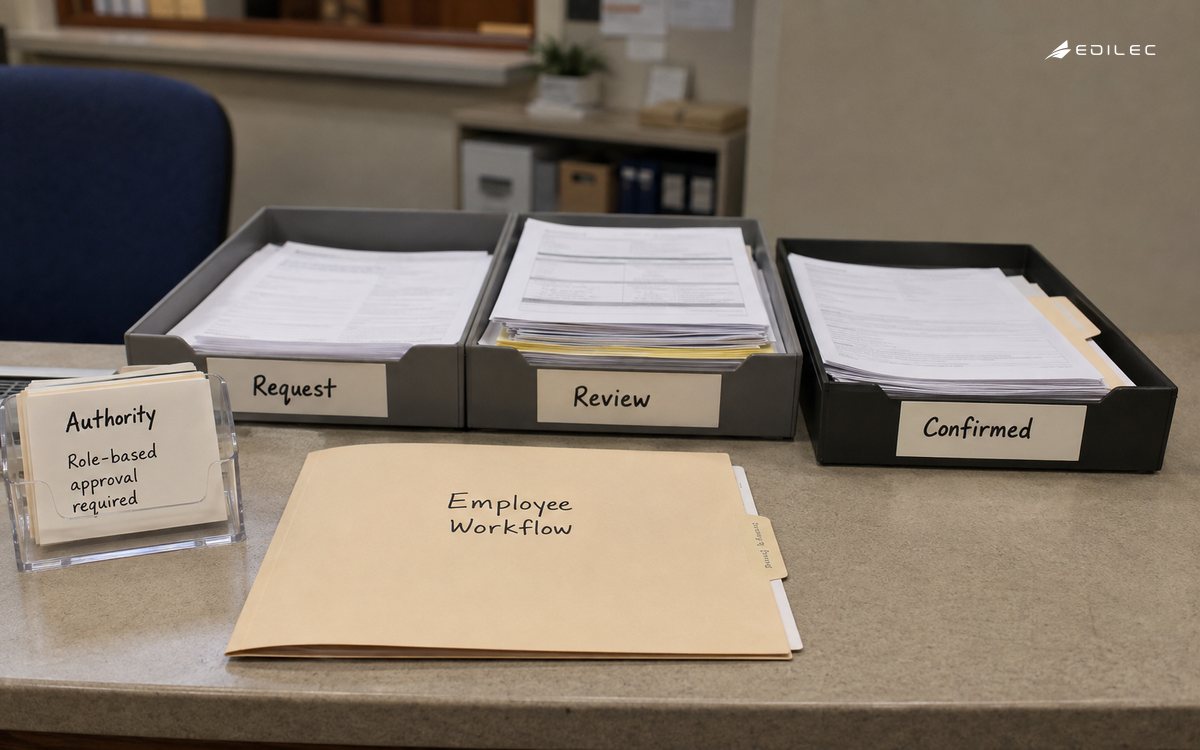
Production control begins at the boundary between an HRMS request and a change to an employee record. Define the authoritative system and the fields it owns, then retain the requester identity, role or approval context, policy version, effective time, and resulting state. Access should be limited to the people and services that need the relevant data; audit evidence must support reconstruction without placing unnecessary personal information in broadly accessible logs. When a check fails or the evidence is incomplete, keep the case provisional, name the resolver, and preserve the prior state. A correction record should identify the affected records, reason, approval, rollback point, and verification result. This makes privacy, authorization, and recovery controls concrete for the operator who inherits the workflow after release.
| Decision point | Evidence to retain | Owner response |
|---|---|---|
| Normal case | The input, rule, actor, timestamp, and outcome for an employee workflow outcome. | Confirm the result and publish its status. |
| Exception | The failed check, affected scope, safe options, deadline, and disposition. | Route the case to the HR operations owner without overwriting history. |
| Change | The previous behavior, new definition, approval, effective time, and rollback point. | Reconcile the affected records before expanding scope. |
Test HRMS production workflow before rollout
- For HRMS production workflow, trace one case from intake through the final decision and observable outcome.
- For HRMS production workflow, replay a normal case and an exception case while preserving employee records and the responsible actor.
- For HRMS production workflow, ask an operator outside the build team to explain the privacy controls route without private context.
- For HRMS production workflow, measure completion quality, exception age, recovery time, and evidence completeness by owner.
- For HRMS production workflow, check that a correction reaches every affected consumer without rewriting the original event.
- For HRMS production workflow, record the next review date, escalation route, and condition for safely expanding scope.
Testing should follow an HRMS case through its state changes, not stop at whether the workflow produces a plausible answer. Exercise a representative employee-record request alongside missing, late, duplicate, conflicting, and denied inputs. Verify that authorization is evaluated at the point of action, that approval context is sufficient but not excessive, and that retries do not create duplicate updates. For each scenario, assert the expected status, audit entry, notification or escalation, and recovery route. Include a material exception that remains with a named HR operations owner until it is resolved. A controlled pilot can then compare the released behavior with the existing process while operators learn where the evidence is incomplete. Rollout is justified only when both normal completion and correction are observable and reversible.
Implementation notes for HRMS production workflow
Treat every workflow definition or policy change as a controlled HRMS release. Version the previous and proposed behavior, record the approver and effective time, and state the rollback point before the change reaches production. Decide how the change affects requests already in progress: an in-flight approval may need to finish under its original rule, while a new request may use the revised definition. Do not overwrite the history of an employee-record decision when correcting it. Reconcile affected records against the authoritative state and record the person who confirmed the result. Release notes should identify the owner, affected population, known exception path, and operational check that follows deployment. This discipline keeps a routine configuration update from becoming an unexplained change in employee status.
Privacy controls must remain legible when HRMS work moves between product, security, HR operations, and support. Classify the employee data used by each decision, pass only the minimum context required for the task, and enforce access in the application rather than relying on workflow text. Approval evidence should identify the authorized role and the policy boundary without exposing unrelated employee details. Logs need actor, action, time, decision, and outcome fields, while sensitive raw values should stay out of general operational traces. Define retention and deletion responsibilities for records and evidence, and make downstream readers part of the review: a correction is incomplete if a report, notification, or dependent system still shows the old state. These practices align the workflow with the privacy and control concerns in the cited NIST guidance.
Production support needs a deliberate response when an HRMS workflow produces an uncertain or incorrect result. Give operators a pause action, an exception queue, and a named owner who can decide whether to correct, retry, or leave the record unchanged. Preserve the original request, decision evidence, approval context, and prior authoritative state; the recovery record should explain what changed and who verified it. Where an employee, manager, or downstream consumer may have relied on the result, identify the notification and reconciliation steps rather than treating the database update as the end of the incident. Review operator actions and recurring exception reasons to find gaps in policy, permissions, or testing. Expansion should wait until the team can restore a correct state and explain the recovery to the people affected.
| Operational question | Evidence to retain | Owner response |
|---|---|---|
| What proves HRMS production workflow is ready? | For HRMS production workflow, a dated employee records decision record connects the input, rule, actor, result, and review. | Confirm the evidence before widening scope. |
| What happens when HRMS production workflow is uncertain? | For HRMS production workflow, the system marks the state, limits the action, names the resolver, and preserves prior context. | Route the exception without erasing history. |
| How is HRMS production workflow corrected? | For HRMS production workflow, the correction names the changed fact, affected readers, approval, effective time, and verification result. | Reconcile consumers and close the case. |
| Which measure protects HRMS production workflow? | For HRMS production workflow, track completion quality, exception age, recovery time, and evidence completeness by owner. | Review the trend with the accountable operator. |
| What should be rehearsed for HRMS production workflow? | For HRMS production workflow, test normal completion, missing data, duplicate input, denied access, delayed dependency, and reversal. | Record the scenario outcome and remaining risk. |
| When may HRMS production workflow expand? | For HRMS production workflow, expand only after representative normal and exceptional cases pass with a usable correction route. | Approve the next bounded use explicitly. |
Keep effective dates and HRMS evidence aligned
HRMS workflows become especially fragile around effective dates. A production handoff should preserve the worker identifier, employing entity, approved change, effective time, source document, downstream acknowledgements, and the owner responsible for unresolved exceptions. Test hires, transfers, leave, compensation changes, manager changes, and terminations that cross payroll or access-control cutoffs. If a downstream system is unavailable, the record must distinguish pending delivery from rejection and show whether access or payment requires an interim control. Reconciliation should prove that each approved change reached the intended payroll, identity, finance, and reporting destinations without exposing sensitive employee data more broadly than necessary.
Key takeaways for HRMS production workflow
For HRMS production workflow, keep the owner, authoritative state, permitted action, evidence boundary, and recovery route visible. For HRMS production workflow, pause the normal path when proof is missing and show how a corrected result reaches each affected reader.
HRMS production workflows FAQ
For HRMS production workflow, what should a team settle first? HRMS production workflow teams should start with the accountable owner, authoritative state, permitted action, evidence boundary, and recovery route. For HRMS production workflow, ask which operator can pause the normal path, what proof they need, and how correction reaches each affected reader.
A dependable HRMS production workflows operating rule
For HRMS production workflow, keep the first release narrow, measurable, and owned. For HRMS production workflow, a result earns its next use only when it can be explained, challenged, corrected, and reviewed by the right person.
For HRMS production workflow, consult these official references for the operating choices in this guide: NIST SP 800-122: Protecting PII; NIST SP 800-53 Rev. 5: Security and Privacy Controls; OWASP Authorization Cheat Sheet; OWASP Logging Cheat Sheet. HRMS production workflow related guide 1; HRMS production workflow related guide 2; HRMS production workflow related guide 3