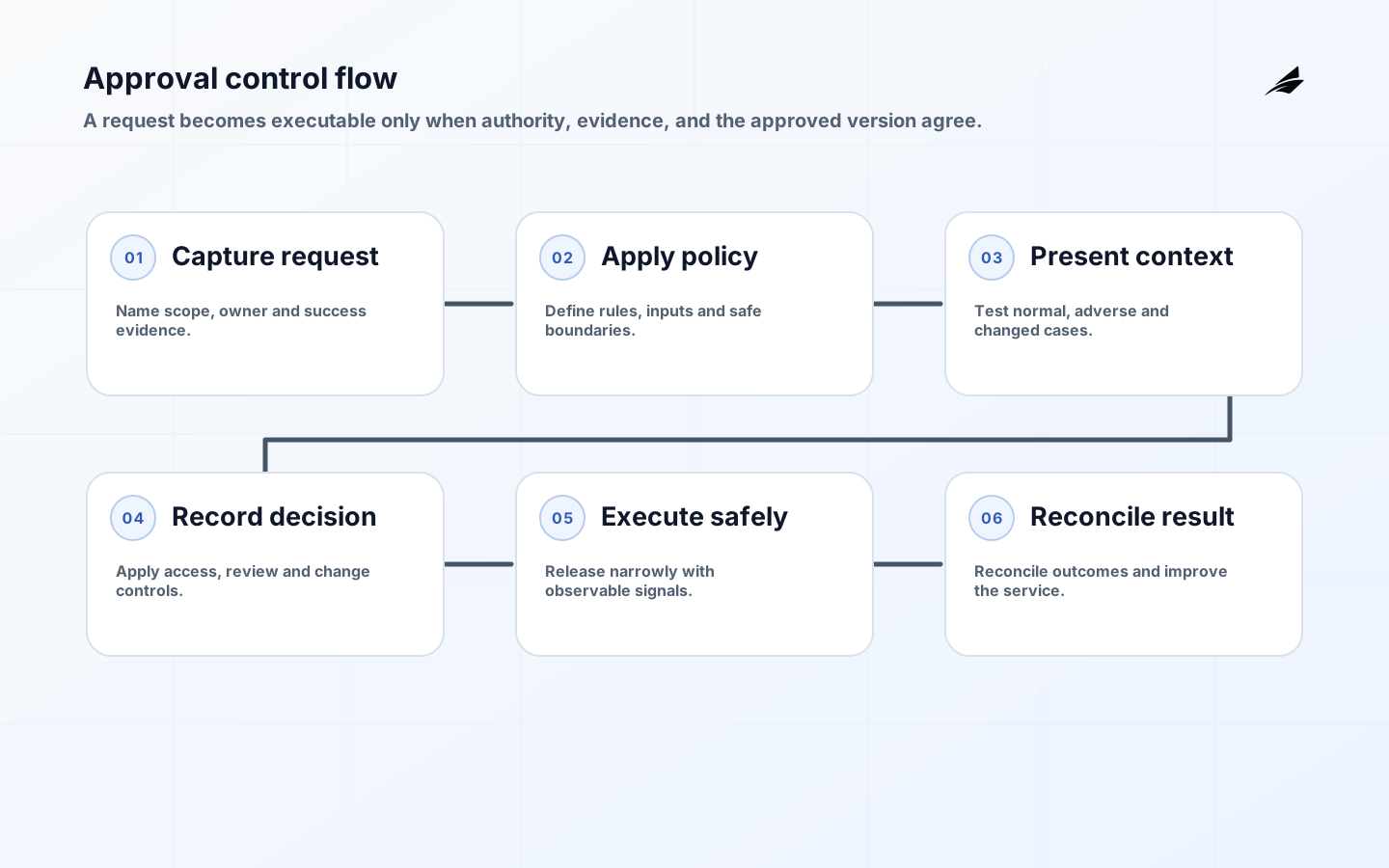
An approval workflow stops being a simple routing feature when requests arrive faster than a familiar group can resolve them from memory. At that point, the company needs explicit answers to practical questions: who may approve a given amount, which policy version applies, what happens when the usual approver is absent, and what evidence must survive the decision? A useful approval workflow checklist begins with the controlled action, such as releasing a payment, granting access, accepting a vendor, or publishing a price. For that action, name the requester, accountable approver, permitted delegates, required checks, expiry rule, and record of outcome. This frames the system around authority instead of screen count. It also exposes the exceptions that need deliberate treatment: conflicting reviewers, incomplete evidence, emergency overrides, withdrawn requests, and changes made after approval. The linked standards help teams examine security, data stewardship, and incident handling, while the workflow design remains grounded in the organization's own policies and consequences.
Frame the approval workflows decision
Begin the checklist with a decision statement, not a screen mockup. Name the business action that waits for approval, the policy that creates the threshold, the accountable role, and the latest useful decision time. Capture where the request originates and which service performs the approved action. This boundary prevents a notification chain from quietly becoming the source of authority. NIST's data-governance definition is useful here because it centers formal decision rights over enterprise data assets. Record who may alter routing policy, who may authorize a temporary exception, and which evidence the executor must verify before acting. The approval workflow engineering notes extend this checklist into implementation choices.
Define records, states, and boundaries
Model the approval as linked records: the immutable request version, evaluated policy, authority snapshot, decision, conditions, and execution receipt. A request edited after approval should move to a new version and require fresh evaluation when the change is material. Delegation needs effective dates and a defined scope; an organizational manager is not automatically the authorized approver for every decision class. Keep the originating system authoritative for request facts and let the workflow retain references plus decision evidence. The NIST Data Governance and Management Profile connects authority with privacy and cybersecurity risk, which matters when routing exposes sensitive attachments or employee data. An integration may transport the record, but convenience does not grant it ownership.
| Approval design question | Control decision | Decision record |
|---|---|---|
| Which request enters review? | Accept a defined request type only after required facts pass validation | Requester, submitted values, attachments, and submission time |
| Whose approval is valid? | Resolve approvers from current policy, amount, entity, and conflicts | Policy version, assigned approver, delegation, and identity |
| How are exceptions handled? | Pause incomplete, conflicted, expired, or unavailable reviews in named states | Reason code, queue owner, elapsed time, and disposition |
| What happens after a change? | Invalidate or reapprove when a material field or governing rule changes | Prior decision, changed fields, new review, and resulting action |
Design the exchange and exception path
Specify the normal route as a contract. Required fields, policy version, authority lookup, due time, duplicate key, decision result, and execution acknowledgement should all be inspectable. Route changes must be recalculated when amount, entity, category, requester, or other policy inputs change. If approvals expire, the executor should reject stale decisions rather than assuming that an old authorization still applies. Give every exception a reason code, safe retry rule, and named queue owner. Carry a correlation identifier from request creation through the downstream action so an operator can prove what happened without aligning timestamps by hand. The system-of-record design guidance helps teams separate the owner of a business fact from applications that merely copy or display it.
Control access and change
Choose controls from the consequence of a wrong decision. High-value payments may require separation between requester and approver; low-risk routine changes may need only policy validation and sampled review. Authority must come from maintained role or mandate data, not a hard-coded email list. Preserve what the approver saw, the rule version, identity, timestamp, decision, and conditions in an append-only history. Emergency access should expire automatically and produce a review task. The NIST Cybersecurity Framework supports treating governance, protection, detection, response, and recovery as one system. Apply that idea to workflow changes: record purpose, affected request classes, test evidence, approver, deployment, and rollback. Keep sensitive request details out of broad notifications, diagnostic exports, and support tickets.
| Approval signal | Possible control problem | Owner's first check |
|---|---|---|
| Requests exceed the decision deadline | Assignment, delegation, evidence, or reviewer capacity may be failing | Inspect the oldest requests by state and contact the responsible approver |
| Approvals are frequently withdrawn | Reviewers may lack context or request details may change after review | Sample withdrawals and tighten submission or reapproval rules |
| The same action is approved twice | Retries or parallel routes may not share an idempotent request identity | Stop release, identify affected actions, and repair deduplication |
| Decisions move to email or chat | The official path may omit an approver, exception, or usable notification | Trace one workaround and add the missing supported state |
Control Approval Workflow Changes
Run a workflow rehearsal before expanding scope. Use one representative request and exercise an absent approver, expired delegation, material edit after decision, rejection, duplicate submission, execution failure, and urgent bypass. Confirm that each path ends with an owned state and that no approved action can be detached from its exact request version. Include the process owner, an everyday requester, the control owner, and the engineer who supports the integration. Agree which failures pause execution, which are retryable, and who communicates delay. CISA's incident response planning guidance is security-focused, but its emphasis on prepared roles and communication is useful for consequential workflow failures. The aim is a practiced decision path, not inflated incident terminology.
Release in small, observable slices
Pilot one request class, one policy owner, and one downstream action for a fixed observation window. Baseline total cycle time, waiting time, rework, bypasses, and manual coordination before configuration begins. During parallel operation, compare decisions and execution results rather than merely counting completed tasks. Look specifically for self-approval created by role changes, delegation that outlives its mandate, stale decisions after material edits, and attachments copied into unmanaged channels. Reconcile open and completed requests at cutover, publish a support contact, and define thresholds for expansion, pause, or rollback. A limited parallel run often exposes details that process diagrams miss, such as a user holding two roles or a target system acknowledging receipt before the business action is actually complete.
Measure useful operation
Monitor whether decisions arrive with valid authority and usable evidence. Track median and tail decision time, expired requests, reroutes, active delegations, emergency bypasses, edits after approval, execution failures, and records missing policy evidence. Segment results by request class and business unit so a healthy average cannot hide one broken path. Google's monitoring guidance separates fast detection signals from richer diagnostic evidence; an approval alert should likewise identify an owner and the record needed for investigation. Review sampled decisions and exceptions on a regular cadence, retire alerts that lead to no action, and schedule rule changes with affected operators. The production operations guide gives more context for running that review as ongoing service work.
Walk one approval from request to reconciliation

Test a purchase request above the normal threshold while the usual approver is away. Preserve requester, amount, supplier, budget evidence, policy version, delegation, decision, and purchase-order result. Exercise rejection, missing information, expiry, withdrawal, duplicate submission, and a delegation ending while work is queued. The final record must show what the approver saw at decision time. A later material amendment should create a new decision rather than silently rewriting old evidence.
Use this review with the article tables and linked Edilec guides. Sample completed records as well as exceptions, retain the rule and source versions that produced each outcome, and assign every corrective action to a policy, data, interface, integration, security, or operating owner. Metrics indicate where to investigate; representative cases reveal what must change. Before scope expands, repeat the exercise with an unavailable dependency, a delayed message, an unauthorized user, and a correction after the nominal process has finished. This review is specific to approval authority and delegated decisions.
- Document thresholds and prohibited role combinations.
- Snapshot inputs and policy version.
- Expose every pending and terminal state.
- Strengthen review for privileged actions.
- Reconcile approval to downstream result.
- Replay open work before rule changes.
Key takeaways
- Anchor the approval workflow checklist in a specific controlled action and its policy owner.
- Resolve approver authority from current context, including limits, delegation, and conflicts of interest.
- Preserve the submitted evidence, policy version, reviewer identity, rationale, and final effect as one trace.
- Represent expiry, withdrawal, rejection, escalation, and material post-approval change as explicit states.
- Test duplicate release, absent reviewers, incomplete evidence, and emergency override before widening use.
Frequently asked questions
What is the first practical step for approval workflows?
Select one recurring decision where unclear authority or missing evidence creates visible rework. Map the request source, policy inputs, decision states, delegated roles, downstream action, due time, and correction path. That compact map is enough to test an approval design without pretending the organization must redesign every workflow at once.
When is automation ready?
An approval workflow is ready for automation when operators can trace a normal request, duplicate, rejection, expiry, amendment, emergency path, and failed execution to an accountable state. Test those cases with representative records and verify policy and authority versions before treating throughput charts as release evidence.
Conclusion
A dependable approval workflow makes authority, policy evidence, request version, decision, and execution result easy to reconstruct. Keep the initial boundary narrow, make every exception owned, and rehearse correction as deliberately as the normal route. Review delegation expiry, bypass use, and failed execution with the policy owner so operational drift becomes visible before it weakens the control. The result is not just faster routing; it is a decision control that remains understandable as people, policies, and systems change.