A ticketing platform should make service work easier to own, route, communicate, resolve, and improve. Buyers often compare form builders and dashboards while overlooking the operating model, migration, identity, integrations, reporting semantics, and administration effort that determine value. This ticketing workflow buyer’s guide complements Edilec’s reliable operations checklist, CRM plain-language guide, and system-of-record design guide.
Design the service request lifecycle
Ask vendors to configure and demonstrate your service lifecycle, not their preferred demo script. Provide a scenario with intake, acknowledgement, assignment, active work, a documented waiting state, resolution, user verification, and closure. Require the supplier to show who can enter and leave each state, how target clocks behave, and what history survives a correction. Add a misclassification, priority increase based on new impact, reassignment across teams, supplier dependency, and disputed closure. Inspect whether identifiers, timestamps, actors, reasons, and linked records remain available without exporting data to a spreadsheet. A product that models every transition as a generic status may look flexible while making ownership and reporting ambiguous. The evaluation should prove that the platform can express your actual service semantics using maintainable configuration and supported extension points.

| Decision | Working rule | Evidence to retain |
|---|---|---|
| Boundary | State the ticketing workflows outcome and exclusions. | Definition, examples, and lifecycle states. |
| Authority | Name the accountable business and technical owners. | Authority record and escalation route. |
| Identity and time | Keep durable references and effective time. | Source reference and change history. |
| Exception | Route ambiguous or failed work visibly. | Queue, reason, and disposition. |
Make priority and ownership observable
Evaluate whether ownership is native to the work rather than simulated through shared queues. The product should distinguish the accountable service owner, current resolver, collaborating group, approval authority, and vendor assignee, with clear transfer rules and out-of-office coverage. Test role-based access using real boundaries: service-desk staff may update diagnostic facts, an application owner may approve a standard action, and only a duty manager may change business priority or invoke a major-incident path. Ask how administrative configuration is separated from case resolution and how privileged actions are logged. If the only practical recovery method is granting broad administrator access, routine exceptions will weaken control. Buyers should also verify identity lifecycle, group synchronization, delegation expiry, and what happens to owned work when a user or supplier account is disabled.
- State the ticketing workflows decision in terms a business owner can test.
- Retain source references, effective time, and change rationale.
- Give each consequential exception an accountable route.
- Limit service identities and recovery permissions to the action required.
- Test the normal path alongside correction, retry, and unavailable-dependency cases.
Choose a buyer evaluation model that tests daily work
Require end-to-end traceability in the proof of concept. From one request, an evaluator should be able to see the intake channel, original payload, classification rule, entitlement or approval, assignment history, target calculation, integration calls, fulfilment result, notifications, overrides, and final verification. Ask the vendor to change a rule, process new and existing tickets, and show which revision governed each result. Trigger a duplicate webhook and demonstrate idempotent handling; fail a downstream action and show safe retry without repeated fulfilment. Corrections should append a reasoned event rather than overwrite the record that explains an earlier decision. Test whether authorized support staff can investigate this path through the product’s interfaces without assembling unrestricted database exports. Traceability is valuable only when it remains usable under normal roles, retention settings, and production volume.
| Failure pattern | Control | Signal to review |
|---|---|---|
| Duplicate or repeated action | Use stable references and defined retry behaviour. | Duplicate detection and corrective actions. |
| Wrong or stale input | Validate source authority, version, and timing. | Corrections after completion. |
| Unclear responsibility | Assign a queue, owner, and escalation decision. | Unacknowledged or aged exceptions. |
| Silent downstream fault | Separate receipt from final business outcome. | Accepted work without confirmed result. |
Build escalation and knowledge into the queue
Contract for a production pilot that is narrow in catalogue scope but complete in operating depth. Migrate or create a controlled population, connect identity and one meaningful fulfilment or monitoring integration, configure targets and escalation, train the receiving team, and run vendor support through the agreed channel. Acceptance scenarios should include success, rejection, duplicate intake, attachment restrictions, integration outage, reassignment, reopening, and reporting reconciliation. Define evidence for each case before configuration begins and state which defects block expansion. Keep the prior intake path available and document how open pilot records will be exported or completed if the service is rolled back. This pilot tests implementation skill, platform fit, supplier responsiveness, and operational economics together—areas a polished sandbox demonstration cannot establish.
Measure service behaviour rather than dashboard activity
Make bidders calculate service measures from the same supplied case set. Ask for acknowledgement and resolution distributions, active versus waiting time, backlog age, assignment transfers, reopen rate, target breaches, and volume by service and channel. Then inspect how the product derives each clock: whether pauses require a reason, calendar changes are versioned, reopened work resumes fairly, and historical reports remain reproducible. Test drill-down from an aggregate into authorized case evidence and verify that privacy restrictions survive analytics. Buyers should also price data retention, reporting replicas, API extraction, and advanced analytics rather than assuming dashboard screenshots cover operational needs. A useful platform lets service owners identify a routing rule, catalogue gap, supplier bottleneck, or ageing cohort and act on it; a large inventory of configurable widgets is not evidence of that decision path.
Review the operating design before expansion
Use three scripted evaluations with acceptance notes. In a degraded checkout incident, correlate monitoring alerts, group affected contacts, change impact, invoke incident roles, publish updates, link a corrective change, and preserve the timeline. In an employee access request, verify identity, entitlement, approval, fulfilment once, evidence of access, and revocation or cancellation. In a support defect, transfer between service desk and engineering without losing the customer-facing owner or exposing internal material. Add ambiguity to each scenario—conflicting priority claims, an absent approver, a duplicated event, or a late reply—and observe the vendor’s recommended handling. Have frontline operators drive the interface while security, reporting, integration, and service owners inspect their portions. Score demonstrated behavior and required customization separately; unresolved assumptions should become contract conditions or explicit reasons to reject the fit.
Inspect the platform’s data model and export, not just its case screen. The durable record should include service and request type, impact evidence, priority calculation, requester, beneficiary, accountable group, current assignee, state transitions, waiting reasons, approvals, related assets, dependencies, customer communications, fulfilment references, and resolution verification. Determine which fields are first-class, which live only in free text, and which require licensed modules or custom tables. Test field-level access, attachment controls, legal hold, retention by record class, redaction, and deletion propagation. Obtain a documented, machine-readable export with identifiers and history so the organization can investigate, migrate, and meet legitimate data obligations without supplier-only tooling. Buyers need enough context for service operation and audit, while avoiding indiscriminate collection that makes every support record a privacy liability.
Demand a recovery demonstration for configuration and integration failures. Introduce a routing rule that sends requests to the wrong team, then ask the supplier to disable it, identify every affected ticket by revision, restore ownership in bulk without replaying fulfilment, and verify notifications and target clocks. Simulate an unavailable resolver group and confirm escalation reaches a staffed authority. Fail an outbound connector after the remote action succeeds, then prove that retry does not perform the action twice. Evaluate backup and restoration of configuration, rollback granularity, segregation of production changes, emergency access, and vendor incident responsibilities. The contract should state recovery objectives, support severity definitions, evidence supplied after an incident, and responsibility for correcting records. Safe operation depends on known compensating actions, not on a promise that the platform rarely fails.
Include operator usability in scoring. Ask requesters, service-desk analysts, resolvers, approvers, duty managers, and auditors to complete their own scenarios with role-appropriate access. Observe search, keyboard navigation, queue clarity, state language, bulk handling, handoff context, knowledge use, and the effort needed to explain progress to a user. Verify relevant accessibility requirements and test mobile use only where it is genuinely part of duty. Request editable role-based training, administration documentation, integration runbooks, release notes, sandbox access, and a plan for keeping guidance aligned with configuration. Measure training and adoption effort in the total cost. A product that requires unofficial cheat sheets, broad permissions, or constant vendor intervention for ordinary corrections will create a shadow operating model regardless of feature breadth.
Put rollout gates into the statement of work. A gate may require reconciled intake and closure counts, routing accuracy above an agreed threshold, no unresolved high-severity access defects, controlled override volume, successful recovery exercise, acceptable support response, current documentation, and sign-off from frontline owners. Define the observation window and sample size, not just a target percentage. Each additional business unit, language, supplier, or channel should present its catalogue, privacy, identity, calendar, integration, and reporting differences before migration. Tie payments and expansion decisions to demonstrated evidence while preserving a stop option and usable data export. This gives the buyer leverage to correct foundational problems before licence volume, customization, and organizational dependence make change expensive.
Use evidence and controls deliberately
Translate external guidance into procurement evidence. Use the NIST Cybersecurity Framework to question governance, identity protection, detection, supplier response, and recovery ownership. Apply the NIST Privacy Framework when assessing purpose, collection, access, retention, and deletion of employee or customer ticket data. Google SRE monitoring guidance can inform requirements for actionable service alerts and diagnostic telemetry. Relevant OWASP Application Security Verification Standard controls provide concrete checks for authentication, authorization, sessions, files, APIs, logging, and service identities. Ask bidders to map claims to product configuration, independent assessment, test results, contractual commitments, and customer responsibilities. Framework names in a security questionnaire are not substitutes for demonstrating the controls in the proposed deployment.
Run a scenario-based product evaluation
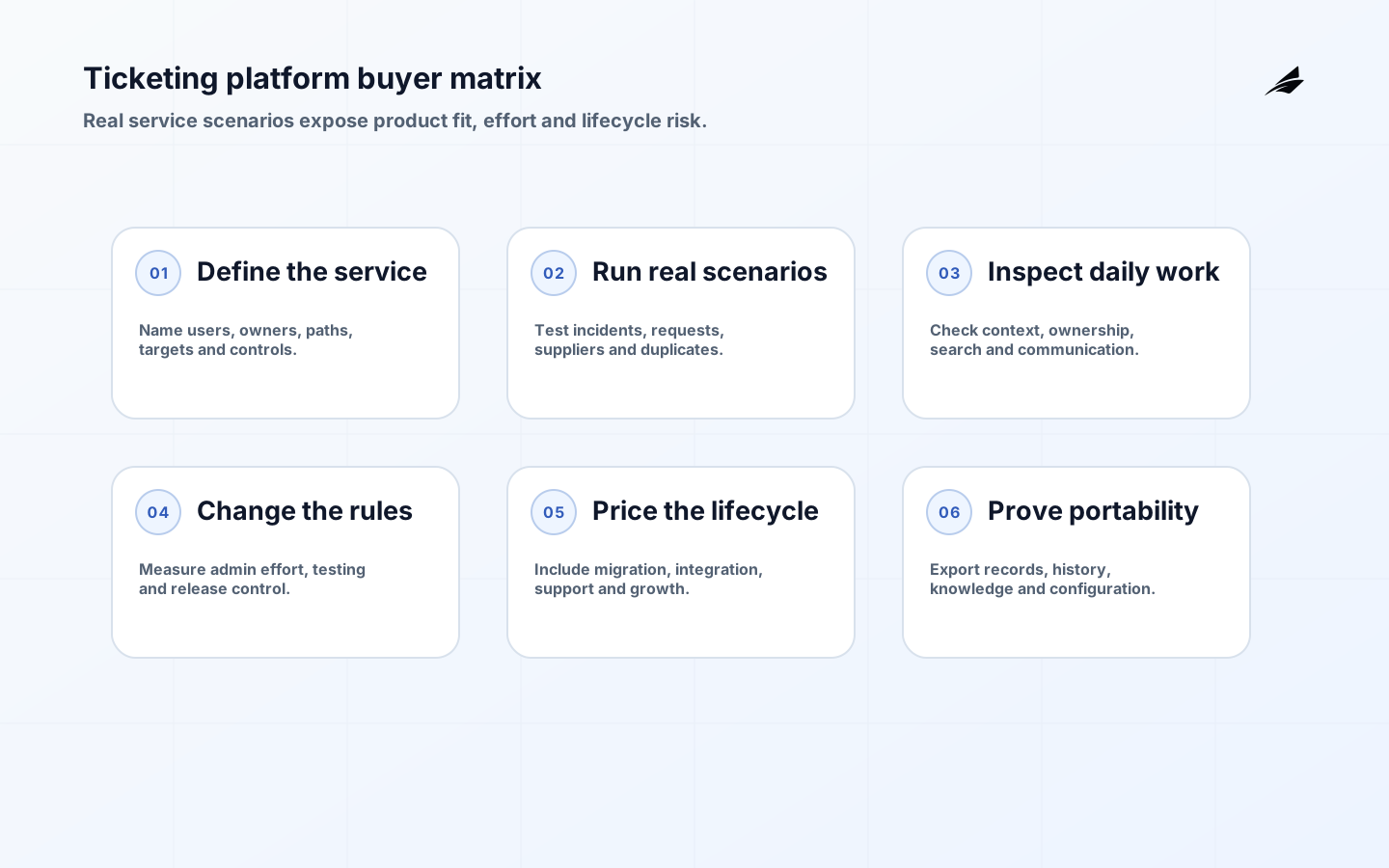
Give shortlisted suppliers the same anonymized scenarios: a new starter request with approvals and a missed start date; a payroll incident affecting one region; a supplier-held application fault; a duplicated request; and a major incident that begins as several ordinary tickets. Ask them to configure the flow, roles, timers, communications, escalation, knowledge link, audit record, and reports. Include a policy change during the exercise to expose administration and release control.
Score the observable result, not presentation polish. Can an agent see user impact and the next action without opening several screens? Does reassignment retain ownership and timing? Can targets pause only for controlled reasons? Are permissions enforced at record, field, and attachment level? Can leaders reconstruct rule and data changes? Export the scenario data and configuration to test portability. Price implementation, integrations, migration, training, environments, storage, reporting, support tiers, administration, upgrades, and exit, not just named-agent licenses.
Key takeaways
- Start ticketing workflows with one consequential decision and its owner.
- Make source, state, timing, and exception evidence visible.
- Treat retries, corrections, and access boundaries as product behaviour.
- Reconcile intended work to the final operational result.
- Use recurring exceptions to improve policy and upstream quality.
Frequently asked questions
Should every ticket be assigned to one person immediately?
A queue can own triage, but it needs an acknowledgement expectation and escalation route. Once active work starts, a responsible person or team should be visible.
What makes an incident different from a request?
An incident restores an unplanned interruption or degradation. A request asks for a standard service or information, so its priority and evidence model are usually different.
Conclusion
A ticketing platform earns its place when agents can preserve context, managers can see accountable service work, administrators can change rules safely, and the organization can leave without losing its records. Test those outcomes in realistic scenarios, price the complete lifecycle, and contract for the evidence needed to operate and exit. The strongest buying decision is grounded in observed service behavior rather than a polished demonstration.