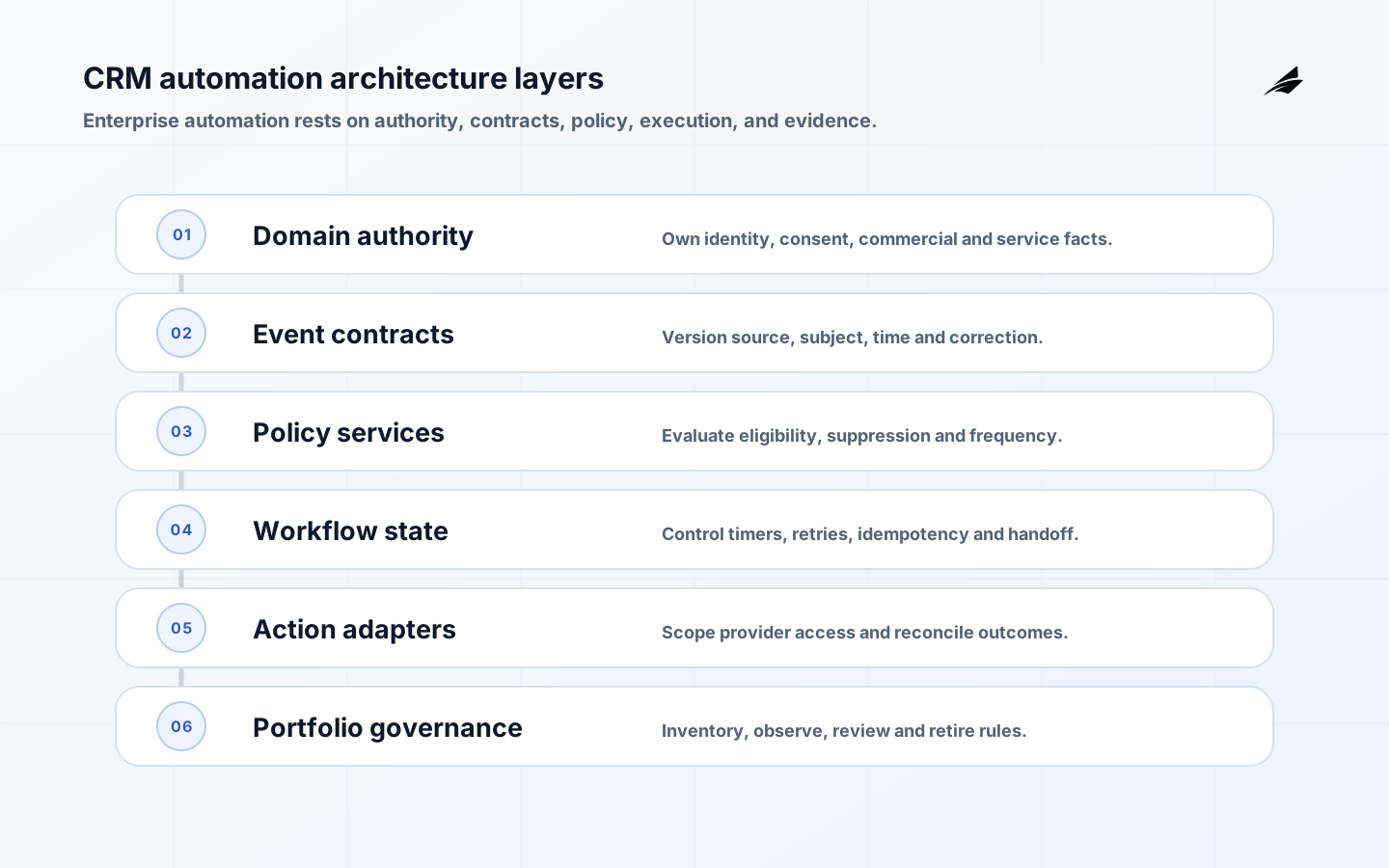
For a CTO, CRM automation is an enterprise decision system distributed across identity, customer records, consent, product usage, billing, support, messaging providers, and human teams. The strategic risk is not one bad workflow; it is a growing web of hidden rules and privileged integrations that nobody can explain, test, or stop. Architecture must keep authority, policy, and evidence visible as automation scales.
The goal is a paved road for customer workflows: stable events, governed data products, reusable policy checks, idempotent actions, observability, and controlled release. Edilec's system-of-record guide, CRM automation explainer, and ticketing workflow checklist help connect architecture to operational ownership.
Key takeaways
- Treat CRM automation as a portfolio of decision services, not a collection of vendor recipes.
- Declare authoritative writers for identity, consent, commercial state, cases, and activity.
- Standardise event envelopes, idempotency, policy checks, action evidence, and kill controls.
- Separate platform guardrails from business-owned eligibility and communication policy.
- Fund migration, observability, incident response, and rule retirement as part of platform cost.
Map authority before selecting architecture
Create a domain map of customer, contact, account, relationship, product, contract, consent, opportunity, case, and interaction. For each entity, record the authoritative writer, identifiers, correction path, latency, retention, and consumers. The CRM can be the operational home for sales activity without becoming the legal authority for every customer fact. Avoid bidirectional field synchronisation where either side can overwrite the other; publish explicit commands and events instead.
| Domain | Authority question | Architecture decision |
|---|---|---|
| Identity | How are people and organisations matched and split? | Stable IDs plus stewarded merge history |
| Consent | Who records purpose, channel, region, and withdrawal? | Low-latency policy service or authoritative ledger |
| Commercial state | Which contract and billing events are final? | Versioned events from commercial systems |
| Service status | What blocks outreach during harm or dispute? | Current case signal with suppression semantics |
| Activity | Which interactions are evidence versus derived engagement? | Immutable provider IDs and provenance |
The NIST Privacy Framework is useful for examining data processing and adverse effects across organisational roles. Build purpose and retention into the domain model rather than relying on a universal customer profile. The GDPR illustrates why rights such as objection to direct marketing must affect profiling and downstream action, not merely a preference field in one interface.
Choose a workflow platform pattern
Native CRM automation offers speed, contextual permissions, and accessible ownership for bounded workflows. An integration platform helps with transformation and connectors but can hide long-lived business state. A durable orchestrator suits cross-system processes needing timers, retries, compensation, and history. Event-driven services decouple producers and consumers but require strong contracts and replay discipline. Most enterprises need a deliberate combination, with clear rules about which pattern owns state and timers.
| Pattern | Best fit | Primary risk |
|---|---|---|
| Native CRM rule | Local deterministic update or task | Sprawl and weak software lifecycle |
| Integration platform | Data movement and short coordination | Business state hidden in mappings |
| Durable workflow | Long-running cross-system process | Specialist operations and migration |
| Event consumer | Independent reaction to stable event | Duplicate, ordering, and schema issues |
| Custom service | High-scale differentiated decision | Engineering ownership burden |
Define a standard action envelope regardless of tool: workflow and policy version, trigger ID and time, subject IDs, eligibility evidence, action key, authority, channel, provider result, and correlation ID. Require a dry-run mode and a global or scoped kill switch. Platform teams should provide reusable consent checks, frequency caps, owner resolution, template retrieval, audit emission, and redaction rather than letting each team rebuild them.
Control privileged integration and data movement
CRM connectors often hold broad read and write power. Use workload identities, least privilege, short-lived credentials, network controls, and separate production authority. Review scopes when workflows change and test denied actions. Apply the OWASP ASVS to custom interfaces and services, including authentication, session, access control, validation, logging, and data protection. Sanitize data crossing template and rendering boundaries.
Use the NIST Cybersecurity Framework to assign governance and response, not only preventive controls. Maintain an inventory of automation, owners, credentials, data classes, vendors, and downstream actions. Threat-model account takeover, malicious rule changes, bulk export, poisoned events, template injection, webhook forgery, and provider compromise. Practise revoking a connector and continuing priority work manually.
Bring rules into a real change lifecycle
Business-readable does not mean risk-free. Store workflow definitions, templates, schemas, and policy as versioned artifacts where the platform allows it. Require peer review, representative test fixtures, negative eligibility cases, volume estimates, and rollback. Promote through environments or isolated test tenants. Diff the actual rule and population impact; screenshots are poor release evidence.
Create a tiering model. A task assignment based on an internal event may follow an automated path. Bulk external communication, pricing, credit, eligibility, or sensitive segmentation needs policy and privacy authority. Emergency changes should link to an incident, expire, and receive retrospective review. Keep migration tooling and exportable definitions in vendor selection criteria to reduce lock-in around accumulated business logic.
Rehearse a cross-system failure
A billing provider delays cancellation events for two hours while a retention journey selects customers. The architecture should mark billing freshness degraded, block actions dependent on current status, and queue decisions rather than continue from stale CRM copies. After recovery, events replay idempotently; eligibility is recalculated at action time, cancelled accounts remain suppressed, and delayed eligible accounts resume within policy.

- Detect source freshness separately from workflow engine availability.
- Preserve event and action keys across retries and replay.
- Stop pending external actions without deleting investigative history.
- Reconcile provider, CRM, and source-of-record outcomes after recovery.
- Review whether the dependency objective and fallback match customer consequence.
Operate the automation portfolio
Maintain a catalogue with owner, purpose, domains, trigger, actions, risk tier, last review, dependencies, volume, and retirement rule. Monitor end-to-end completion, stale-input blocks, duplicates prevented, exception age, manual overrides, policy denials, and customer harm indicators. Google's monitoring guidance supports alerting on user-visible impact; a failed low-priority enrichment is different from messaging after consent withdrawal.
Establish a cross-functional automation council small enough to decide. Platform engineering owns guardrails and service reliability; domain teams own process meaning; security and privacy owners define controls; operations owns exceptions; data stewards own identity and quality. Review recurring exceptions and unused workflows quarterly. Retirement must cancel timers, revoke credentials, archive evidence, update documentation, and remove stale derived data.
Build a pragmatic CRM automation roadmap
The first phase should create visibility: inventory workflows, owners, credentials, data domains, timers, vendors, volumes, incidents, and customer consequences. Retire obvious duplicates and orphaned rules before introducing a new platform. Establish source-of-record decisions and a standard event and action envelope for new work. This foundation often reduces more risk than migrating every existing recipe immediately.
The second phase supplies shared controls: identity correlation, consent and suppression checks, secrets and workload identity, idempotency, audit events, approved templates, observability, dry-run, and kill switches. Select two workflows with different shapes to prove the paved road: one local deterministic task and one long-running cross-system journey. Measure developer effort, operator effort, incidents, and migration friction rather than declaring success when both simply run.
The third phase addresses accumulated logic. Rank migrations by consequence, change frequency, vendor risk, and operational pain. Encapsulate stable legacy workflows behind observability and kill controls when immediate migration offers little value. Rebuild workflows whose hidden state or weak rights handling prevents safe operation. Negotiate platform contracts and internal staffing based on the real inventory, including test tenants, audit export, rate limits, model features, and data egress.
Report the roadmap to leadership in outcomes: percentage of high-risk actions using current policy checks, mean time to identify affected customers, proportion of workflows with tested stop controls, aged exceptions, and retirement of unsupported credentials. Counts of migrated automations or created rules reward motion. The architecture programme succeeds when teams can change customer workflows faster while explaining authority, impact, and recovery with less manual investigation.
Frequently asked questions
Should CRM automation be centralised?
Centralise platform capabilities, standards, inventory, and high-risk review. Keep domain policy and workflow ownership near the teams accountable for customer outcomes. Full centralisation creates a queue; full decentralisation creates incompatible controls.
Where should AI enter CRM automation?
Begin with assistive tasks such as summarisation or draft suggestions whose outputs are reviewed. Before automated prioritisation or action, evaluate data, bias, explanations, override, security, and consequence. AI does not remove the need for deterministic consent and authority checks.
What matters in CRM platform selection?
Assess identity and permission models, workflow versioning, testability, idempotency, event and API contracts, audit export, data residency, observability, kill controls, portability, and limits. Feature counts matter less than the ability to operate and change safely.
Model the full platform economics
Compare platforms using cost per completed, governed workflow rather than licence price. Include connector tiers, API overages, event retention, test environments, observability export, data egress, identity features, specialist staffing, vendor support, exception handling, and migration. A cheap native rule can become expensive when every incident requires manual reconstruction; a powerful orchestrator can be wasteful when used for simple local updates.
Estimate concentration risk. List workflows that would stop, degrade, or become unsafe during a CRM, integration platform, identity, messaging, or consent-service outage. Fund fallback according to consequence. For critical journeys, retain replayable events and an application-owned action ledger so recovery does not depend entirely on vendor history. Test export and credential revocation before contract renewal, when commercial leverage still exists.
Conclusion
CRM automation scales when architecture preserves authority and makes every action explainable. Establish domain ownership, choose workflow patterns deliberately, provide reusable guardrails, secure integrations, and operate a visible portfolio. The CTO's contribution is not approving more automation; it is making customer workflows governable as change accelerates.