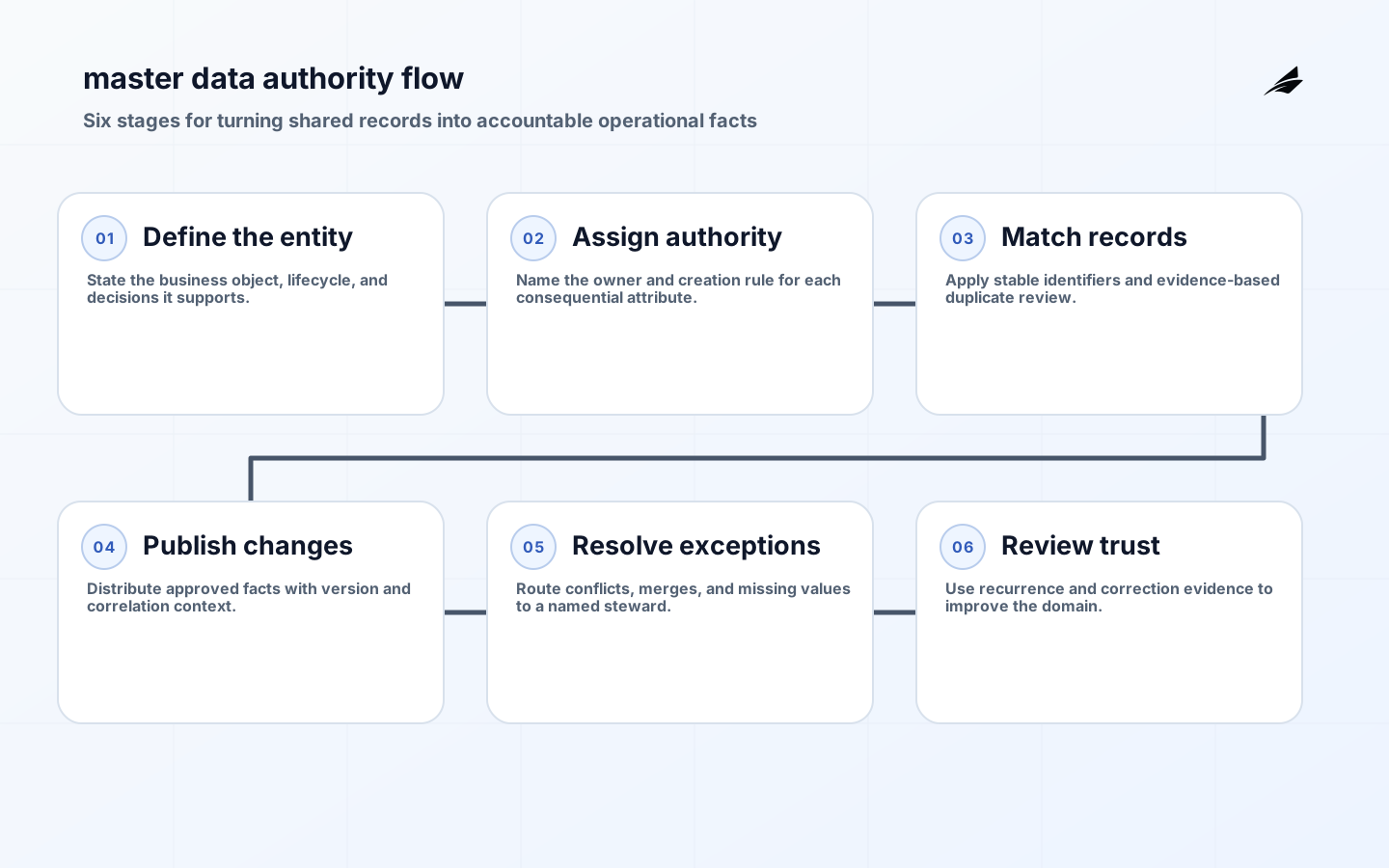
Master data management is the operating discipline for facts that many teams need to recognize in the same way: a customer, supplier, product, location, employee, account, or legal entity. It is not a promise that one database magically contains every truth. It is an agreement about which system may create a fact, who may change it, how competing records are resolved, and how downstream users can see the current state. When that agreement is absent, a sales team, finance team, and support team can all be diligent yet still act on three versions of the same customer. The cost appears as duplicate work, flawed reporting, failed integrations, and awkward conversations with customers. The practical aim is a dependable decision path, not a data-cleaning campaign without an end.
Frame the master data management decision
Start with a consequential decision rather than a broad request to improve data quality. A distributor may need to know whether a product can be sold in a region; a service company may need a reliable parent account before extending credit; a manufacturer may need a single approved supplier identity before paying an invoice. Map that decision from the moment a record is proposed through its consumers and later correction. Name the accountable business steward, the technical custodian, and the systems that are permitted to create or merely copy the record. This follows the useful distinction in the NIST Privacy Framework between identifying risk and governing the response: ownership cannot be inferred from a column name or an integration diagram.
| Question | Good working answer | Evidence to retain |
|---|---|---|
| What is the entity? | A business object with a clear lifecycle and purpose. | Definition, examples, and exclusions. |
| Who is authoritative? | One named owner and one creation rule per attribute. | RACI and system-of-record decision. |
| Who consumes it? | Teams and services with a material operational dependency. | Consumer map and exchange contract. |
| How is it corrected? | A traceable route that preserves prior values. | Change record and exception queue. |
Define the trusted record
A trusted record needs more than a preferred row in a database. Define its business key, source identifiers, lifecycle states, effective date policy, and attributes that each authority owns. For a customer, legal name and tax status may come from an approved onboarding process, while a sales preference may legitimately come from a CRM. A survivorship rule should be specific enough to explain why one value wins when two sources disagree. Keep a proposed match separate from a confirmed merge, especially where a merge can change credit, privacy, or contractual history. The companion system-of-record design guide is useful here: a system of record owns a fact; it does not automatically own every use of that fact.

- Write a plain-language definition and two counterexamples for the entity.
- Use stable internal identifiers; retain source identifiers as references rather than replacing them.
- Record when a value became effective and when the platform learned it.
- Make merge, split, retirement, and reactivation states explicit before imports begin.
- Give users a visible route to challenge a record that is wrong or incomplete.
Design distribution and exceptions
Distribution should make normal processing boring and abnormal processing legible. Every exchange needs a purpose, contract, acknowledgement, retry policy, and accountable owner. Validate required values before an update reaches a consumer, and use an idempotent event reference so a retry does not create another customer or duplicate a product. A rejected record should explain whether the source needs repair, whether a reviewer must decide, and whether retrying is safe. Preserve a correlation reference from the originating change to downstream effects; timestamps alone rarely settle a dispute. Reconciliation is equally important: compare the intended population with the received and applied populations on a defined cadence. Treat the queue as work to be resolved, not a graveyard for records nobody can classify.
| Failure pattern | Control | Operational signal |
|---|---|---|
| Duplicate created on replay | Stable business key and idempotency check. | Duplicate rate after retries. |
| Two sources overwrite each other | Attribute-level authority and effective-time rule. | Conflicting update count. |
| Consumer misses a change | Acknowledgement and population reconciliation. | Unapplied events by age. |
| Uncertain match is merged | Human review threshold and reversible merge record. | Merge reversals and review delay. |
Control access and change
Not every data edit deserves the same control. Routine enrichment can be delegated; a merge, tax classification change, or retirement with many consumers may require a separate authority and an audit record. Preserve the old value, new value, actor, reason, effective time, and systems notified. Limit exports, logs, and support tickets to the fields necessary to solve the problem. The OWASP Application Security Verification Standard is a practical reminder that authorization, logging, and secure handling are application responsibilities, not paperwork added after an interface is finished. Review privileges when roles change, and test a denied action as deliberately as an allowed one.
Make stewardship a daily practice
Stewardship works when it is a small, repeated operational practice rather than a committee that convenes only for a major migration. Give the steward a manageable review set: new duplicates above a confidence threshold, unresolved source conflicts, proposed merges, materially incomplete records, and recurring consumer failures. Pair that person with a technical maintainer who can explain the matching rules and delivery paths, but do not make the steward wait for engineering to decide ordinary business meaning. Their shared backlog should distinguish an individual correction from a rule defect. The first changes a record; the second changes the behavior that will affect future records.
Create a lightweight decision log for changes that alter authority, matching, lifecycle, or publishing behavior. A useful entry says what changed, why, which population may be affected, who approved it, how it was tested, and how the prior rule can be restored. This is especially important when a source-system team changes a code list or when a new consumer interprets a field differently. The log gives support and audit teams a way to understand a surprising result without reconstructing intent from chat history. It also makes deliberate retirement possible when a matching rule or field no longer serves a business decision.
Keep the review close to real cases. A monthly scorecard can show trends, but a steward learns faster by tracing one disputed customer, one late update, and one failed synchronization from start to finish. Ask whether the definition was clear, whether the authority rule held, whether the exception reached the right person, and whether downstream users received a comprehensible correction. That investigation can identify a policy problem, a training gap, a contract defect, or an interface weakness. It prevents data quality from becoming a vague complaint with no accountable next action.
Release and operate the domain
Release one bounded domain with representative difficult cases: a duplicate, a late correction, an incomplete record, a source outage, and a downstream rejection. Reconcile before and after cutover, publish the support contact, and state what would pause expansion. A short parallel run often reveals semantics that data models conceal, such as a subsidiary using the same name as a parent or a customer changing legal status during an order. Monitor both fast detection signals and detailed investigation evidence. Google SRE's monitoring guidance usefully separates signals used to notice a condition from the context needed to diagnose it. For master data, that means alerting on an aged exception queue while retaining the identifiers, rule outcome, and owner needed to resolve it.
Measure trust, not activity
A count of records cleaned is not evidence that master data management improved operations. Track duplicate recurrence, age of unresolved matches, percentage of records with a named steward, reconciliation breaks, correction time across consumers, and manual workarounds discovered by frontline teams. Review a small sample with the people who use the result, not only the team that operates the platform. If a metric rises, inspect examples before changing a threshold. The goal is to learn whether the decision path is becoming clearer and faster to correct. The established master data management engineering notes can help teams turn this review into a regular operating habit.
Key takeaways
- Start with one decision that fails because a shared entity is unreliable.
- Specify authority, lifecycle, identifiers, and correction before connecting more consumers.
- Use contracts, acknowledgements, reconciliation, and visible exception ownership across exchanges.
- Apply stronger access and audit controls to changes with wider operational consequences.
- Judge the program by trusted decisions and correction speed, not by a volume-of-records claim.
Frequently asked questions
Does master data management require a new platform?
No. The first valuable step is often an operating decision about authority and a small set of controls around existing systems. A dedicated platform can help when matching, stewardship, publishing, and lineage exceed what current tools can safely support, but software does not substitute for a clear owner or correction route.
Which domain should a team start with?
Choose a domain that crosses at least two operational systems and causes measurable rework or risk. Customer accounts shared by CRM, billing, and support are common candidates because duplicate identity and ownership errors have visible downstream effects.
Conclusion
Good master data management makes a shared business fact easier to recognize, use, correct, and defend. Keep the first scope close to a real decision, give authority a name, and make exceptions first-class work. That produces a durable operating capability rather than a periodically repeated clean-up exercise.