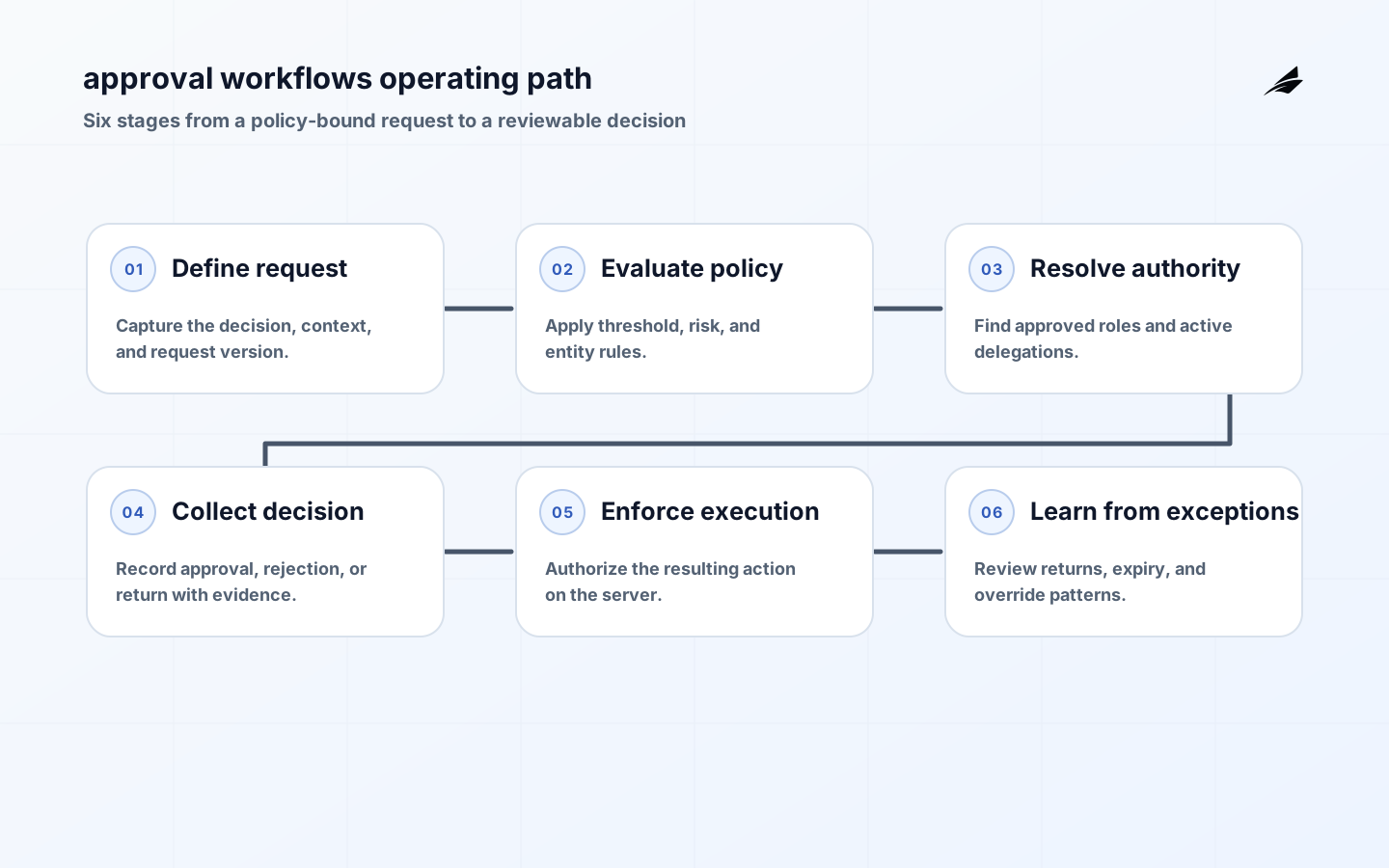
Approval workflows are product features for making consequential decisions visible, authorized, and reversible where possible. They fail when the workflow copies an organizational chart instead of expressing a real policy. A good design lets a requester understand what is needed, gives an approver the context required to decide, and records the decision with enough evidence that an operator can resolve a later dispute.
Build approval workflows around an accountable operating model
Define the decision before defining the chain. Is the organization approving spend, access, a content change, a contract deviation, or an operational exception? Name the request object, the policy inputs, the decision maker, the deadline, and the action that becomes possible after approval. Separate high-risk approvals from routine acknowledgements. A manager’s awareness may be useful, but treating it as a blocking approval can create delay without improving control. Teams planning adjacent work should also consider this ticketing workflows guide, because shared records and handoffs often determine whether an apparently local improvement survives production use.

Define the records and states that make approval workflows explainable
Represent the workflow as a state machine with explicit transitions: draft, submitted, in review, approved, rejected, returned, expired, cancelled, and executed where relevant. Calculate the required approver set from policy inputs such as amount, legal entity, role, or data sensitivity; do not rely on a client-supplied approver list. Capture the policy version, delegated authority, comments, and timestamp. A decision must be bound to the exact request content it authorizes.
| Decision | Practical definition | Why it matters |
|---|---|---|
| Decision object | Spend, access, deviation, or operational exception | Defines what policy governs |
| Authority rule | Threshold, role, entity, and risk context | Resolves legitimate approvers |
| Decision binding | Request version and policy version | Prevents approval of changed content |
| Execution gate | Server-side check before sensitive action | Stops UI-only authorization |
Set ownership and controls before automating the happy path
Business policy owners define thresholds and exceptions, while product and engineering own implementation quality and access controls. Delegation needs start and end dates, scope, and a record of who granted it. Sensitive actions should be authorized on the server at the point of execution, not only when a screen renders an approval button. Give operators a controlled path to correct an assignment or recover from an unavailable approver without bypassing evidence. The related billing operations guide is a useful comparison when the design includes cross-team rules, because both practices depend on knowing whose decision controls the next state.
- Name the decision, policy inputs, accountable owner, and allowed post-approval action.
- Create explicit states and test every transition, including expiry and cancellation.
- Resolve approvers from trusted server-side policy data.
- Record policy version, delegation scope, decision evidence, and request version.
- Provide a controlled recovery path for unavailable or incorrect approvers.
- Review returns, expiry, and overrides with the policy owner.
Deliver approval workflows in slices and make exceptions visible
Launch with a narrow policy and a small set of roles. Test edits after submission, concurrent approver actions, approval expiry, delegation expiry, rejected requests resubmitted with changes, and an execution request that arrives after policy changed. Use notifications as prompts, not as the source of truth; the workflow record must remain current even when a message is delayed. Include an audit view that a non-engineer can use during review.
Use operating signals that lead to an action
Track decision time by policy path, returned requests, expired approvals, delegation use, unauthorized execution attempts, and operator overrides. Look for policy friction rather than celebrating a high volume of completed approvals. If the same request category is repeatedly returned for missing information, change the form or upstream validation. If a threshold produces excessive escalation, revisit the policy with the accountable business owner.
| Control area | Signal to review | Accountable role |
|---|---|---|
| Latency | Time in review by policy path | Process owner |
| Request quality | Return and resubmission reasons | Product owner |
| Authority | Delegation use, expiry, and assignment correction | Policy owner |
| Enforcement | Unauthorized execution attempts and overrides | Security owner |
Common approval workflows failure modes and practical responses
Approval workflows have their own failure patterns. A configured tool can still fail because a key record is ambiguous, authority is missing, or an integration hides a rejected change. Treat each repeated exception as a case with evidence, a named owner, and a specific decision about whether policy, data, process, or code must change. That approach preserves operational learning without normalizing a workaround as part of the system.
Use a decision workshop before expanding scope
A useful decision workshop for approval workflows starts with a concrete operating case rather than a platform diagram. Put the people who create the record, apply the policy, consume the result, and repair failures in the same discussion. Ask them to trace the first design choice: decision object. The team should agree on spend, access, deviation, or operational exception and why it matters: defines what policy governs. Then repeat the exercise for authority rule. Disagreement is useful evidence; it often reveals that two teams have been using the same term for different business conditions.
Turn the workshop into a short operational rehearsal. First, name the decision, policy inputs, accountable owner, and allowed post-approval action. Next, create explicit states and test every transition, including expiry and cancellation. Then test whether the team can resolve approvers from trusted server-side policy data. Do this with a representative, non-sensitive record and an ordinary time constraint. A review that only describes the ideal path will miss the handoff, authorization, or missing-data condition that causes the real escalation. The purpose is to make ownership and evidence usable before more users depend on the workflow.
The exception path deserves equal design attention. Use the next steps as a practical test: record policy version, delegation scope, decision evidence, and request version. Also, provide a controlled recovery path for unavailable or incorrect approvers. Finally, review returns, expiry, and overrides with the policy owner. Record the decision with the relevant source evidence and avoid repairing a symptom in a private message. When an exception returns, compare it with the earlier case; recurrence is a signal to change the input rule, policy, mapping, or service boundary rather than simply closing another ticket.
As scope grows, preserve the second set of design choices. For decision binding, the operating definition is request version and policy version; this matters because it prevents approval of changed content. For execution gate, use server-side check before sensitive action so the team can stop ui-only authorization. These details are where a pilot becomes a service other teams can rely on. They also give reviewers a stable way to distinguish a legitimate exception from an undocumented bypass.
Review evidence on a regular cadence with the people able to change the system. Look at latency through time in review by policy path, owned by process owner. Pair that with request quality: return and resubmission reasons. The goal is not a perfect dashboard. It is a short list of decisions: which failure needs an immediate repair, which trend needs a policy change, and which measurement no longer represents the operating outcome the team cares about.
Use a written acceptance test for the next release of approval workflows. The test should show that a normal record completes, an invalid record is stopped with a useful reason, and a corrected record can continue without creating a second outcome. It should also prove the policy behind decision object remains visible to the person reviewing the result. These tests create shared confidence between the business owner and the delivery team, especially when a change crosses an integration boundary.
Keep the review practical by sampling a recent case and asking the questions users actually ask: When should a workflow require multiple approvers? Can an approver edit a request? How should emergency approvals work? Then compare the answers with the current evidence in the system. The control view should help the responsible team inspect authority through delegation use, expiry, and assignment correction, and decide whether the next improvement belongs in policy, data, product behavior, or operations. This small discipline prevents a growing system from accumulating unexplained exceptions.
Key approval workflows takeaways
- An approval is meaningful only when it is bound to the content and policy it authorizes.
- Delegation is an authority record with scope and expiry, not a convenience toggle.
- Return and override patterns are evidence that the policy or request design needs work.
Frequently asked questions about approval workflows
When should a workflow require multiple approvers?
Require multiple approvers when distinct authorities must independently decide, such as budget and security approval. Do not add sequential steps merely to mirror reporting lines; each step should have a defined question and accountability.
Can an approver edit a request?
Usually the requester should revise and resubmit so the resulting decision is bound to a clear version. An approver may add comments or request changes, but silent edits can make it unclear who authorized the final content.
How should emergency approvals work?
Define an emergency policy in advance with narrow authority, time limits, and post-action review. Emergency access should create stronger evidence and a follow-up task, not remove the need for accountability.
Conclusion
Approval workflows work when they make a real policy easier to apply and harder to misinterpret. Model the decision, bind it to the approved content, and preserve authority and exception evidence. A compact workflow that staff can explain during an audit or incident is more valuable than a universal engine with unreadable rules.