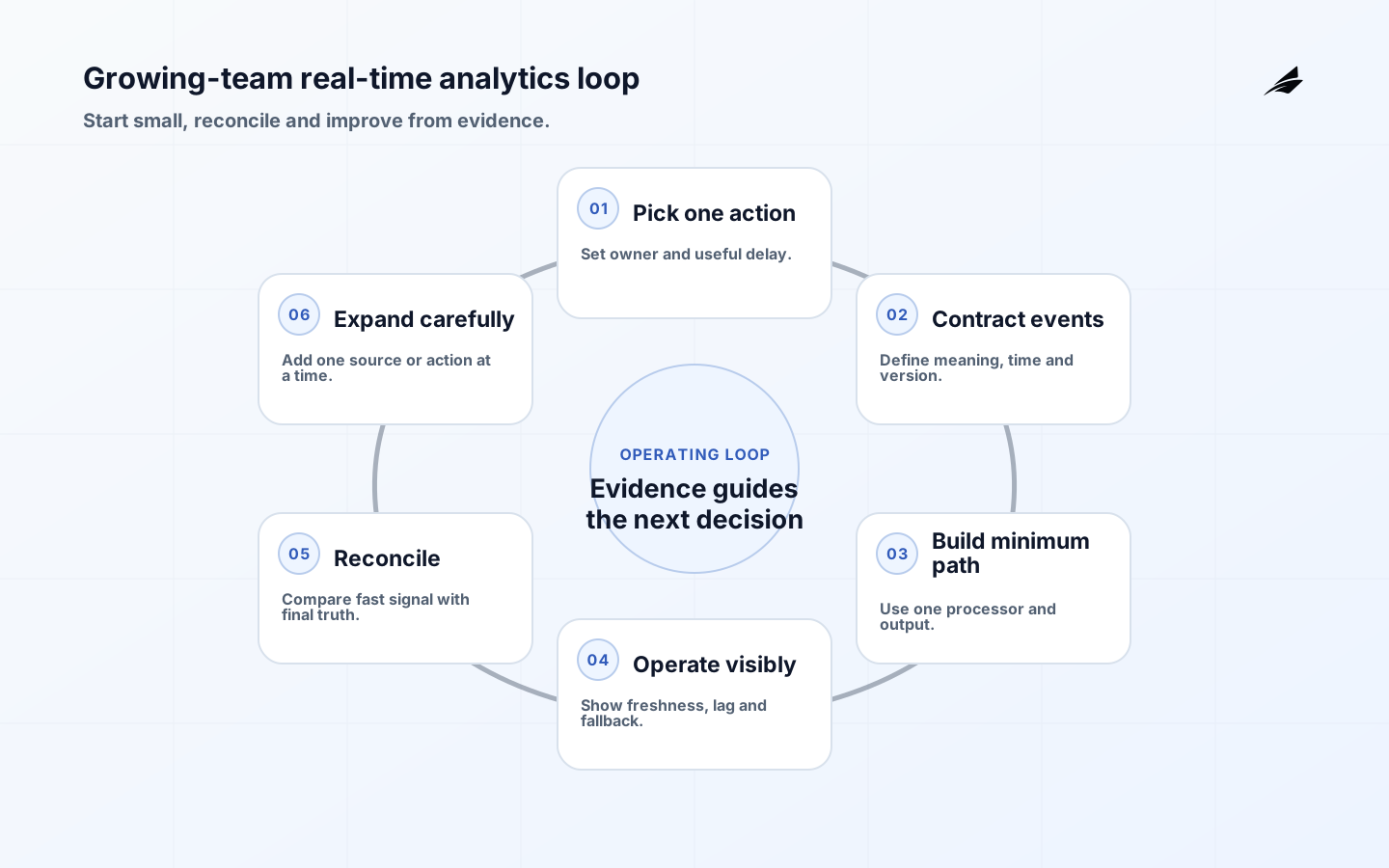
Real-time analytics for growing teams should start with one useful alert or queue, not an enterprise streaming program. The team is ready when it can name the event, the maximum useful delay, the person who acts, the source of truth and the safe behavior when data is stale. A live chart without a response usually creates more infrastructure and meetings, not better operations. Begin with a reversible decision such as routing a delivery exception or flagging service pressure, then build the minimum event, processing, review and reconciliation path that makes that response trustworthy.
This field guide emphasizes practical implementation and team routines. The growing-team stream processing guide compares platform patterns, while the reliable data-pipeline checklist covers broader pipeline controls. Real-time capability should grow only when each new source and action has an owner. A small system with clear semantics and fallback is more valuable than a complex platform nobody can safely replay.
1. Pick the first use case from the action backward
Shadow an operator during the period when timing matters. Record what they notice, how often the situation occurs, which evidence they verify, the latest useful intervention and what a false alert costs. Select a high-frequency, bounded scenario with accessible data and a reversible response. Avoid executive dashboards as the first consumer; start where someone can confirm whether earlier information changed work. Define a baseline for detection delay, cases handled, missed conditions and manual effort.
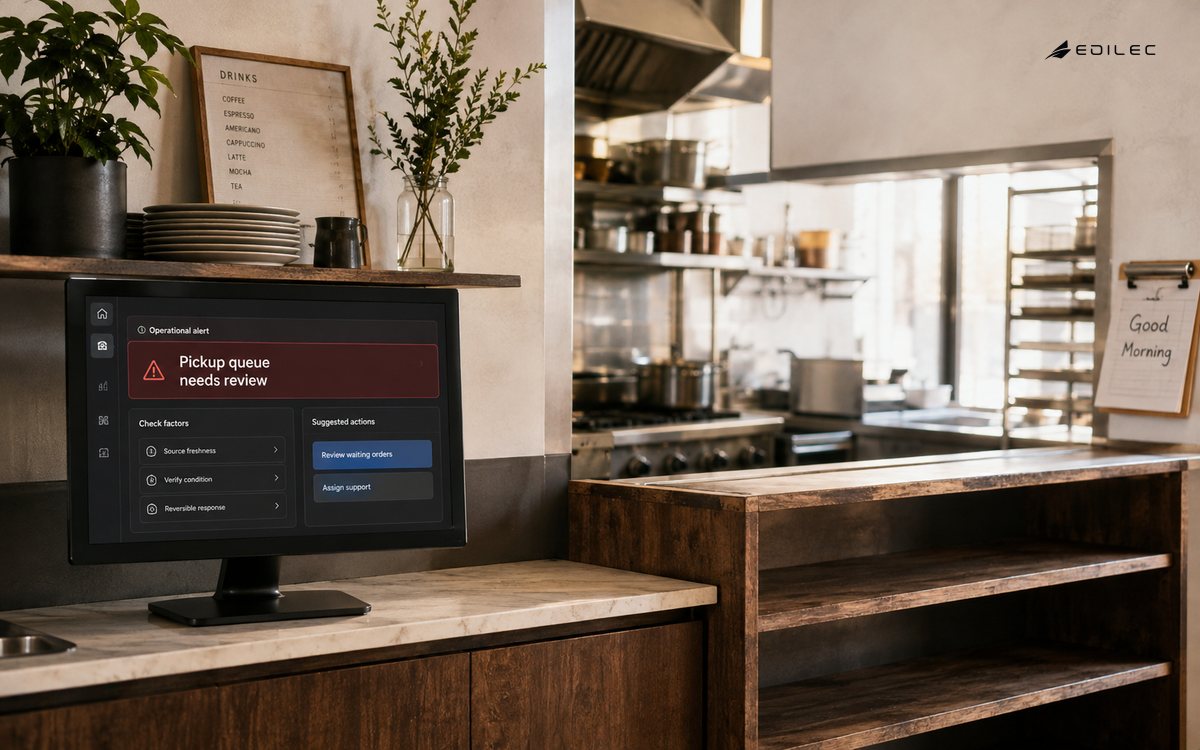
Write a one-page contract: 'When event pattern X occurs, within Y minutes the system creates Z for owner A, unless data condition B is stale; final truth comes from C.' This exposes missing ownership immediately. Use the event analytics notes to design durable event meaning. If staff can respond only once per shift, a fifteen-minute batch may be enough. Earn continuous processing through need, not fashion.
| First-use-case test | Good sign | Warning sign |
|---|---|---|
| Action | Named owner can intervene within the window | Dashboard has no operating response |
| Evidence | Source and final record are known | Metric combines undocumented sources |
| Failure | Manual fallback is practical | Automation must continue on stale data |
| Volume | Representative events can be sampled | Only a polished demo dataset exists |
| Reversibility | False action can be corrected | One error creates irreversible harm |
| Learning | Outcome can be reviewed weekly | No one owns threshold changes |
2. Create event contracts before pipelines multiply
Each event needs a stable name, purpose, owner, unique identifier, subject key, occurrence time, schema version and documented fields. Distinguish facts such as 'package scanned' from commands such as 'reroute package.' Producers should not emit ambiguous snapshots and call them events. Define compatibility and deprecation, and validate at ingestion. Quarantine malformed events with enough context to fix the producer; do not let one bad record stop unrelated work indefinitely.
Events arrive late and out of order. Apache Flink's streaming analytics guide explains event time and watermarks as policies for deciding when to stop waiting for earlier events. Choose allowed lateness from observed source behavior and decision value. Record whether late data updates the result, creates a correction, enters a review queue or is ignored. Make this visible to users rather than burying it in processor configuration.
3. Build the minimum operable stack
A practical first stack has a source adapter, durable transport or log, one processor, an operational store or queue, and a reconciled analytical destination. Add a schema registry or equivalent contract control when multiple producers emerge. Managed services can reduce infrastructure effort, but the team still owns event meaning, retention, permissions, cost and incident response. Keep deployment definitions and transformations versioned and separate development traffic from production.
Partition on the entity whose order matters and test uneven traffic. Keep state bounded by time or business completion. Plan for retries and duplicates. Apache Kafka's message delivery semantics distinguish at-most-once, at-least-once and exactly-once within documented boundaries. For a growing team, robust idempotency and reconciliation are often clearer than assuming an end-to-end exactly-once promise across email, databases and partner APIs.
4. Make dashboards honest and alerts actionable
Every operational view should display event-time freshness, source coverage and whether values are provisional. A page refreshed now can still show hour-old events. Define denominator and population; a 'success rate' without missing-source visibility can improve when ingestion fails. Keep final reporting separate when late adjustments matter. The growing-team ELT guide can provide the reconciled path for accountable daily or financial reporting.
Alert on conditions that require a timely action, not every implementation fluctuation. Include affected service, current delay, last reliable point, owner and runbook. Rate-limit repeated cases and deduplicate by subject and condition. Provide a simple way for operators to mark useful, false, stale or duplicate alerts; review feedback with source and threshold evidence. An ignored alert is a product defect, not proof that operations need more training.
| Signal | What it tells the team | Action |
|---|---|---|
| End-to-end event age | Whether the decision still meets its window | State delay or invoke fallback |
| Late-event rate by source | Which producer violates timing assumptions | Fix source or revise policy |
| Duplicate rate | Whether retry and producer behavior changed | Check idempotency and source |
| Processing backlog | How close the service is to stale output | Scale, shed or pause noncritical work |
| Alert usefulness | Whether the rule changes operations | Tune, retire or redesign the alert |
| Reconciliation difference | Whether fast and final truth diverge | Correct records and investigate |
5. Establish lightweight operating routines
Assign one service owner and a backup. Document how to check source arrival, transport health, processor lag, sink state and user impact. OpenTelemetry signals can connect traces, metrics and logs when correlation is consistent. Start with a handful of indicators: end-to-end age, valid-event rate, backlog, late events, action completion and reconciliation difference. Keep sensitive payloads out of routine telemetry and control access to diagnostics.
Test four failures before launch: producer silence, duplicate event, malformed event and unavailable sink. Then test restart and bounded replay. Verify that replay does not resend an email or repeat a credit. Define when to stop automated action and display a delayed-data notice. Google SRE SLO guidance helps connect these measures to user expectations. A modest objective with a practiced fallback is healthier than an unsupported promise of instant data.
6. Reconcile, review cost and expand carefully
Run a scheduled reconciliation against the authoritative system. Compare counts and material state, produce an exception queue and assign resolution. Keep source events long enough for the required replay and investigation, then delete according to policy. Track cloud or platform cost by source and use case: ingestion, storage, processing, state, queries, egress and support. A small team should know which alert or decision justifies each continuously running path.
Expand by adding one source, one consumer or one action at a time. Repeat contract, load, failure and reconciliation tests. Apache Beam's programming guide describes triggers as a tradeoff among latency, completeness and cost; revisit that balance as the use case changes. Move from alert to automated action only after historical evidence shows acceptable false and missed cases and the action has limits, idempotency, monitoring and a compensating route.
Agree team ownership before the first incident. A producer owner fixes event quality, the stream owner operates transport and processing, the use-case owner decides thresholds and the operations owner acts on output. One person may hold several roles in a small team, but the decisions remain distinct. Write escalation contacts and review them after staffing changes. Shared ownership without named authority tends to fail at the exact moment a stale alert, disputed metric or expensive replay requires a quick decision.
Use a weekly review during the first months. Sample alerts and missed cases, compare fast and final results, inspect late sources, review changes and cost, and decide one improvement. Keep the meeting tied to evidence and retire rules that no longer lead to action. As behavior stabilizes, reduce cadence rather than accumulating ceremony. This short loop gives product and data engineers the same view of value and prevents infrastructure metrics from becoming detached from the people making decisions.
Key takeaways
- Start with one timely, reversible operational action and a measurable baseline.
- Create owned event contracts before adding producers and consumers.
- Design late-data, duplicate and replay behavior explicitly.
- Show freshness and provisional status in every operational view.
- Keep alerts actionable and practice source, sink and replay failures.
- Reconcile with final truth, track cost per use case and expand one boundary at a time.
Real-time analytics for growing teams FAQ
What is the simplest useful architecture? Often one durable event source, one managed processor, an operational queue or view and a scheduled reconciled dataset. Add components only for a measured need.
How much event history should be retained? Enough for replay, investigation, correction and obligations, balanced against privacy and cost. Define the period per event class and test restoration before depending on it.
Should every metric become real time? No. Move a metric only when a shorter window changes an action. Keep planning, finance and low-frequency reporting on simpler governed pipelines when appropriate.
How does a team know it is ready to automate? The alert is consistently useful, data delay and errors are visible, duplicates are harmless, limits and authorization are enforced, and operators have tested pause, fallback and compensation.
Conclusion
Growing teams can build real-time analytics without creating a miniature platform organization. Choose one action, define the event and time semantics, use a small operable stack and make stale data visible. Reconcile fast signals with final truth and practice replay before granting automation authority. When each new stream has a clear owner, cost and response, the capability grows with the business. When those answers are missing, keeping the workflow batch-based is a sound engineering decision.