A Field Guide to Stream Processing for Growing Teams
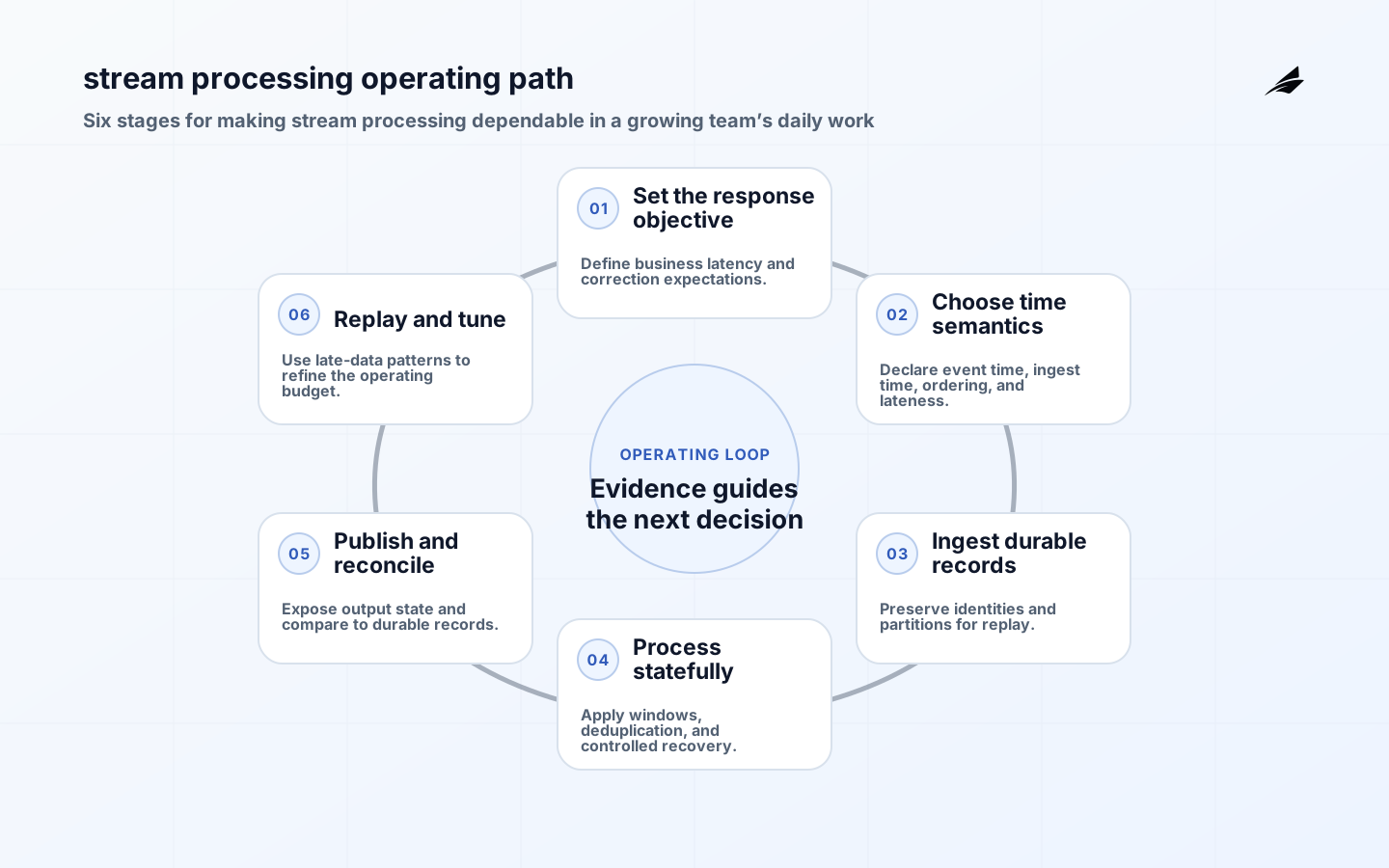
Stream processing helps IT managers make a decision with evidence they can inspect. For this stream processing case, the need usually appears when a recurring meeting ends with someone exporting data, rebuilding a calculation, or asking whether a number is current. The remedy is not a larger reporting estate. For this stream processing case, it is a controlled path from evidence to action: agree the decision, preserve context behind the measure, make exceptions visible, and give a named person responsibility for the response. This guide treats stream processing as an operating capability, not a one-time technical deliverable.
Choose the Stream’s First Operational Decision
For this stream processing case, write the decision in one sentence before selecting a tool: at this cadence, this person will decide this action using this evidence. For stream processing, the practical question is whether a signal needs immediate handling, short-delay updates, or batch processing. For this stream processing case, this identifies the user, deadline, alternatives, and cost of a late or incorrect answer. It also creates a sensible boundary for the first release. For this stream processing case, a credible implementation supports one important decision consistently; a vague platform promise cannot be tested or owned in the same way.
| Question | What to define | Evidence to keep |
|---|---|---|
| Decision | Who acts, at what cadence, and what changes. | Meeting, threshold, owner, and next action. |
| Meaning | The scope is durable time-stamped events such as payments and inventory changes. | Definitions, examples, identifiers, and exclusions. |
| Timing | When output is expected and becomes stale. | Cutoff, refresh state, and exception policy. |
| Response | Who investigates a material discrepancy. | Escalation route, incident note, and recovery decision. |
Separate Event Evidence From Derived State
Walk an Order-Status Event Through the Topology

Consider a growing fulfilment team that wants to alert a dispatcher when an order is at risk of missing its promised window. The source event should carry an order identifier, status, event timestamp, source revision, and producer context. The durable log preserves that fact before enrichment. A keyed state step then remembers the latest accepted status and the promised window; it should not infer that a missing event means the order was delivered. The decision output includes the current risk, the evidence cutoff, and whether the result is provisional. That boundary matters because an operator may choose an expensive intervention based on one alert. Apache Flink’s documentation describes stateful operators, event time, and snapshots as separate concerns that work together; the design should make each concern visible to the team.
Now walk the unhappy cases. If a carrier sends the same status twice, the event identifier and source revision should prevent a second intervention. If a status arrives late, the pipeline should apply the declared lateness policy and emit a correction or a qualified result. If the state store is restored from a checkpoint, the team should know which input offsets and state version were recovered. Record these cases as acceptance evidence, not as informal test notes. A growing team can add producers and consumers safely only when the contract explains time, identity, state ownership, retention, and the action that follows a changed result.
An accountable stream processing design separates evidence, controlled logic, interpretation, and presentation. Evidence needs stable identifiers, timestamps, and traceable context. Transformations need versioned logic, observable runs, and checks at meaningful boundaries. Interpretation needs definitions that the decision owner accepts. For this stream processing case, presentation must show reporting state rather than imply certainty it does not possess. For this stream processing case, the separation is practical: it lets a team repair a calculation, replay a run, correct a source, or change a dashboard without silently changing the record of what happened.
The implementation choices in this guide are grounded in Apache Flink event timer service, Apache Kafka documentation, OpenTelemetry concepts, Google SRE monitoring guidance. For this stream processing case, these authoritative references help distinguish data characteristics, provenance, instrumentation, and operating monitoring. For this stream processing case, apply their concepts to the workflow, data classification, and service expectation in front of the team. For this stream processing case, a reference can explain a concept; only an accountable owner can approve what good enough means for a decision with real consequences.
| Layer | Responsibility | Failure question |
|---|---|---|
| Source evidence | Preserve identifiers, time, origin, and permitted access. | Can the team distinguish missing, late, and incorrect input? |
| Controlled logic | Transform, test, version, and observe the output path. | Can a release be traced, reproduced, or rolled back? |
| Decision view | Show context, state, comparison, and appropriate detail. | Can a user see the cutoff and limits before acting? |
| Operating response | Own exceptions, communication, and improvement work. | Who owns the first decision when stream processing fails its acceptance criteria? |
Launch One Replayable Event Path
Begin with durable time-stamped events such as payments and inventory changes. Name one sponsor, one decision cadence, and one observable success condition. For this stream processing case, record source ownership, allowed access, timing assumptions, and the response path before connecting every adjacent system. For this stream processing case, build a small path that can be exercised with ordinary and troublesome examples. For this stream processing case, the first implementation should expose enough state for a user to tell what is current, what is pending, and what requires judgment. For this stream processing case, that evidence is more valuable than a broad release with no proven support or recovery practice.
- Choose one stream processing decision with a named sponsor and a daily or weekly cadence.
- Document access, source ownership, timing assumptions, and the expected exception path.
- For this stream processing case, ship an observable path with test cases based on normal and troublesome examples.
- For this stream processing case, run the workflow with users, record questions and overrides, then broaden scope deliberately.
Design for Lateness, State, and Replay
Processing time and event time answer different questions. A team must declare late-event, idle-partition, duplicate, retention, and correction behavior before a live output drives an operational response.
Review Watermarks, State, and Decisions
Track consumer lag, event age, watermark delay, state growth, late data, and replay results. For this stream processing case, segment evidence by source, release version, product area, or operating unit where it can reveal a concentrated problem. For this stream processing case, pair aggregate graphs with a small decision sample reviewed by the person who acts on it. For this stream processing case, the purpose is to learn whether an output was fit for use, not merely whether a job completed. For this stream processing case, after a failure, record business impact and decide whether to fix a defect, adjust a documented threshold, improve a contract, or retire a measure that no longer supports a decision.
Review a Live Topology Against Its Decision
For this stream processing case, set a recurring review that is short enough to happen and specific enough to change work. For this stream processing case, bring the current output, its reporting cutoff, a small sample of exceptions, and the decision taken since the previous review. For this stream processing case, ask whether the evidence changed an action, whether any manual override was necessary, and whether a user misunderstood a definition. This approach turns stream processing into a feedback loop instead of an asset that is assumed to be correct because it was published.
For stream processing, use the review to distinguish defects from ordinary uncertainty. For this stream processing case, a late source, a documented approximation, an access limitation, and a calculation error deserve different treatment. For this stream processing case, record who owns the next action and when the team will confirm the result. For this stream processing case, over time, the review should reduce avoidable exceptions and remove measurements that produce noise without helping a decision. For this stream processing case, that is a stronger sign of maturity than simply adding more dashboards, events, models, or alerts.
- Review decisions with the accountable user, not only aggregate system health.
- For this stream processing case, keep a record of exceptions, impact, and the changed control or definition.
- Test permissions and recovery during releases rather than during an incident.
- Remove measures, views, or checks that no longer support a decision.
Set Evidence Requirements for the Next Consumer
Set a Promotion Gate for New Consumers
Wider use should require more than a successful replay. Before adding a second decision or consumer, confirm that the new reader has a defined meaning, access boundary, retention need, and owner for corrections. Check whether its query changes state pressure, watermark progress, or the cost of retaining the source events. For an order stream, a fulfilment alert and a finance reconciliation may legitimately use different windows and correction policies; forcing them into one “current” value creates confusion. Record the promotion decision with the evidence reviewed, unresolved limitations, and the next date for checking them.
For stream processing, rehearse a bounded replay from durable input and compare the corrected output to the original operating decision. The drill should include late records and a temporarily idle partition. It establishes whether retention, deduplication, and correction rules work together rather than only working in isolated component tests.
Before extending stream processing to more teams or decisions, document what this review proved, what it did not prove, and which assumption will be checked next. For this stream processing case, keep the evidence alongside the operating record rather than in a private project note. For this stream processing case, wider rollout should be a deliberate response to demonstrated usefulness, clear ownership, and a recovery path that people have actually exercised.
Key Takeaways
- Stream processing works when tied to a specific decision, owner, and cadence.
- Definitions, timestamps, provenance, and exception handling are part of the product.
- For this stream processing case, a narrow observable release produces better evidence than a broad unowned rollout.
- Useful next reading: the stream processing guide, the stream processing implementation notes, and the stream processing operations reference.
Frequently Asked Questions
When does a stream platform earn its cost?
Not necessarily. First assess whether current systems preserve the evidence required for stream processing, run a controlled path, expose reporting state, and support people who must act. A new platform can reduce effort, but cannot supply missing ownership, definitions, or a decision cadence. Build the smallest dependable workflow first, then use its constraints to evaluate technology choices.
Who owns the order-status decision?
For stream processing, ownership is shared but should not be vague. A business owner accepts the decision definition and resolves meaning. For this stream processing case, a technical owner maintains the data path, access controls, and recovery practice. For this stream processing case, contributors may own sources or models, yet the decision owner must say whether an exception blocks use, qualifies the result, or can wait for the next cycle.
What evidence proves the first event path works?
Success for stream processing appears in changed behavior: fewer manual reconciliations, better-focused reviews, visible treatment of exceptions, and decisions that reference agreed evidence. Watch for harms too, such as a measure becoming an incentive to game or a report exposing more detail than its audience needs. Adoption without trust is not success.
Growth also changes the social shape of stream processing. New producers need a contract route, new consumers need a semantic review, and on-call teams need a way to distinguish a source failure from a processing failure. Make those handoffs part of the platform’s service design. A small ownership forum or change review can be enough if it has authority, a short record, and a clear escalation path. The aim is to preserve shared meaning while allowing teams to ship independently.
Conclusion
The practical standard for stream processing is answerability. A user should be able to ask what an output means, where it came from, when it is current, who owns it, and what happens when it is wrong. Start with one consequential decision, design the evidence and response path around it, and review results with people doing the work. That creates a capability a growing team can maintain instead of an artifact that cannot survive its first real exception.
A growing team should expand stream processing only when one replayable path has a clear decision, durable event contract, time policy, state owner, and exception route. Review lag, watermarks, checkpoints, corrections, and reader behavior together. Add a consumer when its meaning and operating cost are understood, not because another source is available. That keeps shared meaning intact as the topology grows.