A Field Guide to Customer Analytics for Growing Teams
Customer analytics helps product teams make a decision with evidence they can inspect. The remedy is not a larger reporting estate. This guide treats customer analytics as an operating capability, not a one-time technical deliverable.
Start with the decision customer analytics must support: customer analytics identity and consent
For customer analytics, the practical question is which customer journey or segment deserves a response. It also creates a sensible boundary for the first release.
| Question | What to define | Evidence to keep |
|---|---|---|
| Decision | Who acts, at what cadence, and what changes. | Meeting, threshold, owner, and next action. |
| Meaning | The scope is activation, repeat contact, retention, and service questions. | Definitions, examples, identifiers, and exclusions. |
| Timing | When output is expected and becomes stale. | Cutoff, refresh state, and exception policy. |
| Response | Who investigates a material discrepancy. | Escalation route, incident note, and recovery decision. |
Build an accountable customer analytics system
An accountable customer analytics design separates evidence, controlled logic, interpretation, and presentation. Evidence needs stable identifiers, timestamps, and traceable context. Transformations need versioned logic, observable runs, and checks at meaningful boundaries. Interpretation needs definitions that the decision owner accepts.

The implementation choices in this guide are grounded in NIST Privacy Framework, Google Analytics event setup, W3C PROV data model, W3C Data Quality Vocabulary. These authoritative references help distinguish data characteristics, provenance, instrumentation, and operating monitoring Apply their concepts to the workflow, data classification, and service expectation in front of the team.
| Layer | Responsibility | Failure question |
|---|---|---|
| Source evidence | Preserve identifiers, time, origin, and permitted access. | Can the team distinguish missing, late, and incorrect input? |
| Controlled logic | Transform, test, version, and observe the output path. | Can a release be traced, reproduced, or rolled back? |
| Decision view | Show context, state, comparison, and appropriate detail. | Can a user see the cutoff and limits before acting? |
| Operating response | Own exceptions, communication, and improvement work. | Who owns the first decision when customer analytics fails its acceptance criteria? |
Implement customer analytics in a narrow first release
Begin with activation, repeat contact, retention, and service questions. Name one sponsor, one decision cadence, and one observable success condition. Record source ownership, allowed access, timing assumptions, and the response path. Before connecting every adjacent system, exercise a small path with ordinary and troublesome examples.
- Choose one customer analytics decision with a named sponsor and a daily or weekly cadence.
- Document access, source ownership, timing assumptions, and the expected exception path.
Failure modes that undermine customer analytics
Weak identity matching, consent, or population definitions create false certainty. Minimize fields, aggregate when it answers the question, make exclusions visible, and do not use behavior as a proxy for sensitive traits.
Operating signals and review habits
Track identity match rate, consent and deletion processing, segment stability, sensitive access, and action outcomes.
Walk One Customer Decision from Signal to Action
Bring the current output, its reporting cutoff, a small sample of exceptions, and the decision taken since the previous review Ask whether the evidence changed an action, whether any manual override was necessary, and whether a user misunderstood a definition. This approach turns customer analytics into a feedback loop instead of an asset that is assumed to be correct because it was published.
For customer analytics, use the review to distinguish defects from ordinary uncertainty.
- Review decisions with the accountable user, not only aggregate system health.
- Test permissions and recovery during releases rather than during an incident.
- Remove measures, views, or checks that no longer support a decision.
Gate Expansion on Purpose, Privacy, and Correction Evidence
For customer analytics, review a sample segment with a product owner and a privacy-aware reviewer before activation. Check identity handling, purpose, cohort definition, and the customer consequence of a false positive. This slows down risky inference just enough to keep a useful insight from becoming an inappropriate action.
Before extending customer analytics to more teams or decisions, document what this review proved, what it did not prove, and which assumption will be checked next.
Turn a Customer Signal into an Accountable Intervention
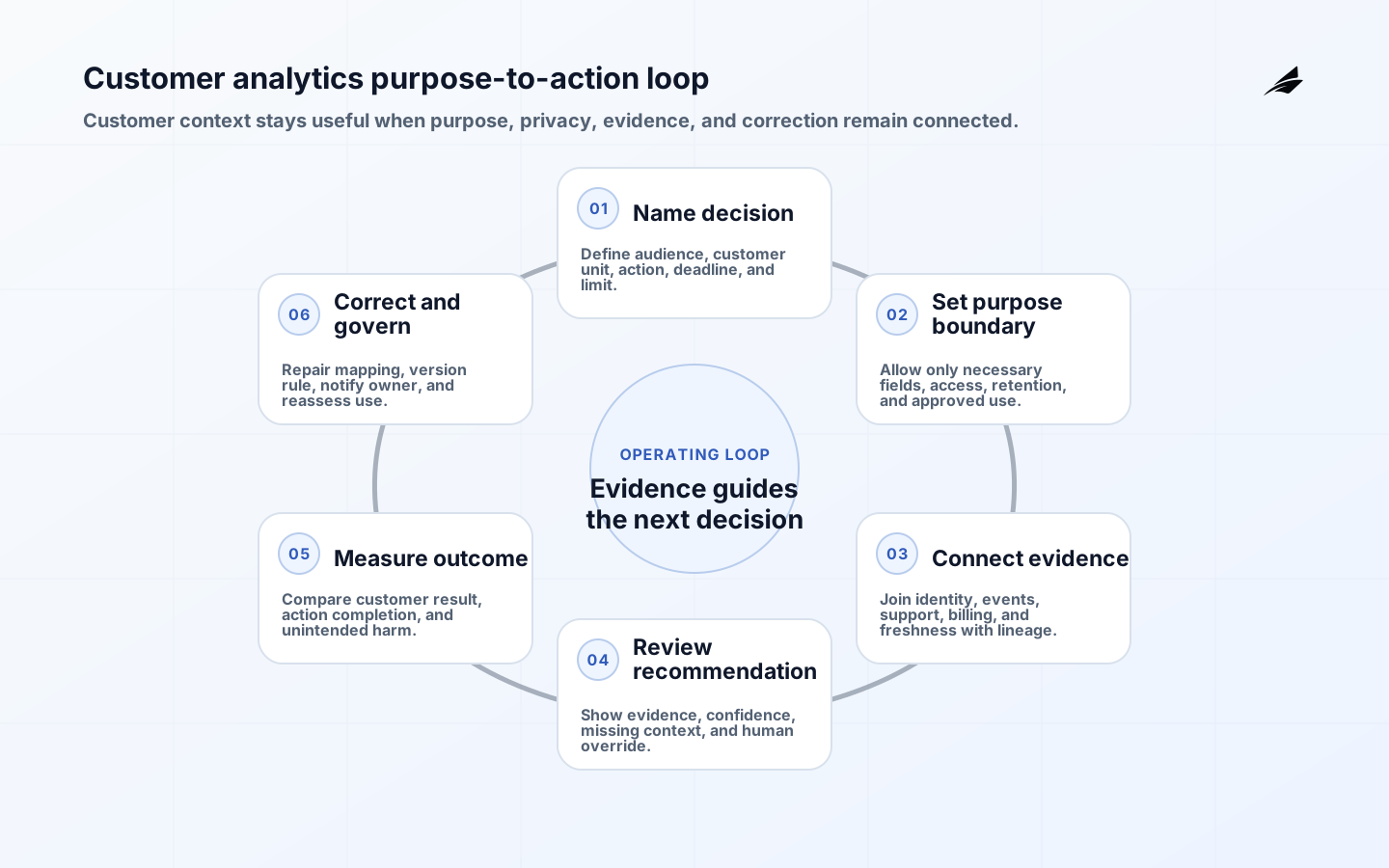
Customer analytics becomes operational when a named team can move from evidence to an action without guessing what the result means. Consider an account-health signal that flags a customer for outreach. Define the customer unit first: is the signal about a person, account, subscription, or support case? Then state the action, time window, and excluded cases. An account-level risk score should not trigger a person-level message when the model cannot explain which account evidence supports that recommendation.
Put the decision evidence beside the recommendation: source cutoff, matched records, missing fields, confidence or rule reason, and the latest correction. Google Analytics documents User-ID as a controlled configuration used to connect signed-in activity across sessions and devices; that is a useful example of keeping identity behavior explicit rather than treating it as an invisible join. NIST’s Privacy Framework provides a governance lens, but the local review still has to decide whether this purpose, audience, retention period, and access role are permitted.
Run one human-in-the-loop exercise before automation. Give a customer-success lead three records: a well-supported recommendation, a stale record with a missing source, and two customers merged by an incorrect identifier. The lead should be able to accept, defer, or reject each result and leave a reason that the data owner can use to correct the path. W3C PROV is helpful for expressing where evidence came from; it does not replace the business owner’s decision about whether an action is fair, useful, and reversible.
The intervention owner should be able to decline a recommendation without creating a hidden data-quality incident. Record the reason, whether the issue is identity, freshness, purpose, or interpretation, and route it to the owner who can change the evidence or rule. That feedback is part of the customer analytics product because it tells the team where the decision contract is failing in practice.
Key takeaways
- Customer analytics works when tied to a specific decision, owner, and cadence.
- Definitions, timestamps, provenance, and exception handling are part of the product.
- Useful next reading: the customer analytics guide, the customer analytics implementation notes, and the customer analytics operations reference.
Customer analytics needs a consent-aware operating rhythm, not just a joined table. At intake, record the customer unit, permitted purpose, identity confidence, retention limit, and action owner. At publication, show whether the result is current, delayed, provisional, or corrected. At intervention, preserve the reason the signal was used, the human decision, and any override. At review, examine whether the action helped the customer and whether the evidence excluded people or exposed more detail than the purpose allowed. These checkpoints give customer teams a practical way to challenge a result before it becomes an automated habit.
A useful pilot can follow one service journey from an authenticated event to a support action. Test an account merge, a missing identifier, a late event, a withdrawn purpose, and a correction issued after outreach. For each case, state whether the system should continue, pause, annotate, or ask for a reviewer. Keep the test fixtures and decision notes with the operating record. This gives the technical owner a durable acceptance set and gives the customer owner a way to explain why a recommendation was made without claiming that the model knows more than the evidence supports.
Growth changes the ownership surface. A person who built the first report may not be the person who handles a consent question, a stale segment, or a disputed account match six months later. Name the escalation route before widening access, publish the evidence state beside the customer signal, and schedule a short review of overrides and unresolved exceptions. The review should retire measures that no longer change an action and strengthen the controls around measures that carry higher customer consequence.
Keep the review proportionate to the decision. A low-risk descriptive segment may need a visible status and owner, while an intervention that changes service treatment needs stronger purpose evidence, human review, and a documented route for correction. The distinction should be visible to the person choosing the next action.
Frequently asked questions
Do we need a new platform for customer analytics?
Not necessarily. First assess whether current systems preserve the evidence required for customer analytics, run a controlled path, expose reporting state, and support people who must act. A new platform may lower effort, but it cannot provide missing ownership, definitions, or a decision cadence. Start with the smallest dependable workflow, then use its constraints to evaluate technology choices.
Who should own the work?
For customer analytics, ownership is shared but should not be vague. A business owner accepts the decision definition and resolves meaning.
How do we know the first release succeeded?
Success for customer analytics appears in changed behavior: fewer manual reconciliations, better-focused reviews, visible treatment of exceptions, and decisions that reference agreed evidence. Also check for harms, such as a measure becoming an incentive to game or a report exposing more detail than its audience needs. A clean adoption count is not proof of trust.
Conclusion: make customer analytics answerable
The practical standard for customer analytics is answerability.
Use the customer analytics implementation checklist, plain-language event analytics guide, and data quality guide as neighboring references when the first workflow expands. They reinforce a useful boundary: customer analytics should help a named person make a better decision, while source quality, privacy, and access controls remain visible enough for that person to challenge the result. If the team cannot state the action or correction route, narrow the output before adding more data.
Customer analytics is ready to grow when the people taking action can name the purpose, inspect the evidence state, respect the use boundary, and correct a representative mistake. Keep that test in the operating record so every new source or automated recommendation has to earn its place through answerable customer outcomes.