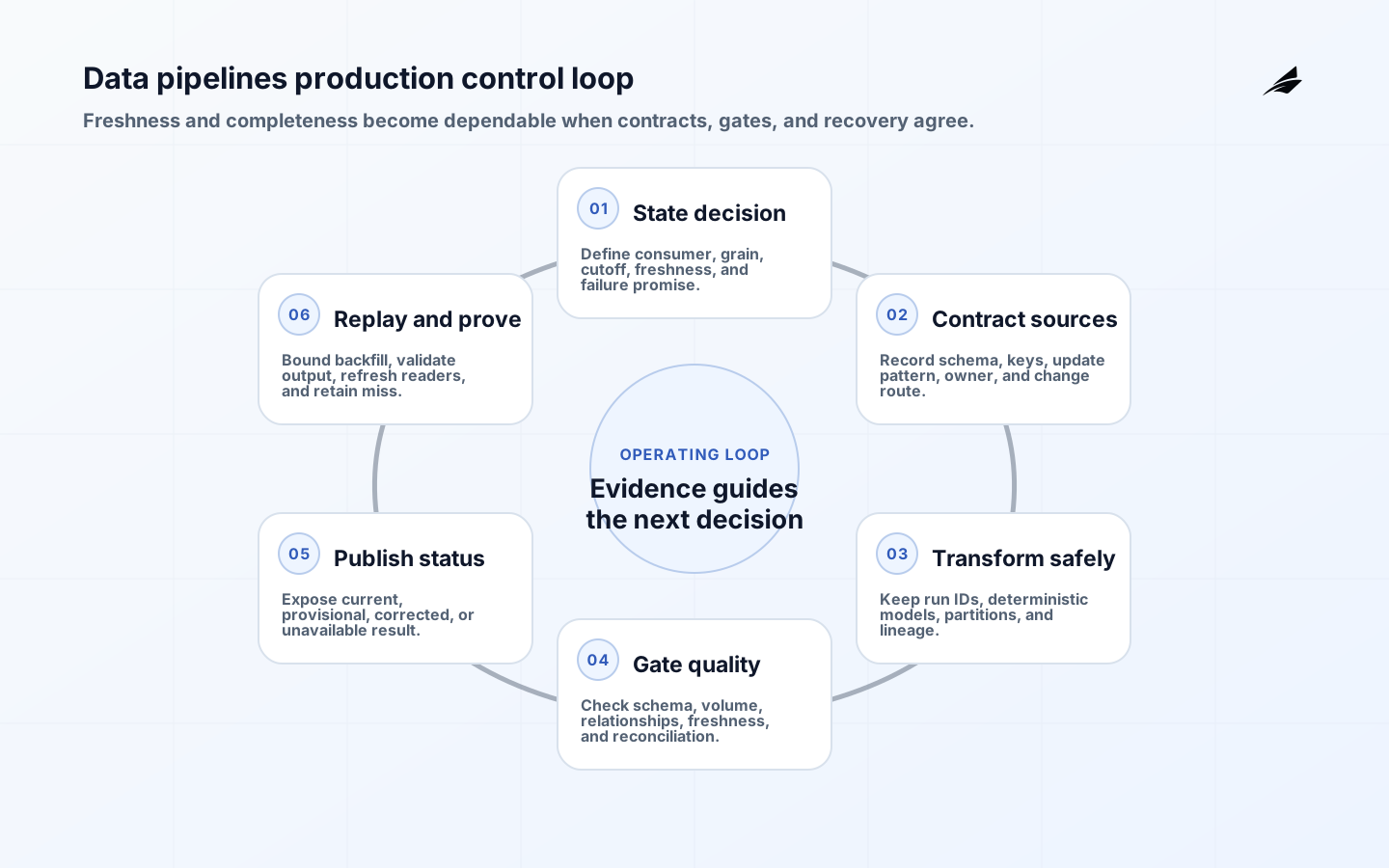
Data pipelines become valuable when they help the owner who must keep downstream decisions supplied with trustworthy data make a better decision, not when they merely add another technical artifact. The practical question is whether data can be delivered, recovered, and explained safely after scheduled jobs meet real dependencies. Begin with the source-to-consumer path, data contract, schedule, retry behavior, and recovery point. Those cases require different controls. Production design records the run identifier and input boundary, makes partial state visible, and gives responders a safe retry or rollback choice rather than a blanket “run again.” A dependable implementation makes the state of the evidence visible, gives people a way to challenge it, and leaves a trace when a definition or result changes.
Start with the decision data pipelines must support
Treat a data pipeline in production as a service around a recurring decision. The service boundary should also say what it does not promise. For data pipelines, the relevant inputs are source contracts, orchestration state, credentials, checkpoints, transformations, quality assertions, and lineage.
| Decision question | Specific answer to record | Evidence to retain |
|---|---|---|
| Who acts? | Name the role with authority to change the outcome. | Owner, escalation route, and review cadence. |
| What is true? | State the grain, time policy, inclusion rules, and known exclusions. | Definition, examples, and version history. |
| When is it usable? | Declare freshness or latency expectations and correction behavior. | Status signal, run evidence, and incident notes. |
| What happens on doubt? | Offer a safe challenge, containment, or fallback path. | Ticket, decision log, and correction record. |
Write the Publication Promise
The Data Pipelines in Production: A Decision Guide promise is credible only when its business meaning maps to a behavior an operator can test. For this topic, capture source contracts, orchestration state, credentials, checkpoints, transformations, quality assertions, and lineage. Then state observable stages with clear alerts, least-privilege access, idempotent recovery where possible, and an incident playbook. Avoid vague claims such as “single source of truth” unless the scope and authority are named: many useful sources can coexist when their purpose is clear Define identifiers, expected values, ownership, and compatible change rules at the point where a consumer can inspect them. A job may complete successfully while delivering incomplete, duplicated, stale, or misrouted records. Clear promises also make handoffs calmer.
- Name a business owner and a technical owner for data pipelines; either role alone is insufficient.
- Make material changes reviewable, dated, and understandable to affected readers.
- Keep an auditable exception route instead of silently correcting surprising records.
Trace Change from Source to Reader
Those cases require different controls. Production design records the run identifier and input boundary, makes partial state visible, and gives responders a safe retry or rollback choice rather than a blanket “run again.” data contracts are often part of the dependency story, so their contract and recovery behavior deserve the same attention as the final interface. Prefer a small release with measured use over a broad launch.
Exercise Late, Partial, and Corrected Data
Verify that the team can replay or contain a failed run without silently duplicating data or losing the evidence of what happened.

| Operating moment | Control | Useful signal |
|---|---|---|
| Before release | Review definitions, ownership, permissions, and consumer impact. | Approval and test evidence linked to the change. |
| Normal operation | Publish status with the result and monitor declared checks. | Freshness, completion, quality, and usage trend. |
| Exception | Contain impact, preserve evidence, notify readers, and correct safely. | Time from detection to understandable status. |
| After correction | Explain material movement and improve the failed control. | Repeat incident rate and unresolved follow-up. |
Give Every Data State an Owner
After launch, the work shifts from construction to stewardship. Monitor freshness, completion and quality success rates, failed-run age, mean time to detect, and recovery time.
Decide from Freshness, Quality, and Recovery Signals
Adoption and reliability are complementary. For data pipelines, watch freshness, completion and quality success rates, failed-run age, mean time to detect, and recovery time. Pair quantitative evidence with short interviews or support reviews.
Choose Publication Semantics Before the First Backfill
A pipeline does not become dependable merely because its transformation completed. Decide what a reader sees while the source is late, partially loaded, or being corrected. The status may be current, provisional, stale, corrected, or unavailable, but each label needs a definition and a consumer action. BigQuery’s performance guidance points teams toward reducing scanned data and making query behavior deliberate; that is useful only after the pipeline has decided which partition and cutoff represent the promise being measured. Power BI’s star-schema guidance adds a practical reminder: a model’s grain and relationships must support the way people slice the result, not just the way a load job happens to land rows.
Consider a daily revenue pipeline that receives late refunds. If the dashboard silently replaces yesterday’s value, finance cannot tell whether the business changed or the pipeline corrected history. A better contract publishes the close cutoff, shows a provisional state until the late-arrival window closes, and records a correction run when a refund changes a previously reported day. Dbt data tests can assert relationships and valid values in the model, while the publication layer must still expose the run ID and correction state to readers.
Backfill design should be reviewed with the person who consumes the output. Define the smallest safe replay boundary, the keys or partitions it may rewrite, the reconciliation query, and the notification path for affected reports. Snowflake’s data-loading documentation distinguishes bulk loading from continuous loading and calls out ingestion latency; use that distinction to choose whether a source belongs in a batch close, an incremental window, or a separate provisional feed.
| Publication state | Reader can do | Pipeline must retain |
|---|---|---|
| Current | Use within the stated freshness window. | Source cutoff and successful run ID. |
| Provisional | Use cautiously while late data may change the result. | Open window, expected close, and late-arrival policy. |
| Corrected | Revisit decisions made from the earlier result. | Correction reason, affected scope, and notification evidence. |
| Unavailable | Wait or follow the escalation route. | Failure reason, owner, and next recovery action. |
Key takeaways for data pipelines
- Data pipelines start with a named decision and a clear boundary, not a tool choice.
- Test representative failure modes and preserve evidence so corrections are explainable.
- Measure trusted use and decision quality alongside technical delivery signals.
The pipeline controls can be checked against BigQuery performance guidance, Power BI star-schema guidance, dbt data tests, Snowflake loading guidance, and Snowflake streams documentation when choosing publication, validation, and recovery evidence.
Data pipeline operators need publication semantics before they need another scheduler feature. Define whether a consumer receives a complete snapshot, an incremental change set, a provisional partition, or an explicit unavailable state. Tie that choice to the run identifier and the source cutoff so a reader can tell whether a late record belongs in the current result or the next correction. For backfills, record the affected interval, the models rebuilt, the rows reconciled, and the readers who must be notified. A replay is complete only when the published state and the audit trail agree.
Use a compact recovery ledger for every material pipeline: source boundary, orchestration run, input volume, rejected volume, publication timestamp, status, and next action. During an incident, the ledger lets an operator pause downstream use without guessing whether the failure happened before extraction, during transformation, or after publication. It also supports a useful handoff between engineering and the business owner. The engineer can show which control failed; the owner can decide whether to wait, use a prior settled result, or disclose a provisional value. That decision is part of the data product, not an afterthought.
When the pipeline serves finance, operations, and customer teams at different cadences, publish the cutoff and confidence for each audience rather than forcing one status to cover every use. That small distinction prevents a useful near-real-time signal from being mistaken for a settled financial figure.
Frequently asked questions about data pipelines
When is data pipelines ready to use? A pipeline can serve a limited audience only after its decision, source boundary, owner, status signal, and exception path have been exercised with realistic data.
Who should own data pipelines? A technical owner operates the path, credentials, and recovery procedures, while a data owner approves what is delivered and who can consume it. Downstream owners need a named contact and notice period when a change could alter their results.
How often should data pipelines be reviewed? Review data pipelines after source contract changes, reliability incidents, credential changes, or consumer migrations. Scheduled operational reviews should examine alert quality, recovery evidence, and whether retry or backfill procedures still match actual dependencies.
Conclusion: make data pipelines explainable
The durable version of data pipelines is explainable under pressure.
Before promoting a pipeline change, ask three practical questions. Can the team identify the exact source window affected? Can a reader see whether the published result is current, provisional, or corrected? Can an on-call owner rerun only the safe boundary without duplicating facts? The reliable data pipelines checklist and warehouse modeling guide provide adjacent references. A bounded answer to each is more valuable than a generic claim that the warehouse is scalable because it connects infrastructure behavior to the decision a person must make.
A pipeline guide should leave a clear publication promise: readers can tell whether a result is current, provisional, corrected, or unavailable, and responders know which run and boundary to inspect. Keep backfill evidence beside the consumer-facing status, and make recovery ownership part of the service rather than an afterthought to orchestration.