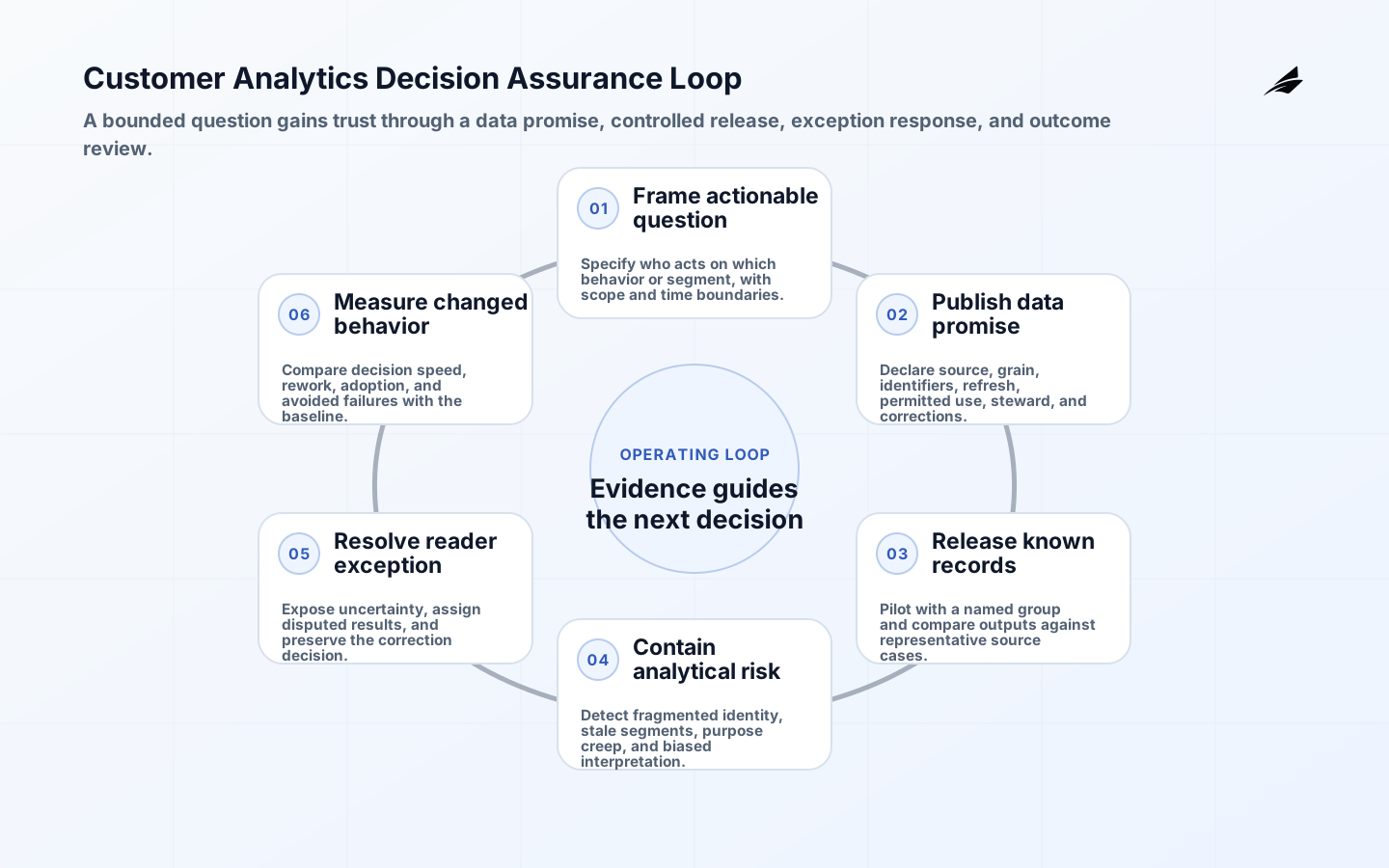
For customer analytics, which behavior or segment can be acted on without overstating evidence or misusing personal information. That is a better starting point than a dashboard request or a tool selection because it makes the action, evidence, population, and timing explicit. A Team Can Label A Quiet Weekly Visitor As Churned When The Product Is Naturally Used Monthly A useful implementation lets product and growth teams distinguish an early signal from a result that is final enough for accountability. It shows what is known, what is excluded, and who can respond when the evidence changes. This guide treats customer analytics as an operating capability rather than a reporting feature: the people using it can explain its purpose, the people supporting it can inspect its path, and the people governing it can make changes without guessing at the impact.
Define the decision and boundary for customer analytics
Start by writing one recurring decision in plain language: which behavior or segment can be acted on without overstating evidence or misusing personal information. State the entity or record being counted, the time boundary, inclusion rules, exclusions, and intended reader. A title or a familiar label is not enough; two teams can use the same word while applying different filters or clocks. Describe the threshold that calls for action and the route for questions or corrections. This small brief becomes the shared reference for engineering, operations, and leadership. It also gives event analytics a clear partner: reusable analytical assets work best when the downstream decision and its limits are visible before delivery begins.
| Question | Decision-ready answer | Evidence to retain |
|---|---|---|
| Who acts? | Name the person who can change the outcome, not merely the report recipient. | Owner and review cadence. |
| What is included? | Declare the entity, grain, time window, and exclusions. | Definition with representative records. |
| When is it valid? | State refresh promise and correction behavior. | Freshness status and change history. |
| What happens on doubt? | Use a safe exception path rather than forcing a false certainty. | Queue, escalation owner, and decision log. |
Design the customer analytics data promise
A data promise converts intent into behavior that can be inspected and tested. Name the source-of-record, stable identifiers, expected arrival pattern, permitted use, steward, and technical owner. Define formulas at the level needed to reproduce a result, including filters, time treatment, and known limitations. The promise must describe compatible changes and changes that require review. That matters because identity fragmentation, biased interpretation, purpose creep, and stale segments may leave a familiar chart looking plausible while altering its meaning. The goal is not elaborate documentation for its own sake. It is a concise contract that lets an analyst trace an output to evidence and lets a decision maker understand when not to rely on it.
- Give every material customer analytics asset a named user, decision, owner, and review rhythm.
- Use stable field and metric names with definitions that describe scope rather than marketing labels.
- Expose freshness, coverage, exclusions, and provisional status near the result.
- Keep sensitive attributes, retention, and access rules explicit before joining or distributing data.
- Treat a manual correction as an auditable record with actor, reason, timestamp, approval, and durable follow-up.
- Test failures that are plausible in this domain before they become a production incident.
Build an operating model for customer analytics
Automation can deliver checks and alerts, but it cannot settle business meaning. Give the work a compact operating model: a business owner decides purpose and trade-offs; a technical owner maintains the path; a steward resolves definition questions; and a support route handles failures. Review material changes before release. During an incident, preserve the source status, affected consumers, validation evidence, containment decision, and correction plan. This creates a feedback loop instead of a one-time repair. For customer analytics, it is especially important to separate a broken delivery from a changed business condition. Otherwise teams can publish a fast fix while losing the evidence required to prevent the next recurrence.

| Operating moment | Minimum control | Useful signal |
|---|---|---|
| Input changes | Assess meaning, ownership, sensitivity, and downstream impact before use. | Review completed before release. |
| Normal delivery | Run declared checks and publish interpretable status. | ${measure}. |
| Exception | Contain impact, preserve evidence, notify accountable readers, and correct safely. | Detection-to-status time. |
| Periodic review | Retire stale outputs and revisit thresholds, permissions, and assumptions. | Assets with current owners. |
Implement in small, reviewable releases
For customer analytics, begin with a bounded use case where people can compare the result against known records. Capture baseline behavior, then release to a named pilot group. Test normal and uncomfortable conditions: missing identifiers, delayed arrivals, duplicates, permissions changes, corrections, and rollback. Instrument the path so support can explain what happened without reconstructing a story from unrelated logs. A release is ready when the team can state what it will publish, what it will withhold, who receives an alert, and how a correction reaches both the data and the person making the decision. That discipline turns implementation into evidence, not a promise of future governance.
Check quality and control risk in use
Quality is fitness for a declared purpose, not a single score. Choose checks that reveal the failure modes relevant to customer analytics, including identity fragmentation, biased interpretation, purpose creep, and stale segments. Some can be automated; others require a steward to assess a rule or an unexpected pattern. Never report a pass rate without a denominator, severity policy, and accountable owner. A high score can still be unsafe when the remaining records contain the customer, transaction, or queue needing immediate attention. Pair automated evidence with sampled record review and a clear policy for provisional, corrected, and unavailable results. This approach keeps uncertainty visible without making the workflow unusable.
- Set severity by the consequence of a wrong customer analytics decision, not by implementation convenience.
- Preserve representative edge cases that explain past failures and make future regression testing sharper.
- Track failures by source, owner, and age so recurring issues are not averaged away.
- Reconcile material totals or cohorts to accountable records on a stated schedule.
- Revisit thresholds after product, policy, process, or system changes alter the operating context.
Measure adoption and outcomes
A view, query, or event does not prove that customer analytics improved work. Look for evidence that the intended reader decided sooner, resolved an exception with less rework, or avoided a known failure. Compare outcomes with a baseline and review cases in which people chose not to act; non-action can reveal either healthy judgment or an unclear signal. Monitor identity match quality, segment refresh timeliness, experiment lift, and opt-out handling. When a measure worsens, first distinguish a changed process, changed population, or changed measurement. That habit protects the team from treating an instrumentation artifact as operational truth and keeps improvement work focused on the actual constraint.
Key takeaways
- Customer Analytics begins with a recurring decision and a declared boundary, not a tool choice.
- Make ownership, freshness, limitations, and correction paths visible to readers.
- Use controls that address identity fragmentation, biased interpretation, purpose creep, and stale segments, with severity tied to consequence.
- Release a small path with real users, record-level evidence, and a safe exception route.
- Treat changes to meaning as governed changes even when a familiar label remains.
- Review whether behavior improves; delivery volume alone is not evidence of value.
Frequently asked questions
When should a team start? Start when a repeated decision is slow, disputed, expensive, or risky because its evidence is unclear. Who owns it? The business owner for the decision and the technical owner for the path must both be named; neither role can safely absorb the other. How much automation is needed? Automate repeatable checks and evidence capture, then keep judgment points visible where context matters. What is the usual mistake? Expanding customer analytics before the team can explain boundaries, failure behavior, and correction routes. How often should it be reviewed? At the decision cadence and after any material source, policy, or workflow change.
Conclusion
Good customer analytics gives product and growth teams a trustworthy route from evidence to action. It declares the decision, protects meaning, names owners, and makes exceptions manageable. Begin with one high-consequence question, a small group of users, and evidence that can be inspected at record level. Once that route is reliable, extend it without losing the context that makes it useful. The lasting test is simple: when a number changes, can the responsible person explain what changed, decide what to do, and show the evidence behind the decision? In the first review, ask whether the team can still answer the original question: which behavior or segment can be acted on without overstating evidence or misusing personal information. Inspect consent-aware identity rules, segment evidence, and experiment results, not just a summary percentage, and make an explicit decision about any unresolved uncertainty. The next release should address the most consequential gap rather than add a decorative metric or a broader integration. Watch closely for identity fragmentation, biased interpretation, purpose creep, and stale segments; each is a reason to strengthen the definition, control, or support path before confidence is lost. This sequence keeps the work proportionate. It helps product and growth teams make a better decision today while leaving behind evidence that makes the next decision faster, more explainable, and easier to audit. Schedule the review around the operational cadence, record the decision and its rationale, and assign a specific owner for the next correction. That small habit prevents the analysis from becoming a static artifact after the original launch. Keep the resulting review record available to the people who must act on the next exception.