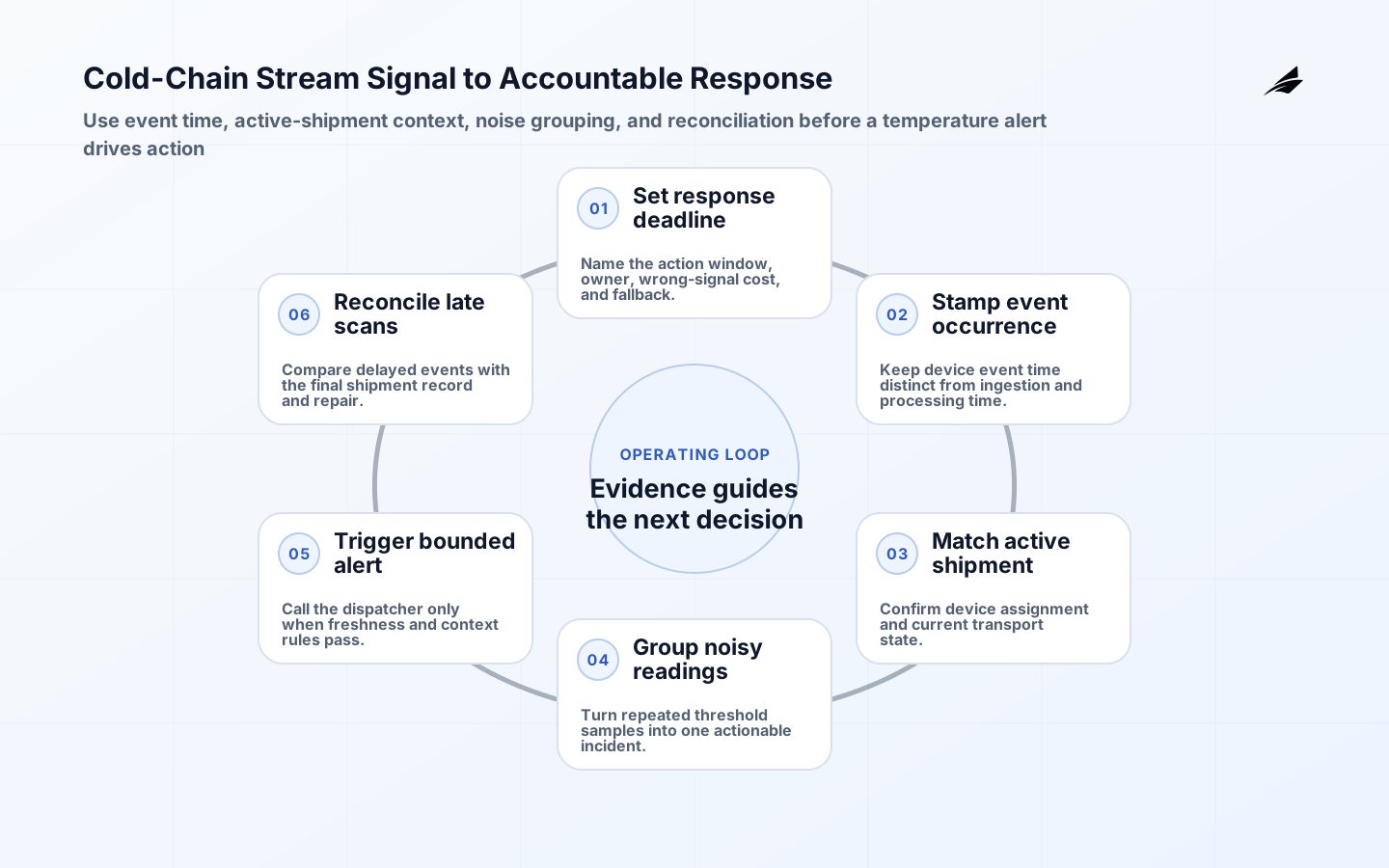
Stream processing earns its complexity when a shorter delay changes an operational decision. A dispatcher who can reroute a vehicle before a service promise is missed has a real-time use case; a monthly capacity review usually does not. Operations leaders should state the action, deadline, cost of a wrong signal, and fallback procedure before approving a streaming program. This prevents a team from treating sub-second delivery as a goal in itself. The service promise includes how quickly an event becomes usable, how long the system waits for late arrivals, what happens during an outage, and which record is authoritative when the stream and a later system of record disagree.
Define the decision before expanding stream processing
The first boundary for stream processing is the decision contract: who uses the result, what action they can take, when they need it, and what error is unacceptable. Turn that statement into a short review artifact with an accountable business owner and a technical owner. It should state the population, time basis, authoritative source, material exclusions, and a route for exceptions. This prevents a broad platform initiative from claiming success because it produced data, while the intended reader still relies on a spreadsheet or private interpretation. A narrow, repeated decision is the best starting point because it forces the team to make terms and handoffs concrete.
- Name the operator or leader who will change an outcome after seeing stream processing.
- Describe the population and time rule in plain language, including exclusions.
- Identify the source or record that is authoritative when systems disagree.
- Set a freshness or review window that matches the action rather than a generic technical target.
- Write the fallback and escalation path for missing, contradictory, or restricted data.
Make stream processing evidence inspectable
Time semantics are the center of the design. Event time is when something happened in the real world; ingestion or processing time is when the platform observed it. A scan performed at 09:00 can arrive at 09:08 because a device was offline. The Apache Flink guidance on timely processing explains why applications need an explicit event-time and watermark policy rather than assuming arrival order is truth. Operations must approve the lateness threshold because it trades prompt action against a more complete answer. Keep the late-event route visible: update a downstream state, issue a correction, or send the record for reconciliation.
| Design area | Decision to make | Evidence to keep |
|---|---|---|
| Decision | Timing need | Acceptable fallback |
| Reassign at-risk delivery | Minutes | Use last confirmed location and qualify the action |
| Detect equipment fault | Seconds to minutes | Create a review queue when telemetry is stale |
| Close financial period | Days | Reconcile to the ledger rather than streaming estimate |
Build an operating path for stream processing
Separate durable transport, stateful computation, and business sinks. Retention in a log makes replay possible, but replay is not automatically safe if a sink emails a customer or creates an invoice. Design idempotent writes, stable event identities, and a clear boundary between advisory signals and irreversible actions. The Apache Kafka documentation is a sound starting point for understanding durable event streams and consumer behavior; it does not replace a business decision about ownership. Monitor lag, processing errors, watermark progress, and state growth alongside the operational metric itself.

Set controls and responses for stream processing
Controls should test a declared promise and lead to a known response. For stream processing, combine preventive controls, such as controlled schemas or access roles, with detective controls, such as reconciliation, freshness checks, and review of unexpected distributions. Do not make every deviation an incident; define materiality so teams can separate a correctable record from a decision-threatening condition. Each alert or review should identify the owner, affected scope, evidence available, containment choice, and communication expectation. The result is a service that can explain its limitations under pressure, not just a successful scheduled job.
| Control moment | Question | Expected response |
|---|---|---|
| Condition | Design choice | Operational consequence |
| Late event | Watermark and correction policy | Readers know whether the prior result changes |
| Duplicate event | Idempotent sink and event identity | Replay does not repeat an external action |
| Sink unavailable | Durable queue and retry boundary | Backlog is visible and recovery is controlled |
Work through a real stream processing case
Imagine a cold-chain operator receiving temperature readings from refrigerated containers. A threshold breach triggers a call only when the reading is recent, the device is assigned to an active shipment, and repeated noisy readings are grouped into one actionable incident. A broker outage should not erase the history or page staff with hundreds of duplicates after recovery. The operating playbook specifies who acknowledges the alert, how an unavailable device is reported, and how a late calibration update changes the incident record. That is stream processing in service of work, not a live chart for its own sake.
Govern change and access in stream processing
Require a reconciliation path to the system that closes the business process. Streaming estimates may drive a fast response while a batch or transactional record establishes the final count. Compare the two on a regular cadence, investigate material differences, and retain enough source context to explain a correction. For more on the delivery foundation, pair this guide with the data pipeline architecture guide. A real-time path is ready to expand only after teams have rehearsed a late event, a replay, a state migration, and an unavailable downstream system.
Measure whether stream processing improves the work
Measure stream processing through the quality of the decision path, not implementation activity alone. Useful signals include time from a material signal to a documented response, recurring disputes over a definition, percentage of decisions supported by current evidence, unresolved exceptions, and the number of parallel workarounds. Compare these with a baseline, then ask users to explain a representative result and what they would do if its main input were delayed. A higher dashboard view count or a larger catalog may be encouraging, but neither proves that decisions became more reliable. Revisit the measure when the workflow, source system, or ownership model changes.
Run the first 90 days of stream processing deliberately
In the first month, choose one high-value workflow and establish its baseline: current preparation time, exception rate, decision delay, and the manual reconciliation that people perform today. In the second month, release the smallest complete stream processing path to the people who already do that work. Include source status, an owner, a drill route, and a log for disputed cases; do not add broad self-service until these basics survive ordinary use. In the third month, review a sample of normal decisions, difficult exceptions, and a controlled failure such as a late input or a definition change. Record what the team learned, remove a workaround only after the replacement is reliable, and decide whether the same pattern is ready for a second domain. This sequence makes investment visible without rewarding superficial rollout activity.
Review the stream processing operating system
A quarterly review keeps stream processing aligned with the work rather than the original project plan. Bring together the business owner, source owner, technical operator, and a regular reader. Examine the most consequential incident, the most common reader question, meaningful changes to source scope or policy, access exceptions, and measures that no longer lead to action. Verify that contact details and runbooks still work, that failed checks retain enough evidence for investigation, and that historical comparisons carry the right definition label. Decide explicitly whether to tighten a promise, accept a bounded limitation, automate a repeated check, or retire a stale output. The review should leave a short record of decisions and owners, so the next change starts with context instead of rediscovery.
Make the next stream processing decision easier
Use the review to remove friction for the next person who needs stream processing. Add a concise definition where a reader hesitated, preserve a representative failing record where an incident was difficult to reproduce, and put the owner or escalation contact beside the output that needs it. When a workaround has become routine, decide whether it represents a missing product feature, an unavoidable control, or a path that should be retired. This small discipline prevents institutional knowledge from living only in chat messages and meeting memory. It also makes scale more realistic: a new team can adopt an established decision pattern with its boundaries, evidence, and response practice already visible.
Key takeaways for stream processing
- Start stream processing with a real decision, named owner, and explicit time requirement.
- Make source authority, definitions, scope, and limitations visible near the result.
- Test declared promises at the source, transformation, and publication points.
- Treat exceptions, late data, and semantic changes as design cases rather than edge cases.
- Use incidents and reader questions to improve the next release instead of accumulating undocumented workarounds.
Frequently asked questions about stream processing
Who owns stream processing? Ownership is shared but not vague: a business owner approves the decision meaning, source owners protect captured facts, and technical owners operate the path and controls. How broad should a first release be? Make it narrow enough to test in one working cadence, but complete enough to include authority, quality checks, access, and an exception route. When should a definition change? Change it when the business meaning genuinely changes; version the rule, compare results where practical, and tell affected readers the effective date. What should happen when data is late? Show the status, follow the agreed fallback or hold rule, and investigate the cause instead of presenting a silently stale answer.
Conclusion: make stream processing a maintained decision capability
Operations Leaders get the greatest return from stream processing when they build it as a maintained capability: a bounded decision, inspectable evidence, explicit controls, a response owner, and a learning loop. Begin with the path that is already causing friction, document its promises, and prove the workflow with ordinary and difficult cases. Then expand only after the team can explain a result, recover from a known failure, and show that the decision improved. That approach keeps technical ambition connected to the people, records, and consequences that make the data worth trusting.