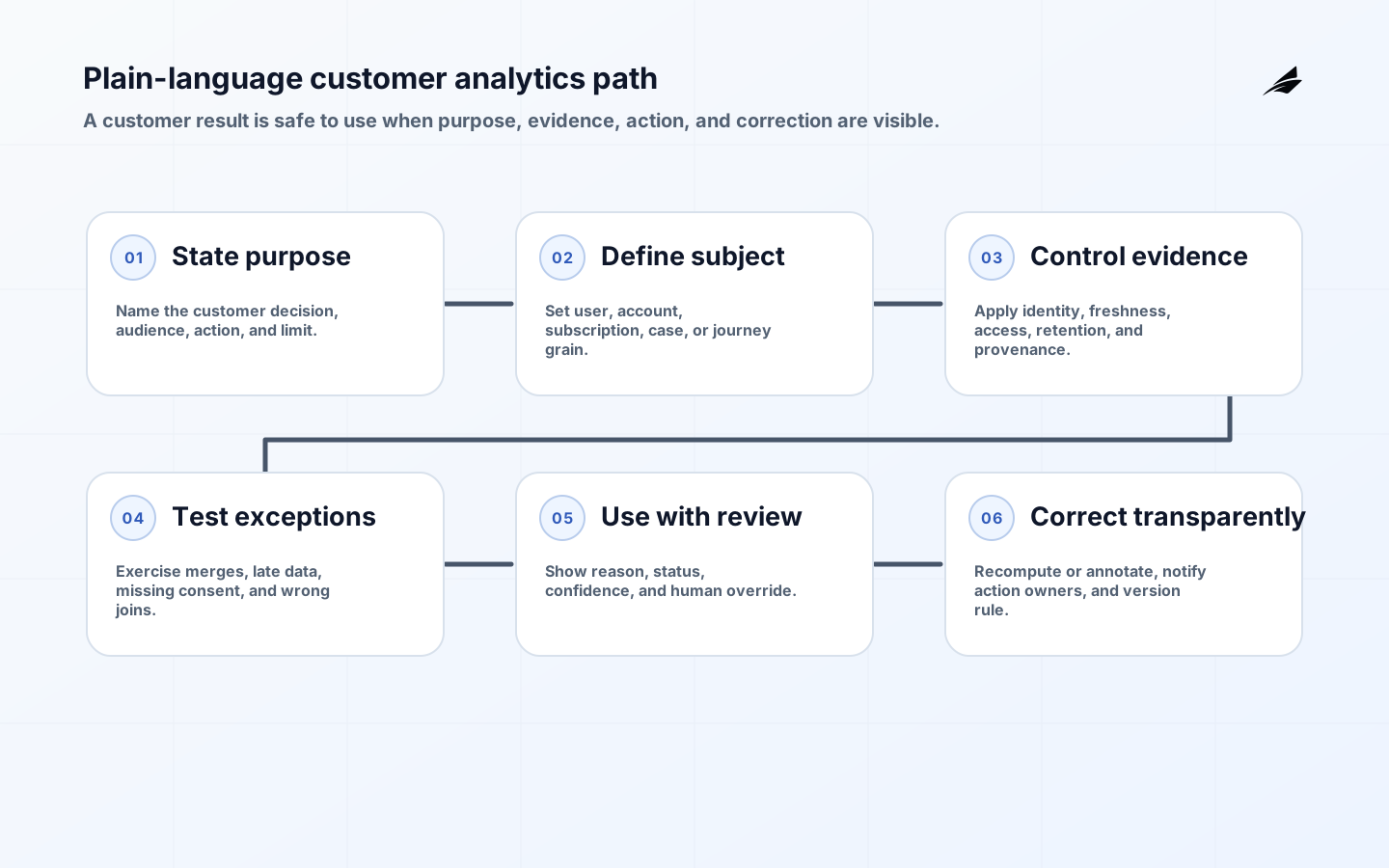
Customer analytics is not a dashboard feature or a warehouse setting in isolation. It is a working agreement about customer interactions and outcomes under clear identity, consent, and business definitions. This guide starts with one specific unit: a customer journey, consent state, and service outcome. It asks what should be true before a the customer success lead uses that unit to improve a retention intervention without misclassifying or overreaching. The result is practical: a team can decide what to capture, where to test it, who approves a change, and what evidence to retain when the answer is challenged.
What customer analytics means in practice: semantic layer ownership
For this use case, customer analytics means more than collecting data. The relevant inputs come from product, support, sales, and consent-management systems. A useful definition also states its boundary: which cases are included, what timestamp governs the result, and when a record is too incomplete to use ICO guidance on data protection principles provides implementation context, while W3C PROV data model is a helpful model for recording the entities, activities, and agents behind a result.
| Question | Working answer | Evidence to keep |
|---|---|---|
| Decision | What customer decision must this result support? | Named decision owner and review date |
| Unit of analysis | Which customer, account, subscription, case, or journey is one record? | Stable identifier and timestamp rule |
| Authoritative input | Which source can settle a disputed event or status? | Source owner and refresh expectation |
| Failure boundary | When is the evidence too incomplete or stale to use? | Visible exception state and escalation path |
Anchor the metric in an action under a recovery drill
Begin with the moment when the customer success lead must act. For a customer analytics contract, trace a clean match, a late record, and a disputed identity from source to decision, then use the event-analytics guide to compare how event semantics affect the customer-facing result. The review should identify the person who can resolve the ambiguity and the evidence that will be retained.
- Write the decision as a sentence: when this signal changes, the customer success lead will consider a specific action.
Set contract evidence and controls for a customer-facing decision
A sound design separates source facts from derived meaning. For customer analytics, document identity resolution, consent status, purpose limits, retention, and segment validation. If the condition fails, the system should mark the output as incomplete, delay publication, or route it for review; silently substituting an old value turns a technical convenience into an unrecorded business decision PROV-DM: The PROV Data Model is useful background for designing these operational controls, and W3C Data Quality Vocabulary offers patterns for making data systems observable and maintainable.

| Control point | Question to settle | Operational response |
|---|---|---|
| Identity | How is Which customer, account, subscription, case, or journey is one record? recognized across inputs? | Reject or quarantine ambiguous matches. |
| Time | Which event or processing time governs the result? | Show lateness and rerun rules. |
| Change | Who can alter logic or thresholds? | Require review, versioning, and a release note. |
| Exception | What makes an output unsafe to use? | Expose status, owner, and next action. |
Exercise the failure path before scale when ownership changes
Implementation should start small enough to verify. Create a thin path from a representative source record through the transformation or calculation to the consumer-facing result Test the path against real examples, including the failure pattern already identified: a segmentation model built from incompatible identities or data used beyond its permitted purpose.
Change Definitions Without Erasing History
Definitions evolve because the business evolves. For customer analytics, the customer-data owner should coordinate the review, but subject-matter owners must confirm whether the changed rule still represents the work.
- Keep a concise definition page for customer analytics, including owner, purpose, formula or rule, and known limitations.
Give Customer Signals an Actionable Status
The operating view for customer analytics should include both the result and its health. The linked data-quality guide covers a neighboring discipline that becomes important as this customer analytics operating model expands.
Make the review outcome explicit: accepted for the stated purpose, restricted to aggregate use, held for correction, or retired. That small vocabulary prevents an unresolved identity problem from being mistaken for a harmless data-quality footnote and gives customer teams a consistent way to explain why an action was deferred.
Work an Identity Mismatch Without Hiding It
A customer analytics result becomes risky when an identity mismatch is treated as a nuisance to be patched inside a join. Imagine an account appears under two CRM IDs, one subscription is recorded under an email alias, and a support case arrives without a stable account key. The correct response is not to pick the most convenient match. Preserve the unmatched state, quantify its impact on the decision, and route the case to the owner who can correct the source relationship.
Use the evidence contract to decide whether the result can still be used. The ICO’s data-protection principles emphasize purpose limitation, data minimisation, accuracy, storage limitation, and accountability; those principles translate into concrete checks for customer analytics. Keep only the fields needed for the stated decision, show the last verified identity mapping, and set a retention rule for the supporting detail. W3C PROV can connect a result to its source and transformation, while the local owner decides whether the evidence is adequate for the action.
| Mismatch state | Safe reader action | Correction evidence |
|---|---|---|
| Duplicate account | Hold automated outreach and request review. | Mapping decision, affected records, and effective date. |
| Missing identifier | Use only aggregate evidence within the stated limit. | Source owner, missing-field rate, and next collection change. |
| Stale consent | Pause the purpose-specific use. | Consent state, policy version, and re-approval route. |
For a customer-facing workflow, also test the communication boundary. Decide what the customer is told when evidence is incomplete, whether a human must review the action, and how a correction reaches people who already acted. A corrected score that changes an internal chart but leaves an automated message or support queue untouched is not a complete correction.
The first release should therefore name both the data owner and the action owner. The former repairs evidence and definitions; the latter decides whether a customer-facing response should proceed, pause, or be corrected. Keeping those roles distinct prevents a technically accurate result from becoming an unreviewed intervention. It also makes escalation visible when the correction cannot meet the customer’s stated decision window during a live campaign.
Takeaways for Answerable Customer Analytics
- Customer analytics is useful only when it is attached to a specific decision and a defined unit of analysis.
- Version important changes and explain their impact on historical comparisons.
- Use the dashboard-adoption guide as the next implementation reference for this practice.
For identity and quality review, Google Analytics user-ID guidance and the W3C Data Quality Vocabulary provide concrete reference points for matching, correction, and status decisions.
Use a customer evidence card to make an answerable result portable between analytics, support, and customer-success work. The card should name the customer unit, source cutoff, purpose, identity confidence, freshness, status, decision owner, and correction route. Attach the representative input and the expected interpretation, but avoid copying sensitive fields that the next reader does not need. When a source changes, update the card with the effective date and affected decision rather than silently rewriting the old explanation.
A practical review follows three cases: a customer whose records join cleanly, a customer with conflicting identifiers, and a customer whose consent or purpose state blocks use. For each case, the team should explain the safe action, the evidence to retain, and the person who can resolve the exception. This keeps customer analytics grounded in accountable choices instead of treating a polished result as permission to act.
This record also protects continuity when the team changes. A new analyst can reproduce the evidence, a customer owner can question the purpose, and an engineer can trace the correction without relying on a private notebook or an informal explanation.
Frequently asked questions about customer analytics
How do we know whether customer analytics is ready for wider use?
For customer analytics, begin with a bounded audience and one recurring decision.
What should happen when the underlying data changes?
When customer analytics inputs change, preserve the changed record and identify the results that depend on it. The owner should decide whether to recompute, annotate, or pause publication according to the documented decision window Explain material revisions to people who acted on the earlier result; for customer analytics, silence turns a normal correction into an avoidable confidence problem.
Conclusion
A dependable customer analytics practice makes reasoning visible. It gives the customer success lead a result they can act on and gives the customer-data owner enough evidence to defend, correct, or retire that result. Begin with a customer journey, consent state, and service outcome, define the decision and failure boundary, and build controls that make uncertainty explicit.
For engineering teams, the implementation boundary should be visible in code review and in the support view. A new source field needs a purpose and retention decision; a new join needs a grain and effective-date check; a new automated action needs a human override and correction path. The plain-language guide to dashboard adoption and plain-language guide to data quality are useful adjacent references. Keep customer outcome, evidence state, and privacy constraint together so a technically successful release is not mistaken for a safe one.
Plain-language customer analytics is working when an accountable person can explain what the signal means, why it is permitted, how current it is, and what to do when it is wrong. Preserve that explanation with the evidence and correction record; it is the durable link between a customer outcome and the data used to support it.