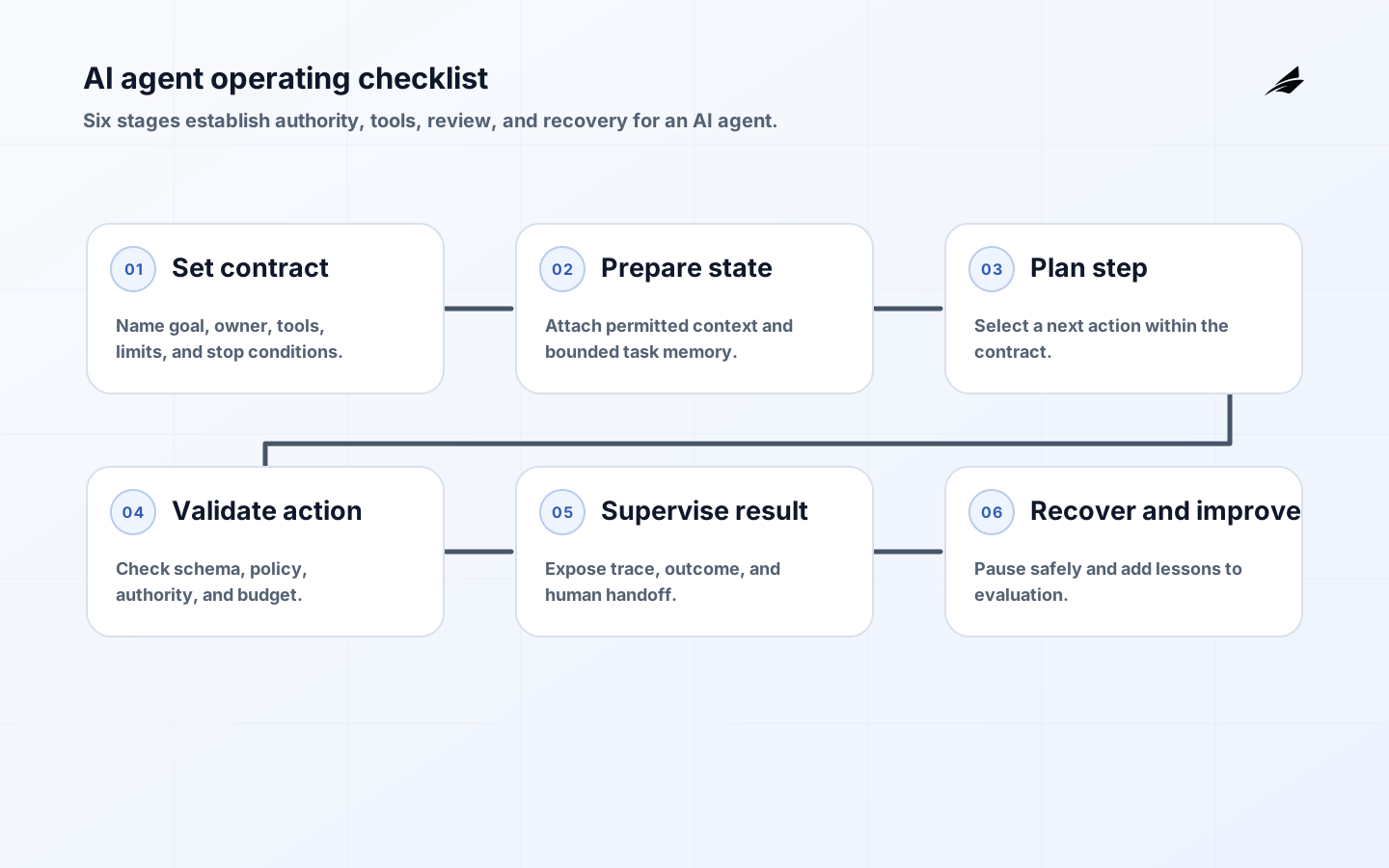
AI agents are software systems that can select steps, use tools, and continue work toward a goal within a defined environment. That description can sound broader than a production system should be. Reliable digital operations start with an agent that performs one bounded job: assemble evidence for a support case, reconcile a known data discrepancy, or prepare a change request. The agent should not receive a vague instruction to improve operations or unrestricted credentials to every business system. This checklist focuses on the practical controls that make an agent inspectable, interruptible, and recoverable. Tool calling is a useful companion for the interfaces an agent uses.
1. Bound the agent's authority
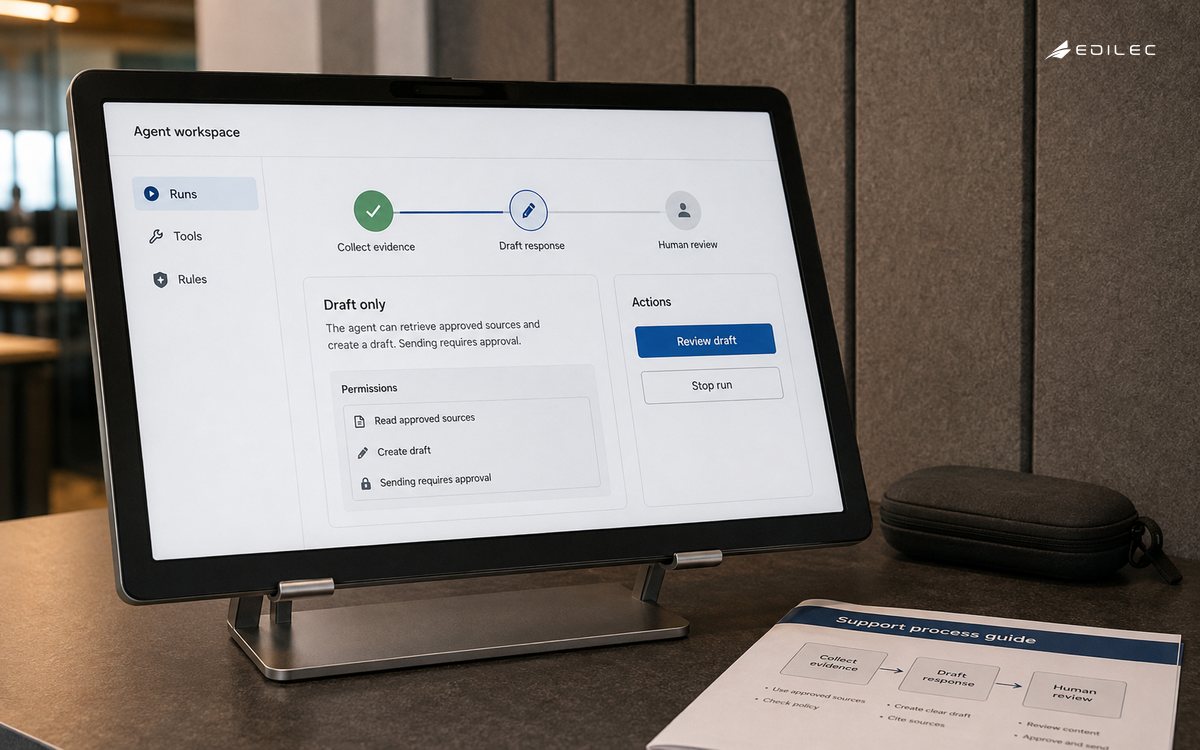
Write an operating contract that names the initiating event, target outcome, permitted evidence, allowed tools, maximum steps or budget, prohibited actions, and stop conditions. An agent that drafts a support response may retrieve approved articles and create a draft; it may not grant a refund or send a message without a separate authorization path. Define who owns the goal and who receives an exception. The NIST AI Risk Management Framework helps teams make those responsibilities explicit. Authority must be designed before autonomy is increased.
| Contract item | Example | Required proof |
|---|---|---|
| Goal | Prepare a cited case summary. | Case identifier and owner. |
| Allowed tool | Read approved knowledge service. | Scoped service credential. |
| Prohibited action | No customer-record changes. | Server rejects write attempts. |
| Stop condition | Missing authority or evidence. | Escalation case and trace. |
2. Make tools narrow and typed
Expose tools that do one well-defined thing with typed inputs and predictable results. A tool called update_customer is too broad; a tool that proposes a status change with an allowed transition, record ID, reason, and approval token is testable. Validate arguments on the server, return structured errors, and set explicit timeouts and idempotency behavior. Avoid giving an agent raw database access or shell-like execution when a purpose-built service can express the necessary action. This reduces accidental side effects and makes traces intelligible to an operator.
- Use least-privilege credentials scoped to a specific service and operation.
- Define input schemas, output schemas, and retry behavior for every tool.
- Require idempotency keys or safe reconciliation for actions that may be retried.
- Record tool version, authorization decision, response, and resulting business state.
3. Keep state explicit and bounded
Agent state should be a governed record, not an unbounded conversation transcript. Keep the task ID, approved context references, plan or step state, tool results, budget consumption, and final disposition. Set retention by purpose and avoid carrying prior-user context into unrelated tasks. A state record lets the system pause, resume, or hand off work without making the next action depend on hidden memory. It also distinguishes a transient model failure from a genuine business exception. For sensitive work, display a concise state summary to the human responsible for intervention.
| State element | Why it exists | Control |
|---|---|---|
| Task context | Connects work to a legitimate request. | Case and tenant validation. |
| Step history | Explains what was attempted. | Append-only trace with limits. |
| Budget | Prevents unbounded planning or calls. | Step, time, and cost ceilings. |
| Disposition | Closes or escalates work. | Named owner and recovery status. |
4. Validate each proposed action
Treat model-generated plans, retrieved instructions, and tool outputs as inputs that require validation. Enforce authorization, state transitions, amount or rate limits, separation of duties, and confirmations in the application layer. The OWASP Top 10 for LLM Applications is relevant because agents face prompt injection, excessive agency, and insecure tool use. When evidence is missing or contradictory, the correct action is to stop and create a reviewable exception. A graceful stop is a sign of control, not a failure of intelligence.
- Check policy before every write, even if a previous step was approved.
- Require human confirmation for externally visible or high-consequence actions.
- Cap recursive delegation, tool fan-out, and elapsed time.
- Make refusal and escalation formats easy for downstream systems to handle.
5. Supervise exceptions and outcomes
An operator needs more than a transcript. Provide the task purpose, current status, evidence references, tools attempted, policy decisions, budget use, and the next available human action. Monitor completion quality, failed tool calls, halted tasks, human overrides, duplicate effects, and time spent in exception. Review a sample of apparent successes as well as failures; an agent can complete a workflow in a way that creates hidden downstream repair. The NCSC secure AI guidance supports ongoing monitoring and maintenance rather than treating deployment as the end of engineering.
6. Release and recover deliberately
Start with read-only or draft-producing tasks, then add a single low-consequence action only after measured performance and review procedures are stable. Use sandbox accounts or simulated cases to exercise tool limits, outages, duplicate requests, and bad input. Set a kill switch, a way to revoke credentials, and a known manual continuation route before production access is granted. Version the agent instructions, tools, policy, and evaluation suite together. Expansion should follow evidence that the agent reduces work without creating unowned risk.
Prepare for agent incidents before autonomy expands
An agent incident plan should describe how to identify affected tasks, pause new work, revoke access, preserve traces, reconcile external effects, notify owners, and resume safely. Practice it with a simulation that includes a tool timeout, duplicate execution, misleading retrieved instruction, and loss of a dependency. The plan needs to distinguish work that the agent merely drafted from work that reached an external system. For the latter, reconciliation against the system of record is essential; a conversational trace cannot prove whether a transaction occurred. Decide which events require immediate human notification and which can enter a routine exception queue. This preparation makes the kill switch useful rather than a dramatic control that nobody knows how to use.
As the agent grows, retain a portfolio view of its capabilities. Each capability should have a goal, owner, tool set, evaluation status, authority level, and recent incident or override signals. This prevents a collection of prompts and tools from quietly becoming an unowned operating platform. Review the portfolio when an agent begins to delegate, access a new source, or act on behalf of another role. Ask whether the existing state model, budget, test set, and supervision surface still cover the new behavior. Expansion is justified when it reduces a documented burden while keeping failures detectable and recoverable. It is not justified merely because a tool can be called from the same agent framework.
AI agents implementation checklist
- Name one business goal, initiating event, accountable owner, and safe completion state for each agent capability.
- List permitted sources, tools, actions, budgets, prohibited outcomes, and conditions that require an immediate stop.
- Use narrow typed tools with server-side authorization, validation, timeouts, and idempotency behavior.
- Avoid raw infrastructure or broad database credentials when a purpose-built service can express the needed action.
- Store task state, approved context references, tool outcomes, budget use, and final disposition explicitly.
- Apply policy and state-transition checks before every write, even after an earlier step was allowed.
- Require confirmation or human approval for externally visible, irreversible, or high-consequence actions.
- Limit recursive delegation, parallel tool fan-out, elapsed time, and total spend for every task.
- Show operators the task purpose, evidence, tool trace, policy decisions, exception status, and available recovery action.
- Test duplicate requests, tool outages, malicious instructions, stale context, and partial external effects in simulation.
- Maintain a kill switch, credential-revocation procedure, reconciliation path, and documented manual continuation route.
- Measure completion quality, policy compliance, duplicate effects, halted tasks, overrides, and exception age.
- Release read-only and draft-producing tasks before granting a new transactional authority level.
- Version instructions, tools, policies, state schemas, and evaluation cases together for every meaningful change.
- Review the capability portfolio so new tools or delegation do not quietly expand an unowned agent platform.
Use an agent task ledger for every production capability. The ledger can be compact, but it should show the task identifier, owner, initiating event, active capability version, authority level, tool calls, budget result, disposition, and any human intervention. Aggregate views reveal which capabilities repeatedly halt, which tools cause rework, and where authority is expanding. Individual records make recovery possible when a person inherits work from an interrupted agent. This is preferable to treating a long conversational transcript as the system of record: transcripts are difficult to query, may contain unnecessary data, and rarely show the actual effect in downstream services.
Key takeaways
- Give an AI agent one owned job, bounded tools, and explicit stop conditions.
- Enforce all authorization and business rules outside the agent's reasoning.
- Keep state, traces, budgets, and human handoffs visible to operators.
- Release draft and read-only capabilities before granting transactional authority.
AI agents FAQ
What is the safest first agent use case? Choose a task that prepares evidence or drafts work for an existing owner, has a measurable current process, and can fall back to manual completion without customer harm.
Can an agent use many tools? It can, but each additional tool expands the control and evaluation problem. Add tools only when they support the defined job and their permissions, schemas, failures, and recovery path are understood.
How do we measure agent reliability? Combine task completion quality with policy compliance, correct tool use, duplicate-effect rate, exception age, human override rate, and the ability to recover from a paused task.
Conclusion
Reliable AI agents are deliberately modest at first. They act inside a contract, use narrow tools, carry visible state, stop when evidence or authority is absent, and leave enough trace for a person to recover the work. Those disciplines let a team gain operational leverage without turning autonomy into an unmeasured production risk.