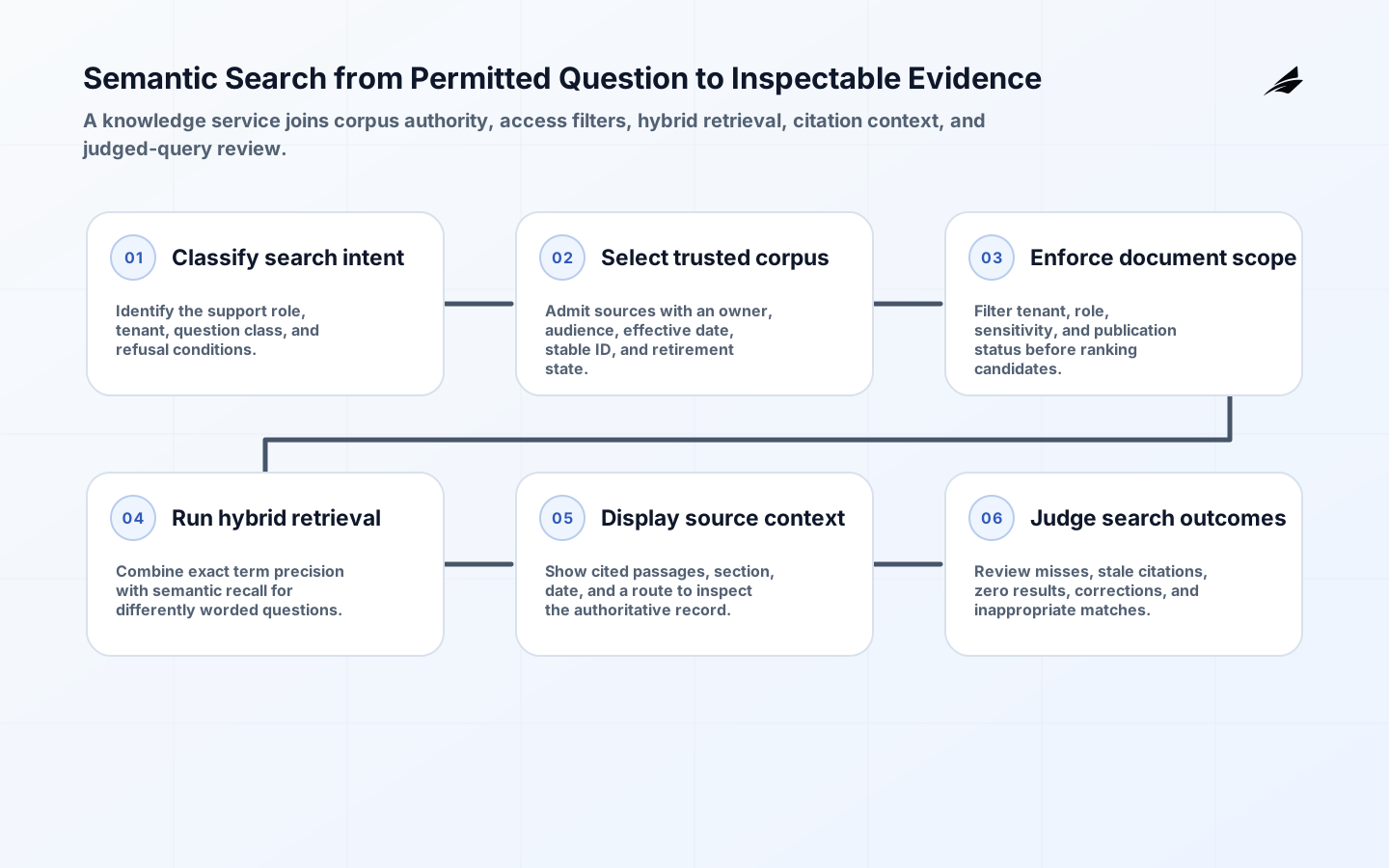
Semantic search is worth building when people repeatedly lose time translating a real question into the exact language of a document. A support engineer may ask for the current recovery procedure for an integration failure while the approved runbook uses a product code and an older incident uses different vocabulary. The useful outcome is not a charming answer. It is a permitted, current passage that the engineer can inspect and act on. This semantic search guide treats search as a knowledge service: source owners decide what is authoritative, application controls decide what a requester may see, and reviewers use evidence to improve the result. Semantic search in practice is a helpful companion when the team reaches implementation.
Define the semantic search boundary
Start with a decision contract, not an index. Name the user, the question types that matter, the approved corpus, the expected response, and the conditions that require a refusal. A first release might search published support procedures and release notes for authenticated support staff; it should not silently search private incident channels or make account changes. The NIST AI Risk Management Framework is useful here because it frames risk as a system property. The boundary turns abstract concerns into testable rules about authority, freshness, and outcome.

| Boundary question | Concrete choice | Evidence to retain |
|---|---|---|
| Who asks? | Named employee role and tenant context. | Authenticated identity and access decision. |
| What is searched? | Approved procedures, product notes, and current policy. | Source owner, version, and effective date. |
| What is returned? | Cited passages and an answer draft. | Ranked results and displayed citations. |
| When does it stop? | No permitted or sufficiently current evidence. | Refusal reason and escalation route. |
Build a corpus that can be trusted
Text alone is not a corpus record. Each searchable item needs an owner, audience, effective date, retirement state, source link, and a stable identifier. Split documents at meaningful boundaries such as procedures, prerequisites, and exception steps; a chunk that loses its version or permission context is difficult to trust. Preserve headings and surrounding context so a reviewer can see whether a retrieved paragraph actually answers the request. The embedding approach described in Sentence-BERT can capture related phrasing, but it does not decide whether a passage is still policy.
- Maintain a source register with owner, access label, effective date, and scheduled review.
- Exclude drafts, retired procedures, and sensitive records until their use is explicitly approved.
- Re-index changed documents predictably and record the corpus version that served a result.
- Keep a way for users to report a missing, misleading, or obsolete answer.
Use retrieval methods that fit the question
Semantic search should supplement rather than erase lexical search. Exact identifiers, error codes, product names, and quoted policy language often need term matching; differently worded how-to questions benefit from semantic recall. A hybrid retrieval path can retrieve candidates using both signals, then filter by permission, document status, and metadata before ranking. The Dense Passage Retrieval paper explains why learned representations can improve retrieval, while the production decision remains local: choose methods by judged query outcomes, not by a model demonstration.
| Query pattern | Preferred signal | Check before showing results |
|---|---|---|
| Error code or case number | Lexical match | Exact identifier and tenant scope. |
| How do I renew an expiring credential? | Semantic plus lexical | Current procedure and audience. |
| What did finance approve? | Metadata-filtered search | Authorization and source authority. |
| Ambiguous request | Clarify or decline | Enough context to select evidence. |
Evaluate semantic search on real work
Create a versioned set of privacy-reviewed queries from the work the service is meant to support. Include routine questions, acronyms, near-duplicates, requests that should return nothing, changed permissions, and documents that were recently replaced. Mark whether the right evidence appeared, whether its ranking was useful, whether the answer was grounded, and whether the system should have abstained. Track citation-supported resolution, stale-result rate, zero-result rate, and the share of results a specialist corrects. Inspect results by source family and role, because an attractive average can hide a failure for one user group.
- Turn confirmed misses into regression cases with the expected source and owner.
- Sample high-confidence results as well as failures; misplaced confidence is costly.
- Compare query sets before and after a corpus, embedding, ranking, or prompt change.
- Review whether users bypass search, since bypassing can reveal an evidence or usability problem.
Operate the service with independent controls
Authentication, tenant isolation, document filtering, rate limits, logging, and downstream action rules belong in application code that can be tested independently. Treat retrieved text as untrusted input: it may contain obsolete instructions or content that attempts to redirect a model. The UK National Cyber Security Centre guidance supports designing security requirements and monitoring from the beginning. Retain enough evidence to investigate a harmful result without storing unnecessary sensitive query text. A clear fallback to the existing knowledge route matters as much as a fast search response.
Release a narrow search service first
Pilot with one team and a bounded corpus. Run the new search beside the current process long enough to compare answer quality, time to find evidence, and reviewer correction load. Set rollback triggers before traffic grows: a permission leak, a rise in stale citations, or a material degradation on the judged set should stop expansion. Release corpus updates, embedding changes, ranking logic, and interface changes as traceable versions. The aim is a service that can explain what it searched and why it displayed a result, not a one-time relevance score.
Build an operating rhythm for semantic search
Treat source change as a production event. When a procedure is published, amended, or retired, the source owner should know when that change will appear in search and how to verify it. A practical weekly review includes failed ingestion, high-impact feedback, stale-result reports, zero-result queries that may reveal a content gap, and the most frequently corrected results. The review should distinguish a search problem from a documentation problem. If the correct procedure does not exist, changing an embedding will not help. If the procedure exists but was not admitted to the corpus, the remedy is ownership or ingestion. If it is present but poorly ranked for a known query, use the judged set to compare retrieval changes. That separation keeps teams from tuning the most visible component while leaving the real failure untouched.
Support the service with a small set of named operational records: a corpus register, a query evaluation set, a change log, and an incident path. The corpus register answers who owns a source and when it became effective. The evaluation set makes relevance regressions visible before a release. The change log connects an unexpected result to a parser, corpus, embedding, or ranking version. The incident path gives a user a way to stop relying on a harmful result and reach a human owner. These records need not be elaborate. Their value is that an engineer, content owner, and support lead can discuss the same evidence when a result is challenged. That is how semantic search becomes a maintained knowledge capability rather than a hidden feature of an interface.
Semantic search implementation checklist
- Name the question classes that the first search release must resolve and the requests it must decline.
- Assign an owner and effective date to every source family admitted to the corpus.
- Preserve source sections, stable identifiers, audience labels, and retirement state during chunking.
- Test exact identifiers separately from paraphrased how-to questions and ambiguous terms.
- Apply tenant, role, and document-state filtering before any candidate can be ranked.
- Display source title, section, date, and a usable route to inspect the original record.
- Keep a reviewed set of queries whose expected evidence is known by a source owner.
- Measure stale citations, missing expected sources, unsupported answers, and user correction patterns.
- Test a source retirement event from the source system through every index and cache.
- Version corpus content, parser behavior, embeddings, ranking rules, and answer configuration together.
- Give support staff a documented route when a search result is incomplete or misleading.
- Review zero-result queries to separate vocabulary gaps from missing or unowned knowledge.
- Set service objectives for source freshness, access-filter reliability, and response latency.
- Run significant ranking changes beside the stable path before shifting broad user traffic.
- Keep an established manual knowledge route available while the service is being improved.
Key takeaways
- Start semantic search with one accountable question class and a permitted corpus.
- Use source ownership, freshness, and access metadata as first-class retrieval inputs.
- Combine lexical precision and semantic recall where judged queries show each is useful.
- Measure cited resolution and abstention quality, then expand only after the pilot is operable.
Semantic search FAQ
Should every company document be indexed? No. Begin with records that have an identified owner, a known audience, and a dependable update process. Indexing broad, unmanaged stores often increases apparent coverage while weakening authority and access control.
How do we know semantic search is better than keyword search? Use the same judged query set against both approaches. Compare whether the right, current source appears in a useful position and whether specialists can resolve the task with less correction.
Can the search result trigger an action? Keep the first release advisory. An action needs explicit authorization, business rules, confirmation, and a recovery path; a retrieved passage is evidence, not permission.
Conclusion
A durable semantic search service begins with evidence discipline. Define the question and permitted corpus, preserve source context, choose retrieval signals through evaluation, and make refusal and recovery normal outcomes. That gives a growing team a search capability that becomes easier to trust as its knowledge changes rather than a broad index that slowly becomes impossible to explain.