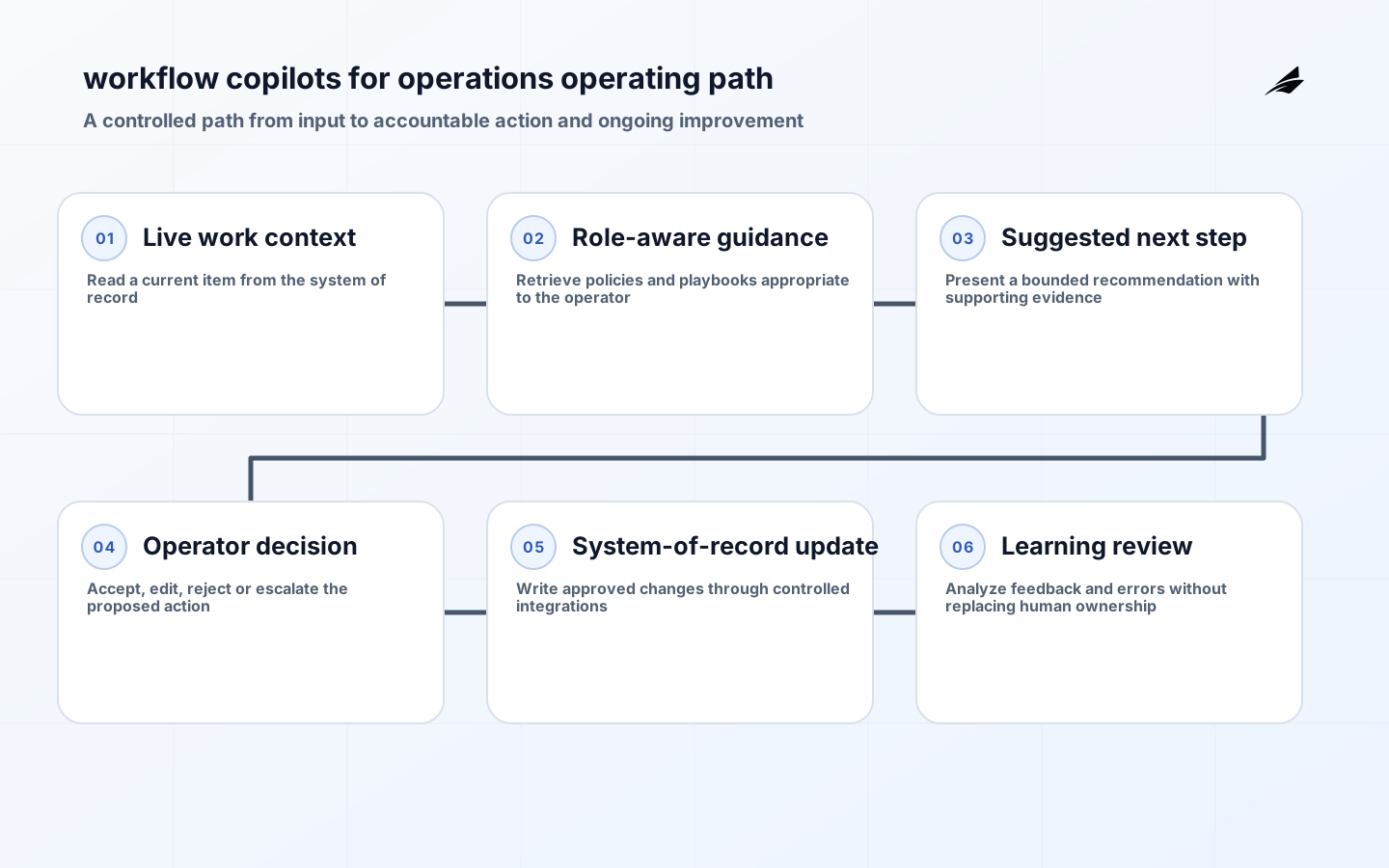
Workflow copilots for operations are most useful when they support a real operational decision rather than becoming a general chat surface. This guide explains how operations leaders and growing companies can define the work boundary, control data and actions, evaluate real cases and operate the result after release. The practical aim is to make repeated operational work easier without hiding state, ownership or exceptions.
Define the workflow copilots for operations work boundary
Workflow copilots for operations should begin with a work boundary, not a model choice. For operations leaders and growing companies, the useful question is whether a defined workflow can be made clearer, faster or more dependable. Write down the triggering event, the input that may be trusted, the expected outcome and the cases that must stop. The intended outcome is to make repeated operational work easier without hiding state, ownership or exceptions. That statement keeps a pilot from turning into an open-ended request for an assistant that can do everything.
The operating design needs one named owner for the workflow, one owner for each system of record and a person who can decide when a result is good enough to use. This is especially important when the output influences customers, money, access or obligations. A model can help interpret information, but it cannot replace the accountability of the people and systems that own the decision. The human role here is explicit: the operator confirms decisions, executes consequential changes and supplies feedback when the suggestion is wrong.
| Design question | Decision to make | Evidence to keep |
|---|---|---|
| Who uses it? | Name the worker, requester and accountable owner | Role map and access rules |
| What starts it? | Define the event and required input | Example cases and validation rules |
| What may it do? | Separate recommendation, draft and official action | Policy and approval boundary |
| When does it stop? | List uncertainty, risk and exception conditions | Escalation and recovery path |
Map data, context and permissions
Describe the data path in plain language before building. The starting input is a live work item, its system-of-record data, prior activity, user role and service-level context. Teams should decide which records are authoritative, which content is merely helpful context, how freshness is detected and what information is excluded. Retrieval, prompts and tool calls should all inherit those boundaries. If data access is unclear, a polished answer can still be unsafe because it rests on the wrong record or reveals material that the user should not receive.

For delivery teams working on workflow copilots for operations, this information boundary should connect governed inputs, model behavior, permitted tools, human judgment, and recorded outcomes to evidence an accountable owner can inspect. Integration choices should preserve a single source of truth. Prefer controlled reads from authoritative records and narrowly scoped writes through stable interfaces. Where a full integration is not ready, make the handoff explicit instead of building a side spreadsheet or an undocumented copy of customer data. Every integration needs a response to downtime, duplicate delivery and partial completion. Idempotent operations, visible queues and clear ownership make those ordinary engineering problems manageable. In this operating review, move beyond the information boundary only after the owner can show the accepted result, the exception path, and the signal for another review.
- Use the system of record as the authority for the current state of the workflow copilots for operations workflow.
- Attach source dates, owners and permissions to contextual content rather than assuming all text is equally trustworthy.
- Test denied access, stale records, conflicting records and incomplete submissions before inviting broad use.
- Keep an operator-facing trace that explains the input, policy result, output and next owner.
Design controls and human review
A dependable control design separates advice from effect. The automated component may summarize state, retrieve relevant guidance, propose the next action and draft structured work for the operator. Before a change reaches an official system, a deterministic check should validate identity, role, scope, required fields and any transaction or policy limits. The design also needs a visible escape path: the operator confirms decisions, executes consequential changes and supplies feedback when the suggestion is wrong. This keeps a useful assistant from quietly becoming an unaccountable actor.
Plan failure cases before celebrating a demonstration. One material risk is that the copilot becomes a second source of truth, obscures the official record or encourages people to act without checking context. Make those conditions observable: missing input, conflicting sources, low confidence, denied access, tool errors and unusual volume should result in a visible state rather than a fabricated answer or a silent retry. The appropriate response may be refusal, queueing, human escalation or a safe no-op. The right choice depends on consequence, but it must be deliberate and testable.
| Control | Purpose | Test case |
|---|---|---|
| Identity and scope | Bind each request to an authorized user and permitted record set | A caller cannot obtain a restricted record through a paraphrased request |
| Input validation | Reject malformed, unexpected or incomplete work items | A missing required field becomes a visible exception |
| Action gateway | Check policy before any external write or customer commitment | A prohibited tool call is denied and recorded |
| Human escalation | Route consequential or uncertain work to an accountable person | A low-confidence case cannot complete silently |
| Trace retention | Explain what happened and support investigation | An operator can reconstruct one completed case |
Build a small, testable first release
In workflow copilots for operations, delivery teams should make the relationship between governed inputs, model behavior, permitted tools, human judgment, and recorded outcomes explicit and reviewable. Stage delivery so each phase earns the next one. Start with representative examples and a narrow group of real users. Use the first release to test the boundary, permission behavior, handoff and recovery path; do not use it to promise broad autonomy. Expand only when support owners can explain the output, correct a failure and pause or roll back the change without improvising. A production plan should include logging, incident ownership, change review and a simple way to remove unsafe context or disable a tool. This operating review should close the acceptance decision only when the result, unresolved exception, and next review condition are recorded.
Use a set of realistic examples instead of only happy-path demonstrations. Include ordinary cases, uncomfortable edge cases, cases that should be refused, and cases that must be routed to a person. The related operational guide can help the team frame adjacent decisions, while this companion guide covers a related workflow boundary. Keep the first release narrow enough that the owner can observe every important exception.
Evaluate before expanding
A dependable workflow copilots for operations design makes governed inputs, model behavior, permitted tools, human judgment, and recorded outcomes visible to the owner responsible for this acceptance decision. Evaluation should answer a practical question: does this workflow help the right person complete the task correctly and safely? Assemble representative examples with expected results, known ambiguous cases and a method for human review. Test changes to the model, retrieval set, prompt, policy or tool integration against that material. A comparison is meaningful only if the input set, scoring approach and release candidate are recorded; otherwise a result cannot be reproduced or explained. The next step in this operating review is justified when the team can trace the accepted outcome, the fallback route, and the owner of follow-up.
| Evaluation area | What good looks like | What requires action |
|---|---|---|
| Task completion | The user reaches a usable next step with the right context | Repeated manual repair or abandoned work |
| Grounding | Outputs point to approved, current evidence where evidence is needed | Unsupported detail or source mismatch |
| Control behavior | Policy checks and escalation work under adverse inputs | Unexpected access, hidden retries or bypassed review |
| Operational fit | Support owners can diagnose and recover from a failure | Resolution depends on a developer improvising |
Operate and improve after launch
This release decision for workflow copilots for operations is strongest when governed inputs, model behavior, permitted tools, human judgment, and recorded outcomes can be reviewed as one operating record. After launch, treat changes to models, prompts, tools, source content and workflow rules as production changes. Each can alter behavior even when application code stays the same. Keep versions, test material changes against representative cases and record why an exception was accepted. This is less about bureaucracy than about making the system supportable when an operator asks why a result appeared, why an action was blocked or what changed after last week’s release. Acceptance in this operating review requires a visible outcome, a bounded exception path, and a measurable reason to revisit the decision.
Measure workflow copilots for operations as an operating service, not only a launch project. Useful signals include suggestion acceptance, time saved per task, correction rate, handoff quality, abandoned work and user adoption. Review a small set of real failures alongside aggregate numbers. A decrease in manual work is not success if it creates unreviewed exceptions, unreadable traces or weaker customer outcomes. The measures should show both usefulness and control: whether the workflow finishes well, whether it stops when it should, and whether people can understand what happened after the fact.
Key takeaways
- Treat workflow copilots for operations as a bounded workflow with named authority, not a general-purpose substitute for operations.
- Make data authority, permissions, approval points and recovery paths visible before connecting models or tools.
- Evaluate representative work, including failures and denied cases, before widening access or autonomy.
- Use traces, incident review and controlled changes to keep the system understandable after launch.
- Measure both task usefulness and control effectiveness so speed does not hide risk.
Frequently asked questions
What is the right first use case?
Choose one repeated task where the input, intended outcome and accountable owner can be named. For workflow copilots for operations, a small, observable workflow provides better evidence than a broad launch promise.
When should a human review the work?
Delivery teams can keep workflow copilots for operations accountable by recording how governed inputs, model behavior, permitted tools, human judgment, and recorded outcomes shape this operating decision. Human review is appropriate when the consequence is material, the evidence is weak or conflicting, policy requires judgment, or the action changes an official record. Routine, reversible steps can be more automated when their boundaries are tested. For this operating review, the responsible owner should be able to explain what passed, what remains exceptional, and which signal reopens review.
Which metric matters most?
For workflow copilots for operations, the evidence behind this operating signal should cover governed inputs, model behavior, permitted tools, human judgment, and recorded outcomes. There is no universal metric. Start with a measure of correct task completion and pair it with a measure of unsafe or costly failure. Add the operational signal most relevant to this workflow, such as queue age, rework, escalation or trace completeness. Do not widen the scope from this operating review until the evidence supports the result, the recovery route, and the next operating check.
Conclusion
A strong workflow copilots for operations implementation is deliberately bounded. It helps people do a specific part of work with better context and less repetition, while clear authority remains visible for decisions that matter. Start with one workflow, define the unacceptable outcomes, test the controls with real cases and build an improvement loop before expanding. That is how an AI feature becomes dependable operational software rather than a temporary demonstration.