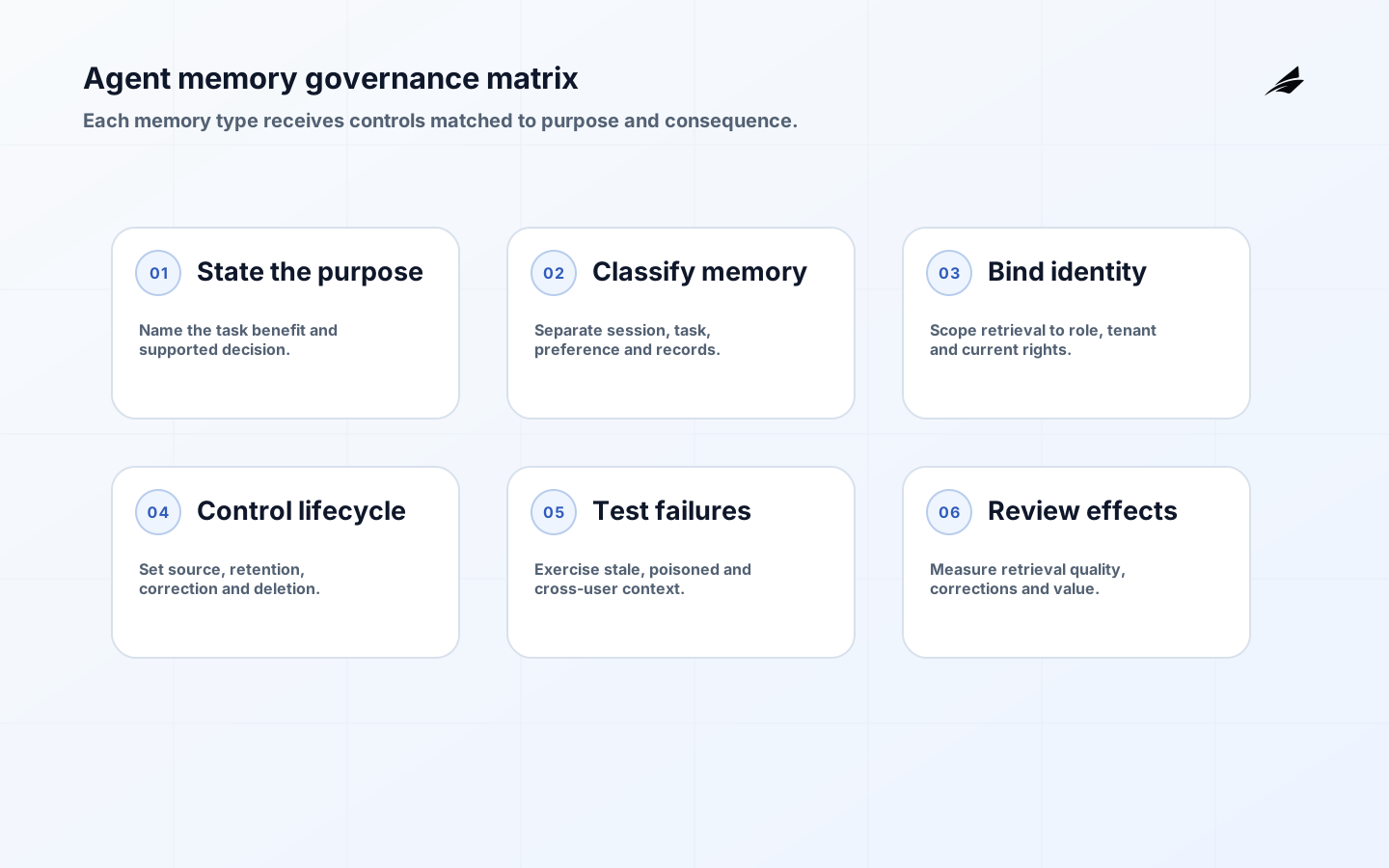
Agent memory is most useful when it improves a named piece of work without hiding who owns the decision. This guide is for the audience named in the title and focuses on AI memory design, memory retention, context management, agent privacy as connected operating choices. Start with a bounded workflow, establish what evidence is allowed, and retain a route for a person to inspect, challenge, or recover the result. A fluent answer, a high similarity score, or a successful demo is not by itself proof that the workflow is reliable.
Agent memory often depends on vector search, acts through tool calling, and needs the evidence described in Edilec’s model evaluation guide.
Set the operating boundary for agent memory
Define memory by the service outcome it improves, not by how much context the agent can retain. A customer-success assistant might remember a client's stated communication preference while retrieving contractual terms from the authoritative account system whenever they matter. Document the eligible user, permitted memory categories, business purpose, source of each fact, and actions that always require human authority. State exclusions just as clearly: preferences from one account must never shape another, inferred traits must not masquerade as supplied facts, and expired cases must not remain convenient background forever. Reviewers can then ask a concrete question of every retrieval and downstream action: was this information necessary, current, and permitted for this task? Anything outside that envelope should be ignored or referred to the established owner.
| Design question | Practical decision | Evidence to retain |
|---|---|---|
| Service purpose | Which recurring task benefits from remembered context, and which decisions remain outside the agent | Approved use statement, process owner, and explicit exclusions |
| Memory admission | Which supplied or derived facts may be stored and under what authority | Origin, user or policy basis, sensitivity, scope, and validation result |
| Retrieval decision | When a memory item is relevant, sufficiently fresh, and visible to this user | Query context, matched item, authorization check, age, and use in the response |
| Lifecycle exit | How a fact is corrected, quarantined, expired, or deleted across every representation | Request, operator, disposition, completion checks, and residual-copy handling |
Test agent memory against real work
Evaluate memory with sequences, because the dangerous behavior often appears on the second or tenth interaction rather than the first. Include a normal continuation, a corrected preference, a role change, a closed account, two people with similar names, an attempted cross-tenant request, and a prompt that asks the agent to preserve information outside policy. For each sequence, label whether the right behavior is recall, fresh retrieval, clarification, human review, or refusal. Operational staff should supply realistic cases, while privacy and security owners determine how examples are minimized or protected. Repeat the suite whenever the embedding model, prompt, index, access filter, retention job, source connector, or summarization logic changes. Record both helpful use and inappropriate influence; an answer can look accurate while relying on context that the requester was not entitled to see.
| Test slice | What to inspect | Decision |
|---|---|---|
| Stable continuation | The same authorized user resumes an active case | Relevant context is recalled with provenance and no unnecessary attributes |
| Fact changes | A preference, role, or account state is corrected after storage | The superseded value stops influencing output and the authoritative fact wins |
| Scope collision | Names or topics overlap across users, accounts, or tenants | Isolation filters prevent a plausible but unauthorized match |
| Policy boundary | A request seeks prohibited retention, inference, or autonomous action | The agent declines safely and transfers the case with appropriate context |
Assign controls and ownership for agent memory
Allocate ownership across the memory lifecycle. The customer-success director owns the service purpose and acceptable outcome; the product owner controls feature behavior and release scope; the privacy lead approves purpose, retention, and data-subject handling; source owners remain responsible for authoritative records. Retrieval authorization must be enforced by deterministic application controls before content reaches the model. Admission rules should reject unsupported memory types, and downstream tools should accept only validated structures within the caller's permissions. When a case carries material consequence, a separate authorized person should approve the action using cited source evidence rather than a model score. The NIST AI RMF functions—Govern, Map, Measure, and Manage—provide a useful structure for keeping these duties connected as the service changes.
- Assign separate accountable roles for service purpose, memory-platform operation, privacy rules, and authoritative source quality.
- Evaluate tenant, user, purpose, and record permissions before retrieval, then repeat authorization before a consequential tool call.
- Require provenance, creation time, sensitivity, expiry, and correction state for every memory object admitted to storage.
- Redact operational telemetry and restrict diagnostic access so observability does not become an alternate memory repository.
- Trigger control review when user groups, allowed facts, models, storage providers, connected tools, or retention promises change.
Measure live agent memory behavior
Observe admission, retrieval, use, and disposal as separate stages. Admission metrics reveal unsupported sources and overbroad capture; retrieval reviews reveal stale, irrelevant, or unauthorized matches; outcome sampling shows whether recalled context actually reduced effort or introduced correction; deletion verification exposes residual indexes and caches. Segment results by memory class, source, tenant, user role, workflow, and release version. A global relevance average can remain healthy while one account experiences leakage or one data source supplies obsolete facts. Establish the manual-service baseline before launch and attach action thresholds to owners. A privacy lead may order quarantine after an isolation breach, while the product owner may disable a noisy memory class when corrections exceed its usefulness. Monitoring is effective only when the response and decision authority are agreed before the alert fires.
| Signal | Why it matters | Review response |
|---|---|---|
| Unauthorized retrieval attempts | Tests isolation and purpose enforcement | Block delivery, inspect the access path, and assess exposure |
| Superseded-memory influence | Shows whether corrections propagate through indexes and summaries | Quarantine the memory class and verify the fresh authoritative value |
| Useful retrieval rate | Indicates whether recalled context improves the named task | Review successful and unhelpful samples before tuning retrieval |
| Verified disposal time | Measures completion across primary storage, indexes, caches, and governed backups | Escalate overdue components and communicate the actual disposition |
Run and recover agent memory safely
Practice recovery with a deliberately planted stale or mis-scoped memory. The operator should locate its origin and every derived representation, stop further retrieval, determine whether any tool action relied on it, and restore work from the current account record. Correction may require superseding one item; suspected leakage may justify quarantining an index or disabling the feature for an affected tenant. Preserve the minimum investigation trail under restricted access, but assign a person to decide the remedy and notification rather than assuming logs create accountability. The exercise ends only after downstream effects are reconciled, the requester receives an understandable resolution, and tests demonstrate that the same path no longer exposes or applies the bad context.
- Place a visible correction and privacy-report route beside the assistant response so users need not understand the storage architecture.
- Design feature flags and index boundaries that can isolate one memory class or tenant without stopping unrelated service.
- Trace any action influenced by suspect context and compare its final state with the current authoritative record.
- Document affected users, containment, disposal or correction evidence, approval to resume, and the test that supports that decision.
- Aggregate recurring complaints by source and memory class, then fix admission or lifecycle policy instead of relying on individual vigilance.
Do not route every bad recall to prompt tuning. First determine whether the fault came from admission, source freshness, identity resolution, authorization filtering, ranking, summarization, lifecycle processing, or a policy change. A model adjustment cannot repair an entitlement filter, and a larger context window will not make an obsolete preference authoritative. Reproduce the failure with its original sequence, apply the narrowest correction, and rerun neighboring cases that share the source, user type, or retrieval rule. The release record should identify the incident pattern, affected scope, changed component, approving owner, evaluation evidence, and live signal that will detect recurrence. This history lets operators distinguish a recurring design flaw from normal variation and prevents repeated changes from obscuring the actual control failure.
Release checklist
- The service specification names allowed memory classes, excluded uses, authoritative records, responsible roles, and stateless fallback.
- Sequence tests cover correction, expiry, role change, similar identities, tenant separation, prohibited capture, and safe refusal.
- Application code enforces access and tool permissions independently of instructions contained in prompts or retrieved text.
- Dashboards separate admission, retrieval, outcome, and disposal signals, with owners and predetermined containment thresholds.
- A rehearsal has proved quarantine, authoritative-record recovery, downstream reconciliation, user communication, and controlled resumption.
Use an evidence review to decide whether memory deserves a wider scope. Bring the source steward, customer-success owner, privacy lead, support representative, and product operator together around a small sample: helpful recalls, corrections, refusals, expired facts, and hard isolation tests. Trace what entered storage, why it was eligible, how it was retrieved, what the agent did with it, and whether the final service outcome improved after review effort is counted. Examine complaints and non-use as well as successful sessions. Expansion is justified only when the present population stays within its purpose, disposal promises are verifiable, exceptions reach empowered owners, and stateless fallback remains workable. Record those findings as measurable entry gates for the proposed new memory type, user group, or tool action.
Design memory around a service case
Example: an internal service-desk assistant

An employee asks an assistant to restore access to a finance application. The current ticket and troubleshooting steps may belong in task memory. A communication preference may be user-controlled memory. The entitlement remains an authoritative identity-system record and should be retrieved when needed, not copied into conversation history. A generated summary can help the next analyst only if it links to source events, identifies uncertainty, and can be corrected without rewriting the underlying ticket.
Run deletion, correction, and isolation tests before release. Change the employee’s role and verify that earlier entitlements no longer influence the response. Correct a mistaken summary and confirm the old value is absent from indexes and caches. Attempt cross-user and cross-tenant retrieval. Expire the case and prove that summaries, embeddings, backups, and logs follow policy. In production, sample retrievals for relevance, authorization, age, correction status, and effect on outcomes. A high retrieval rate is not success if stale context makes decisions worse.
Key takeaways
- Store context only when a named cross-session benefit outweighs the lifecycle and privacy burden.
- Treat provenance, authorization, correction, expiry, isolation, and disposal as core memory behavior.
- Test conversational sequences that change facts and permissions, including cases where stateless handling is safer.
- Increase reach only after live evidence shows helpful recall, controlled exceptions, and recoverable failures.
Frequently asked questions
Does an agent need long-term memory?
Only when a defined workflow benefit requires cross-session context and the organization can govern it. Many tasks need short-lived state plus authoritative retrieval.
Are embeddings safe storage for sensitive memory?
Embeddings are derived data, not anonymization. Apply classification, access, isolation, retention, deletion, logging, and recovery controls.
What is a sensible first use? Choose a frequent service task where an optional preference or short summary saves effort, the original record remains available, and an operator can finish without memory. How much review is appropriate? Base it on what recalled context can influence: sample low-impact assistance, but require direct authority and cited evidence before changing access, money, employment, safety, or legal position. Can similarity or confidence authorize use? No. Ranking signals help retrieval; they do not establish identity, permission, freshness, or policy. When should scope grow? Add a memory class or user population only after sequence tests and production samples demonstrate isolation, correction, disposal, useful outcomes, and adequate fallback capacity.
Conclusion
Useful agent memory is deliberately small, sourced, scoped, correctable, and temporary unless the work proves otherwise. Separate task state, preferences, summaries, and authoritative records; enforce permission before retrieval; and test deletion and stale-context behavior end to end.
Agent memory becomes dependable when every remembered fact has a justified purpose, visible origin, access boundary, useful lifetime, and provable exit. Couple those properties with sequence-based evaluation and a rehearsed stateless fallback. Operations leaders can then extend memory because the current service has earned trust through inspectable behavior—not because an assistant happened to sound familiar in a demonstration.