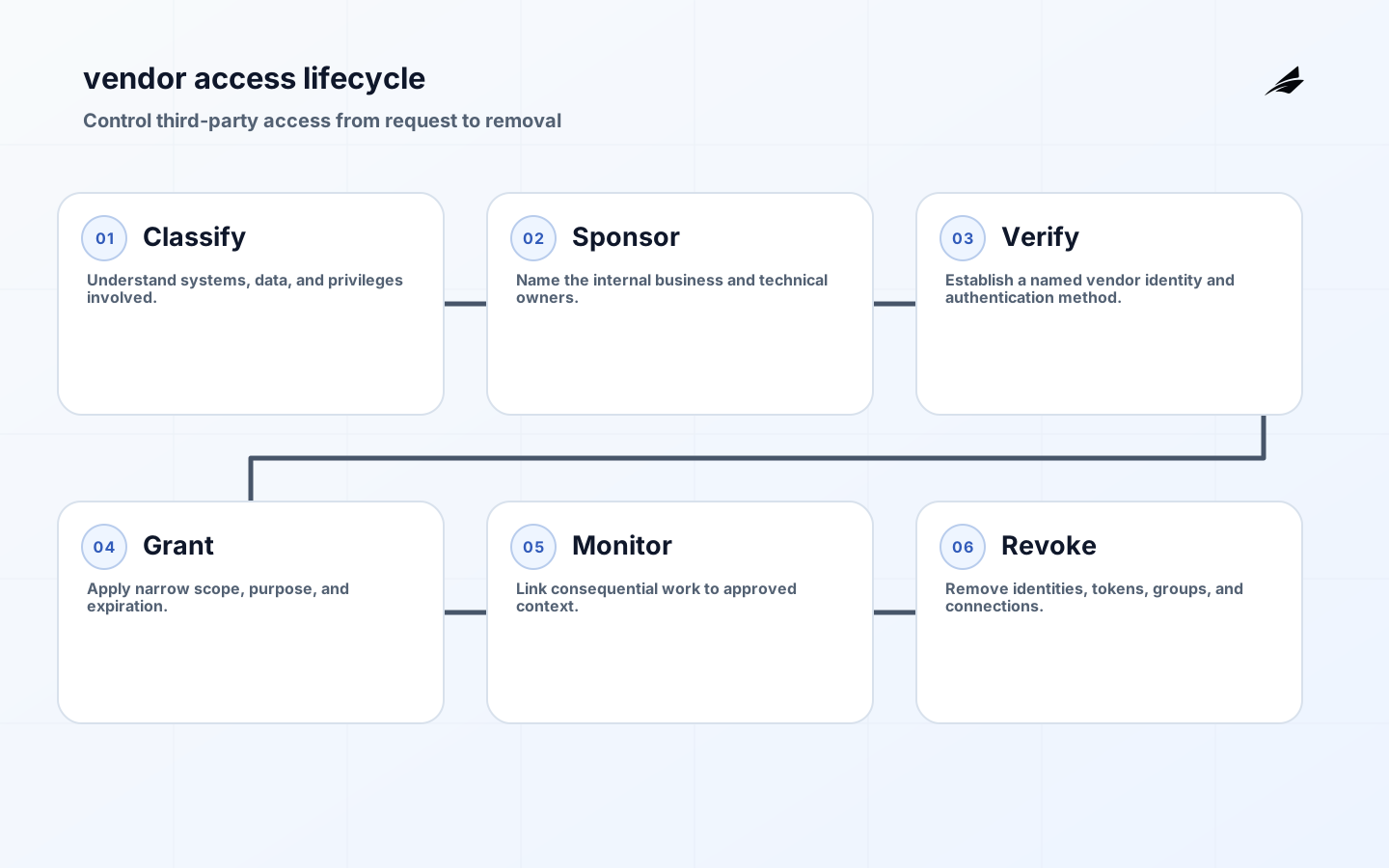
Vendor access management is the operating discipline for third parties that need to see, administer, support, or integrate with company systems. Vendors may host a SaaS service, maintain an application, provide managed detection, help with an implementation, or remotely service equipment. Their access can be legitimate and still create risk when it is broad, shared, unowned, or left active after the work ends. The practical goal is not to ban vendors from useful work. It is to make every connection attributable to a business sponsor, limited to a clear purpose, protected by appropriate authentication, and removable on demand. Vendor access management for IT managers adds broader program context.
Classify vendor access by what it can affect
Do not group all suppliers under one generic third-party label. A payroll provider with limited employee data, a cloud consultant with production administration, and a marketing platform using a scoped API token present different technical and business questions. Classify the data, systems, privileges, connectivity, and downstream dependencies involved. Note whether the vendor uses named people, service identities, a support portal, a federation connection, remote desktop, an API, or a managed agent. This inventory should distinguish the vendor organization from its individual users and machine credentials; otherwise a contract may have an owner while individual access has none.
| Access pattern | Main risk | Control starting point |
|---|---|---|
| Named support user | A former contractor or shared account retains interactive access. | Named identity, strong authentication, sponsor, expiry, and periodic review. |
| Privileged remote session | A vendor can alter production configuration or retrieve sensitive data. | Just-in-time elevation, session controls, logging, and narrowly defined administration scope. |
| Service integration | A token or workload identity can act continuously and invisibly. | Minimum scopes, secret handling, owner, rotation, and monitoring of use. |
| Federated partner access | External identity changes may not be visible to the relying organization. | Trust configuration, group restrictions, lifecycle agreement, and revocation test. |
Set the access lifecycle before the request arrives
Every vendor request should have a sponsor who can explain the business need, system owner who understands the technical boundary, and an approver with authority proportionate to the risk. Define how the vendor is verified, which identity is created or trusted, which resources and actions are allowed, when access expires, and how renewal is justified. Make time limits the default for project and support work. A renewal should be an affirmative decision, not a calendar event that silently extends access. When an agreement changes, a project ends, or a supplier is replaced, the deprovisioning path must remove individual identities, groups, tokens, network paths, and any temporary exceptions.
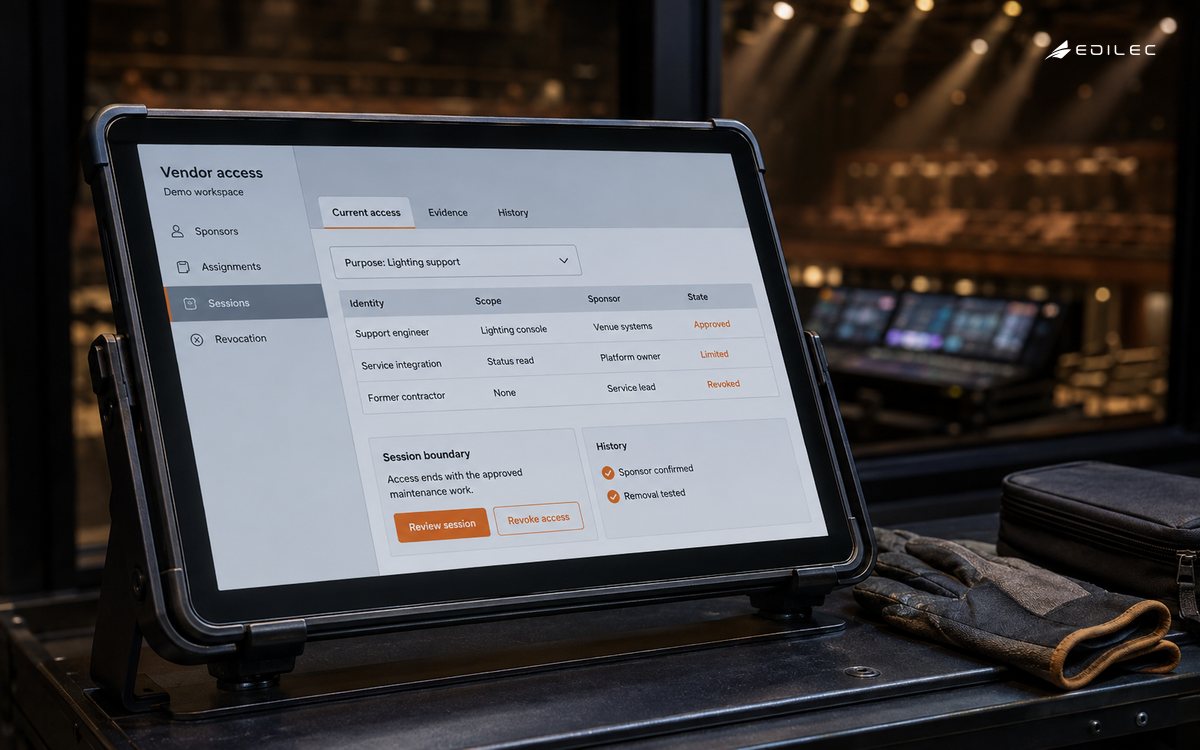
- Use named accounts instead of shared vendor credentials, even when several people from one supplier perform similar work.
- Grant the smallest workable scope and prefer a managed support channel to broad network reachability.
- Require strong authentication and avoid recovery methods controlled solely by the vendor for high-impact access.
- Bind each access record to a business sponsor, system owner, purpose, approval, expiry, and contact route.
- Test revocation periodically, including inactive accounts, service tokens, federated groups, and emergency access paths.
Monitor work that changes the risk
Monitoring is most useful when it supports a decision. Capture sign-ins, privilege elevation, configuration changes, bulk data operations, access denials, token creation, and administrative changes to the vendor relationship. Correlate events with the named identity, target system, ticket or approved change, and outcome. Review unusual timing, geography, volume, or actions outside the agreed scope, but do not rely on vague anomaly claims when ordinary operations are poorly understood. A support session at an unusual hour might be expected during an incident; the question is whether the sponsor, scope, and records support that explanation.
Prepare for exit and incident response
Plan the offboarding sequence before a vendor becomes critical. Know which services, certificates, code repositories, data copies, administrator accounts, API keys, and integration dependencies must change. Keep an emergency contact list and a technical runbook for disabling access without making the company unable to operate. During an incident, preserve relevant records, constrain access to what is necessary, and coordinate decisions with the business owner and legal or contractual contacts. Avoid instantly deleting evidence or credentials that may be needed to understand scope; contain first, then follow the documented recovery and credential-rotation plan.
| Review question | Good answer | Escalate when |
|---|---|---|
| Who owns this relationship? | A current internal sponsor and system owner are named. | No employee can explain the continuing purpose. |
| What can the vendor do? | Resources, actions, data classes, and environments are explicit. | The record says only 'admin access' or 'support'. |
| How is access removed? | Identity, tokens, groups, and connections have a tested disable path. | Revocation relies on a vendor email or an untested manual step. |
| What evidence exists? | Important actions can be tied to a named identity and approved work. | Shared credentials or missing logs prevent reconstruction. |
Run a sensible review cadence
Review high-impact vendor access more often than ordinary business SaaS use, and trigger a review after contract changes, incidents, new data use, major technical changes, acquisitions, or project completion. The review should confirm current sponsor, scope, identities, privileges, authentication, monitoring, and exit readiness. It is also a chance to identify workarounds that teams have normalized, such as shared support credentials or permanent VPN accounts. A useful outcome is a short corrective list with owners and dates, not a generic assurance score detached from the systems that are actually connected.
Run a practical operating exercise
Use a vendor access management drill when a supplier finishes a project or changes the people assigned to it. Start from the relationship record and identify every named account, federated group, API credential, support portal role, VPN route, certificate, and service integration connected to that supplier. Disable or rotate a controlled subset in a test environment, then verify that the organization can still operate through a documented fallback. Compare the technical result with the contract owner and system owner records. Any mismatch is valuable: it may reveal a shadow integration, a shared identity, an undocumented dependency, or a departure process that only removes one access path. Rehearse the same steps for an urgent containment scenario where evidence must be preserved before access is removed. This turns supplier offboarding into a predictable capability instead of a last-minute search across email and consoles.
Add a short review session whenever a supplier transition during a time-sensitive maintenance window changes the assumptions behind vendor access management. Bring the relationship sponsor, system owner, and procurement contact together and start with the actual request rather than a control label. Trace the request from the authoritative record through identity, configuration, policy, implementation, and the evidence an investigator would use. Ask whether access can be reduced without breaking an undisclosed dependency. Then introduce one realistic failure: a delayed directory update, unavailable dependency, stale configuration, unexpected retry, or departure of the person who normally knows the workaround. The group should choose a safe response before the next urgent event forces improvisation. Capture only concrete outcomes: a missing owner, an unclear approval limit, a test that does not reach the enforcement point, a recovery step that is too broad, or an evidence record that cannot be retrieved. Assign each outcome to a person and date, and rerun the same scenario after the change lands. This practice keeps vendor access management connected to daily operations. It also reveals when a process appears complete because a document exists, while the service itself still depends on unwritten knowledge or standing privilege. Over time, retain a small decision history so new team members can understand why the boundary exists and which assumptions must be revisited as the product, vendors, and workforce change.
Key takeaways
- Vendor access management begins with the data, systems, and actions a supplier can affect.
- Every connection needs a current internal sponsor, technical owner, purpose, scope, and removal path.
- Named, time-bound, strongly authenticated access is easier to govern than shared standing credentials.
- Monitor consequential work and tie it to a person, target, and approved context.
- Plan and test revocation before a contract ends or an incident makes speed essential.
Frequently asked questions
Conclusion
Vendor access management is a way to keep useful outside expertise from becoming uncontrolled standing access. Give suppliers enough access to complete defined work, make the decision legible, watch consequential use, and rehearse removal. Those habits protect both the company and the vendor relationship when circumstances change.