Zero trust is most useful when it starts with a real operational question. For a technical decision maker reducing implicit access to sensitive services and data, it is a security approach that treats access as an explicit, continuously evaluated decision based on identity, device, resource, context, and policy. That definition prevents a familiar label from hiding an unfinished decision. A team still needs to say who begins the work, which facts are trusted, what result is allowed, and how a person corrects the outcome when the system cannot resolve the case. The technology may change, but those responsibilities are what make the capability dependable.
Treat zero trust as an accountable path, not a feature request. Protect one high-value service path before attempting broad redesign. A decision-ready scope names the trigger, the authorized actor, the records in scope, and the result that a user can rely on. It also names what is deliberately out of scope. That restraint helps a team learn from genuine use before it turns a narrow improvement into an unowned layer between people and the work they are trying to complete.
What zero trust meaning means in practice
The practical purpose is to support actions such as authenticate a user, assess device posture, issue a scoped session, evaluate a request, or revoke access. The path should have a discernible starting condition, an observable state while work is in progress, and an outcome that can be checked later. A useful implementation makes the normal route easy without obscuring exceptions. It should be possible for an affected person to understand what happened and for an owner to locate the supporting evidence. That is the difference between a convenient interface and an operational commitment.
Authority belongs with the policy decision point and resource owner that decide which action is allowed. Other tools can display, cache, summarize, or relay that information, but they should not silently redefine it. This distinction matters whenever a new screen, service, or integration is introduced. An attractive experience does not prove that a value is current, that the actor has permission, or that a correction will reach the system where it matters. Naming authority early turns later architecture choices into reviewable trade-offs instead of assumptions.
Define the boundary before choosing a solution
Write the boundary in concrete language: when this event occurs, this role may perform this action against this scope, and this owner handles incomplete or disputed cases. That statement gives design a model, engineering a test target, and operations a service boundary. For zero trust meaning, it is more helpful than a promise to make everything seamless. It also provides a fair way to assess future expansion requests, because each new source, role, or action can be tested against the same accountable terms.

| Boundary question | Decision-ready answer | Warning sign |
|---|---|---|
| Who starts the path? | A named role, event, or service identity | Any person can initiate it |
| What may change? | A defined record or approved output | The action affects whatever appears related |
| Where is authority? | A named system and business owner | Several copies are treated as final |
| What happens on failure? | A visible exception and repair route | Someone must reconstruct the event from email |
Trace the policy decision path
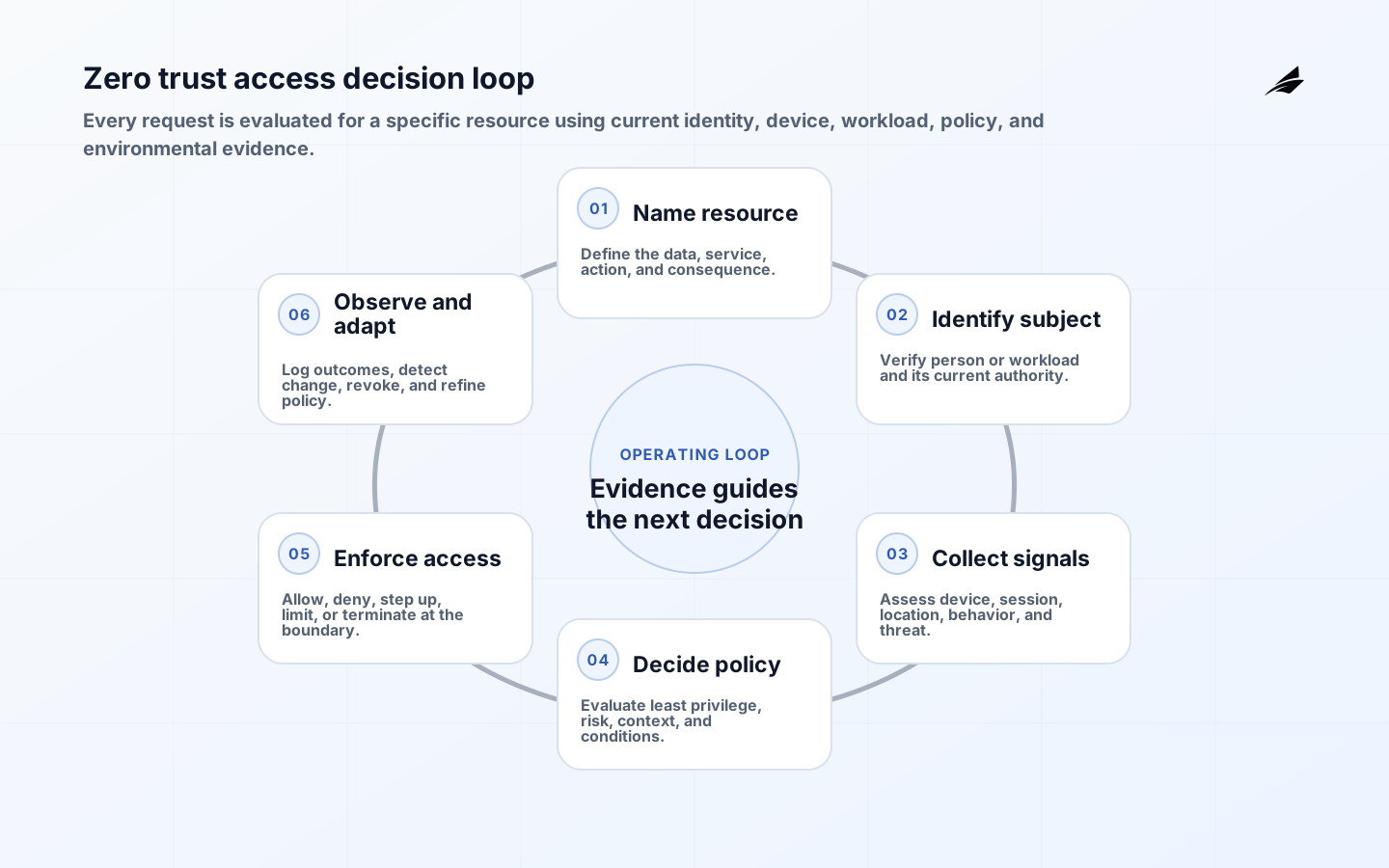
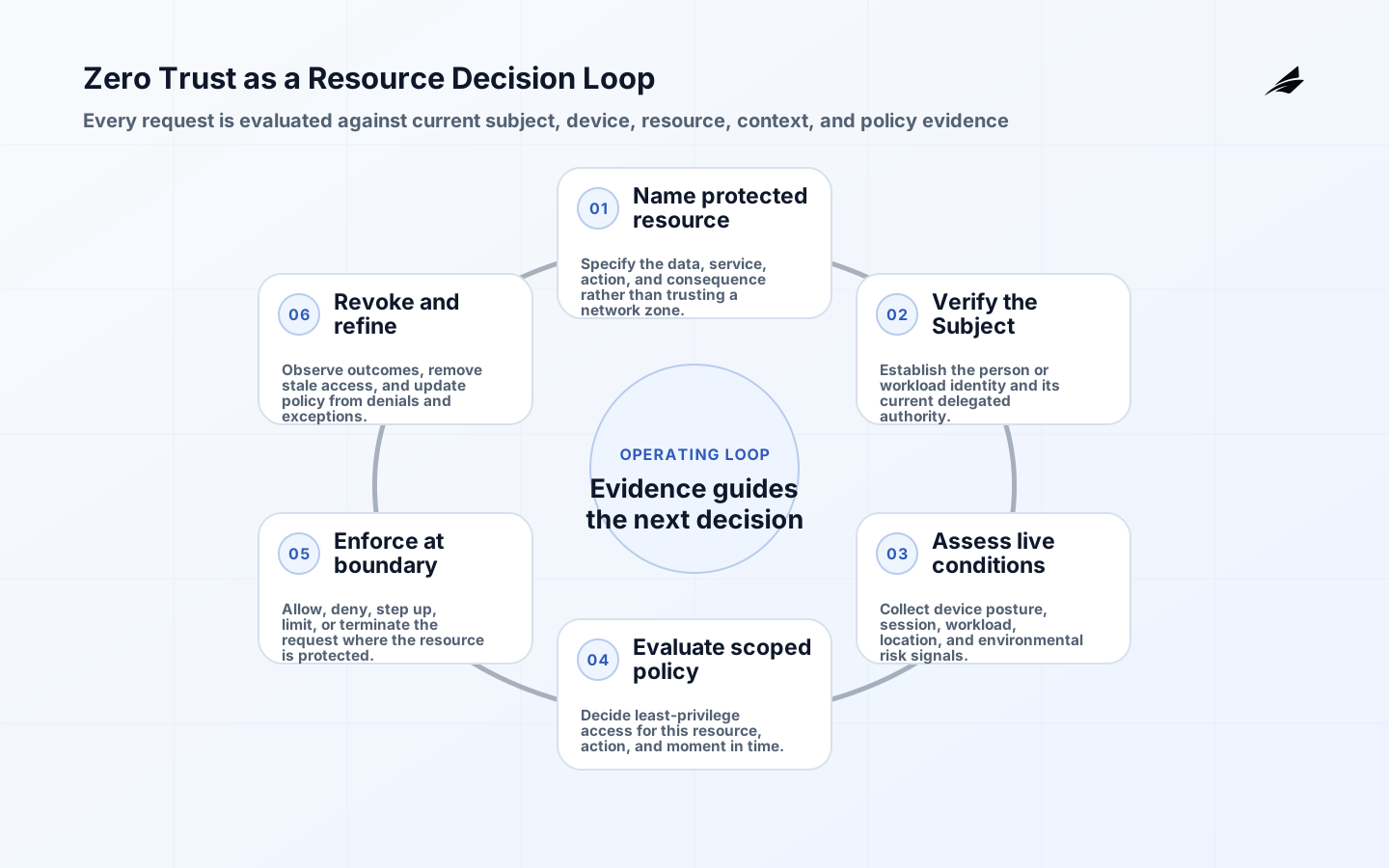
Zero trust means trust is not granted merely because a request originates from an internal network or a previously approved session. NIST SP 800-207 defines zero trust around protecting resources and making dynamic access decisions with information about the subject, asset, and environment. Map the complete path: where identity is established, which device and workload signals are considered, where policy is decided, where it is enforced, which data is released, and how the outcome is logged. This reveals gaps that a product inventory or “never trust, always verify” slogan cannot.
Choose a resource and transaction with a clear consequence before redesigning the whole estate. For example, protect administrative access to production, then measure denied stale accounts, unmanaged devices, emergency exceptions, policy latency, and failed enforcement. CISA’s Zero Trust Maturity Model organizes progress across identity, devices, networks, applications and workloads, and data, with visibility and automation spanning the pillars. Related Edilec guides explain multi-tenant SaaS boundaries, data pipeline trust boundaries, and the custom software versus SaaS decision when access architecture depends on product ownership.
Choose controls that fit consequence
The essential controls are strong identity, least privilege, device signals, segmentation, session limits, continuous logging, and recovery procedures. They should be designed into normal work rather than appended as a compliance ritual. A person should see the confirmation or denial when it matters, an operator should see the exception, and an owner should be able to find evidence without relying on personal memory. The right control profile depends on consequence: a read, an irreversible change, and an external disclosure are different decisions even when they appear in the same workflow.
A zero-trust design needs a control profile tied to the actual action. Use the likely harm of an incorrect outcome to decide where identity checks, validation, approval, and durable evidence belong. Exercise the ordinary case alongside a denied, incomplete, conflicting, and corrected case; those less tidy paths show whether the capability is safe to rely on. Avoid adding friction everywhere while the few irreversible actions remain under-specified. Proportionate controls are clearer for users and easier for teams to operate.
| Design choice | Use it when | Trade-off |
|---|---|---|
| Narrow initial scope | Evidence is needed before expansion | Some requests remain manual |
| Structured approval | A decision has material impact | A named reviewer may slow the path |
| Automated execution | The rule and inputs are stable | Monitoring and rollback are required |
| Human exception route | Context changes the right result | Owners need capacity and response expectations |
Operate zero trust meaning as a service
Review denials, privileged sessions, unmanaged devices, policy exceptions, lateral indicators, and revocation time with people who can change the underlying process. These signals should separate normal variation from a broken rule, missing source field, access problem, or training gap. A growing dashboard does not improve the service by itself. Each alert needs an owner and an expected response. Over time, the operational record becomes a valuable source of product insight because it exposes the conditions that users cannot resolve through the intended path.
For zero trust meaning, keep a concise change record that is useful to the next operator. Capture why the change was made, the policy or contract affected, the users and records in scope, the expected signal, and the rollback or repair route. This helps a technical decision maker reducing implicit access to sensitive services and data evaluate a change as a decision, not merely as a technical adjustment. It also prevents a seemingly small edit from becoming an undocumented change to work another team depends on.
Make a proportionate implementation decision
The first release should usually be a constrained path with representative users and real but limited data. Test the normal outcome, invalid input, interrupted request, denied action, and correction. Measure both the work saved and the new work introduced. Protect one high-value service path before attempting broad redesign. Expanding only after those checks keeps the team from making a permanent commitment before it knows whether the process, data, and ownership model can support it.
Before scaling, ask whether the organization can explain a result to the person affected by it. Can staff identify the source, the rule, the owner, and the next step? Can they stop or reverse an outcome when evidence changes? If not, scale will amplify ambiguity. The first improvement is usually a clearer decision rule or repair path, not another feature. This is particularly important for zero trust meaning, where an apparently small exception can have a disproportionate operational or trust cost.
Common failure modes to avoid
A recurring failure is buying a tool without mapping the actual decision path from subject to protected resource. Another is allowing a temporary workaround to become an invisible dependency: a manual export, shared account, spreadsheet override, or verbal approval may quietly join the production process. Surface those dependencies and decide whether to formalize, retire, or monitor them. Teams also underestimate change. A new field, role, policy, or customer segment should trigger an intentional review of the path rather than an assumption that existing behavior will stretch without consequence.
Key takeaways
- Zero trust should be defined by an accountable business decision, not by a feature label.
- Start with one bounded path and make authority, permissions, and exceptions explicit.
- Test denied, incomplete, and correction cases along with the happy path.
- Treat denials, privileged sessions, unmanaged devices, policy exceptions, lateral indicators, and revocation time as operating signals with owners, not decorative reporting.
Frequently asked questions
Is zero trust meaning only for large organizations? No. Smaller teams often benefit earlier because a few people carry a great deal of process knowledge. The scope should still be narrow and consequential. Should it replace human judgment? Only where the rule is stable and the cost of error is understood. Where context changes the right answer, the design should prepare a timely human decision with the relevant evidence rather than attempting to conceal uncertainty.
Conclusion
Zero trust earns its place when it gives a specific person a clearer and safer way to complete real work. Define the boundary, preserve authority, select proportionate controls, and operate the result with evidence. That foundation is more durable than a broad technology promise, and it lets the team expand only after the first decision path is genuinely working.