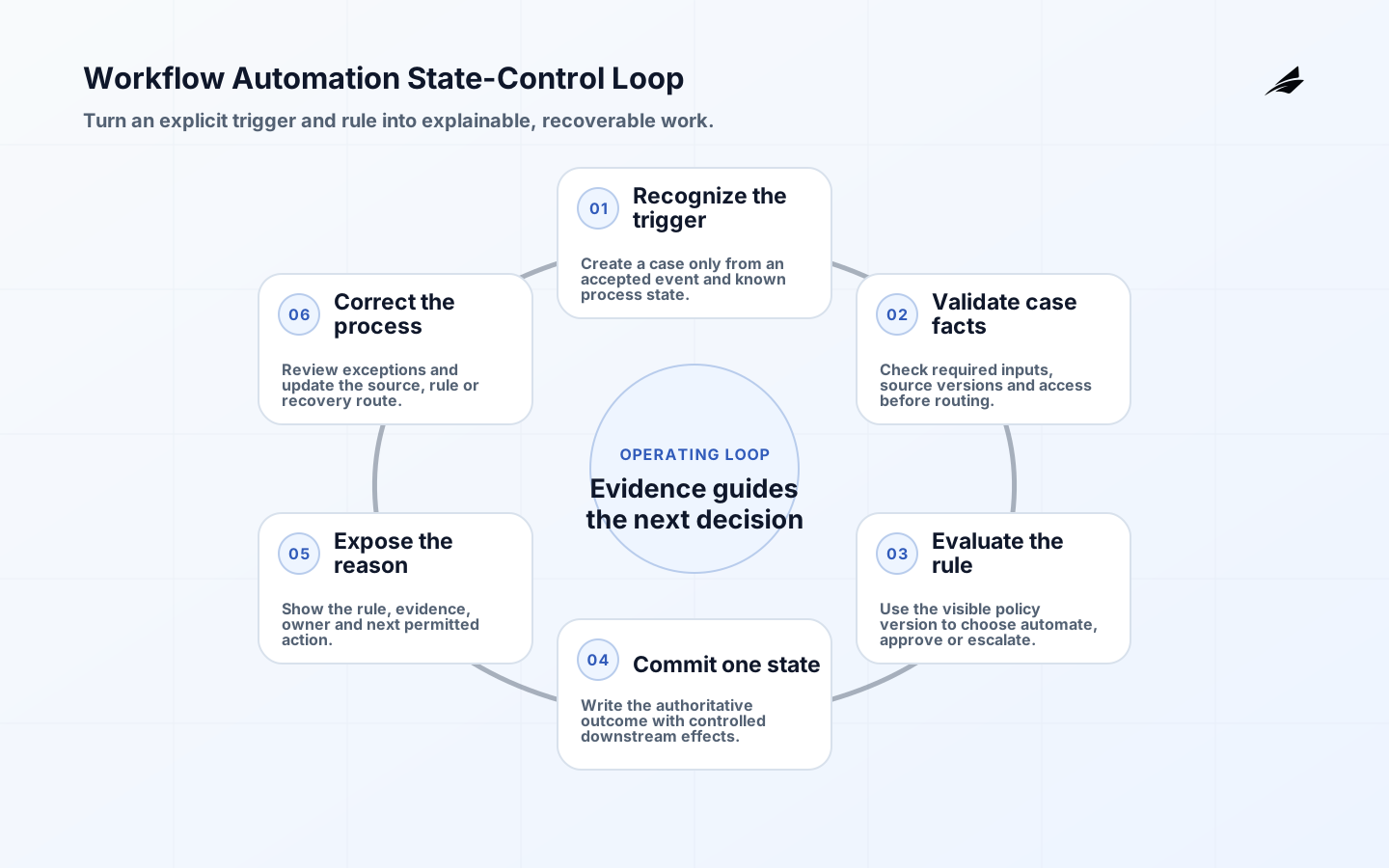
Planning workflow automation before development starts requires putting a practical boundary around a familiar term. Workflow automation uses software to move a defined piece of work through triggers, validations, decisions, assignments, and outcomes according to an explicit process rule; it is not merely a chain of integrations. That definition matters because teams often buy a tool or start a build before they can state the operational decision it must support. Here, the decision is what should happen next when an event occurs, whether it can happen automatically, and when a person must review, override, or repair the path. A useful first brief names the reader or actor, the event that begins work, the information that may be used, the outcome that counts as complete, and the person who can correct an exception. Those details turn a loose capability request into something a buyer, designer, engineer, and operator can assess together.
What workflow automation definition means in an operating system
The term should be judged by evidence, not by a product label. In this context, workflow automation definition describes the use of software to move a defined piece of work through triggers, validations, decisions, assignments, and outcomes according to an explicit process rule; it is not merely a chain of integrations. It has a visible boundary: it should be possible to tell what is included, what is excluded, and what happens when the normal path fails. A team does not need a massive specification to begin. It does need one decision statement, one accountable owner, a realistic sample case, and acceptance criteria that make a result checkable. This prevents the common drift in which a feature looks complete in a demo yet leaves staff guessing about authority, history, and repair when it reaches live work. For this workflow step, name the accountable owner, supporting evidence, exception route, and next measurable check.
Start with the decision rather than the interface. Ask: when this situation occurs, who needs to decide or act, what evidence do they need, and what consequence follows? For workflow automation definition, the relevant question is what should happen next when an event occurs, whether it can happen automatically, and when a person must review, override, or repair the path. That phrasing makes trade-offs concrete. It reveals whether the work needs immediate response or periodic review, whether a person must approve it, and whether an automated service may act alone. It also lets teams remove nice-to-have requests that do not change the decision. The result is a narrower first release with an outcome that can be observed, challenged, and improved. Within this workflow step, name the accountable owner, supporting evidence, exception route, and next measurable check.
Assign ownership and identify the authoritative record
The process owner owns the business rule and exception policy; operations owns day-to-day queue health; engineering owns implementation; control or compliance owners approve sensitive rules and evidence requirements. This division is deliberate: one person or team should not silently own policy, implementation, operations, and independent review. The authoritative record is the versioned workflow definition, its input and output contracts, decision rules, ownership map, and event history rather than a diagram disconnected from running work. Other applications may cache, present, transform, or relay the information, but they should not redefine it without a governed write path. Record this boundary in plain language. It lets staff resolve disagreement without choosing whichever screen was opened most recently, and it gives buyers a way to test whether a proposed platform preserves responsibility instead of scattering it.
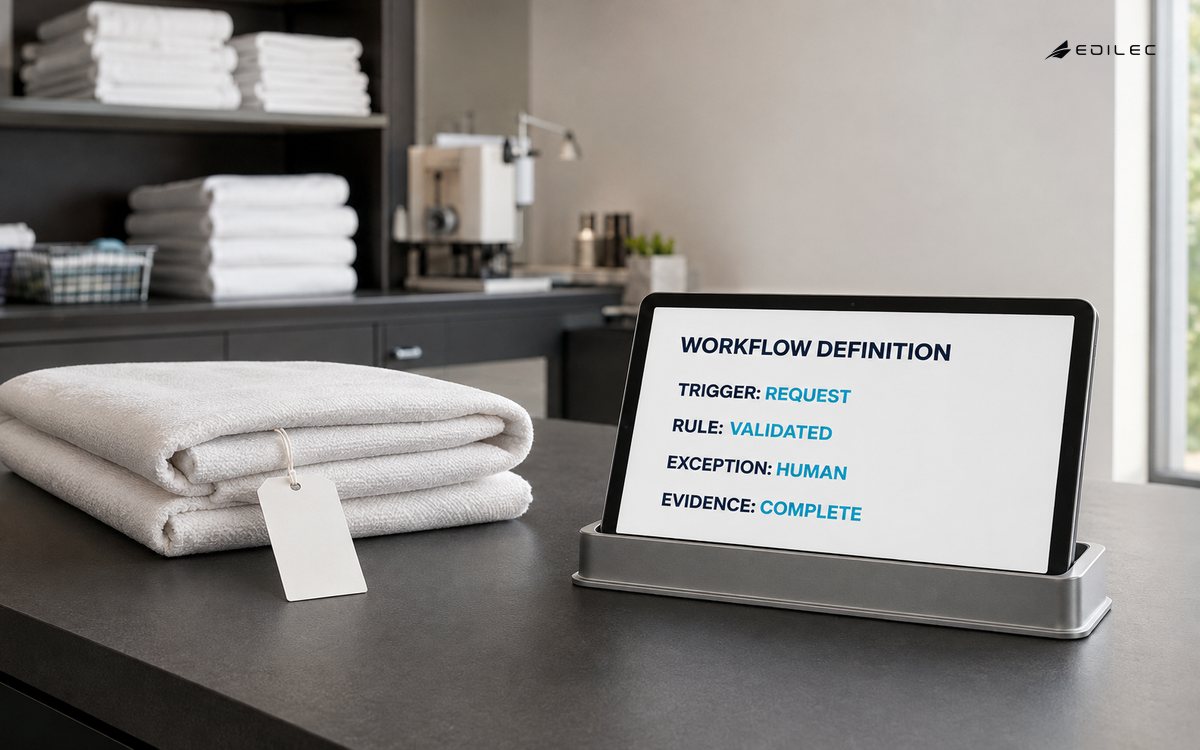
| Question | Decision-ready answer | Risk if omitted |
|---|---|---|
| What starts work? | a submitted request, completed task, threshold breach, customer response, time limit, or approved data change | Events arrive with no agreed handling |
| Who owns policy? | the process owner owns the business rule and exception policy; operations owns day-to-day queue health; engineering owns implementation; control or compliance owners approve sensitive rules and evidence requirements | A technical setting becomes an unreviewed business rule |
| Where is authority? | the versioned workflow definition, its input and output contracts, decision rules, ownership map, and event history rather than a diagram disconnected from running work | Copies compete and corrections do not converge |
| What is permitted? | validate inputs, separate duties where needed, make rule versions visible, set retry and idempotency behavior, limit automation authority, and preserve a human route for uncertain or harmful cases | The normal path works while misuse remains possible |
| Who repairs failure? | missing information, conflicting data, downstream outage, policy edge case, expired approval, automated action that needs reversal, or a case that exceeds a service deadline | Staff improvise through inboxes and spreadsheets |
| What proves success? | straight-through completion, exception volume and age, false-positive automation, rule-change lead time, rework, queue ownership, and customer impact of delay | Teams report activity instead of service outcomes |
Design controls around the workflow automation definition boundary
Controls should make the intended path easier to operate and the unintended path harder to hide. For this capability, that means validate inputs, separate duties where needed, make rule versions visible, set retry and idempotency behavior, limit automation authority, and preserve a human route for uncertain or harmful cases. These are not decorative compliance tasks. They establish what the service can prove when someone asks why an action occurred, why it did not occur, or whether a result has been changed. Match control strength to impact: a low-risk informational route may need a clear owner and basic monitoring, while a financial, privacy-sensitive, or safety-relevant action may need stronger identity, segregation, review, and retained evidence. Document the rationale so future changes can be evaluated consistently. When implementing this decision boundary, name the accountable owner, supporting evidence, exception route, and next measurable check.
Exception design deserves equal attention. Examples include missing information, conflicting data, a downstream outage, a policy edge case, an expired approval, an automated action that needs reversal, or a case that exceeds a service deadline. Every such case needs a named queue or owner, a target response time, and a safe way to resume, decline, or reverse work. Blind retries, direct database changes, and shared administrator credentials can make a failed process appear repaired while destroying the evidence needed to understand it. A buyer should ask to see the exception path in a working environment, including what a frontline employee sees, what is recorded, and who can authorize an override. That demonstration is usually more informative than a polished happy-path walkthrough.
| Control area | Practical test | Evidence to retain |
|---|---|---|
| Identity | Can the service distinguish the actor or service account? | Verified identity, role or service credential context |
| Scope | Is the requested object and action explicitly limited? | Authorization decision and affected record identifier |
| Validation | Are incomplete or contradictory inputs handled deliberately? | Validation result and user-facing failure reason |
| Change | Can policy or configuration be altered under review? | Version, approver, deployment and effective time |
| Recovery | Can a failed or disputed outcome be repaired safely? | Case owner, correction action and closure rationale |
| Review | Can owners detect material weakness or drift? | Measure, exception trend and follow-up decision |
How to evaluate workflow automation definition before purchase or build
Choose products that expose state, rules, retries, permissions, audit history, testing, and operational queues. A visual builder is insufficient if staff cannot understand why a case moved or stop a harmful rule. Run the evaluation against two or three representative scenarios, including an awkward one: a role change, disputed record, unavailable dependency, unusual approval, or client deadline. Ask suppliers and internal teams to trace the scenario from trigger to evidence, identify their retained responsibility, and show how the configuration is tested and changed. Price the operating work as well as the license or delivery effort. Integration maintenance, access reviews, monitoring, data quality, training, and incident response often determine whether the apparently simpler option remains simpler after the first year. Before releasing this design choice, name the accountable owner, supporting evidence, exception route, and next measurable check.
For delivery teams working on workflow automation definition, this acceptance decision should connect search intent, canonical URLs, rendered content, structured metadata, crawl paths, and measurable search outcomes to evidence an accountable owner can inspect. A build-versus-buy decision can be staged. Buy or configure a component when its policy is mature, the market offers a credible fit, and the organization can accept the service boundary. Build a differentiated capability when the workflow itself is strategic, evidence requirements cannot be met by configuration, or the integration and experience must be controlled closely. Hybrid designs are common: a purchased service can manage a standard concern while a tailored layer handles a unique decision. In every case, keep the boundary explicit, retain export and transition options, and avoid making a vendor-specific feature the only place critical business knowledge exists. In this operating review, move beyond the acceptance decision only after the owner can show the accepted result, the exception path, and the signal for another review.
Implementation checklist
- Write one decision statement for what should happen next when an event occurs, whether it can happen automatically, and when a person must review, override, or repair the path.
- Name the accountable owners for policy, operation, technology, and review: the process owner owns the business rule and exception policy; operations owns day-to-day queue health; engineering owns implementation; control or compliance owners approve sensitive rules and evidence requirements.
- Confirm the authoritative record and every permitted writer: the versioned workflow definition, its input and output contracts, decision rules, ownership map, and event history rather than a diagram disconnected from running work.
- Exercise a normal case, a denied case, and an exception such as missing information, conflicting data, downstream outage, policy edge case, expired approval, automated action that needs reversal, or a case that exceeds a service deadline.
- Define the evidence and measures to inspect: straight-through completion, exception volume and age, false-positive automation, rule-change lead time, rework, queue ownership, and customer impact of delay.
- Set a review date for access, configuration, costs, incidents, and boundary changes.
In workflow automation definition, delivery teams should make the relationship between search intent, canonical URLs, rendered content, structured metadata, crawl paths, and measurable search outcomes explicit and reviewable. Implementation should begin with a controlled slice, not a promise to connect every team and record. Choose one use case that has a clear trigger, manageable volume, real users, and a known exception owner. Instrument it from the start, then compare actual behavior with the decision statement. If a measure moves without a meaningful action, refine the measure. If exceptions are frequent, improve inputs, rules, or handoff design before expanding automation or access. This approach makes the first release a source of operational learning and protects the organization from spreading an unclear process across additional systems. This operating review should close the operating decision only when the result, unresolved exception, and next review condition are recorded.
Frequently asked questions about workflow automation definition
Is this only a technical concern? No. Technology implements the path, but the business still owns the purpose, policy, authority, and consequences. Workflow automation fails when those decisions are left implicit and staff must reconstruct them under pressure. Does standardization reduce flexibility? A clear boundary can make legitimate flexibility safer: teams can specify who may approve an exception, how long it lasts, and what evidence must accompany it instead of relying on informal workarounds.
How often should the design be reviewed? Review after material incidents, policy changes, supplier changes, major integrations, and at a cadence that matches the risk of the action. The review should ask whether the owner is still correct, whether the record remains authoritative, whether exceptions reveal a missing rule, and whether controls create unacceptable friction. A review that only confirms a dashboard is green will miss the operating assumptions that tend to fail first. During support for this workflow step, name the accountable owner, supporting evidence, exception route, and next measurable check.
Key takeaways for workflow automation definition
- Workflow automation establishes decision and accountability boundaries, not merely a feature label.
- Name an authoritative record and retain a usable route for correction and dispute.
- Evaluate controls and exception handling with real scenarios before expanding scope.
- Keep policy ownership, technical operation, and independent review visible.
- Track outcomes through straight-through completion, exception volume and age, false-positive automation, rule-change lead time, rework, queue ownership, and customer impact of delay.
Conclusion: make workflow automation definition explainable
The strongest implementation is not the one with the most settings or integrations. It is the one that allows an affected person and an accountable owner to explain what happened, why it was allowed, what evidence supports the result, and how an exception will be corrected. Treat workflow automation definition as a bounded service with explicit ownership, controlled change, and a review rhythm. That gives a growing team a fair basis for choosing technology and a sturdier foundation for the next workflow, integration, report, or client-facing capability it adds. To validate this workflow step, name the accountable owner, supporting evidence, exception route, and next measurable check.