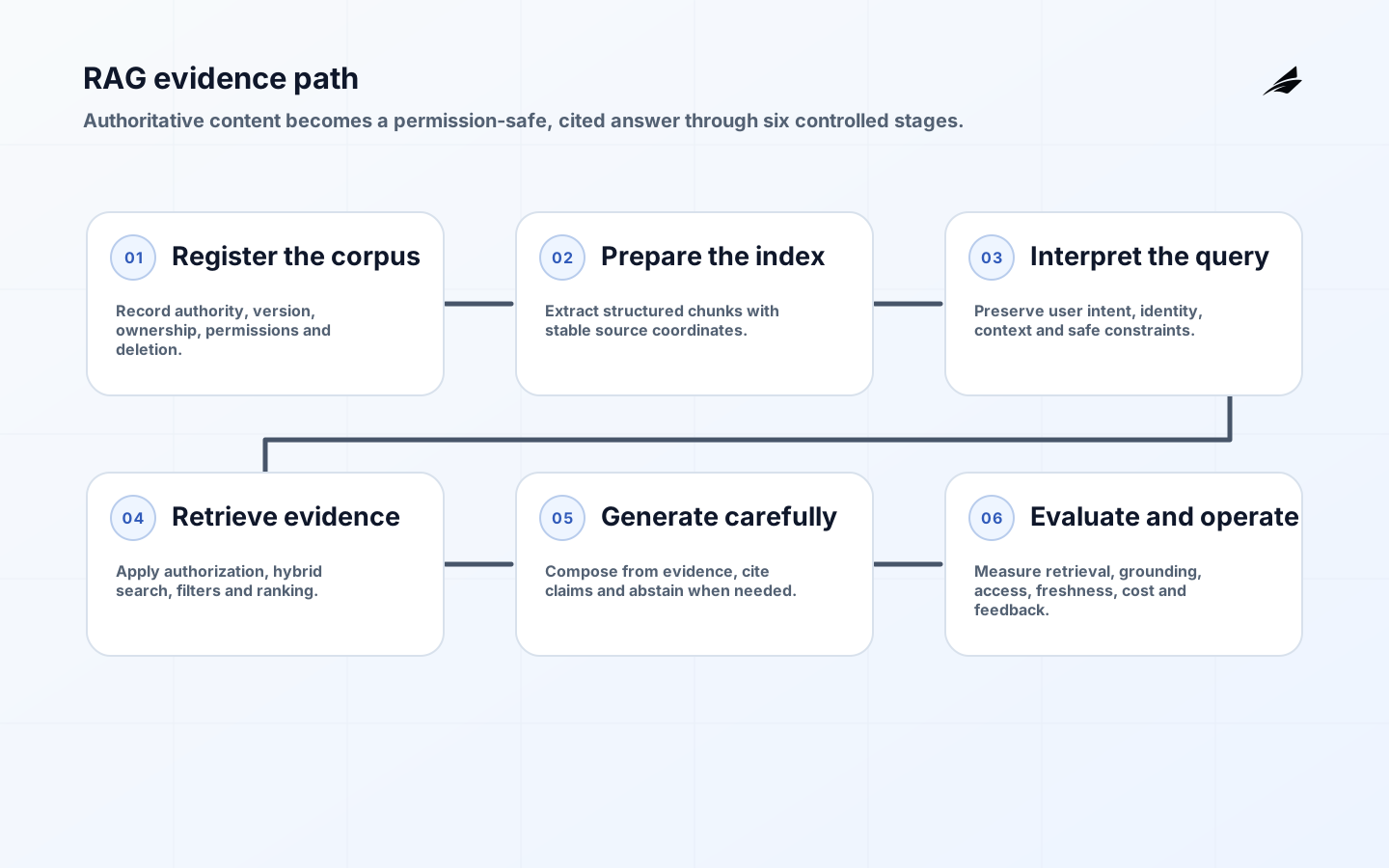
RAG means retrieval-augmented generation: an application pattern that retrieves relevant information from an external corpus and supplies that evidence to a generative model for the current request. The model does not permanently learn the retrieved documents. It receives selected passages in context and uses them to compose an answer. RAG can make an AI application more useful with current, private or domain-specific material and can provide sources that users inspect. It does not guarantee truth, permission safety or complete answers. Enterprise teams still need to govern the corpus, retrieval, authorization, prompt boundary, citations, evaluation and operation of the complete system.
Key takeaways
- RAG combines a retrieval system with a generative model at request time.
- The index is a derived search asset; authoritative records remain in source systems.
- Retrieval quality, permissions and source freshness constrain answer quality.
- Citations help verification but do not prove that a claim is supported.
- RAG, fine-tuning, long context and ordinary search solve different problems and can coexist.
What does RAG mean in AI?
The term was popularized by the 2020 paper Retrieval-Augmented Generation for Knowledge-Intensive NLP Tasks, which combined a parametric model with retrieved non-parametric memory. In enterprise applications, the phrase usually describes a broader pipeline: ingest approved content, extract and divide it into searchable units, create lexical or vector representations, retrieve candidates for a question, rerank and select evidence, then ask a model to answer within that context. The application may return citations and an abstention when evidence is weak. RAG is therefore an architecture, not a model feature or a synonym for uploading files to a chatbot.
How the RAG architecture works
At ingestion time, connectors read controlled sources, preserve identifiers and permissions, extract text and structure, create chunks and update an index. At query time, the application authenticates the user, interprets the question, applies authorization and metadata filters, retrieves candidates, reranks them and assembles a compact context. The model receives instructions, the question and evidence. Output processing checks structure, citations and connected actions before presentation. Microsoft’s Foundry overview summarizes preparation, indexing and application integration while warning that poor preparation and retrieval can still yield incomplete answers.
| Stage | Purpose | Typical failure |
|---|---|---|
| Ingest | Acquire approved current material | Missing versions or deleted content persists |
| Chunk and index | Make evidence searchable | Rule separated from its qualification |
| Authorize | Limit candidates to requester entitlement | Privileged index leaks restricted text |
| Retrieve and rank | Find the best evidence for intent | Semantically similar but wrong passage |
| Generate | Compose a useful answer from evidence | Unsupported synthesis or ignored conflict |
| Verify and observe | Show sources and capture quality | Citation points to irrelevant material |
Follow evidence from source to answer
A defensible implementation preserves source ID, owner, version or effective date, section coordinate, classification and access attributes for every chunk. The answer should associate material claims with specific passages and offer a route to the authoritative record. When evidence conflicts or does not cover the question, the correct behavior is to explain the limitation or abstain. The index should never become a shadow system of record. Updates, revocation and deletion must propagate from the source within defined targets. The Edilec guide to AI search across company records covers permission-aware enterprise implementation in detail.

RAG compared with search, fine-tuning and long context
Traditional search returns documents or passages for a person to inspect. RAG adds synthesis, which can reduce reading but introduces generation risk. Fine-tuning changes model behavior or task performance through training examples; it is not a reliable way to insert frequently changing facts and generally does not provide source provenance. Long-context prompting sends more source material directly, which can simplify small-corpus cases but increases latency and cost and may still bury relevant evidence. Tool-using agents can invoke retrieval as one capability, then take additional actions; that increases the authority and control problem.
| Approach | Best fit | Important limitation |
|---|---|---|
| Search | Reader can inspect ranked sources | More reading and synthesis required |
| RAG | Current or private evidence needs concise synthesis | Retrieval and generation both can fail |
| Fine-tuning | Consistent style, format or specialized behavior | Knowledge updates and provenance remain difficult |
| Long context | Small bounded document set | Cost, latency and attention dilution |
| Agent with retrieval | Multi-step research or workflow | Tool authority and state require stronger controls |
Retrieval quality determines the ceiling
Start with representative questions and owner-labeled relevant passages. Evaluate recall at a practical candidate count, ranking quality, permission correctness and freshness before judging answer prose. Hybrid retrieval can combine lexical matches for exact terms with vector similarity for paraphrases. Metadata filters, synonyms and query rewriting help only when tested against real intent. Microsoft’s Azure AI Search RAG guidance identifies query understanding, multi-source access, token constraints, latency, security and content preparation as central challenges. Segment evaluation by source, document type, language and user group.
Secure the corpus and prompt boundary
Apply access control before retrieved passages reach the model. Carry document or record permissions into the index and test recent revocation, cross-tenant queries and administrator access. Treat retrieved content as untrusted because a document may contain instructions that try to override policy or trigger a tool. Keep system rules separate, restrict connected tools, validate output and never derive authorization from model text. The OWASP LLM risks help structure threat scenarios such as prompt injection and sensitive information disclosure. Protect logs because questions and retrieved text may themselves be confidential.
Evaluate answers and outcomes
Measure groundedness, citation correctness, completeness, useful abstention, harmful content and task success. A response can be factually plausible but unsupported by the approved corpus; it can also cite a source that does not entail the claim. Ask domain owners to review high-consequence cases and preserve a versioned evaluation set. Include contradictory sources, stale documents, missing evidence, hostile instructions and denied-access questions. The NIST Generative AI Profile emphasizes governance, pre-deployment testing, content provenance and incident disclosure—useful themes for a production RAG evidence package.
Where RAG works well—and where it does not
Strong uses include controlled policy assistance, product documentation, support knowledge, research navigation and evidence-backed drafting. RAG is weaker when authoritative data is highly structured and exact computation or transaction logic is required; query the system through a validated API instead. It is also a poor substitute for legal, medical or financial judgment, and cannot repair a corpus with contradictory ownership or obsolete documents. The support knowledge-base guide shows how to bound RAG around a specific operating task.
Operate RAG as a production system
Monitor ingestion failures, freshness lag, deleted-document propagation, retrieval latency, no-result rate, answer abstention, citation use, corrections, permission denials and cost per useful outcome. Version chunking, embedding, ranking, prompt and model settings; any change can alter quality. Sample apparently successful answers and route source errors to content owners. Define fallback to ordinary search or source navigation, and test provider and index outages. Keep an exit path that can rebuild the derived index from authoritative content.
Practical review checklist
- Select a bounded corpus with a clear owner and deletion path. Before indexing, resolve duplicate current versions, unsupported formats and records whose access rules cannot be represented safely.
- Create twenty to fifty representative questions for an initial proof, including exact terms, paraphrases, no-answer cases and denied-access questions. Have domain owners mark the evidence passages and acceptable limitations.
- Compare lexical, vector and hybrid retrieval against the same labeled set. Measure whether relevant evidence appears within the context budget, not whether a demonstration answer merely sounds reasonable.
- Require claim-level citations for factual answers and make the source easy to open. Sample citations for entailment: the linked passage must actually support the claim, not just discuss a similar topic.
- Define useful abstention and fallback. The application should explain that approved evidence was insufficient and offer ordinary search, source navigation or an accountable owner rather than inventing a completion.
- Version the entire RAG configuration and rerun evaluation after model, embedding, ranking, chunking, prompt or corpus-policy changes. A model upgrade can alter answer behavior even when retrieval is unchanged.
A worked operating example
A simple policy assistant illustrates the boundary. The system indexes only approved policy versions, applies employee permissions before retrieval, returns the relevant clause with its effective date and declines exceptions that require HR judgment. If a source owner publishes a revision, the old chunk is retired and tests confirm the new answer. That is RAG: retrieval supplies current evidence to generation. It is not autonomous policy interpretation, and the indexed copy never replaces the controlled repository.
Frequently asked questions
Does RAG prevent hallucination?
No. It can supply relevant evidence and make verification easier, but retrieval may miss the right source and the model may misstate retrieved material. Groundedness, citation correctness and abstention require explicit evaluation and interface support.
Does every RAG system need a vector database?
No. A small or terminology-heavy corpus may work with lexical search, a relational index or a provider’s managed search. Many systems use hybrid retrieval. Choose based on evaluated relevance, permissions, lifecycle, latency and operating cost rather than the label.
Conclusion
RAG means adding retrieved evidence to generation at request time. Its value comes from current sources, useful synthesis and inspectable provenance; its risk comes from poor retrieval, stale permissions, untrusted documents and overconfident output. Enterprise teams should design the complete evidence path, evaluate each layer and retain authoritative systems and human judgment where the consequence demands them.