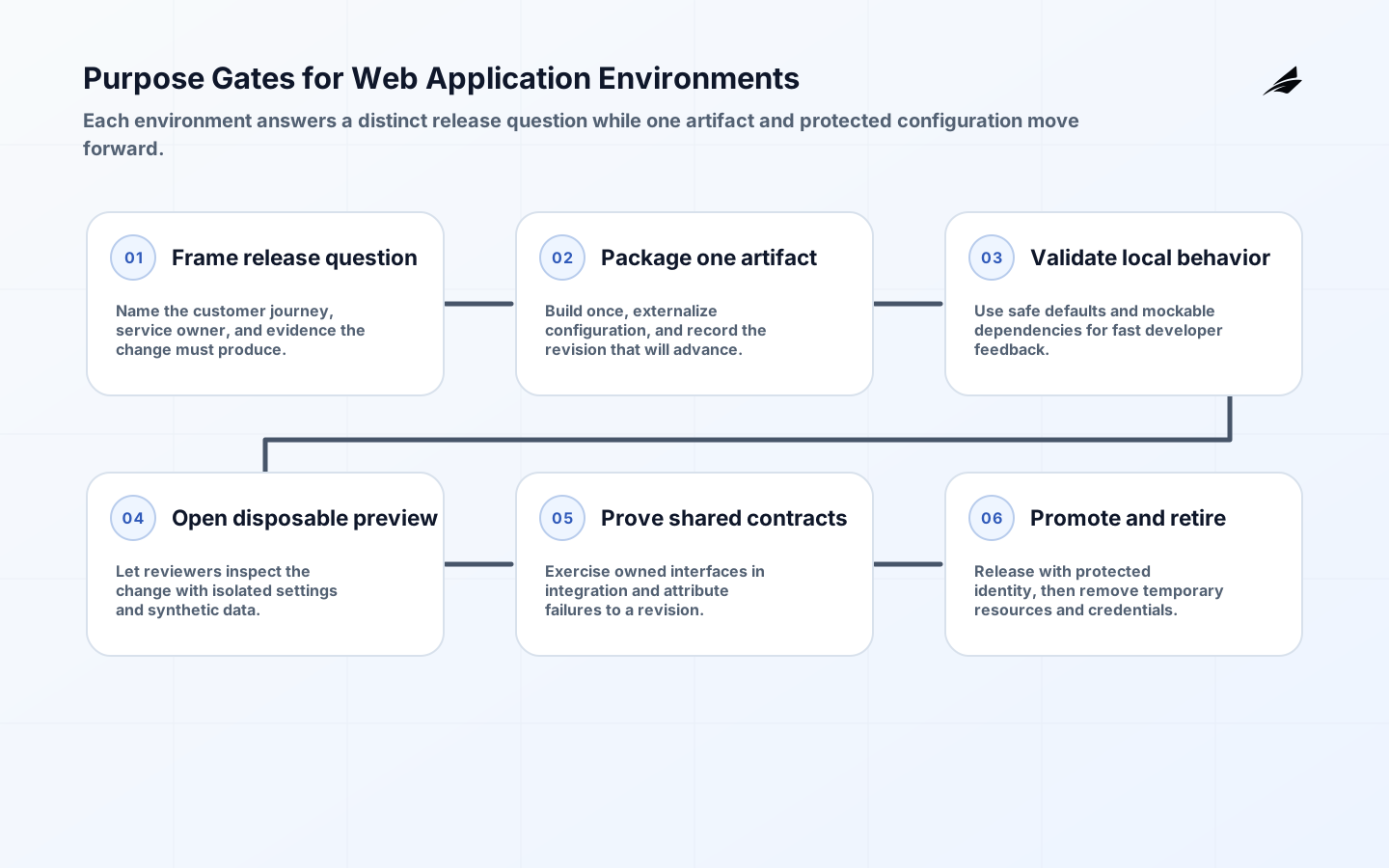
Environment strategy for web apps is a planning and operating capability, not a tool purchase. Give every environment a distinct decision purpose, protect production access, and reduce drift between release stages. The useful first step is to connect a real client or customer outcome to an owner, a technical boundary, and evidence that the team can use when normal delivery is interrupted.
Key takeaways
- Start environment strategy for web apps from the business or customer outcome that can be harmed, then select controls proportionate to that consequence.
- Name the service owner, operating authority, and fallback decision before automation obscures the handoffs.
- Pilot a narrow real path, including controlled failure and recovery, before standardizing it for every team.
- Measure the evidence that changes the next decision rather than collecting activity metrics for their own sake.
What environment strategy for web apps needs to solve
Stale or misleading staging systems create false assurance; shared targets with uncontrolled changes create queues. Fewer purposeful environments are stronger than a sprawling landscape.
| Decision area | What to decide | Why it matters |
|---|---|---|
| Outcome and owner | Identify the critical journey, accountable service owner, and consequence of failure for environment strategy for web apps. | Technical choices need a customer and operational context. |
| Scope boundary | For local, preview, integration, pre-production, and production, write the acceptance question, data policy, configuration boundary, access rules, and lifecycle owner. | A bounded first release can be tested and supported. |
| Evidence | Choose the health, change, access, and recovery record required for environment strategy for web apps. | Teams should not reconstruct important facts during an incident. |
| Authority | Set who can approve, pause, contain, and verify a material change. | Fast action depends on clear decision rights. |
Set a practical scope and architecture
For local, preview, integration, pre-production, and production, write the acceptance question, data policy, configuration boundary, access rules, and lifecycle owner. Build the first version around one meaningful service path and document its dependencies, access model, data handling, and expected failure behavior. A concise service brief should describe what healthy looks like to a customer, where the important state lives, and which assumption would require the design to change. This keeps architecture choices anchored to a supportable result rather than a broad platform promise.
| Planning artifact | Minimum content | Evidence of readiness |
|---|---|---|
| Service brief | Customer outcome, owner, critical journey, and consequence of interruption | Product and service owners agree what healthy means. |
| Dependency map | Data, identity, integrations, limits, and likely failure paths | The team can describe expected behavior when a critical dependency is slow or absent. |
| Operating contract | Routine changes, access, alerts, escalation, and recovery authority | A responder can act without first discovering ownership. |
| Change record | Intent, risk, validation, stop conditions, and recovery option | Review distinguishes a known trade-off from an unknown risk. |
Design the operating path for environment strategy for web apps
An environment strategy for web apps should give each stage a distinct decision, not create identical copies of production by habit. Local work can validate fast feedback with emulated dependencies; a preview can support product review of a change; integration can prove shared contracts; production validates real customer behavior. For example, an address-form change might be reviewed in a short-lived preview with synthetic data, tested against the shipping API in integration, then released behind a feature flag. Do not use production customer records to make previews realistic; make the test data and data-handling boundary explicit instead.
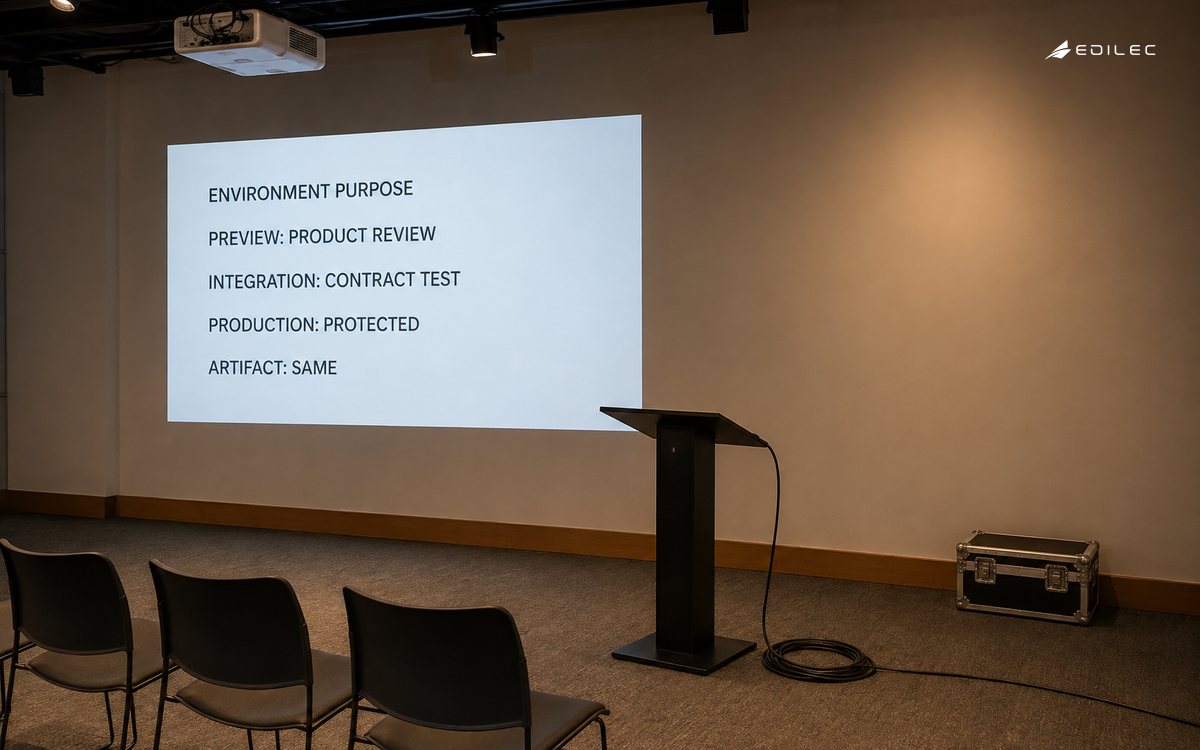
Give every environment a testable purpose
| Stage | Acceptance check | Operating risk |
|---|---|---|
| Local | Developers can run the core path with documented safe defaults and mockable dependencies. | Slow or secret-dependent setup causes changes to skip early feedback. |
| Preview | A reviewer can inspect the change with isolated configuration and disposable data. | Long-lived previews accumulate credentials, cost, and misleading state. |
| Integration | Contract tests exercise owned interfaces and report the version under test. | A shared environment becomes a queue where failures cannot be attributed to one change. |
| Production | The same artifact has protected configuration, observability, and a containment path. | A final manual rebuild or hidden setting invalidates prior evidence. |
Put controls where the work happens
Promote the same artifact and keep configuration external. Protect secrets and production authority with target-specific identities and record deployment history and concurrency.
- Give every material alert, approval, exception, or recovery decision a named owner and escalation route.
- Keep changes to access, configuration, and production state reviewable and traceable.
- Document pause and fallback conditions in the normal workflow, not only in an incident binder.
- Exercise recovery and access paths with the people who will use them in production.
- Treat repeated exceptions as feedback on the supported operating contract.
Pilot the path before scaling it
Begin with local, optional short-lived preview, integration, and production. Add pre-production only when it answers a real question; test configuration change, secret rotation, failed deployment, and teardown.
| Pilot question | How to test it | Decision enabled |
|---|---|---|
| Can customers complete the critical path? | Use a representative workflow and service signal. | Proceed, redesign, or narrow scope based on outcome evidence. |
| Can the team operate it? | Have actual service and support owners perform routine work. | Clarify ownership, improve documentation, or reduce complexity. |
| Can the team recover it? | Introduce a controlled fault or failed change and follow the runbook. | Fix recovery gaps before wider exposure. |
| Can the team govern it? | Review access, audit history, cost or capacity, and exceptions. | Accept the operating model or add focused controls. |
Measure decisions, not activity
Metrics for environment strategy for web apps should reveal whether the intended service outcome is holding and whether the team can make a timely operating decision. Establish a baseline before the pilot and attach context to material changes. Do not use a single number as a verdict on people; use it to locate the next improvement while the evidence is fresh.
| Metric | What it reveals | Review use |
|---|---|---|
| Customer outcome | Completion, success, or timeliness for the critical journey | Compare against the agreed service objective. |
| Detection and response | Time to recognize, own, contain, and verify a material problem | Improve routes, authority, and runbooks. |
| Control adherence | Changes using the supported, evidenced path | Investigate exceptions and friction. |
| Recovery confidence | Recent exercises that reached business validation | Prioritize untested or unreliable services. |
Frequently asked questions about environment strategy for web apps
Do we need staging?
Only where it validates a meaningful release condition that other stages cannot. A neglected staging system is worse than an honest smaller strategy.
Can previews use production data?
Avoid it. Use synthetic or governed masked data; customer data adds privacy, security, and cleanup obligations that rarely fit a review preview.
Where does configuration live?
Version non-secret configuration where it can be reviewed. Manage secrets in protected systems, never ordinary repositories or build logs.
A practical checklist for environment strategy for web apps
- Confirm the service owner, support contact, and authority to pause or contain a material issue.
- Keep the decision record, current configuration, dependency map, and verification evidence discoverable to the people on call.
- Run a controlled exercise before wider rollout and record the actual time to detect, act, and verify recovery.
- Review exceptions and repeated manual steps; they identify where the operating contract needs improvement.
- Set a review date after significant product, dependency, staffing, or compliance change.
For web environments, document the allowed differences rather than chasing identical copies. Production may require real scale, restricted identities, and customer traffic; integration may need controllable dependencies and test data. The important discipline is that these differences are intentional, versioned, and visible in the release record. Unexplained environment-specific edits are a major source of surprise.
Keep the plan alive after launch
Retire temporary environments and credentials automatically where possible. A preview with unknown data, an expired branch, or a forgotten integration can become both a cost issue and a security issue. Review the cleanup report alongside deployment failures. Environment strategy is successful when teams get fast feedback without creating a shadow fleet that no one can patch, audit, or explain.
Make environment strategy for web apps survive real handoffs
The enduring test for environment strategy for web apps is whether a capable person who was not present for the original design can make the next safe decision. Keep environment purpose, protected configuration, and resource lifecycle in a concise operating record that is linked from the normal delivery and support path. The record should distinguish facts from assumptions, name the current owner, and say what evidence is needed before an exception becomes a permanent change. During a staff change, vendor incident, or urgent customer request, this clarity is more valuable than a polished architecture diagram because it shows who may act and how success will be verified. Review the record after every meaningful release or incident. Remove instructions that are no longer true, add the context that responders had to discover, and turn recurring verbal advice into a visible control or supported workflow. This review habit prevents the service from quietly depending on a few people who remember why an old decision was made.
| Handoff item | Question to answer | Owner check |
|---|---|---|
| Current state | What version, configuration, and operating condition is in effect for environment strategy for web apps? | A named owner can locate the evidence quickly. |
| Decision boundary | Which action can proceed routinely, and which needs escalation? | Authority matches the service consequence. |
| Verification | What customer, technical, and operational signals confirm the action worked? | The result is recorded before work is declared complete. |
| Review trigger | Which change, incident, or date requires the plan to be revisited? | The operating record remains current. |
Conclusion
Environment strategy for web apps creates value when it becomes a dependable operating capability rather than another layer of tooling. Start with one accountable service path, make failure and recovery concrete, and use pilot evidence to decide what deserves standardization. That is a plan clients can fund, operate, and improve without relying on untested assumptions.