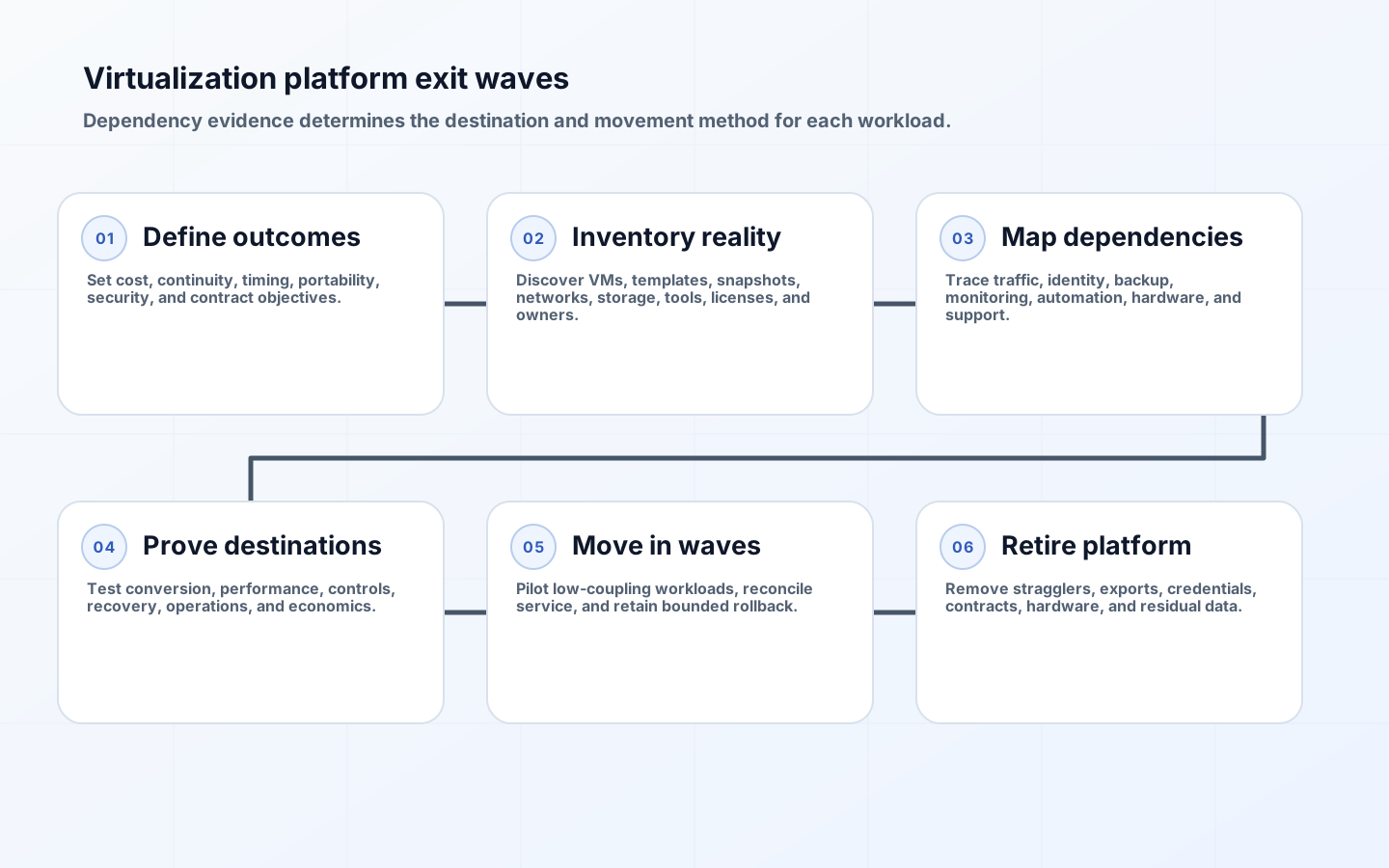
A virtualization platform migration plan is a portfolio exit program, not a bulk virtual-disk conversion. Workloads depend on virtual networks, storage semantics, snapshots, backup agents, replication, identity, monitoring, automation, hardware passthrough, licensing, operational knowledge, and vendor support. A virtual machine that boots on a new hypervisor can still fail its service objective because its network path, clock, disk behavior, backup, or recovery process changed.
Start with the outcomes that justify movement: cost predictability, contract leverage, support continuity, hardware choice, security, cloud alignment, operational simplification, or an explicit exit right. Then inventory reality, map dependencies, classify destinations, prove representative workloads, and move in waves with rollback boundaries. DMTF’s OVF standard improves portable packaging, but even its guidance recognizes that packaging alone cannot guarantee universal runtime portability. Migration evidence must extend beyond the VM envelope.
Define exit outcomes, deadlines, and non-negotiable constraints
Write measurable outcomes and the date by which they matter. Separate a contract-renewal deadline from the final platform retirement date; compressing both into one milestone encourages risky migrations and expensive emergency exceptions. State continuity, recovery, security, residency, performance, cost, and support constraints. Identify workloads that cannot move during business peaks, regulated periods, or product launches. Establish who can approve a temporary remain decision and what commercial or technical consequence it carries.
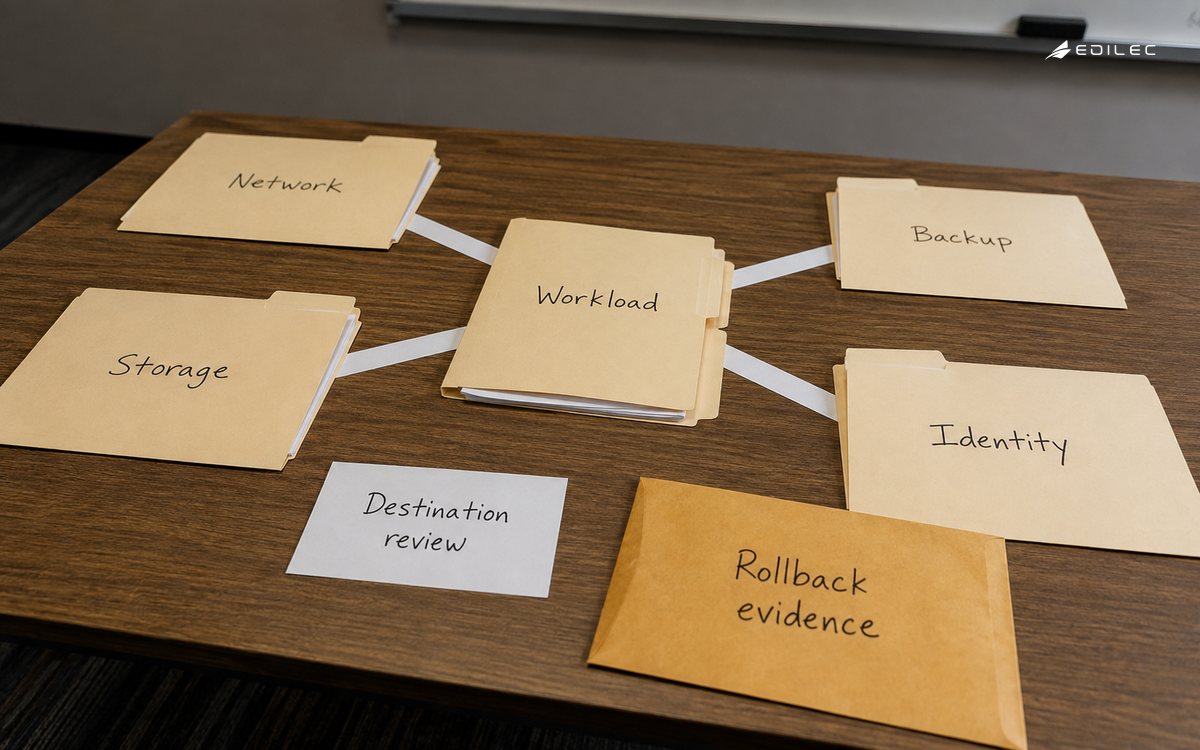
Do not select one destination for the entire estate before discovery. Candidate dispositions may include another hypervisor, bare metal, containers, managed cloud services, hosted private cloud, application replacement, or retirement. Define architecture principles that apply to each: supported operating systems, identity integration, encryption, backup, observability, infrastructure as code, network segmentation, and recovery testing. This creates a destination policy without forcing incompatible workloads into a fashionable target.
| Outcome | Metric | Evidence before commitment | Retirement proof |
|---|---|---|---|
| Lower recurring cost | Run cost per workload or capacity unit | Comparable licensing, infrastructure, support, and team model | Legacy invoices and entitlements closed |
| Portability | Time and work to move a representative service | Export/import, data, network, automation, and recovery test | Portable artifacts and current runbook retained |
| Support continuity | Workloads on supported platform and guest stack | Vendor matrices and exception inventory | Unsupported components removed or approved |
| Operational resilience | Service and recovery objectives in target | Failure, backup, restore, monitoring, and patch tests | Legacy recovery dependencies decommissioned |
| Simpler operations | Reduction in distinct tools and manual tasks | Target operating model and staffing analysis | Old consoles, agents, credentials, and procedures removed |
Discover the complete estate and reconcile ownership
Collect platform-manager inventory, but also query network, DNS, IPAM, load balancers, firewalls, storage, backup, replication, monitoring, vulnerability management, identity, CMDB, service desk, and finance systems. Record VM identity, business service, owner, guest OS, CPU and memory, disks, controllers, firmware mode, tools and drivers, network interfaces, addresses, tags, affinity rules, snapshots, templates, schedules, protection policy, support state, and observed activity. Flag conflicting records for resolution rather than choosing one source silently.
Find dormant and hidden dependencies. Observe flows over representative business cycles, inspect scheduled jobs, certificates, hard-coded addresses, shared file systems, database links, license servers, domain membership, time synchronization, outbound allowlists, and monitoring callbacks. Interview application and operations owners because telemetry cannot reveal every manual month-end process. Use an evidence status such as verified, inferred, owner-asserted, or unknown. Unknown dependencies belong in wave risk and test scope; they do not disappear because a deadline approaches.
Classify portability blockers and destination fit
Assess guest operating-system and driver support, virtual hardware, disk formats, boot mode, network adapters, storage features, snapshot dependence, time sensitivity, CPU instruction requirements, NUMA topology, accelerators, USB or PCI passthrough, clustering, licensing, and vendor appliance restrictions. NIST SP 800-125A emphasizes that hypervisors mediate hardware resources and isolation; changing that layer changes a security boundary. Reassess secure configuration, device virtualization, administrative access, and platform monitoring rather than copying old settings mechanically.
Score destinations against application fit and operating fit. A VM may convert easily but become expensive to back up or difficult to monitor. A container refactor may improve delivery but is not a shortcut for an unsupported application. Bare metal may suit licensed or latency-sensitive systems but increase provisioning work. Cloud infrastructure may accelerate capacity but change egress, network latency, identity, and resilience economics. Record the reason for each disposition and a fallback destination for material uncertainties.
| Domain | Inventory evidence | Target test | Typical failure |
|---|---|---|---|
| Compute and guest | OS, drivers, boot, tools, CPU features, passthrough | Boot, performance, time, shutdown, patch, and support | Unsupported driver or changed CPU behavior |
| Network and security | Flows, addresses, DNS, firewall, load balancer, segmentation | Allowed and denied paths, failover, monitoring | Missing callback or widened access |
| Storage and data | Volumes, latency, consistency, snapshots, replication | Application-consistent move, performance, rollback | Crash-consistent copy accepted as recovery |
| Protection | Backup, retention, immutability, restore, DR | File, VM, database, and site restore | Backup succeeds but restore path is absent |
| Operations | Monitoring, automation, access, patching, incident workflow | Alert, deploy, scale, troubleshoot, and recover | Target runs but support team lacks control |
| Commercial | Licenses, support, appliances, contracts, exit rights | Entitlement and support confirmation | Unexpected metric or prohibited conversion |
Prove the target operating model with representative workloads
Build a landing zone or platform baseline before volume migration. Configure identity, privileged access, segmentation, images, encryption, logging, monitoring, backup, patching, capacity, automation, and service ownership. Test a representative set: simple stateless VM, high-I/O database, multi-tier service, appliance, Windows and Linux guests, large data volume, strict recovery workload, and any passthrough case. Measure performance and total operational steps, not only conversion duration.
Run recovery and security tests early. Restore from target backup into an isolated network, rebuild a host, rotate credentials, apply a critical update, investigate an alert, and recover from a failed migration. NIST SP 800-125B calls out segmentation, path redundancy, firewalls, and traffic monitoring for virtual networks; validate each in the destination. Confirm that automation can recreate configuration from governed sources. A platform that depends on manually imported settings recreates lock-in in a less visible form.
Migrate in waves with explicit rollback and reconciliation
Group workloads by dependency and risk, not merely by owner. Start with low-coupling systems that exercise the target controls, then move representative medium-risk services before critical clusters. For each wave, define data replication or copy, freeze requirements, change window, DNS or traffic transition, validation journeys, observability comparison, rollback trigger, rollback data treatment, support coverage, and stabilization period. A rollback that loses writes made after cutover is a recovery plan requiring business approval, not a simple switch.
Use a wave ledger to reconcile inventory, target configuration, backups, monitoring, licenses, costs, incidents, and user acceptance. Preserve source systems only for the approved rollback period, then remove or isolate them so stale instances cannot receive traffic or create security exposure. Track exception age and economic consequence. If stragglers require the old management plane, storage array, backup product, or support contract, their full residual cost must remain visible to decision makers.
Retire the platform with technical and commercial evidence
Retirement includes VMs, templates, snapshots, orphaned disks, replication copies, exports, backup policies, service accounts, certificates, firewall rules, DNS, monitoring, automation credentials, hardware management, licenses, support, and operational documentation. Retain records and backups according to policy, then securely erase residual data. Verify that disaster-recovery plans no longer invoke the old platform and that no target workload downloads tools or licenses from it. Update asset and financial systems.
Conduct a final outcome review against the original exit measures: recurring cost, support state, recovery performance, incident load, deployment effort, portability evidence, and team capability. Capture conversion defects and destination exceptions for future moves. Maintain periodic export and recovery tests if portability was a strategic objective; an exit plan that is never exercised decays as platforms, data, and skills change. The program is complete only when the organization can operate and recover without the former platform.
Key takeaways
- Define why and by when the organization must exit before selecting destinations.
- Reconcile VM inventory with network, storage, backup, identity, monitoring, finance, and owner evidence.
- Treat OVF or disk conversion as one portability layer; runtime, security, data, and operations still need proof.
- Pilot representative workloads and recovery tasks before volume waves.
- Price stragglers at their full residual platform cost and retire technical and commercial dependencies explicitly.
FAQ
Does OVF make every VM portable?
No. OVF standardizes packaging and metadata, which can simplify transfer. Guest drivers, virtual hardware, storage, networks, licensing, appliances, performance, and target implementation still affect whether the workload operates correctly.
Can live migration remove downtime between platforms?
Sometimes a vendor-supported path can reduce interruption, but do not assume cross-platform live migration. Data synchronization, application consistency, network transition, and rollback still need design. Select the movement method per workload and supported toolchain.
How long should discovery take?
Long enough to cover representative business cycles and resolve critical unknowns. Discovery can continue while low-risk pilots begin, but deadline pressure should not turn unknown ownership or data dependencies into assumed absence.
Conclusion
A virtualization exit succeeds when workloads, controls, people, contracts, and recovery capabilities move together. Complete inventory exposes the true platform boundary, destination tests convert assumptions into evidence, and staged waves contain the consequences of surprise. Retiring the final VM is only one milestone; removing residual tools, data, entitlements, and operational dependence is what completes the exit and preserves future choice.